A French Word to Live By
Translate Capitaine to English
/ka.pi.tɛn/
Le capitaine means the captain.
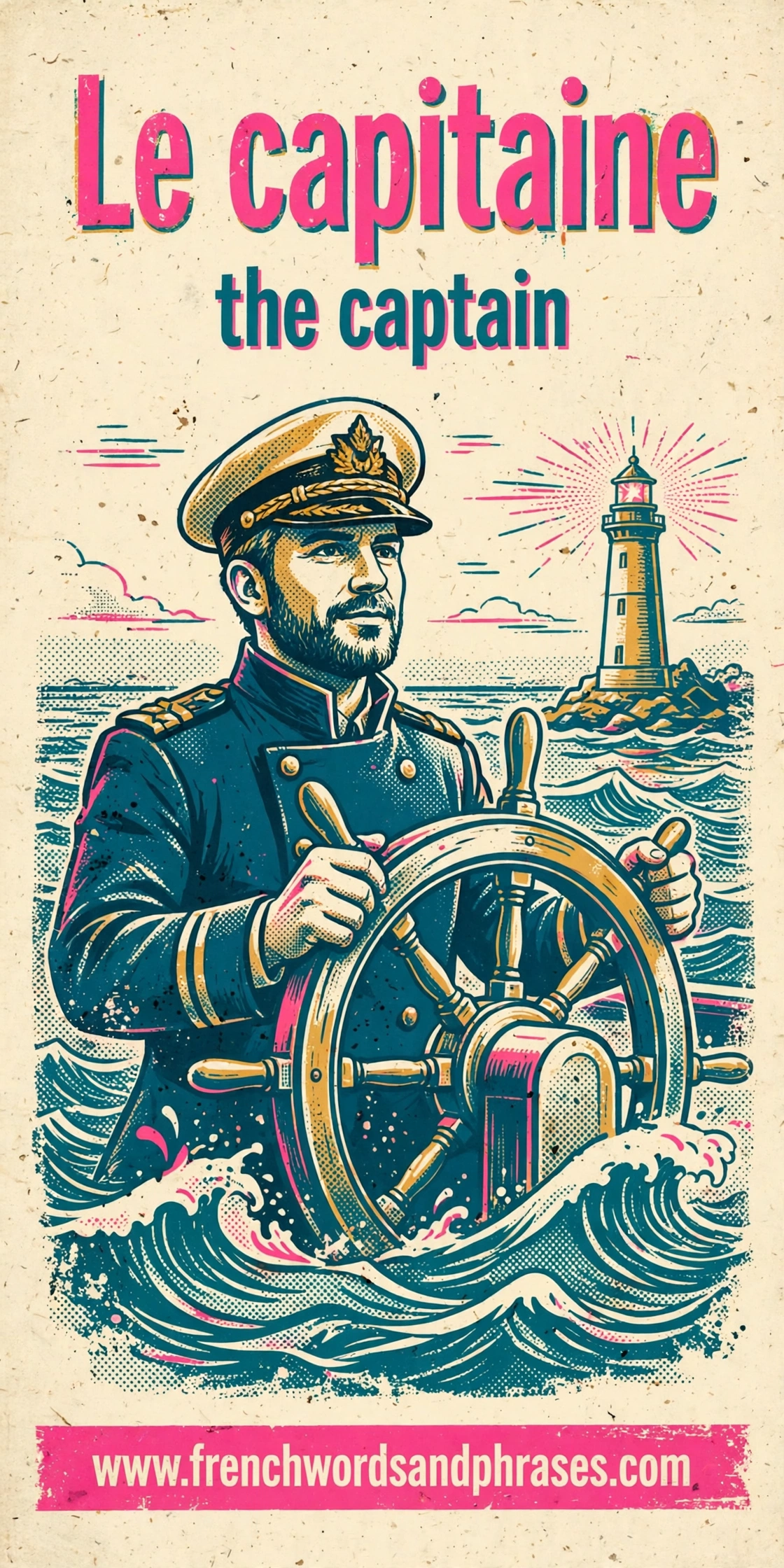
A steady hand on the wheel in a rising sea, a calm voice giving orders while everyone else looks at the waves: le capitaine, the captain — the one person on the ship, in the team or at the head of the company whose job is to be responsible for everyone.
In this guide, you’ll learn what capitaine means in English, how to use it with its articles, how to form its plural, and how it appears in everyday French. Explore French examples, English translations, and practice quizzes.
Understanding the French Noun Capitaine
Capitaine is a masculine French noun, learned with its article: le capitaine, un capitaine. It comes from the Latin capitaneus, the chief, built on caput, the head — the captain is, in the word’s own memory, the head of the vessel. For a woman captain, modern French increasingly writes la capitaine; the traditional title in address remains capitaine for everyone, and this page teaches the classic masculine form.
It means a captain — first of a ship: le capitaine du navire, the ship’s captain, capitaine au long cours, a master mariner. Then of a team: le capitaine de l’équipe, the team captain, the one with the armband. Then of soldiers and police: un capitaine is an army captain, a rank above lieutenant. In every sense the word carries the same weight: the captain decides, the captain answers, and the captain is the last to leave — le capitaine quitte le navire en dernier.
Gender: Masculine — le capitaine (la capitaine is increasingly used for a woman)
Definite article: le — le capitaine (the captain)
Indefinite article: un — un capitaine (a captain)
Plural: les capitaines — regular, with a simple -s
Spelling note: from Latin capitaneus, the chief, from caput, the head
Key frames: le capitaine du navire (ship); le capitaine de l’équipe (team); capitaine au long cours (master mariner)
English equivalents: The captain.
Addressing the captain, French drops the article: oui, capitaine !, yes, captain! — never oui, le capitaine. On a team, the captain is chosen, not born: être nommé capitaine, to be made captain. And the old rule of the sea is the word’s finest phrase: le capitaine est le dernier à quitter le navire — the captain is the last to leave the ship.
Experience the Word
Capitaine is the noun of the last responsibility — when everything goes wrong, all eyes turn to one chair, one wheel, one armband.
Imagine the ferry in the night crossing, the sea roughening, the passengers quiet at the windows — and on the bridge, le capitaine, coffee cold beside him, reading the waves the way you read this page: completely, and without hurry.
You have not just named a rank. You have named the one who stays — le capitaine, the head who answers for all.
How to Use Capitaine in French: Complete Guide
Let’s explore how capitaine works in French, beginning with its articles — le capitaine, un capitaine, le capitaine du navire.
Capitaine with the Definite Article (Le, Les)
Used for a specific captain — of this ship, of this team.
| Form | French |
|---|---|
| Masculine singular | le capitaine |
| Plural | les capitaines |
Example
Le capitaine du navire salue les passagers.
The ship’s captain greets the passengers.
Capitaine with the Indefinite Article (Un, Des)
Used for a captain in general — any officer with the wheel or the armband.
| Form | French |
|---|---|
| Masculine singular | un capitaine |
| Plural | des capitaines |
Example
Un bon capitaine garde son calme dans la tempête.
A good captain keeps calm in the storm.
Capitaine in His Three Worlds (Mer, Sport, Armée)
Sea, sport and soldiers — the three commands of the word.
| Quantity | French |
|---|---|
| the ship’s captain | le capitaine du navire |
| the team captain | le capitaine de l’équipe |
| a master mariner | un capitaine au long cours |
| to be made captain | être nommé capitaine |
| yes, captain! | oui, capitaine ! |
Example
Le capitaine de l’équipe lève la coupe sous les applaudissements.
The team captain lifts the cup to applause.
Quick Quiz 1
Complete the sentence:
______ capitaine donne l’ordre de partir. (the)
Reveal the answer
Le
Le capitaine donne l’ordre de partir.
The captain gives the order to leave — capitaine is masculine, so le.
The Plural of Capitaine
Capitaine takes a regular plural in -s — captains compared, crews commanded.
| Number | French |
|---|---|
| Singular | le capitaine |
| Plural | les capitaines |
Example
Les capitaines des deux équipes se serrent la main.
The two team captains shake hands.
Capitaine with Possessive Adjectives (Mon, Ton, Son…)
Possessives agree with the noun: capitaine is masculine, so mon, ton, son in the singular.
| Owner | French |
|---|---|
| my | mon capitaine |
| your (tu) | ton capitaine |
| his / her | son capitaine |
| our | notre capitaine |
| your (vous) | votre capitaine |
| their | leur capitaine |
Example
Notre capitaine nous a menés à la victoire.
Our captain led us to victory.
Quick Quiz 2
Complete the sentence:
Les marins obéissent à ______ capitaine sans discuter. (their)
Reveal the answer
leur
Les marins obéissent à leur capitaine sans discuter.
The sailors obey their captain without arguing — leur, singular possessive for le capitaine.
Capitaine with Demonstrative Adjectives (Ce, Ces)
Used to point: ce capitaine, this captain — the one on the bridge, the one with the cup.
| Form | French |
|---|---|
| Masculine singular | ce capitaine |
| Plural | ces capitaines |
Example
Ce capitaine connaît la côte par cœur.
This captain knows the coast by heart.
Capitaine with Adjectives
Adjectives agree with capitaine — masculine singular: un capitaine courageux, un jeune capitaine.
| Adjective | With Capitaine |
|---|---|
| courageux (brave) | un capitaine courageux |
| jeune (young) | un jeune capitaine |
| expérimenté (experienced) | un capitaine expérimenté |
| célèbre (famous) | un capitaine célèbre |
| ancien (former, veteran) | un ancien capitaine |
Example
Un capitaine expérimenté ne craint pas cette mer.
An experienced captain does not fear this sea.
Quick Quiz 3
Complete the sentence:
C’est un capitaine très ______. (brave)
Reveal the answer
courageux
C’est un capitaine très courageux.
He is a very brave captain — courageux, masculine, to agree with capitaine.
Everyday Expressions with Capitaine
Bridges, stadiums and barracks — the capitaine phrases of daily life.
| Expression | In English |
|---|---|
| le capitaine du navire | the ship’s captain |
| le capitaine de l’équipe | the team captain |
| être nommé capitaine | to be made captain |
| oui, capitaine ! | yes, captain! (in address, no article) |
| le capitaine quitte le navire en dernier | the captain leaves the ship last |
Example
Le capitaine quitte toujours le navire en dernier.
The captain always leaves the ship last.
Words from the Same Family as Capitaine
Command and crews — the words that travel with capitaine.
| French | In English |
|---|---|
| un navire | a ship |
| une équipe | a team |
| un lieutenant | a lieutenant — the rank below |
| commander | to command (the verb) |
| un équipage | a crew |
Example
L’équipage attend les ordres du capitaine sur le pont.
The crew awaits the captain’s orders on deck.
Quick Quiz 4
How do you say Yes, captain! in French?
Reveal the answer
Oui, capitaine ! — in direct address, French drops the article.
Oui, capitaine, nous sommes prêts !
Yes, captain, we are ready!
Capitaine in Everyday French: Real-Life Examples
Now that you know the word, let’s see how capitaine appears in everyday French.
Example 1 — At sea
Le capitaine du navire connaît chaque rocher de la côte.
The ship’s captain knows every rock on the coast.
Example 2 — Sport
Le capitaine de l’équipe porte le brassard.
The team captain wears the armband.
Example 3 — Orders
Oui, capitaine, nous levons l’ancre.
Yes, captain, we are weighing anchor.
Example 4 — Honour
Le capitaine quitte le navire en dernier.
The captain leaves the ship last.
Example 5 — A promotion
Elle a été nommée capitaine de son équipe.
She was made captain of her team.
Example 6 — Calm
Un bon capitaine ne panique jamais.
A good captain never panics.
Beyond Translation: The Meaning of Capitaine
Capitaine is the head made visible: caput, the head, stands inside the word, and every language of command in Europe borrowed the same idea. French gave the title three kingdoms — the sea, the stadium and the regiment — and one unbreakable rule that became proverbial: the captain leaves last.
To say capitaine is to point at the chair where responsibility sits.
It evokes the cold coffee on the bridge, the armband lifted with the cup, and the voice that stays calm when the sea does not.
How to Remember the French Noun Capitaine
Remember it this way: Capitaine is the captain of ship, team and company — masculine: le capitaine, and oui, capitaine with no article in address.
- Always masculine in the classic form — le capitaine, un capitaine, mon capitaine.
- Three worlds — le capitaine du navire, le capitaine de l’équipe, the army rank.
- In address, drop the article — oui, capitaine !
The key idea is le capitaine — the captain, masculine; the last to leave the ship.
Test Your Knowledge of Capitaine
Let’s see how much you’ve learned. Try answering these questions before revealing the answers.
Question 1
Is capitaine masculine or feminine?
Reveal the answer
Masculine — le capitaine, un capitaine (la capitaine is increasingly used for a woman).
Question 2
How do you say the team captain?
Reveal the answer
Le capitaine de l’équipe.
Question 3
Translate: The captain leaves the ship last.
Reveal the answer
Le capitaine quitte le navire en dernier.
Question 4
How do you address the captain directly?
Reveal the answer
Capitaine, with no article — oui, capitaine !
Question 5
Complete the sentence:
______ capitaine de l’équipe lève la coupe. (the)
Reveal the answer
Le
Le capitaine de l’équipe lève la coupe.
The team captain lifts the cup.
Your Final Challenge
Can You Use It?
How would you say this in French?
“A good captain keeps calm in the storm.”
Reveal the answer
Un bon capitaine garde son calme dans la tempête.
A good captain keeps calm in the storm.
A little French. A little curiosity. A richer everyday life.
LEARN FRENCH ONE WORD AT A TIME