A French Word to Live By
How to Conjugate Bourrer in French
/bu.ʁe/
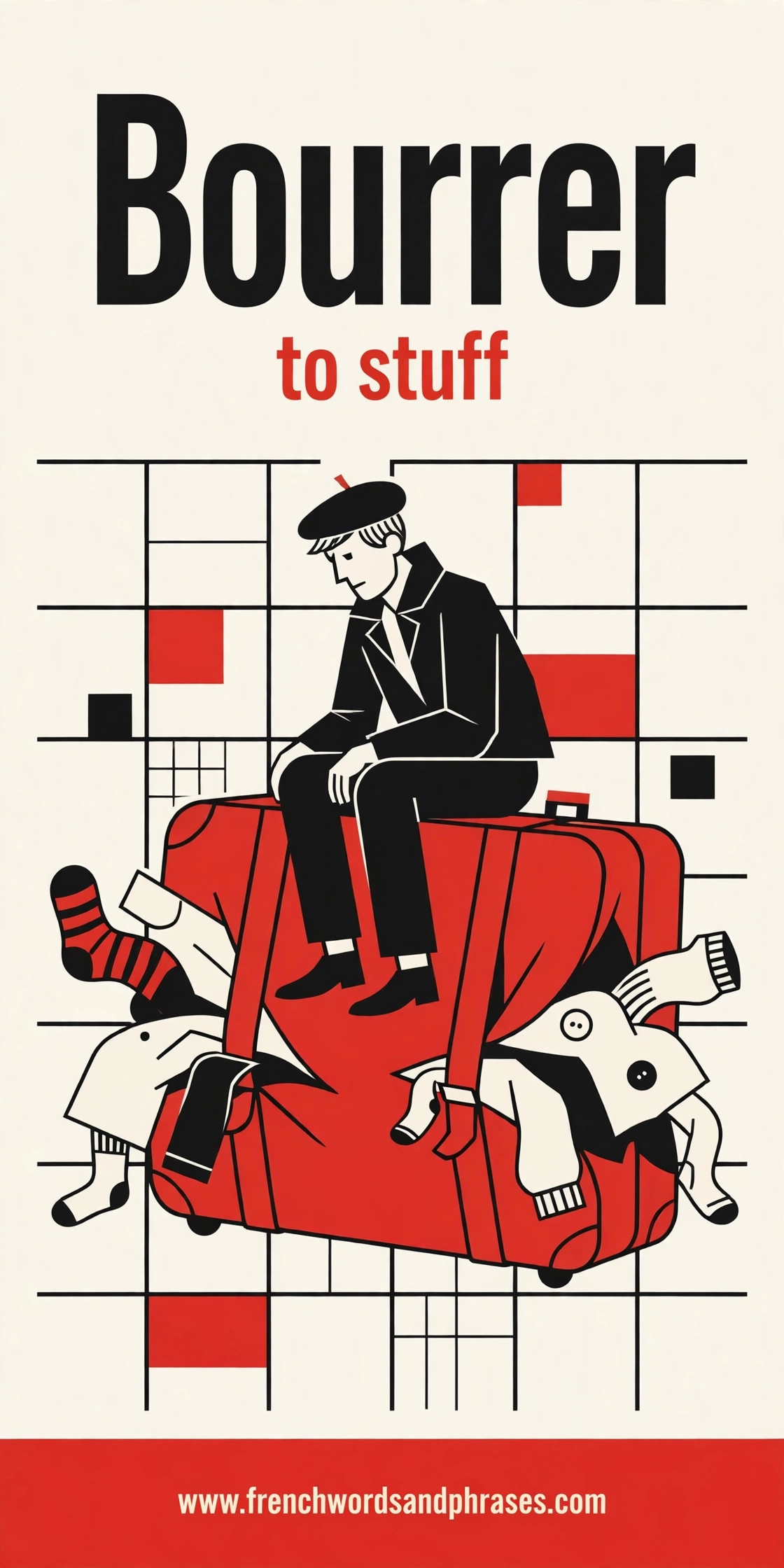
Bourrer means to stuff — to pack something tight: a pipe, a suitcase, a turkey, or somebody’s head with ideas.
A pipe packed tight with tobacco, a suitcase sat on and zipped by force, a Christmas turkey filled to bursting — bourrer is the verb of stuffing things full, and French uses it for heads too: bourrer le crâne, to cram someone’s mind with propaganda.
In this guide, you’ll learn how to conjugate bourrer in all the major French tenses and moods. Explore complete conjugation tables, French examples, English translations, and practice quizzes.
Understanding the French Verb Bourrer
Bourrer is a regular French verb belonging to the first group of verbs, those ending in-er.
It means to stuff. It is commonly used in the kitchen (stuffing poultry), in the hall with the suitcase that will not close, in politics (bourrer les urnes, ballot-box stuffing) and in two famous head idioms: bourrer le crâne, the propaganda sense, and bourrer le mou, telling someone a tall tale to take them in.
Verb classification: First group (-er)
Auxiliary verb: Avoir
Past participle: bourré
Present participle: bourrant
English equivalents: To stuff, to cram, to pack tight; bourrer une pipe — to fill a pipe; bourrer une valise — to cram a suitcase; bourrer le crâne à quelqu’un — to fill someone’s head, to brainwash them; bourrer le mou à quelqu’un — to spin someone a yarn, to take them in; bourrer les urnes — to stuff the ballot boxes.
One important detail: bourrer keeps its double r in every single form — je bourre, nous bourrons, je bourrerai, bourré — as if the word itself were stuffed. The noun behind it is la bourre, the padding or stuffing inside a cushion, and the adjective bourré means full to bursting — which is why, in familiar French, être bourré also means to be drunk: filled right up.
Experience the Word
Bourrer is the verb of no space wasted — if it can hold one more thing, bourrer will put it in.
Imagine the hall on the morning of departure. The suitcase lies open like a crocodile; she bourre it with books, jumpers and presents, kneels on the lid, pulls the zip an inch at a time — and wins. Bourrée à craquer, the case closes like a verdict.
Nothing is neatly folded. It has been stuffed — bourré, pressed down and packed to bursting.
How to Conjugate Bourrer: Complete French Conjugation Guide
Let’s explore every major conjugation of bourrer, beginning with the indicative mood.
How to Conjugate Bourrer in the Indicative Mood
The indicative mood is used to express facts, observations, actions, and events.
How to Conjugate Bourrer in the Present Tense (Présent)
Used for actions happening now, habitual actions, and general truths.
| Subject | Conjugation |
|---|---|
| je | bourre |
| tu | bourres |
| il / elle | bourre |
| nous | bourrons |
| vous | bourrez |
| ils / elles | bourrent |
Example
Elle bourre la dinde de marrons et de chair à saucisse.
She stuffs the turkey with chestnuts and sausage meat.
Quick Quiz 1
Complete the sentence:
Nous ______ la voiture de cartons.
Reveal the answer
bourrons
Nous bourrons la voiture de cartons.
We are packing the car full of boxes.
How to Conjugate Bourrer in the Passé Composé
Used for completed actions in the past. Bourrer takes the auxiliary verb avoir.
| Subject | Conjugation |
|---|---|
| j’ | ai bourré |
| tu | as bourré |
| il / elle | a bourré |
| nous | avons bourré |
| vous | avez bourré |
| ils / elles | ont bourré |
Example
Il a bourré sa valise de livres et de pulls.
He crammed his suitcase with books and jumpers.
How to Conjugate Bourrer in the Imparfait (Imperfect Tense)
Used for habitual past actions, descriptions, and ongoing situations in the past.
| Subject | Conjugation |
|---|---|
| je | bourrais |
| tu | bourrais |
| il / elle | bourrait |
| nous | bourrions |
| vous | bourriez |
| ils / elles | bourraient |
Example
Mon grand-père bourrait sa pipe après chaque repas.
My grandfather used to fill his pipe after every meal.
Quick Quiz 2
Choose the correct form:
She stuffed the turkey.
Elle ______ la dinde. (a bourré / est bourrée)
Reveal the answer
a bourré
Elle a bourré la dinde.
Bourrer takes avoir.
How to Conjugate Bourrer in the Plus-que-parfait
Used to describe an action that had already been completed before another past event.
| Subject | Conjugation |
|---|---|
| j’ | avais bourré |
| tu | avais bourré |
| il / elle | avait bourré |
| nous | avions bourré |
| vous | aviez bourré |
| ils / elles | avaient bourré |
Example
Ils avaient bourré la salle de chaises avant le concert.
They had packed the hall with chairs before the concert.
How to Conjugate Bourrer in the Passé Simple
Primarily used in formal writing, literature, and historical narratives. It is rarely used in everyday conversation.
| Subject | Conjugation |
|---|---|
| je | bourrai |
| tu | bourras |
| il / elle | bourra |
| nous | bourrâmes |
| vous | bourrâtes |
| ils / elles | bourrèrent |
Example
Le cuisinier bourra le poulet d’herbes et de citron.
The cook stuffed the chicken with herbs and lemon.
How to Conjugate Bourrer in the Passé Antérieur
A literary tense used to express an action completed immediately before another past action, generally in the passé simple.
| Subject | Conjugation |
|---|---|
| j’ | eus bourré |
| tu | eus bourré |
| il / elle | eut bourré |
| nous | eûmes bourré |
| vous | eûtes bourré |
| ils / elles | eurent bourré |
Example
Quand elle eut bourré la valise, elle s’assit dessus pour la fermer.
When she had crammed the suitcase, she sat on it to close it.
How to Conjugate Bourrer in the Future Tense (Futur Simple)
Used to describe actions that will take place in the future.
| Subject | Conjugation |
|---|---|
| je | bourrerai |
| tu | bourreras |
| il / elle | bourrera |
| nous | bourrerons |
| vous | bourrerez |
| ils / elles | bourreront |
Example
Demain, nous bourrerons la voiture de cartons.
Tomorrow, we will pack the car full of boxes.
How to Conjugate Bourrer in the Futur Antérieur (Future Perfect)
Used for an action that will have been completed before a particular point in the future.
| Subject | Conjugation |
|---|---|
| j’ | aurai bourré |
| tu | auras bourré |
| il / elle | aura bourré |
| nous | aurons bourré |
| vous | aurez bourré |
| ils / elles | auront bourré |
Example
À midi, elle aura bourré trois valises.
By noon, she will have crammed three suitcases.
How to Conjugate Bourrer in the Near Future (Futur Proche)
Used to describe something that is going to happen soon. Formed with aller + infinitive.
| Subject | Conjugation |
|---|---|
| je | vais bourrer |
| tu | vas bourrer |
| il / elle | va bourrer |
| nous | allons bourrer |
| vous | allez bourrer |
| ils / elles | vont bourrer |
Example
Je vais bourrer ce sac, il reste encore de la place.
I am going to stuff this bag, there is still room.
How to Conjugate Bourrer in the Conditional Mood
The conditional mood expresses what would happen under certain circumstances. It is also frequently used to make polite requests or express wishes.
How to Conjugate Bourrer in the Present Conditional
| Subject | Conjugation |
|---|---|
| je | bourrerais |
| tu | bourrerais |
| il / elle | bourrerait |
| nous | bourrerions |
| vous | bourreriez |
| ils / elles | bourreraient |
Example
Sans les cartons, on bourrerait moins la voiture.
Without the boxes, we would pack the car less full.
How to Conjugate Bourrer in the Past Conditional
| Subject | Conjugation |
|---|---|
| j’ | aurais bourré |
| tu | aurais bourré |
| il / elle | aurait bourré |
| nous | aurions bourré |
| vous | auriez bourré |
| ils / elles | auraient bourré |
Example
Tu aurais bourré ta valise si tu avais prévu le froid.
You would have stuffed your suitcase if you had expected the cold.
Bourrer in the Literary Past Conditional Form
This less common literary form uses the imperfect subjunctive of avoir.
| Subject | Conjugation |
|---|---|
| j’ | eusse bourré |
| tu | eusses bourré |
| il / elle | eût bourré |
| nous | eussions bourré |
| vous | eussiez bourré |
| ils / elles | eussent bourré |
Example
Il eût bourré le crâne des soldats de promesses.
He would have filled the soldiers’ heads with promises.
How to Conjugate Bourrer in the Subjunctive Mood
The subjunctive is used to express wishes, emotions, doubts, necessity, and uncertainty. It frequently follows expressions such as il faut que (it is necessary that) or bien que (although).
How to Conjugate Bourrer in the Present Subjunctive
| Subject | Conjugation |
|---|---|
| que je | bourre |
| que tu | bourres |
| qu’il / qu’elle | bourre |
| que nous | bourrions |
| que vous | bourriez |
| qu’ils / qu’elles | bourrent |
Example
Il ne faut pas que tu bourres le sac, il va craquer.
You must not stuff the bag, it will split.
Quick Quiz 3
Complete the sentence using the subjunctive:
Il faut que vous ______ moins la valise.
Reveal the answer
bourriez
Il faut que vous bourriez moins la valise.
You must stuff the suitcase less.
How to Conjugate Bourrer in the Imperfect Subjunctive
A literary tense, rarely encountered in modern spoken French.
| Subject | Conjugation |
|---|---|
| que je | bourrasse |
| que tu | bourrasses |
| qu’il / qu’elle | bourrât |
| que nous | bourrassions |
| que vous | bourrassiez |
| qu’ils / qu’elles | bourrassent |
Example
Elle craignait qu’il bourrât le crâne des enfants d’histoires fausses.
She feared he would fill the children’s heads with false stories.
How to Conjugate Bourrer in the Pluperfect Subjunctive
A literary construction used to express an action completed before another past action.
| Subject | Conjugation |
|---|---|
| que j’ | eusse bourré |
| que tu | eusses bourré |
| qu’il / qu’elle | eût bourré |
| que nous | eussions bourré |
| que vous | eussiez bourré |
| qu’ils / qu’elles | eussent bourré |
Example
On racontait qu’ils eussent bourré les urnes le jour du vote.
People said they had stuffed the ballot boxes on voting day.
How to Conjugate Bourrer in the Past Subjunctive
| Subject | Conjugation |
|---|---|
| que j’ | aie bourré |
| que tu | aies bourré |
| qu’il / qu’elle | ait bourré |
| que nous | ayons bourré |
| que vous | ayez bourré |
| qu’ils / qu’elles | aient bourré |
Example
Je suis étonné qu’elle ait bourré autant de livres dans un si petit sac.
I am amazed she stuffed so many books into such a small bag.
How to Conjugate Bourrer in the Imperative
The imperative is used to give commands, instructions, invitations, or suggestions. Subject pronouns are omitted.
How to Conjugate Bourrer in the Present Imperative
| Person | Conjugation |
|---|---|
| (tu) | bourre |
| (nous) | bourrons |
| (vous) | bourrez |
Example
Bourre bien la pipe, mais sans forcer.
Pack the pipe well, but do not force it.
Quick Quiz 4
How would you say Stuff the bag (tu form)?
Reveal the answer
Bourre le sac !
French Participles of Bourrer
Participles are verb forms that can be used in compound tenses and other grammatical constructions.
Present Participle of Bourrer
bourrant
En bourrant la valise, il a cassé la fermeture.
While cramming the suitcase, he broke the zip.
Past Participle of Bourrer
bourré
Bourrée de marrons, la dinde rôtissait lentement.
Stuffed with chestnuts, the turkey was roasting slowly.
Bourrer in Everyday French: Real-Life Examples
Now that you know the conjugations, let’s see how bourrer appears in everyday French.
Example 1 — Present
Elle bourre la dinde de marrons.
She stuffs the turkey with chestnuts.
Example 2 — Passé composé
Il a bourré sa valise de livres.
He crammed his suitcase with books.
Example 3 — Imparfait
Grand-père bourrait sa pipe après le repas.
Grandfather used to fill his pipe after the meal.
Example 4 — Future
Nous bourrerons la voiture de cartons.
We will pack the car full of boxes.
Example 5 — Conditional
On bourrerait moins le sac sans les livres.
We would stuff the bag less without the books.
Example 6 — Imperative
Bourre le sac, il reste de la place !
Stuff the bag, there is still room!
Beyond Translation: The Meaning of Bourrer
English to stuff and to cram share the work of bourrer, but the French verb has a famous wartime chapter: le bourrage de crâne, skull-stuffing, was the soldiers’ bitter name for propaganda in the First World War.
The head is its favourite container.
You can bourrer a pipe, a cushion or a ballot box, but the idioms aim higher: bourrer le crâne is brainwashing, and bourrer le mou — the mou being the soft lights, the lungs — is stuffing someone with stories until they swallow the whole tale.
How to Remember the French Verb Bourrer
Remember it this way: Bourrer is about the suitcase sat on to make it close.
- Double r, always: bourre, bourrons, bourré — the word itself looks stuffed.
- Two famous heads: bourrer le crâne (to brainwash) and bourrer le mou (to spin someone a yarn).
- Regular -er with avoir: j’ai bourré la valise — and être bourré means full to bursting.
The key idea is the suitcase sat on to make it close.
Test Your Knowledge of Bourrer
Let’s see how much you’ve learned. Try answering these questions before revealing the answers.
Question 1
What does bourrer le crâne à quelqu’un mean?
Reveal the answer
To fill someone’s head with propaganda — to brainwash them.
Question 2
How do you say He crammed his suitcase with books in French?
Reveal the answer
Il a bourré sa valise de livres.
Question 3
Translate: She stuffs the turkey with chestnuts.
Reveal the answer
Elle bourre la dinde de marrons.
Question 4
What is the past participle of bourrer?
Reveal the answer
Bourré — être bourré means full to bursting.
Question 5
Complete the sentence:
Il ne faut pas que tu ______ le sac, il va craquer.
Reveal the answer
bourres
Il ne faut pas que tu bourres le sac, il va craquer.
You must not stuff the bag, it will split.
Your Final Challenge
Can You Use It?
How would you say this in French?
She stuffs the suitcase with books, sits on it, and the zip gives way with a sigh.
Reveal the answer
Elle bourre la valise de livres, s’assied dessus, et la fermeture cède en soupirant.
She stuffs the suitcase with books, sits on it, and the zip gives way with a sigh.
A little French. A little curiosity. A richer everyday life.
LEARN FRENCH ONE WORD AT A TIME