A French Word to Live By
Translate Boots to English
/buts/
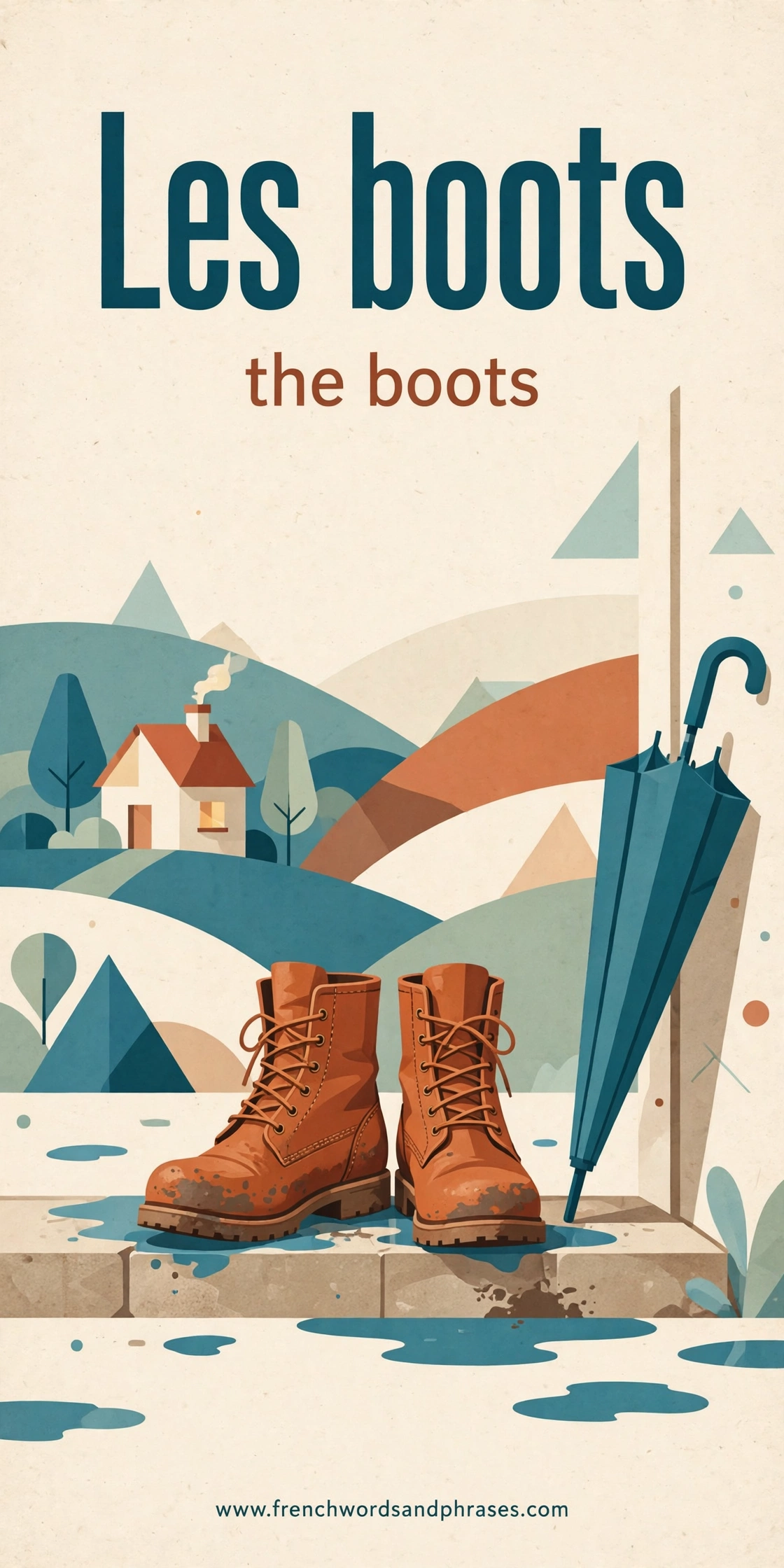
Les boots means the boots.
By the door, still muddy from yesterday’s walk, stands the pair that goes with everything: les boots, the boots — the short, sturdy ankle boots French borrowed from English, name, plural and all, and never gives back.
In this guide, you’ll learn what boots means in English, how to use it with its articles, how to form its plural, and how it appears in everyday French. Explore French examples, English translations, and practice quizzes.
Understanding the French Noun Boots
Boots is a feminine plural French noun, learned with its article: les boots, des boots. It is an anglicism — English boots, taken over exactly as it stands, with its English plural -s already built in. In French it lives only in the plural: a single pair is une paire de boots, and there is no singular boot. It names the fashion ankle boot, shorter and lighter than la botte, the tall boot.
It means boots — in the fashion sense: short boots that stop at the ankle or mid-calf: des boots en cuir, leather ankle boots, des boots à talons, heeled boots. They are the autumn uniform of French streets, worn with dresses as readily as with jeans. For the tall, practical boot — rubber, riding, snow — French uses its own word, la botte, plural les bottes: the boots of this page are the stylish cousins.
Gender: Feminine plural — les boots
Definite article: les — les boots (the boots)
Indefinite article: des — des boots (some boots)
Plural: always plural — the word exists only as boots; one pair = une paire de boots
Spelling note: an anglicism, borrowed with its English -s: never write boot in French
Close neighbour: les bottes — tall boots (rubber, riding, snow); les boots are the short fashion boots
English equivalents: The boots, ankle boots.
Because boots is plural-only, everything around it goes plural: les boots sont neuves, the boots are new — feminine plural agreement, neuves. To put them on is mettre ses boots or enfiler ses boots. Counting is done in pairs: une paire de boots, deux paires de boots. And the word’s fashion register matters: boots belongs to shoes and style pages; a farmer’s working footwear is bottes, never boots.
Experience the Word
Boots is the sound of autumn arriving on the pavement — the first pair of the season taken down as the leaves turn, worn with everything until spring.
Imagine the shoe shop in September: rows of boots in black, tan and suede, and a queue of women trying the same pair in two sizes. La rentrée des boots a commencé — the season has officially changed.
You have not just named footwear. You have named the borrowed word French fashion refuses to translate — les boots, plural in two languages at once.
How to Use Boots in French: Complete Guide
Let’s explore how boots works in French, beginning with its articles — les boots, des boots, une paire de boots.
Boots with the Definite Article (Les)
Boots lives in the plural, so the definite article is always les — the pair by the door, the pair in the window.
| Form | French |
|---|---|
| Feminine plural | les boots |
| One pair | une paire de boots |
Example
Les boots noires sont près de la porte.
The black boots are by the door.
Boots with the Indefinite Article (Des)
Indefinite boots are des boots — some boots, boots in general, on the shelf of the shoe shop.
| Form | French |
|---|---|
| Feminine plural | des boots |
| One pair | une paire de boots |
Example
Elle a acheté des boots en cuir pour l’automne.
She bought leather boots for the autumn.
Boots with Quantities and Kinds (En cuir, à talons…)
Boots are counted in pairs and chosen by leather, heel and colour — the vocabulary of the shoe shop.
| Quantity | French |
|---|---|
| a pair of boots | une paire de boots |
| leather boots | des boots en cuir |
| heeled boots | des boots à talons |
| flat boots | des boots plates |
| two pairs of boots | deux paires de boots |
Example
Une paire de boots à talons suffit pour toutes les soirées.
One pair of heeled boots is enough for every evening out.
Quick Quiz 1
Complete the sentence:
______ boots sont neuves, je les ai achetées hier. (the)
Reveal the answer
Les
Les boots sont neuves, je les ai achetées hier.
The boots are new, I bought them yesterday — boots is plural, so les, and neuves agrees in the feminine plural.
Boots: A Word That Lives in the Plural
There is no singular boot in French: the word arrived from English already plural and stayed that way.
| Number | French |
|---|---|
| Plural (the only form) | les boots |
| One pair | une paire de boots |
Example
Ces boots vont avec toutes mes robes.
These boots go with all my dresses.
Boots with Possessive Adjectives (Mes, Tes, Ses…)
Possessives agree with the plural noun: mes, tes, ses for one owner, nos, vos, leurs for the plural forms.
| Owner | French |
|---|---|
| my | mes boots |
| your (tu) | tes boots |
| his / her | ses boots |
| our | nos boots |
| your (vous) | vos boots |
| their | leurs boots |
Example
Mes boots sont encore couvertes de boue.
My boots are still covered in mud.
Quick Quiz 2
Complete the sentence:
Elle met ______ boots avant de sortir. (her)
Reveal the answer
ses
Elle met ses boots avant de sortir.
She puts on her boots before going out — ses, the plural possessive.
Boots with Demonstrative Adjectives (Ces)
Used to point: ces boots, these boots — always ces, since the word is plural.
| Form | French |
|---|---|
| Feminine plural | ces boots |
| One pair pointed at | cette paire de boots |
Example
Ces boots en daim sont très confortables.
These suede boots are very comfortable.
Boots with Adjectives
Adjectives agree with boots — feminine plural: des boots noires, des boots confortables.
| Adjective | With Boots |
|---|---|
| noires (black) | des boots noires |
| en cuir (leather) | des boots en cuir |
| à talons (heeled) | des boots à talons |
| confortables (comfortable) | des boots confortables |
| neuves (new) | des boots neuves |
Example
Des boots noires et confortables, c’est tout ce qu’il me faut.
Black, comfortable boots, that’s all I need.
Quick Quiz 3
Complete the sentence:
Ses boots ______ arrivent aujourd’hui. (new — feminine plural)
Reveal the answer
neuves
Ses boots neuves arrivent aujourd’hui.
Her new boots are arriving today — neuves, feminine plural, to agree with boots.
Everyday Expressions with Boots
Shoe shops, autumn streets and muddy doors — the boots phrases of daily life.
| Expression | In English |
|---|---|
| une paire de boots | a pair of boots |
| des boots en cuir | leather boots |
| des boots à talons | heeled boots |
| mettre ses boots | to put on one’s boots |
| des boots en daim | suede boots |
Example
Mets tes boots, le chemin est boueux.
Put your boots on, the path is muddy.
Words from the Same Family as Boots
Footwear — the words that travel with boots.
| French | In English |
|---|---|
| les bottes | tall boots — rubber, riding, snow |
| une botte | one tall boot |
| les chaussures | shoes |
| les baskets | trainers, sneakers |
| une paire | a pair |
Example
Pour la neige, prends tes bottes, pas tes boots.
For the snow, take your tall boots, not your ankle boots.
Quick Quiz 4
What is the difference between les boots and les bottes?
Reveal the answer
Boots are the short fashion ankle boots; bottes are tall boots — rubber, riding or snow boots.
Des boots pour la ville, des bottes pour la campagne.
Boots for town, tall boots for the countryside.
Boots in Everyday French: Real-Life Examples
Now that you know the word, let’s see how boots appears in everyday French.
Example 1 — Autumn shopping
J’ai trouvé des boots en cuir en solde.
I found leather boots on sale.
Example 2 — Getting dressed
Elle met ses boots noires avec une robe.
She wears her black boots with a dress.
Example 3 — Mud
Tes boots sont couvertes de boue, laisse-les à la porte.
Your boots are covered in mud, leave them at the door.
Example 4 — Comfort
Ces boots sont confortables même avec des talons.
These boots are comfortable even with heels.
Example 5 — One pair
Une paire de boots suffit pour tout l’automne.
One pair of boots is enough for the whole autumn.
Example 6 — The window
Les boots en daim de la vitrine me plaisent beaucoup.
I really like the suede boots in the window.
Beyond Translation: The Meaning of Boots
Boots is a double borrowing: French took the English word boots in the twentieth century, plural, spelling and all, and gave it a precise job English never gave it — in French, boots means specifically the short fashion boot, while the tall working boot kept the old French name botte. Borrowed words often narrow like this when they emigrate: they arrive meaning everything and stay meaning one stylish thing.
To say boots in French is to speak fashion’s English with a French accent.
It evokes September shoe-shop windows, suede and leather, and the pair by the door that carries its owner through the whole wet season.
How to Remember the French Noun Boots
Remember it this way: Boots is the fashion ankle boots — feminine and always plural: les boots, des boots, une paire de boots.
- Always plural — les boots, des boots, mes boots; there is no singular boot.
- Counted in pairs — une paire de boots, a pair of boots.
- Not tall boots — les bottes are the tall ones, for rain, riding and snow.
The key idea is les boots — the (ankle) boots, feminine plural only; une paire de boots; les bottes = tall boots.
Test Your Knowledge of Boots
Let’s see how much you’ve learned. Try answering these questions before revealing the answers.
Question 1
Is boots singular or plural in French?
Reveal the answer
Plural only — les boots; one pair is une paire de boots.
Question 2
How do you say a pair of boots?
Reveal the answer
Une paire de boots.
Question 3
Translate: She bought leather boots for the autumn.
Reveal the answer
Elle a acheté des boots en cuir pour l’automne.
Question 4
What are les bottes, then?
Reveal the answer
Tall boots — rubber, riding or snow boots; boots are the short fashion ones.
Question 5
Complete the sentence:
______ boots sont neuves. (the)
Reveal the answer
Les
Les boots sont neuves.
The boots are new — feminine plural agreement, neuves.
Your Final Challenge
Can You Use It?
How would you say this in French?
“She bought leather boots for the autumn.”
Reveal the answer
Elle a acheté des boots en cuir pour l’automne.
She bought leather boots for the autumn.
A little French. A little curiosity. A richer everyday life.
LEARN FRENCH ONE WORD AT A TIME