A French Word to Live By
Translate Bonbon to English
/bɔ̃.bɔ̃/
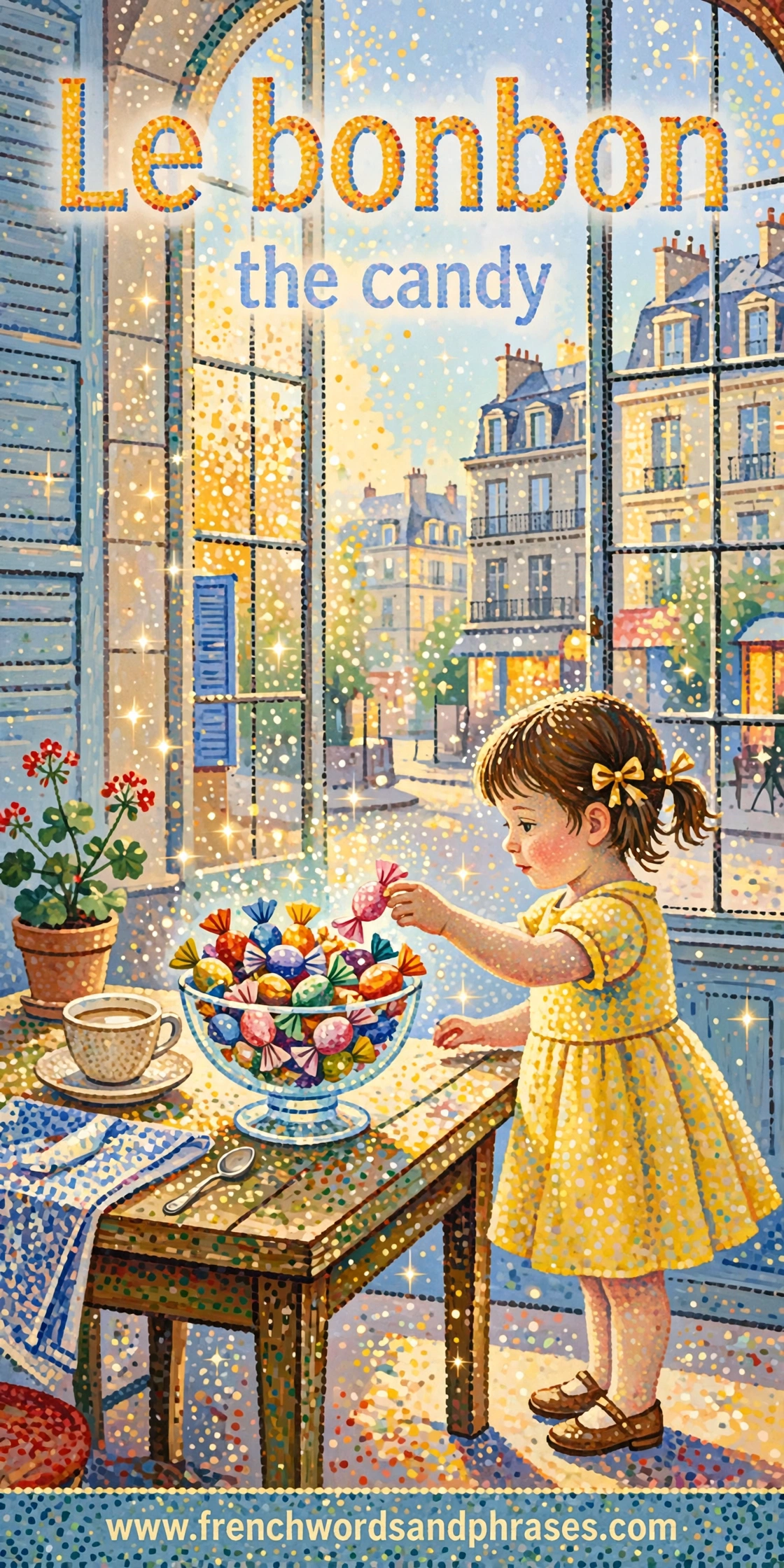
Le bonbon means the candy.
In the boulangerie, next to the till, stands a tall glass jar that every child in the village knows by heart. Inside, in twists of bright paper, shine les bonbons — and the baker always adds one extra to the bag.
In this guide, you’ll learn what bonbon means in English, how to use it with its articles, how to form its plural, and how it appears in everyday French. Explore French examples, English translations, and practice quizzes.
Understanding the French Noun Bonbon
Bonbon is a masculine French noun, learned with its article: le bonbon, un bonbon. It is simply the word bon (good) said twice — a « good-good » — and it is the general French word for a sweet, what American English calls a candy.
It means the candy, the sweet — any small sugary treat: un bonbon à la menthe (a mint), un bonbon au citron (a lemon drop), the jelly sweets and caramels of the jar by the till. A packet is un paquet de bonbons or un sachet de bonbons, and the shop counter that sells them is a childhood landmark in every French town.
Gender: Masculine
Definite article: le — le bonbon (the candy, the sweet)
Indefinite article: un — un bonbon (a candy, a sweet)
Partitive article: des bonbons — some sweets, when helping yourself
Plural: les bonbons
English equivalents: The candy (American); the sweet (British).
One important usage detail: bonbon is countable and usually lives in the plural — des bonbons, a handful of sweets. English « candy » is a mass word, but French counts them one by one: un bonbon, deux bonbons. For chocolate specifically, French switches to un chocolat for a single chocolate, and a lollipop is une sucette.
Experience the Word
Bonbon is more than sugar. It is the reward after the injection, the treasure at the bottom of a grandmother’s handbag, the small bright currency of childhood.
Imagine the jar at the baker’s: you point, the paper twists open with a crackle, and the sweet — mint, strawberry, honey — melts slowly through the walk home.
You have not just eaten a sweet. You have been treated — gâté, spoiled a little, the bonbon’s way.
How to Use Bonbon in French: Complete Guide
Let’s explore how bonbon works in French, beginning with its articles — the word that is just « good » said twice.
Bonbon with the Definite Article (Le, Les)
Used for the sweet everyone in the conversation knows — the one in the jar, the one in your hand.
| Form | French |
|---|---|
| Singular | le bonbon |
| Plural | les bonbons |
Example
Le bonbon à la menthe est mon préféré.
The mint sweet is my favourite.
Bonbon with the Indefinite Article (Un, Des)
Used for sweets in general — and French counts them: un bonbon, deux bonbons, des bonbons.
| Form | French |
|---|---|
| Singular | un bonbon |
| Plural | des bonbons |
Example
La boulangère offre un bonbon à chaque enfant.
The baker gives a sweet to every child.
At the Sweet Jar: Words of the Bonbon
Mints, caramels and paper twists — the vocabulary that surrounds the bonbon.
| French | In English |
|---|---|
| le caramel | the caramel |
| la menthe | mint |
| la fraise | the strawberry |
| le miel | honey |
| sucré | sweet, sugary |
| le sachet | the little bag, the packet |
Example
Ce sachet contient des bonbons à la fraise et au caramel.
This little bag contains strawberry and caramel sweets.
Quick Quiz 1
Complete the sentence:
Tu veux ______ bonbon au citron ?
Reveal the answer
un
Tu veux un bonbon au citron ?
Do you want a lemon sweet? — bonbon is masculine and countable.
The Plural of Bonbon
Bonbon adds an -s in the plural — les bonbons, the natural state of sweets: several at once.
| Number | French |
|---|---|
| Singular | le bonbon / un bonbon |
| Plural | les bonbons / des bonbons |
Example
Les bonbons sont dans un grand bocal en verre.
The sweets are in a big glass jar.
Bonbon with Possessive Adjectives (Mon, Ton, Son…)
Possessives agree with the noun: bonbon is masculine, so it takes mon, ton, son.
| Owner | French |
|---|---|
| my | mon bonbon |
| your (tu) | ton bonbon |
| his / her | son bonbon |
| our | notre bonbon |
| your (vous) | votre bonbon |
| their | leur bonbon |
Example
Ne touche pas à mon bonbon, prends le tien !
Don’t touch my sweet, take your own!
Quick Quiz 2
Complete the sentence:
______ bonbons sont sur la table, servez-vous ! (Our)
Reveal the answer
Nos
Nos bonbons sont sur la table, servez-vous !
Our sweets are on the table, help yourselves! — nos, because bonbons is plural.
Bonbon with Demonstrative Adjectives (Ce, Ces)
Used to point: ce bonbon, the one you are pointing at in the jar.
| Form | French |
|---|---|
| Singular | ce bonbon |
| Plural | ces bonbons |
Example
Ces bonbons au miel sont délicieux avec le thé.
These honey sweets are delicious with tea.
Bonbon with Adjectives
Adjectives agree with the masculine noun: sucré, délicieux, petit.
| Adjective | With Bonbon |
|---|---|
| sucré (sweet) | un bonbon sucré |
| délicieux (delicious) | un bonbon délicieux |
| petit (small) | un petit bonbon |
| dur (hard) | un bonbon dur |
| coloré (colourful) | un bonbon coloré |
Example
C’est un petit bonbon coloré au goût de fraise.
It is a small colourful sweet with a strawberry flavour.
Quick Quiz 3
Complete the sentence:
Elle mange un bonbon très ______. (sweet, sugary)
Reveal the answer
sucré
Elle mange un bonbon très sucré.
She is eating a very sugary sweet.
Everyday Expressions with Bonbon
Jars, pockets and grandmothers — the bonbon phrases of daily life.
| Expression | In English |
|---|---|
| un paquet de bonbons | a packet of sweets |
| offrir un bonbon | to offer a sweet |
| sucer un bonbon | to suck a sweet |
| un bonbon à la menthe | a mint (sweet) |
| les bonbons de grand-mère | grandma’s sweets |
| manger trop de bonbons | to eat too many sweets |
Example
Grand-mère offre toujours un bonbon après le repas.
Grandma always offers a sweet after the meal.
Words from the Same Family as Bonbon
Sugar, chocolate and childhood — the words that travel with bonbon.
| French | In English |
|---|---|
| bon | good |
| le sucre | sugar |
| la confiserie | the sweet shop, confectionery |
| la sucette | the lollipop |
| le chocolat | chocolate; a single chocolate |
| la dent | the tooth |
Example
La confiserie du village vend des bonbons faits maison.
The village sweet shop sells home-made sweets.
Quick Quiz 4
Why is a bonbon called a bonbon?
Reveal the answer
Because it is « bon » said twice — good, good!
C’est bon, c’est même un bonbon.
It’s good, it’s even a sweet.
Bonbon in Everyday French: Real-Life Examples
Now that you know the word, let’s see how bonbon appears in everyday French.
Example 1 — At the baker’s
La boulangère ajoute un bonbon dans le sac de l’enfant.
The baker adds a sweet to the child’s bag.
Example 2 — Asking politely
Je peux prendre un bonbon, s’il te plaît ?
May I take a sweet, please?
Example 3 — Flavours
Ces bonbons au citron sont un peu acides.
These lemon sweets are a little sharp.
Example 4 — A warning
Ne mange pas trop de bonbons, pense à tes dents !
Don’t eat too many sweets, think of your teeth!
Example 5 — Sharing
Il partage ses bonbons avec toute la classe.
He shares his sweets with the whole class.
Example 6 — In the pocket
Elle garde toujours un bonbon à la menthe dans sa poche.
She always keeps a mint sweet in her pocket.
Beyond Translation: The Meaning of Bonbon
The bonbon carries a small piece of French history in its name: children doubling the word for « good » gave the language its sweetest word. Every region guards its speciality — the aniseed bonbons of Flavigny kept in their oval tins, the bergamotes of Nancy, the calissons of Aix — and the glass jar by the baker’s till remains a first lesson in patience, politeness and desire.
To say bonbon is to say « good » twice, the way a child insists.
It evokes the crackle of twisted paper, the jar you may look at but not touch, and the extra sweet the boulangère slips in when nobody is watching.
How to Remember the French Noun Bonbon
Remember it this way: Bonbon is the candy, the sweet — the word bon (good) doubled, masculine and countable: un bonbon, des bonbons.
- You say it like a child — bon, bon… un bonbon.
- You count them — un bonbon, deux bonbons, never a mass.
- You see the jar — les bonbons by the baker’s till.
The key idea is le bonbon — « good » said twice, counted one by one.
Test Your Knowledge of Bonbon
Let’s see how much you’ve learned. Try answering these questions before revealing the answers.
Question 1
Is bonbon masculine or feminine?
Reveal the answer
Masculine — le bonbon, un bonbon.
Question 2
How is bonbon different from English « candy »?
Reveal the answer
Bonbon is countable — un bonbon, deux bonbons — where English candy is a mass word.
Question 3
Translate: The children eat too many sweets.
Reveal the answer
Les enfants mangent trop de bonbons.
Question 4
What is une sucette?
Reveal the answer
A lollipop — a sweet on a stick, from the same sweet family.
Question 5
Complete the sentence:
______ bonbon est à la menthe. (This)
Reveal the answer
Ce
Ce bonbon est à la menthe.
This sweet is a mint one.
Your Final Challenge
Can You Use It?
How would you say this in French?
“The baker offers a sweet to the little girl.”
Reveal the answer
La boulangère offre un bonbon à la petite fille.
The baker offers a sweet to the little girl.
A little French. A little curiosity. A richer everyday life.
LEARN FRENCH ONE WORD AT A TIME