A French Word to Live By
Translate Ben to English
/bɛ̃/
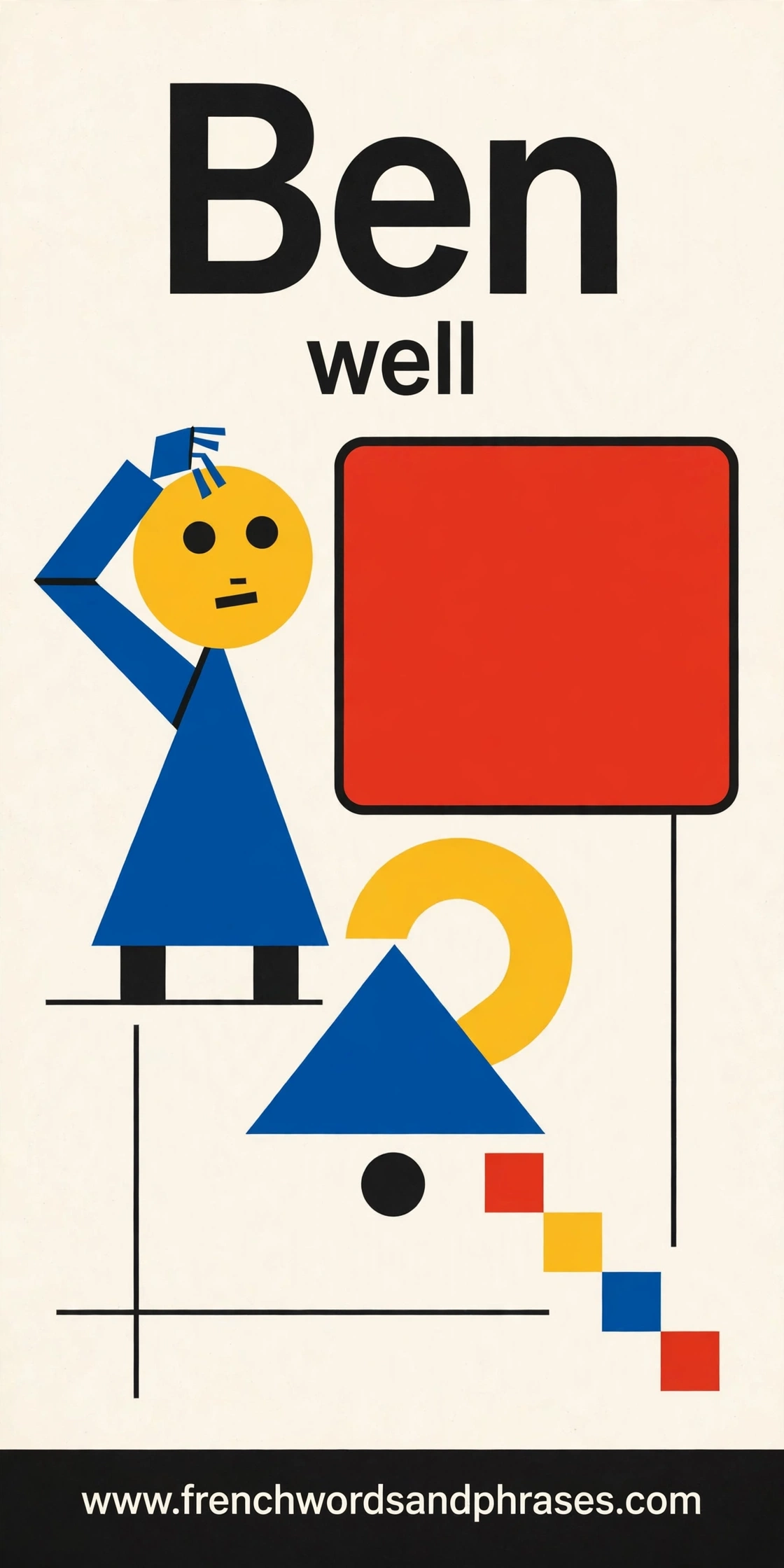
Ben means well….
Two friends study a restaurant menu far longer than the waiter would like. He hovers, pen ready, and finally asks if they have chosen. One of them shrugs, smiles and answers: « Ben… je vais prendre le plat du jour. » Well… I’ll take the dish of the day. That little ben did a lot of work: it filled the silence, softened the delay and gently announced a decision that was still half-formed.
Let’s explore how ben works in French, beginning with the whole word on one card.
Understanding the French Interjection Ben
Ben is a French discourse marker — a relaxed, spoken cousin of bien (well). It is classed with the interjections because it stands outside the grammar of the sentence, but its real job is conversational: it opens replies, marks hesitation, and colours what follows with an attitude — resignation, obviousness, or gentle disagreement.
It means well… — the sound of someone gathering a thought and leaning into an answer. Unlike the empty filler euh, ben always carries a flavour: “well, obviously”, “well, what can you do”, or “well, actually”. It comes from bien, worn down by centuries of fast speech into a single nasal syllable, and it is one of the most frequent sounds in everyday French conversation.
Type: Discourse marker — reply opener / hesitation with attitude
Answers the need: Starting an answer — hesitating while hinting at your position
Register: Informal and warm — everyday speech; too casual for formal settings
Strength: Mild to pointed — a soft ben shrugs; a firm ben oui insists
One important usage detail: ben is almost always written in dialogue and informal messages, but in careful writing French prefers eh bien or alors. Spoken, though, ben is everywhere — and its famous partner is oui: « ben oui ! » means “well, of course!” and can sound delighted or exasperated depending entirely on the tone.
Experience the Word
Ben is the verbal shrug — a whole French attitude compressed into one syllable: acceptance, obviousness, and a touch of “what did you expect?”.
Imagine asking a Parisian why the bakery queue is so long on Sunday morning. He gestures at the croissants and answers: « Ben… c’est dimanche. » Well… it’s Sunday. The ben says the rest.
You have not yet given your answer. But everyone already knows which way it leans.
How to Use Ben in French: Complete Guide
Let’s explore how ben works in French, beginning with the whole word on one card.
Ben at a Glance
The Whole Word on One Card
Meaning, job, register and strength — ben in four lines.
| Point | Ben |
|---|---|
| Meaning | well… — bien worn down to one spoken syllable |
| Job | opens a reply, hesitates, and hints at the speaker’s attitude |
| Register | informal, everyday — a sound of conversation, not of essays |
| Strength | adjustable: soft ben = gentle start; ben oui ! = of course! |
Example
Ben, d’accord, je viens.
Well, okay, I’m coming.
When You Say It: The Trigger Moments
Ben appears at the start of answers like these — each time with a slightly different flavour.
| Situation | Example |
|---|---|
| Answering the obvious | ben oui, c’est fermé le lundi — well yes, it’s closed on Mondays |
| Accepting with resignation | ben, on n’a pas le choix — well, we have no choice |
| Disagreeing gently | ben non, pas exactement — well no, not exactly |
| Filling a thoughtful pause | ben, je ne sais pas trop — well, I don’t really know |
| Explaining the evident | ben, il pleut, alors je reste — well, it’s raining, so I’m staying |
Example
Ben, tu viens ou pas ?
Well, are you coming or not?
Quick Quiz 1
What does ben add that the plain filler euh does not?
Reveal the answer
An attitude — ben hints at a position (obviousness, resignation, gentle disagreement) while euh is pure empty pause.
Ben oui, c’est évident !
Well yes, it’s obvious!
The Reaction Question: Tone, Length and Partners
Ben changes colour with its delivery — and with the small words that attach themselves to it.
| Delivery | What it does |
|---|---|
| Soft, trailing ben… | hesitation — the answer is still forming |
| Firm ben oui ! | ‘of course!’ — delighted or exasperated, tone decides |
| Flat ben non | ‘well no’ — correction without aggression |
| Long beeen | playful or emphatic — stretching it adds theatre |
| Written ben, | in messages and dialogue, the comma shows the little pause |
Example
Beeen oui, je te l’avais dit !
Weeell yes, I told you so!
Where It Goes: The Front Door of the Reply
Ben lives at the start of turns — it opens the door, then the real sentence walks through.
| Position / pattern | Example |
|---|---|
| Opening a reply | ben, je crois que oui — well, I think so |
| Ben + oui / non | ben oui ! / ben non ! — the classic pairings |
| Ben + explanation | ben, c’est parce qu’il est tard — well, it’s because it’s late |
| Ben + euh stacked | ben euh, je ne sais pas — well uh, I don’t know |
| Standalone, with a shrug | ben… — a whole answer in one syllable |
Example
Ben, écoute, je vais y réfléchir.
Well, listen, I’ll think about it.
Quick Quiz 2
What is the classic partner of ben in the phrase meaning “well, of course!”?
Reveal the answer
oui — ben oui ! is the fixed pairing.
Ben oui, je suis d’accord !
Well yes, I agree!
Everyday Expressions with Ben
Ben anchors a family of everyday phrases — learn these and half of spoken French opens up.
| Expression | In English |
|---|---|
| ben oui ! | well, of course! / well yes! |
| ben non ! | well no! / of course not! |
| ben voilà | well, there you go (that’s settled) |
| ben alors ? | well then? (prompting, sometimes impatient) |
| ben dis donc | well I say! (mild amazement, slightly old-fashioned) |
Example
Ben voilà, c’est fini.
Well, there you go, it’s finished.
Close Cousins: The Other Reply Openers
French starts its answers in several ways — ben is the relaxed, nasal one.
| Word | The difference |
|---|---|
| ben | well… — informal, attitude included, from bien |
| eh bien | well… — the fuller, slightly more formal parent form |
| euh | uh… — pure filler, no attitude at all |
| alors | so… — organises and moves the conversation forward |
| bah | meh / whatever — dismissal, a shrug of indifference |
Example
Eh bien, commençons.
Well then, let’s begin.
Quick Quiz 3
Which cousin is the fuller, more formal parent of ben?
Reveal the answer
eh bien — ben is its relaxed spoken descendant.
Eh bien, je vous écoute.
Well, I’m listening.
Ben and Its Neighbours
The reply-opener shelf, from warm engagement to total dismissal.
| French | In English |
|---|---|
| ben oui ! | well, of course! (engaged, affirmative) |
| ben | well… (hesitation with attitude) |
| euh | uh… (empty pause) |
| bof | meh (indifference) |
| bah | whatever (dismissal) |
Example
Ben oui, bien sûr que je t’aide.
Well yes, of course I’ll help you.
Watch Out: The Traps Around Ben
The traps: register, overuse, and the ben oui that lands wrong.
| Trap | The truth |
|---|---|
| Using ben in formal writing | essays, letters and speeches prefer eh bien or alors — ben is a spoken word |
| Ben oui to the wrong person | to a boss or a stranger it can sound like ‘obviously!’ — soften it with bien sûr |
| Starting every sentence with ben | overuse makes you sound permanently resigned, even when you are not |
| Hearing it as rude | ben alone is not impolite — it is the default sound of a French reply beginning |
Example
Ben, merci quand même pour ton aide.
Well, thanks anyway for your help.
Quick Quiz 4
True or false: ben is a good choice in a formal letter.
Reveal the answer
False — ben belongs to speech; formal writing uses eh bien or alors.
Ben, je vous écris pour…
Well, I’m writing to you to… (too casual for a letter!)
Ben in Everyday French: Real-Life Examples
Now that you know the word, let’s see how ben appears in everyday French.
Example Example 1 — The obvious
Ben oui, le musée est gratuit le dimanche.
Well yes, the museum is free on Sundays.
Example Example 2 — Resignation
Ben, tant pis, on prendra le prochain train.
Well, never mind, we’ll take the next train.
Example Example 3 — Gentle no
Ben non, je ne peux pas demain.
Well no, I can’t tomorrow.
Example Example 4 — Thinking
Ben, je dirais plutôt samedi.
Well, I’d say Saturday instead.
Example Example 5 — Explanation
Ben, il est fatigué, il a travaillé toute la nuit.
Well, he’s tired, he worked all night.
Example Example 6 — Settled
Ben voilà, on est arrivés.
Well, there we are, we’ve arrived.
Beyond Translation: The Meaning of Ben
Ben is what happens to a word after a thousand years of being said quickly. Bien — well, good — was worn smooth by everyday speech until only a single nasal syllable remained, like a pebble in a river. Nothing about it is lazy, though: ben does delicate social work, softening disagreement, warming a reply, and telling the listener how to take what comes next.
To say ben is to shrug with your voice — and keep the conversation friendly.
It is also a badge of real spoken French. Textbooks teach eh bien; life teaches ben. Learners who master it suddenly sound less like a phrasebook and more like a neighbour.
How to Remember the French Interjection Ben
Remember it this way: Remember it this way: Ben is bien in slippers — the relaxed little word that opens a French reply and shows its attitude.
- You hear the attitude — ben is never empty: it leans obvious, resigned or gently contrary.
- You keep the pairings — ben oui (of course!) and ben non (well no) do half the work.
- You save it for speech — in formal writing, its parent eh bien takes over.
The key idea is ben means well…: it opens replies, carries an attitude, and pairs with oui and non.
Test Your Knowledge of Ben
Let’s see how much you’ve learned. Try answering these questions before revealing the answers.
Question 1
What does ben mean?
Reveal the answer
Well… — a relaxed spoken form of bien that opens replies and hints at the speaker’s attitude.
Question 2
What does ben oui ! mean?
Reveal the answer
Well, of course! — delighted or exasperated depending on the tone.
Question 3
Translate: Well, I don’t know.
Reveal the answer
Ben, je ne sais pas.
Question 4
What is the fuller, more formal form behind ben?
Reveal the answer
Eh bien — ben is its worn-down spoken descendant, from bien.
Question 5
Complete the sentence:
______ oui, c’est évident ! (Well yes, it’s obvious!)
Reveal the answer
Ben
Ben oui, c’est évident !
Well yes, it’s obvious!
Your Final Challenge
Can You Use It?
How would you say this in French?
“How would you say this in French?”
Reveal the answer
Ben, je vais y réfléchir.
Well, I’ll think about it.
A little French. A little curiosity. A richer everyday life.
LEARN FRENCH ONE WORD AT A TIME