A French Word to Live By
Translate Beau-père to English
/bo.pɛʁ/
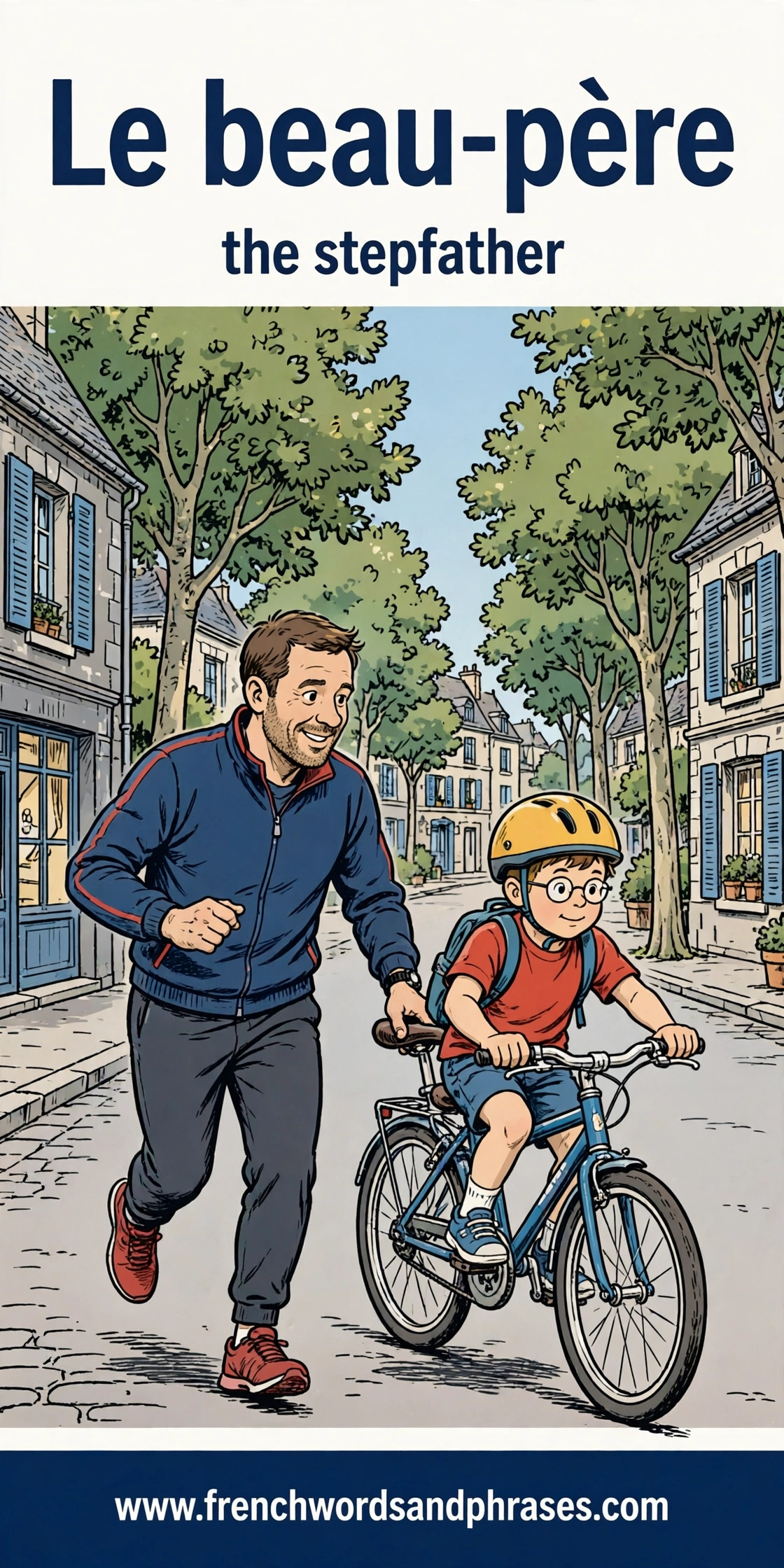
Le beau-père means the stepfather.
The wedding photos are on the mantelpiece, and at Sunday lunch a tall man carves the roast while two families chat like old friends. He is not the children’s father by birth, but he is family all the same — le beau-père.
In this guide, you’ll learn what beau-père means in English, how to use it with its articles, how to form its plural, and how it appears in everyday French. Explore French examples, English translations, and practice quizzes.
Understanding the French Noun Beau-père
Beau-père is a masculine French noun, learned with its article: le beau-père, un beau-père. It is a compound of beau (fine, handsome) and père (father), and it does double duty in French: it means both the stepfather — your mother’s or father’s new husband — and the father-in-law, your spouse’s father. Its feminine partner is la belle-mère, the stepmother or mother-in-law.
It means the stepfather — the man your parent marries after a divorce or bereavement, who helps raise you without replacing anyone. But context decides: after your own wedding, mon beau-père is your wife’s or husband’s father. French uses one warm word where English needs two, and the family situation always makes the meaning clear.
Gender: Masculine
Feminine partner: la belle-mère — the stepmother; also the mother-in-law
Definite article: le — le beau-père (the stepfather)
Indefinite article: un — un beau-père (a stepfather)
Plural: les beaux-pères — beau takes an -x: des beaux-pères
English equivalents: The stepfather; also the father-in-law.
One important usage detail: beau-père covers two English words. « Le père de ma femme » is your father-in-law; « le mari de ma mère » is your stepfather — both are mon beau-père. The same is true of the feminine pair: ma belle-mère is both my stepmother and my mother-in-law. And watch the plural: beau becomes beaux — les beaux-pères, never « les beau-pères ».
Experience the Word
Beau-père is more than a label on a family tree. It is the man who chose a family that already existed — who learned the children’s favourite meals, their fears, their jokes, one Sunday at a time.
Imagine the first holidays together: the awkward silences softening, a fishing trip, a repaired bicycle, and one day the word papa almost said — and understood.
You have not just gained a relative. You have been chosen — famille choisie, family by choice.
How to Use Beau-père in French: Complete Guide
Let’s explore how beau-père works in French, beginning with its articles — and watch beau become beaux in the plural.
Beau-père with the Definite Article (Le, Les)
Used for the stepfather everyone in the conversation knows — yours, hers, theirs.
| Form | French |
|---|---|
| Masculine singular | le beau-père |
| Plural | les beaux-pères |
Example
Le beau-père de Léa l’aide à faire ses devoirs.
Léa’s stepfather helps her with her homework.
Beau-père with the Indefinite Article (Un, Des)
Used for a stepfather in general — un beau-père, des beaux-pères.
| Form | French |
|---|---|
| Masculine singular | un beau-père |
| Plural | des beaux-pères |
Example
C’est un beau-père patient et très drôle.
He is a patient, very funny stepfather.
The Blended Family: Words Around Beau-père
Stepchildren, in-laws and second weddings — the vocabulary of the famille recomposée.
| French | In English |
|---|---|
| la belle-mère | the stepmother; the mother-in-law |
| le beau-fils | the stepson; the son-in-law |
| la belle-fille | the stepdaughter; the daughter-in-law |
| les beaux-parents | the in-laws; the step-parents |
| la famille recomposée | the blended family |
| se remarier | to remarry |
Example
Ses beaux-parents habitent à côté de chez eux.
His in-laws live next door to them.
Quick Quiz 1
Complete the sentence:
Le mari de ma mère est mon ______.
Reveal the answer
beau-père
Le mari de ma mère est mon beau-père.
My mother’s husband is my stepfather.
The Plural of Beau-père
Père adds an -s, and beau — which ends in a vowel sound — takes an -x: les beaux-pères.
| Number | French |
|---|---|
| Singular | le beau-père |
| Plural | les beaux-pères |
Example
Dans sa classe, plusieurs enfants ont des beaux-pères et des belles-mères.
In his class, several children have stepfathers and stepmothers.
Beau-père with Possessive Adjectives (Mon, Ton, Son…)
Possessives agree with the noun: beau-père is masculine, so it takes mon, ton, son.
| Owner | French |
|---|---|
| my | mon beau-père |
| your (tu) | ton beau-père |
| his / her | son beau-père |
| our | notre beau-père |
| your (vous) | votre beau-père |
| their | leur beau-père |
Example
Mon beau-père m’apprend à pêcher.
My stepfather is teaching me to fish.
Quick Quiz 2
Complete the sentence:
______ beau-père est le père de sa femme. (His)
Reveal the answer
Son
Son beau-père est le père de sa femme.
His stepfather — here, his father-in-law — is his wife’s father. Beau-père covers both.
Beau-père with Demonstrative Adjectives (Ce, Ces)
Used to point: ce beau-père, ces beaux-pères.
| Form | French |
|---|---|
| Masculine singular | ce beau-père |
| Plural | ces beaux-pères |
Example
Ce beau-père traite les enfants de sa femme comme les siens.
This stepfather treats his wife’s children as his own.
Beau-père with Adjectives
Adjectives agree with beau-père — and beau itself changes before a vowel: un bel homme, but un beau-père gentil.
| Adjective | With Beau-père |
|---|---|
| gentil (kind) | un beau-père gentil |
| patient (patient) | un beau-père patient |
| jeune (young) | un jeune beau-père |
| formidable (wonderful) | un beau-père formidable |
| strict (strict) | un beau-père strict |
Example
Elle a un beau-père formidable qui l’encourage toujours.
She has a wonderful stepfather who always encourages her.
Quick Quiz 3
What are les beaux-parents?
Reveal the answer
The in-laws — or the step-parents
Les beaux-parents viennent dîner dimanche.
The in-laws are coming to dinner on Sunday.
Everyday Expressions with Beau-père
Weddings, remarriages and Sunday lunches — the beau-père phrases of daily life.
| Expression | In English |
|---|---|
| mon beau-père et ma belle-mère | my father-in-law and mother-in-law; my stepfather and stepmother |
| s’entendre bien avec son beau-père | to get on well with one’s stepfather |
| les beaux-parents | the in-laws |
| un beau-père de cœur | a stepfather in all but name, a father figure |
| appeler son beau-père par son prénom | to call one’s stepfather by his first name |
| la belle-famille | the in-laws, the spouse’s family |
Example
Il s’entend très bien avec son beau-père.
He gets on very well with his stepfather.
Words from the Same Family as Beau-père
Fathers, mothers and the whole beau- family — the words that travel with beau-père.
| French | In English |
|---|---|
| le père | the father |
| la belle-mère | the stepmother; the mother-in-law |
| le beau-frère | the brother-in-law |
| la belle-sœur | the sister-in-law |
| le beau-fils | the stepson; the son-in-law |
| paternel | paternal, fatherly |
Example
Son père et son beau-père jouent aux cartes ensemble.
His father and his stepfather play cards together.
Quick Quiz 4
Complete the sentence:
Après le mariage, le père de ma femme devient mon ______.
Reveal the answer
beau-père
Après le mariage, le père de ma femme devient mon beau-père.
After the wedding, my wife’s father becomes my father-in-law — the same word as stepfather.
Beau-père in Everyday French: Real-Life Examples
Now that you know the word, let’s see how beau-père appears in everyday French.
Example 1 — At Sunday lunch
Mon beau-père prépare le rôti pour toute la famille.
My stepfather is preparing the roast for the whole family.
Example 2 — Talking about family
Son beau-père est le père de son mari.
Her father-in-law is her husband’s father.
Example 3 — A kind gesture
Mon beau-père m’a aidé à déménager samedi.
My stepfather helped me move house on Saturday.
Example 4 — Getting along
Elle adore son beau-père, il est très gentil.
She loves her stepfather; he is very kind.
Example 5 — At a wedding
Les beaux-parents dansent ensemble à la fête.
The in-laws are dancing together at the party.
Example 6 — A phone call
Je téléphone à mon beau-père pour son anniversaire.
I’m calling my stepfather for his birthday.
Beyond Translation: The Meaning of Beau-père
French builds its in-law vocabulary on a compliment: beau and belle mean beautiful, so the family you gain by marriage is literally « the beautiful family » — la belle-famille. It is an old courtesy built into the language itself, a small act of diplomacy every time you say beau-père. English, by contrast, reaches for the law (in-law) or for distance (step-).
To say beau-père is to call a man family with a compliment attached.
It evokes the remarriage feast and the second chance, the man who learns to be a father to children already half-grown — and a language that decided, centuries ago, to welcome him kindly.
How to Remember the French Noun Beau-père
Remember it this way: Beau-père is the stepfather — and the father-in-law too: one French word does both jobs, and its partner is la belle-mère.
- You think of mum’s new husband — mon beau-père, the stepfather.
- You think of your wife’s father — mon beau-père again, the father-in-law.
- You write the plural — les beaux-pères, with an -x on beaux.
The key idea is le beau-père — stepfather and father-in-law in one.
Test Your Knowledge of Beau-père
Let’s see how much you’ve learned. Try answering these questions before revealing the answers.
Question 1
What two English words does beau-père cover?
Reveal the answer
Stepfather and father-in-law — context tells you which one is meant.
Question 2
What is the feminine partner of beau-père?
Reveal the answer
La belle-mère — the stepmother, and also the mother-in-law.
Question 3
Translate: My stepfather is very kind.
Reveal the answer
Mon beau-père est très gentil.
Question 4
How do you write the plural of beau-père?
Reveal the answer
Les beaux-pères — beau takes an -x (beaux) and père takes an -s.
Question 5
Complete the sentence:
Le père de mon mari est mon ______.
Reveal the answer
beau-père
Le père de mon mari est mon beau-père.
My husband’s father is my father-in-law.
Your Final Challenge
Can You Use It?
How would you say this in French?
“My stepfather helps me with my homework.”
Reveal the answer
Mon beau-père m’aide à faire mes devoirs.
My stepfather helps me with my homework.
A little French. A little curiosity. A richer everyday life.
LEARN FRENCH ONE WORD AT A TIME