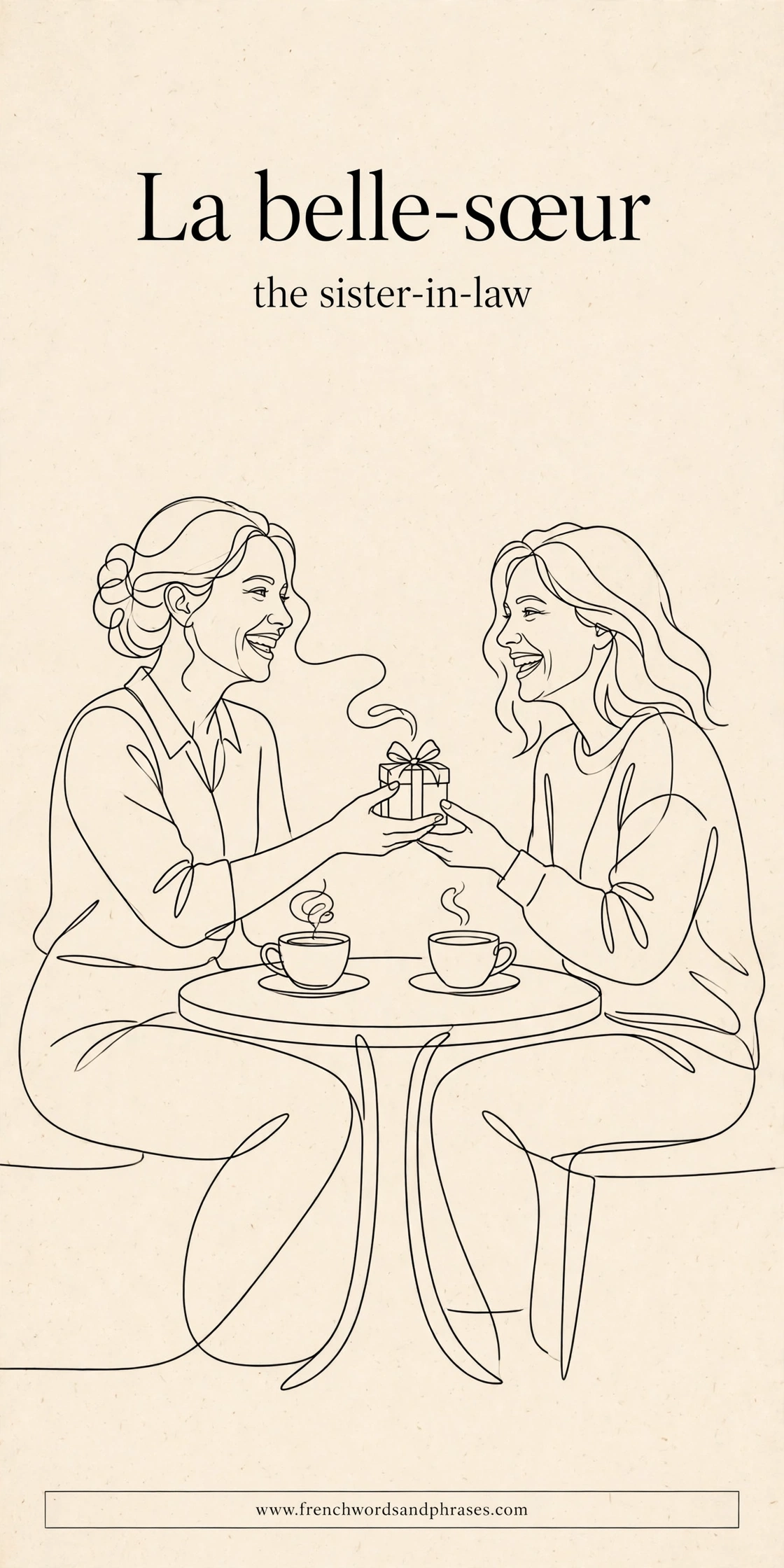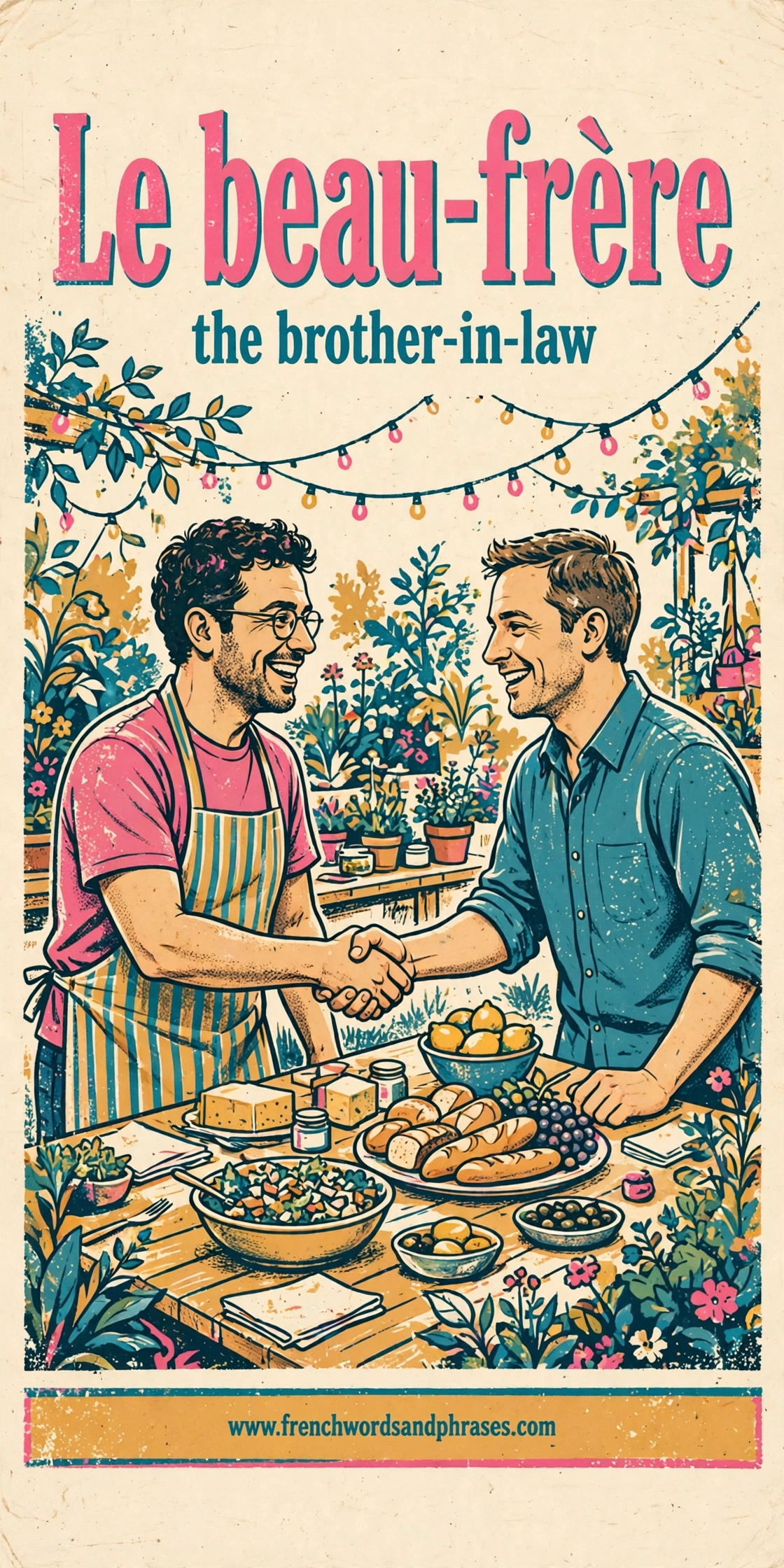
A French Word to Live By
Translate Beau-frère to English
/bo.fʁɛʁ/
Le beau-frère means the brother-in-law.
At the family lunch, a new face is being introduced around the table — the sister’s husband, welcomed with handshakes and a second helping. Everyone already has a word for him: le beau-frère.
In this guide, you’ll learn what beau-frère means in English, how to use it with its articles, how to form its plural, and how it appears in everyday French. Explore French examples, English translations, and practice quizzes.
Understanding the French Noun Beau-frère
Beau-frère is a masculine French compound noun: beau (fine, handsome) plus frère (brother). It is learned with its article: le beau-frère, un beau-frère. Its exact partner is la belle-sœur, the sister-in-law — the two words mirror each other.
It means the brother-in-law — and French uses it for both relationships English covers: your spouse’s brother, and your sister’s (or brother’s) husband. The beau- prefix is the mark of family gained by marriage: the same family of words gives le beau-père and la belle-mère, the parents-in-law.
Gender: Masculine
Feminine partner: la belle-sœur — the sister-in-law
Definite article: le — le beau-frère (the brother-in-law)
Indefinite article: un — un beau-frère (a brother-in-law)
Plural: les beaux-frères — both parts take the plural
English equivalents: The brother-in-law.
One important usage detail: beau-frère covers both of English’s routes into the family — le frère de mon mari (my husband’s brother) and le mari de ma sœur (my sister’s husband) are both mon beau-frère. And watch the plural: beau becomes beaux, so des beaux-frères.
Experience the Word
Beau-frère is more than a family label. It is the brother you did not grow up with and gained all at once, by marriage — an ally delivered by a wedding.
Imagine the first family holiday together: the awkward first dinner forgotten, the two of you escaping the washing-up to talk football on the balcony like brothers of twenty years.
You have not just met an in-law. You have gained a brother — un frère de plus, chosen by love’s arithmetic.
How to Use Beau-frère in French: Complete Guide
Let’s explore how beau-frère works in French, beginning with its articles — and watch beau turn into beaux in the plural.
Beau-frère with the Definite Article (Le, Les)
Used for the brother-in-law everyone in the family knows — the one coming on Sunday.
| Form | French |
|---|---|
| Masculine singular | le beau-frère |
| Plural | les beaux-frères |
Example
Le beau-frère de Marie arrive dimanche pour le déjeuner.
Marie’s brother-in-law is arriving on Sunday for lunch.
Beau-frère with the Indefinite Article (Un, Des)
Used for a brother-in-law in general — un beau-frère, the family’s new member.
| Form | French |
|---|---|
| Masculine singular | un beau-frère |
| Plural | des beaux-frères |
Example
Il est devenu mon beau-frère l’été dernier.
He became my brother-in-law last summer.
The Family by Marriage: the Beau- Words
Brothers, sisters and parents gained by marriage — the vocabulary that surrounds the beau-frère.
| French | In English |
|---|---|
| la belle-sœur | the sister-in-law |
| le beau-père | the father-in-law |
| la belle-mère | the mother-in-law |
| le beau-fils | the son-in-law |
| la belle-fille | the daughter-in-law |
| la belle-famille | the in-laws, the spouse’s family |
Example
Ma belle-sœur et mon beau-frère habitent à Nantes.
My sister-in-law and my brother-in-law live in Nantes.
Quick Quiz 1
Your sister has just married Paul. Complete the sentence:
Paul est mon ______.
Reveal the answer
beau-frère
Paul est mon beau-frère.
Paul is my brother-in-law — your sister’s husband is your beau-frère.
The Plural of Beau-frère
A double plural with a twist: beau becomes beaux — des beaux-frères.
| Number | French |
|---|---|
| Singular | le beau-frère / un beau-frère |
| Plural | les beaux-frères / des beaux-frères |
Example
Ses deux beaux-frères travaillent dans la même entreprise.
Her two brothers-in-law work in the same company.
Beau-frère with Possessive Adjectives (Mon, Ton, Son…)
Possessives agree with the noun: beau-frère is masculine, so it takes mon, ton, son.
| Owner | French |
|---|---|
| my | mon beau-frère |
| your (tu) | ton beau-frère |
| his / her | son beau-frère |
| our | notre beau-frère |
| your (vous) | votre beau-frère |
| their | leur beau-frère |
Example
Mon beau-frère cuisine très bien, c’est un plaisir de l’inviter.
My brother-in-law cooks very well; it is a pleasure to invite him.
Quick Quiz 2
Complete the sentence:
______ beau-frère téléphone ce soir. (Our)
Reveal the answer
Notre
Notre beau-frère téléphone ce soir.
Our brother-in-law is phoning this evening.
Beau-frère with Demonstrative Adjectives (Ce, Ces)
Used to point in the family photo: ce beau-frère, the one on the left.
| Form | French |
|---|---|
| Masculine singular | ce beau-frère |
| Plural | ces beaux-frères |
Example
Ce beau-frère-là habite au Canada depuis dix ans.
That brother-in-law has lived in Canada for ten years.
Beau-frère with Adjectives
Adjectives agree with the compound as masculine: un beau-frère gentil, un beau-frère drôle.
| Adjective | With Beau-frère |
|---|---|
| gentil (kind) | un beau-frère gentil |
| drôle (funny) | un beau-frère drôle |
| jeune (young) | un jeune beau-frère |
| nouveau (new) | un nouveau beau-frère |
| formidable (wonderful) | un beau-frère formidable |
Example
C’est un beau-frère formidable, toujours prêt à aider.
He is a wonderful brother-in-law, always ready to help.
Quick Quiz 3
Complete the sentence:
______ beaux-frères sont frères entre eux. (These)
Reveal the answer
Ces
Ces beaux-frères sont frères entre eux.
These brothers-in-law are brothers to each other.
Everyday Expressions with Beau-frère
Weddings and family lunches — the beau-frère phrases of daily life.
| Expression | In English |
|---|---|
| devenir beau-frère | to become brothers-in-law |
| le mari de ma sœur | my sister’s husband |
| le frère de ma femme | my wife’s brother |
| s’entendre bien avec son beau-frère | to get on well with one’s brother-in-law |
| un déjeuner avec le beau-frère | a lunch with the brother-in-law |
Example
Il s’entend très bien avec son beau-frère.
He gets on very well with his brother-in-law.
Words from the Same Family as Beau-frère
Brothers by blood and by marriage — the words that travel with beau-frère.
| French | In English |
|---|---|
| le frère | the brother |
| la sœur | the sister |
| le mariage | the marriage, the wedding |
| le mari | the husband |
| la famille | the family |
| épouser | to marry |
Example
Son frère et son beau-frère sont devenus de vrais amis.
His brother and his brother-in-law have become real friends.
Quick Quiz 4
Who is la belle-famille?
Reveal the answer
The in-laws — your spouse’s family as a whole, the family the beau-frère belongs to.
Il passe Noël chez sa belle-famille.
He is spending Christmas at his in-laws’.
Beau-frère in Everyday French: Real-Life Examples
Now that you know the word, let’s see how beau-frère appears in everyday French.
Example 1 — Introductions
Je te présente mon beau-frère, le mari de ma sœur.
Let me introduce my brother-in-law, my sister’s husband.
Example 2 — A family lunch
Mon beau-frère apporte le dessert dimanche.
My brother-in-law is bringing the dessert on Sunday.
Example 3 — Helping out
Son beau-frère l’aide à déménager.
His brother-in-law is helping him move house.
Example 4 — Talking family
Elle a deux beaux-frères et une belle-sœur.
She has two brothers-in-law and a sister-in-law.
Example 5 — Good relations
Nous nous entendons bien avec notre beau-frère.
We get on well with our brother-in-law.
Example 6 — A phone call
Ton beau-frère a téléphoné pendant ton absence.
Your brother-in-law phoned while you were out.
Beyond Translation: The Meaning of Beau-frère
French builds its in-laws with a compliment: beau, fine and handsome, stands in front of frère, père and mère for every relative gained by marriage. Older French used beau- to honour the new family rather than mark it as foreign — the brother-in-law is not a lesser brother but a fine one. The mirror word, belle-sœur, completes the pair, and together they map the family’s second circle, the one love adds.
To say beau-frère is to welcome a brother the family chose.
It evokes the wedding-day handshake and the Sunday-lunch familiarity, the shared jokes and the borrowed tools — kinship by celebration rather than by birth.
How to Remember the French Noun Beau-frère
Remember it this way: Beau-frère is the brother-in-law — beau, fine, plus frère, brother: the fine brother marriage brings.
- You picture the wedding — un frère de plus, par mariage.
- You pair the words — le beau-frère et la belle-sœur.
- You make the plural — des beaux-frères, beau devient beaux.
The key idea is beau + frère — the brother gained by marriage.
Test Your Knowledge of Beau-frère
Let’s see how much you’ve learned. Try answering these questions before revealing the answers.
Question 1
What is the feminine partner of beau-frère?
Reveal the answer
La belle-sœur — the sister-in-law; the two compounds mirror each other exactly.
Question 2
How do you say brothers-in-law in French?
Reveal the answer
Des beaux-frères — beau becomes beaux and frère takes its -s.
Question 3
Translate: My brother-in-law is my sister’s husband.
Reveal the answer
Mon beau-frère est le mari de ma sœur.
Question 4
What does the beau- in beau-frère tell you?
Reveal the answer
That the relationship comes by marriage — the same beau- appears in beau-père, belle-mère and belle-famille.
Question 5
Complete the sentence:
______ beau-frère habite à Lyon. (Her)
Reveal the answer
Son
Son beau-frère habite à Lyon.
Her brother-in-law lives in Lyon.
Your Final Challenge
Can You Use It?
How would you say this in French?
“My brother-in-law is coming on Sunday.”
Reveal the answer
Mon beau-frère vient dimanche.
My brother-in-law is coming on Sunday.
A little French. A little curiosity. A richer everyday life.
LEARN FRENCH ONE WORD AT A TIME