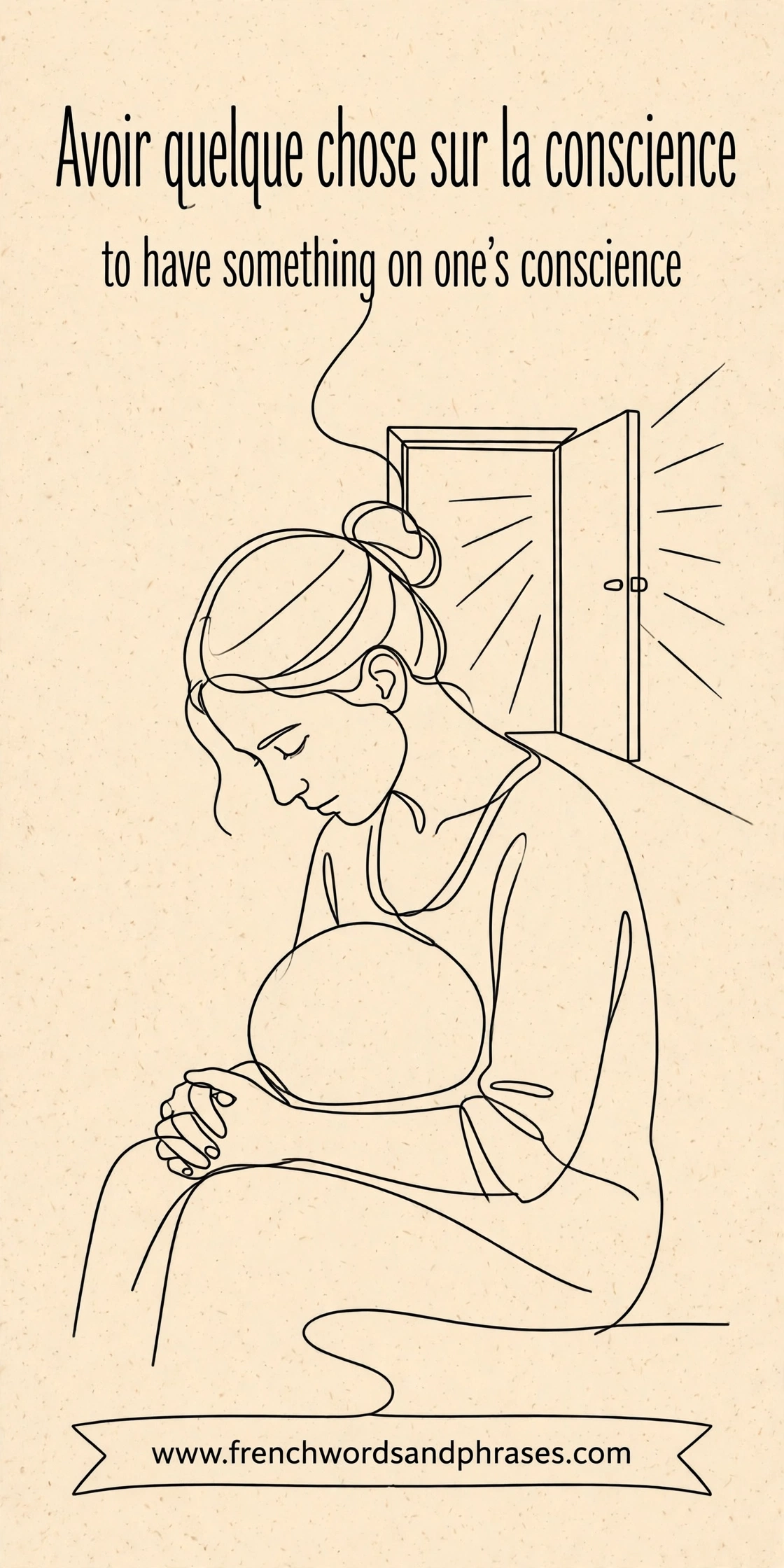
A French Word to Live By
Translate Avoir quelque chose sur la conscience to English
/a.vwaʁ kɛl.kə ʃoz syʁ la kɔ̃.sjɑ̃s/
Avoir quelque chose sur la conscience means to have something on your conscience — a wrong, usually unconfessed, that weighs on you.
For thirty years, the retired schoolteacher has told the story of the broken window as a mystery nobody solved. Tonight, at eighty, she finally laughs and tells her grandchildren the truth: « J’avais quelque chose sur la conscience depuis trop longtemps. » The stone, carried since childhood, is set down at last.
Let’s explore how avoir quelque chose sur la conscience works in French, beginning with the whole phrase on one card.
Understanding the French Phrase Avoir quelque chose sur la conscience
Avoir quelque chose sur la conscience is a French expression built from avoir (to have), quelque chose (something) and sur la conscience (on the conscience). The picture is physical: an unnamed weight sits on the conscience the way a stone sits on a chest — and it stays there until it is confessed or repaired.
It means to have something on your conscience: a specific act — a lie, a theft, a betrayal, a harm never admitted — that you carry with you. Unlike avoir mauvaise conscience, which names the feeling, this phrase names the thing: there is a definite quelque chose, and everyone understands it has never been said out loud.
Type: Expression — guilt (avoir + quelque chose + sur la conscience)
Answers the need: Saying a specific, unconfessed wrong is weighing on someone
Register: Neutral — speech and writing; often half-humorous for small old secrets
Strength: Heavy — a real deed carried in silence, not a passing pang
One important usage detail: the quelque chose can be replaced by the actual burden when it is named — avoir un mensonge sur la conscience, avoir une mort sur la conscience (the gravest form: to have a death on your conscience). The relief has its own phrase: soulager sa conscience, to unburden your conscience, usually by finally confessing.
Experience the Word
Avoir quelque chose sur la conscience is the phrase of old secrets — the ones that outlive everyone who could forgive them.
Imagine the village baker who, at nineteen, let a friend take the blame for the flour stolen from the mill. Forty years of bread later, he still over-fills that friend’s bag and will not say why. The village suspects. The phrase exists precisely for what he carries.
French weighs guilt in stones. Something on the conscience is not a mood; it is an object, and objects can be put down — that is the hope built into the phrase.
How to Use Avoir quelque chose sur la conscience in French: Complete Guide
Let’s explore how avoir quelque chose sur la conscience works in French, beginning with the whole phrase on one card.
Avoir quelque chose sur la conscience at a Glance
The Whole Phrase on One Card
Real meaning, literal picture, English twin and register — avoir quelque chose sur la conscience in five lines.
| Point | Avoir quelque chose sur la conscience |
|---|---|
| What it really means | to have something on your conscience — an unconfessed wrong that weighs on you |
| Word for word | to have something on the conscience |
| English equivalent | to have something on your conscience / to have something weighing on you |
| Register | neutral — serious for real wrongs, half-humorous for small old secrets |
| Use it for | lies never admitted, blames shifted, harms carried in silence |
Example
Il a quelque chose sur la conscience, ça se voit.
He has something on his conscience, you can tell.
Word by Word: Building the Weight
Four pieces — the carrier, the unnamed thing, and the surface it presses on.
| Word | Literal meaning | Its job in the phrase |
|---|---|---|
| avoir | to have | the carrier’s verb — the weight is held, day after day |
| quelque chose | something | the unnamed deed — deliberately vague, because it has never been confessed |
| sur | on | the pressure word — the thing sits on top, it is not inside or behind |
| la conscience | the conscience | the surface that bears the weight — and keeps the account |
Example
Elle avait un secret sur la conscience depuis des années.
She had a secret on her conscience for years.
Quick Quiz 1
Why sur — what does the little word add to the picture?
Reveal the answer
Pressure — the wrong sits ON the conscience like a stone on a chest; it weighs, it is not merely remembered.
Ce mensonge lui pèse sur la conscience.
That lie weighs on his conscience.
When You Say It: The Burden Moments
Avoir quelque chose sur la conscience fires at moments like these — a secret kept too long, a truth finally told.
| Situation | Example |
|---|---|
| Suspecting a secret | il a quelque chose sur la conscience, il évite le sujet — he has something on his conscience, he avoids the subject |
| An old confession | après trente ans, elle a avoué : elle avait quelque chose sur la conscience — after thirty years, she confessed: she had something on her conscience |
| The gravest form | avoir une mort sur la conscience — to have a death on one’s conscience |
| Small and comic | le chat a quelque chose sur la conscience, regarde ses oreilles — the cat has something on its conscience, look at its ears |
| The relief | il a soulagé sa conscience en disant la vérité — he unburdened his conscience by telling the truth |
Example
Depuis l’accident, il a cette nuit-là sur la conscience.
Since the accident, he has that night on his conscience.
Make It Yours: Naming the Weight
The quelque chose can stay vague — or be replaced by the very thing carried.
| Form | French | In English |
|---|---|---|
| The vague form | j’ai quelque chose sur la conscience | I have something on my conscience |
| A named lie | il a un mensonge sur la conscience | he has a lie on his conscience |
| The gravest | avoir une mort sur la conscience | to have a death on one’s conscience |
| In the past | elle avait quelque chose sur la conscience | she had something on her conscience |
| The unburdening | soulager sa conscience | to unburden your conscience, to get it off your chest |
| As a question | tu as quelque chose sur la conscience ? | do you have something on your conscience? |
Example
Il a enfin soulagé sa conscience devant toute la famille.
He finally unburdened his conscience in front of the whole family.
Quick Quiz 2
What is the gravest thing French puts on a conscience?
Reveal the answer
Une mort — avoir une mort sur la conscience, to have a death on your conscience, is the heaviest form of the phrase.
Le conducteur avait cette mort sur la conscience.
The driver had that death on his conscience.
Everyday Expressions: Building on the Burden
Avoir quelque chose sur la conscience slots into these everyday frames — each one ready to use as it stands.
| Frame | In English |
|---|---|
| avoir quelque chose sur la conscience | to have something on your conscience |
| avoir un mensonge sur la conscience | to have a lie on your conscience |
| avoir une mort sur la conscience | to have a death on your conscience |
| soulager sa conscience | to unburden your conscience |
| peser sur la conscience | to weigh on the conscience — the same stone, seen from the deed’s side |
Example
Cette vieille histoire lui pèse encore sur la conscience.
That old story still weighs on his conscience.
Close Cousins: The Other Conscience Phrases
French keeps a whole conscience shelf — this phrase names the burden; its cousins name the feeling, the peace or the relief.
| Expression | The difference |
|---|---|
| avoir quelque chose sur la conscience | to have something on your conscience — a specific, unconfessed deed |
| avoir mauvaise conscience | to feel guilty — the feeling itself, with or without a named deed |
| avoir la conscience tranquille | to have a clear conscience — nothing on it at all |
| en conscience | in all conscience — honestly, as in je ne peux pas, en conscience, accepter |
| un cas de conscience | a moral dilemma — a genuine conflict of duties |
Example
En conscience, il ne pouvait pas signer ce document.
In all conscience, he could not sign that document.
Quick Quiz 3
What is a cas de conscience?
Reveal the answer
A moral dilemma — a case where duties conflict and the conscience itself must decide.
Pour le maire, fermer l’école était un vrai cas de conscience.
For the mayor, closing the school was a real moral dilemma.
Avoir quelque chose sur la conscience and Its Neighbours
The conscience shelf around the phrase — the burden, the carrying, and the laying down.
| French | In English |
|---|---|
| un secret | a secret — the usual shape of the burden |
| avouer | to confess — the way the weight comes off |
| un poids | a weight — ce poids sur la conscience |
| le remords | remorse — the burden’s sharp edge |
| pardonner | to forgive — what the wronged side can grant |
| soulager | to relieve — soulager sa conscience, the great unburdening |
Example
Il a avoué, et le poids a disparu.
He confessed, and the weight disappeared.
Watch Out: The Traps Around Avoir quelque chose sur la conscience
The traps: a feeling mistaken for the deed, a conscience confused with consciousness, and a heart nearby.
| Trap | The truth |
|---|---|
| feeling vs thing | avoir mauvaise conscience is the pang; avoir quelque chose sur la conscience points at a specific deed — the two often travel together but are not the same |
| conscience = consciousness | in medical French conscience is consciousness — reprendre conscience is to come round, not to recover your morals |
| sur le cœur is the neighbour | avoir quelque chose sur le cœur is to have something on your chest — unspoken words or grief, not guilt; conscience judges, the heart aches |
| keep the article | it is sur LA conscience — the definite article never drops in this phrase |
Example
Elle avait quelque chose sur le cœur depuis l’enterrement.
She had something on her chest since the funeral.
Quick Quiz 4
True or false: avoir quelque chose sur le cœur and sur la conscience mean the same thing.
Reveal the answer
False — the cœur holds unspoken feelings and grief; the conscience holds guilt for a deed.
Il avait des mots sur le cœur, mais rien sur la conscience.
He had words on his chest, but nothing on his conscience.
Avoir quelque chose sur la conscience in Everyday French: Real-Life Examples
Now that you know the word, let’s see how avoir quelque chose sur la conscience appears in everyday French.
Example 1 — The old secret
Elle avait quelque chose sur la conscience depuis l’école.
She had had something on her conscience since school.
Example 2 — The suspicion
Tu as quelque chose sur la conscience, je le sens.
You have something on your conscience, I can feel it.
Example 3 — The shifted blame
Il a laissé accuser son frère, et il l’a sur la conscience.
He let his brother take the blame, and he has it on his conscience.
Example 4 — The confession
Je ne pouvais plus dormir, j’avais trop de choses sur la conscience.
I could not sleep anymore, I had too much on my conscience.
Example 5 — The cat
Le chat a encore fait une bêtise, il a quelque chose sur la conscience.
The cat has been up to mischief again, it has something on its conscience.
Example 6 — The relief
Après son aveu, il n’avait plus rien sur la conscience.
After his confession, he had nothing left on his conscience.
Beyond Translation: The Meaning of Avoir quelque chose sur la conscience
Every language gives guilt a geography. English puts it on the conscience too — but French adds the physics: quelque chose sits sur, on top, pressing down, patient as a paperweight on a desk of unfinished business. The genius of the phrase is the indefinite quelque chose — the deed is so unsaid that even the sentence refuses to name it.
Avoir quelque chose sur la conscience is guilt with the label turned to the wall.
And French provides the ceremony for removing it: soulager sa conscience, to relieve the conscience — as if the stone, once confessed, could simply be lifted off by another person’s hands.
How to Remember the French Phrase Avoir quelque chose sur la conscience
Remember it this way: Avoir quelque chose sur la conscience is a stone left sitting on the conscience — unnamed, unconfessed, and heavier every year it stays there.
- You feel the sur — the deed sits on the conscience, pressing down like a stone on a chest.
- You leave it vague on purpose — quelque chose is unnamed because it has never been confessed; name it only when the story does.
- You remember the exit — soulager sa conscience, to unburden your conscience, is how the stone comes off.
The key idea is avoir quelque chose sur la conscience means to have something on your conscience — an unconfessed wrong, carried like a stone.
Test Your Knowledge of Avoir quelque chose sur la conscience
Let’s see how much you’ve learned. Try answering these questions before revealing the answers.
Question 1
What does avoir quelque chose sur la conscience mean?
Reveal the answer
To have something on your conscience — a specific wrong, usually unconfessed, that weighs on you.
Question 2
How is it different from avoir mauvaise conscience?
Reveal the answer
Mauvaise conscience is the feeling; quelque chose sur la conscience is the deed — a definite, unnamed act behind the guilt.
Question 3
What is the gravest form of the phrase?
Reveal the answer
Avoir une mort sur la conscience — to have a death on your conscience.
Question 4
How do you say ‘to unburden your conscience’?
Reveal the answer
Soulager sa conscience — usually by confessing at last.
Question 5
Complete the sentence:
Il a un mensonge ______ la conscience depuis dix ans. (He has had a lie on his conscience for ten years.)
Reveal the answer
sur
Il a un mensonge sur la conscience depuis dix ans.
He has had a lie on his conscience for ten years.
Your Final Challenge
Can You Use It?
How would you say this in French?
“He has something on his conscience.”
Reveal the answer
Il a quelque chose sur la conscience.
He has something on his conscience.
A little French. A little curiosity. A richer everyday life.
LEARN FRENCH ONE WORD AT A TIME