A French Word to Live By
Translate Avoir du retard to English
/a.vwaʁ dy ʁə.taʁ/
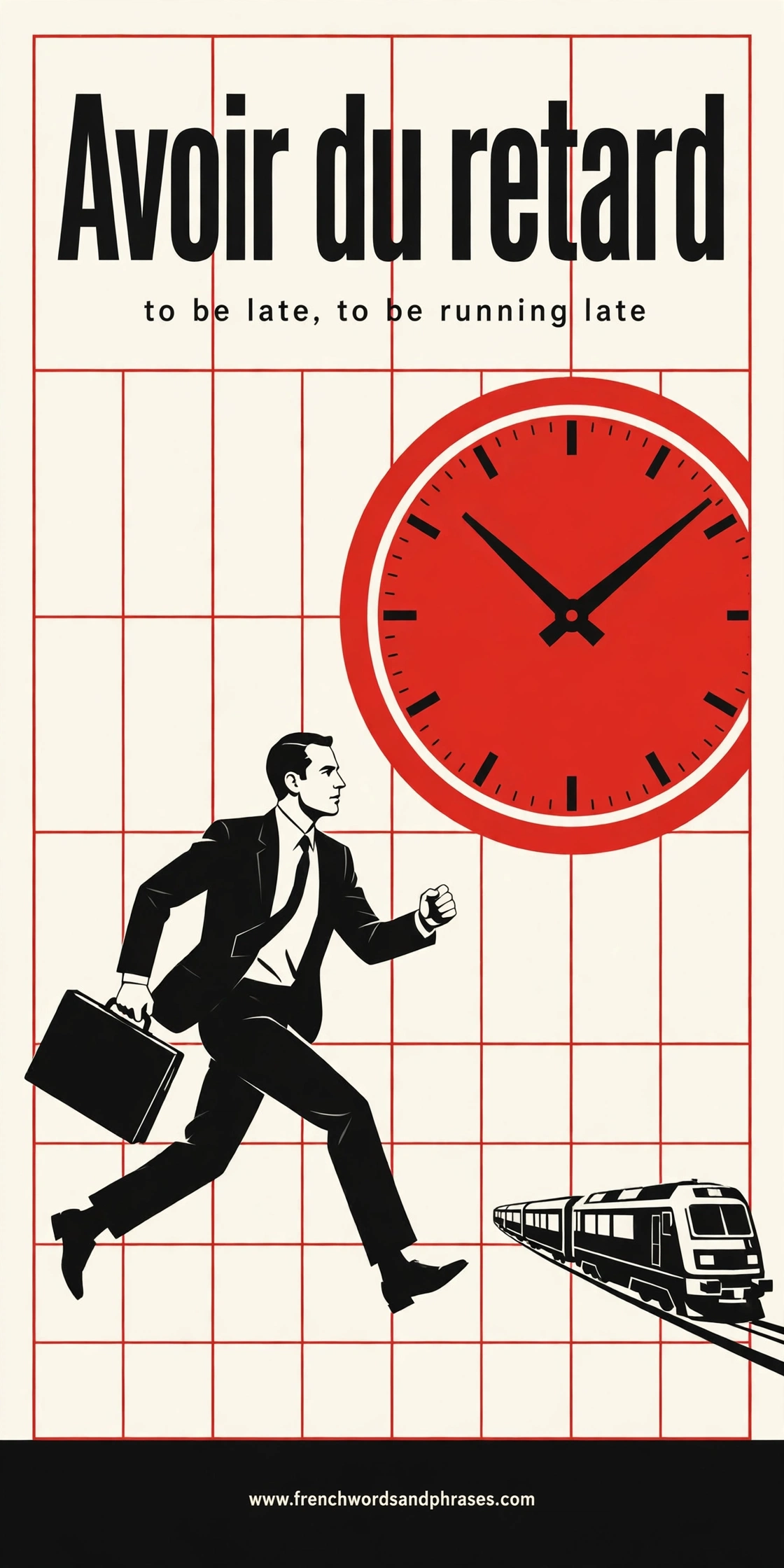
Avoir du retard means to be late — to be running behind the clock, by minutes or by hours.
The platform clock says 8:04, the train was due at 7:50, and the loudspeaker finally crackles into life with the sentence every commuter in France knows by heart: « Le train a du retard. »
Let’s explore how avoir du retard works in French, beginning with the whole phrase on one card.
Understanding the French Phrase Avoir du retard
Avoir du retard is a French expression built from avoir (to have), du (some — the partitive) and le retard (delay, lateness — a masculine noun). Here is the classic French trap in its purest form: English says you ARE late, French says you HAVE lateness — a quantity of delay, measured in minutes, like water in a bucket.
It means to be late, to be running late — behind the expected hour. Nobody is being judged as a person: the delay is a thing you carry, and it can be weighed — cinq minutes de retard, une heure de retard. Trains have it, people have it, projects have it; the phrase serves them all.
Type: Everyday expression — time (avoir + du + retard)
Answers the need: Saying someone or something is late, and by how much
Register: Neutral — from the station announcement to the texted apology
Strength: Measurable — the delay comes in minutes and hours
One important usage detail: the amount of delay is attached with de — avoir dix minutes de retard, to be ten minutes late. And the person version has a twin: être en retard means exactly the same thing. French happily uses both; what it never says is je suis retard — late is something you have, or somewhere you are, never something you are.
Experience the Word
Avoir du retard is the phrase of platforms, traffic jams and breathless arrivals — the small daily drama of the clock winning.
Imagine the text sent from the bus, the flowers bought at a run, the meeting that starts with an apology and a number. In France the number is a courtesy: it tells everyone exactly how much of their day your delay has borrowed.
English makes lateness a character flaw — you ARE late. French makes it luggage — you have some, and you can put it down.
How to Use Avoir du retard in French: Complete Guide
Let’s explore how avoir du retard works in French, beginning with the whole phrase on one card.
Avoir du retard at a Glance
The Whole Phrase on One Card
Real meaning, literal picture, English twin and register — avoir du retard in five lines.
| Point | Avoir du retard |
|---|---|
| What it really means | to be late, to be running late |
| Word for word | to have some delay — lateness measured like a quantity |
| English equivalent | to be late / to be running late |
| Register | neutral — safe everywhere |
| Use it for | people, trains, deliveries, projects — anything behind schedule |
Example
Le train a vingt minutes de retard.
The train is twenty minutes late.
Word by Word: Building the Delay
Three small pieces — take them one by one and the clock starts to slip.
| Word | Literal meaning | Its job in the phrase |
|---|---|---|
| avoir | to have | the verb that holds the delay — j’ai, tu as, il a |
| du | some, of the | the partitive: a quantity of lateness, never all of it |
| retard | delay, lateness | a masculine noun — le retard, the gap between expected and actual |
Example
J’ai du retard, commencez sans moi.
I am running late, start without me.
Quick Quiz 1
‘I am late’: je suis retard or j’ai du retard?
Reveal the answer
J’ai du retard — lateness is had in French, never been. Je suis retard is the English trap wearing French words.
Pardon, j’ai du retard, la circulation était terrible.
Sorry, I am late, the traffic was terrible.
When You Say It: The Running-Late Moments
Avoir du retard fires at moments like these — wherever the clock has got ahead of someone.
| Situation | Example |
|---|---|
| The texted apology | je vais avoir du retard — I am going to be late |
| Trains | le train a une heure de retard — the train is an hour late |
| Work | le projet a du retard — the project is behind schedule |
| Deliveries | la livraison a deux jours de retard — the delivery is two days late |
| School | il a souvent du retard le matin — he is often late in the morning |
Example
Elle a cinq minutes de retard, elle arrive.
She is five minutes late, she is on her way.
Make It Yours: The Delay for Every Person
Avoir conjugates — and the amount rides along in a de phrase.
| Form | French | In English |
|---|---|---|
| I am late | j’ai du retard | I am late |
| Ten minutes late | j’ai dix minutes de retard | I am ten minutes late |
| She is late | elle a du retard | she is late |
| The train is late | le train a du retard | the train is late |
| We are very late | nous avons beaucoup de retard | we are very late |
| The question | tu as du retard ? | are you running late? |
Example
Nous avons une heure de retard à cause de la neige.
We are an hour late because of the snow.
Quick Quiz 2
How do you attach the amount: dix minutes du retard or dix minutes de retard?
Reveal the answer
Dix minutes de retard — quantities are measured with de: minutes de retard, heures de retard, jours de retard.
L’avion a deux heures de retard.
The plane is two hours late.
Everyday Expressions: Building on the Delay
Avoir du retard slots into these everyday frames — each one ready to use as it stands.
| Frame | In English |
|---|---|
| avoir du retard | to be late, to be running late |
| avoir … minutes de retard | to be … minutes late |
| être en retard | to be late — the exact twin, with être |
| prendre du retard | to fall behind — the delay is growing |
| rattraper son retard | to catch up, to make up the lost time |
Example
Travaillons ce soir pour rattraper notre retard.
Let’s work this evening to catch up on our delay.
Close Cousins: The Other Ways to Miss the Hour
French has a whole shelf of lateness phrases — avoir du retard is the measured one; its cousins apologise, accumulate or arrive breathless.
| Expression | The difference |
|---|---|
| avoir du retard | to be late — the delay as a quantity you have |
| être en retard | to be late — the identical twin; en retard is where you are |
| être à la bourre | to be running late — informal, breathless, very everyday |
| arriver en retard | to arrive late — the moment of the late arrival itself |
| en retard sur | behind on something — en retard sur le loyer, behind on the rent |
Example
Il est à la bourre, comme tous les matins.
He is running late, like every morning.
Quick Quiz 3
Your friend texts: je suis à la bourre ! Is she early, on time, or late?
Reveal the answer
Late — être à la bourre is the informal, breathless way to say you are running behind.
Dépêche-toi, on est à la bourre !
Hurry up, we are running late!
Avoir du retard and Its Neighbours
The station shelf around the phrase — clocks, apologies and catching up.
| French | In English |
|---|---|
| une horloge | a clock |
| à l’heure | on time — the happy opposite |
| s’excuser | to apologise |
| un horaire | a timetable |
| la circulation | the traffic |
| se dépêcher | to hurry |
Example
À l’heure ou avec du retard, il finit toujours par arriver.
On time or late, he always ends up arriving.
Watch Out: The Traps Around Avoir du retard
The traps: the English verb in disguise, a quantity phrase that changes shape, and a word that is also a delay in the head.
| Trap | The truth |
|---|---|
| je suis retard | never — you have delay (j’ai du retard) or you are in delay (je suis en retard) |
| the quantity takes de | dix minutes de retard — the du of the base phrase becomes de after a measure |
| retard is not ‘backward’ | un retard can be a delay of minutes; for a person, en retard scolaire is school delay — handle with care and context |
| trains love it too | the phrase is the official language of announcements: le train a du retard, no person needed |
Example
Il n’est jamais en retard, sauf quand son train a du retard.
He is never late, except when his train is late.
Quick Quiz 4
True or false: être en retard and avoir du retard mean the same thing.
Reveal the answer
True — both say you are late. Avoir counts the delay; être en retard places you inside it.
Elle est en retard, elle a dix minutes de retard.
She is late, she is ten minutes late.
Avoir du retard in Everyday French: Real-Life Examples
Now that you know the word, let’s see how avoir du retard appears in everyday French.
Example 1 — The apology text
Désolé, je vais avoir du retard, le bus n’est pas passé.
Sorry, I am going to be late, the bus did not come.
Example 2 — At the station
Le train de Lyon a quarante minutes de retard.
The Lyon train is forty minutes late.
Example 3 — The project
Notre projet a du retard, il faut travailler samedi.
Our project is behind schedule, we have to work on Saturday.
Example 4 — Catching up
Elle lit vite pour rattraper son retard.
She reads fast to catch up on her backlog.
Example 5 — The morning routine
Les enfants ont toujours du retard le lundi.
The children are always running late on Mondays.
Example 6 — Almost on time
Il a seulement deux minutes de retard, c’est rien.
He is only two minutes late, it is nothing.
Beyond Translation: The Meaning of Avoir du retard
English is late the way it is tall or tired — a state of the person, almost a verdict. French weighs the delay instead: minutes of it, hours of it, carried in like shopping.
To avoir du retard is to hold a measurable gap between the plan and the day — and a gap, unlike a character, can be closed.
That is why the language of rattraper, catching up, grows so naturally beside it: what is measured can be recovered.
How to Remember the French Phrase Avoir du retard
Remember it this way: Avoir du retard is lateness by the bucket — a quantity of delay you carry, count in minutes, and can set down again.
- You refuse the English verb — never je suis retard; you have delay or you are en retard.
- You weigh it with de — dix minutes de retard, deux heures de retard.
- You know the rescue verb — rattraper son retard, to catch up and close the gap.
The key idea is avoir du retard means to be late — j’ai dix minutes de retard, I am ten minutes late.
Test Your Knowledge of Avoir du retard
Let’s see how much you’ve learned. Try answering these questions before revealing the answers.
Question 1
What does le train a du retard mean?
Reveal the answer
The train is late — running behind its timetable.
Question 2
How do you say ‘I am twenty minutes late’?
Reveal the answer
J’ai vingt minutes de retard — avoir, the measure, then de retard.
Question 3
Why is je suis retard wrong?
Reveal the answer
Because French never says you ARE late — you have delay (avoir du retard) or you are in it (être en retard).
Question 4
What does rattraper son retard mean?
Reveal the answer
To catch up — to close the gap and make up the lost time.
Question 5
Complete the sentence:
L’avion ______ deux heures de retard. (The plane is two hours late.)
Reveal the answer
a
L’avion a deux heures de retard.
The plane is two hours late.
Your Final Challenge
Can You Use It?
How would you say this in French?
“Sorry, I am ten minutes late.”
Reveal the answer
Pardon, j’ai dix minutes de retard.
Sorry, I am ten minutes late.
A little French. A little curiosity. A richer everyday life.
LEARN FRENCH ONE WORD AT A TIME