A French Word to Live By
Translate À tout à l’heure to English
/a tu a lœʁ/
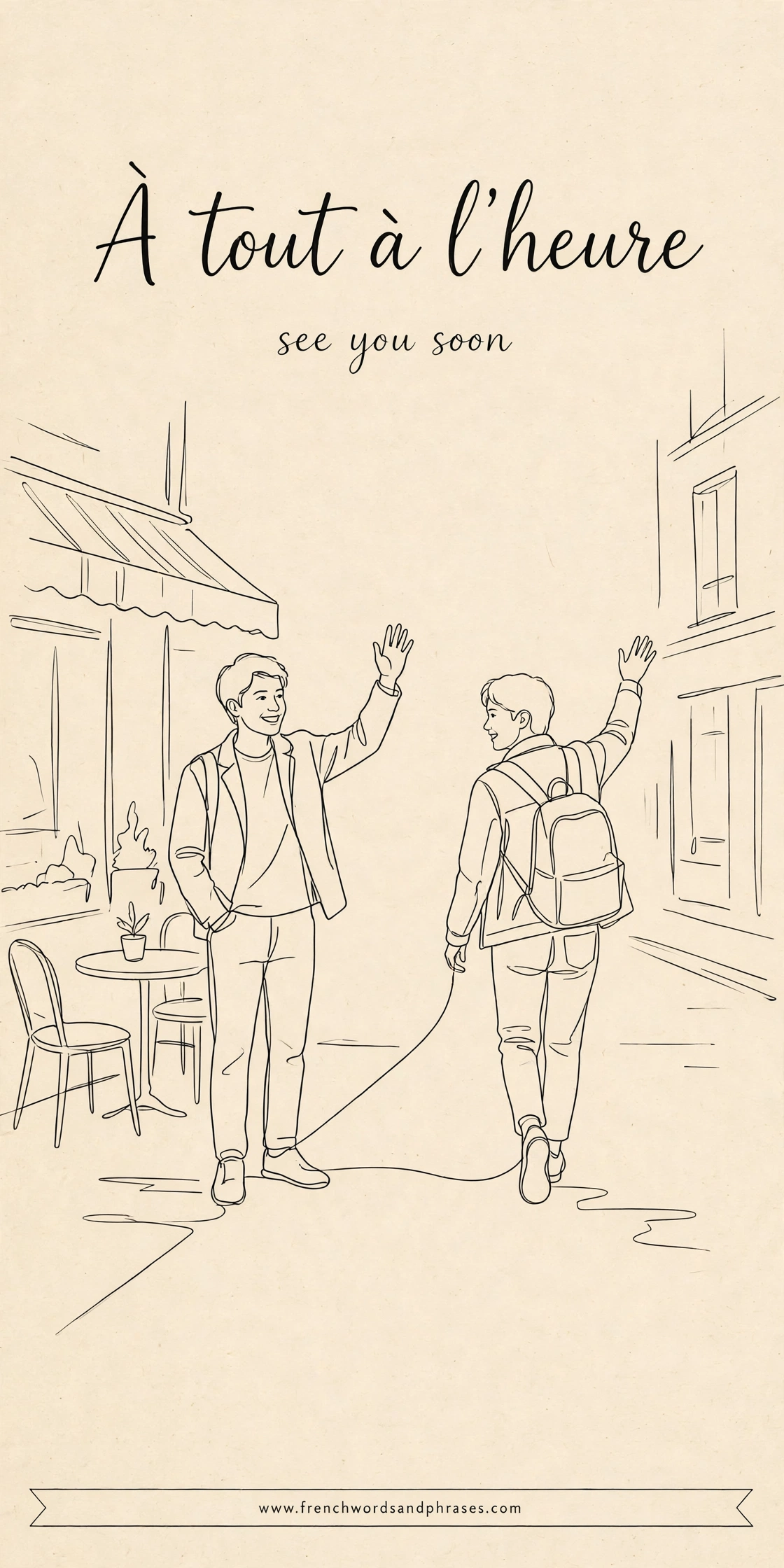
À tout à l’heure means see you later — a parting phrase for meeting again the same day.
The market is packing up at noon and Madame Roux has promised to come back for the cheese she ordered. She waves at the cheesemonger over the crates: « À tout à l’heure ! » See you later — not tomorrow, not someday: later today, when the stall has her parcel ready. The cheesemonger waves back. It is a promise with a time on it.
Let’s explore how à tout à l’heure works in French, beginning with the whole phrase on one card.
Understanding the French Phrase À tout à l’heure
À tout à l’heure is a French parting phrase built from à (until, at), tout (right, straight) and à l’heure (at the hour). Its promise is precise: the parting is short, and the reunion is booked for later the same day.
It means see you later — with the emphasis on later today. Friends leaving the office for lunch say à tout à l’heure; a shopkeeper whose customer will return before closing says it too. The tout is the squeeze that shortens the wait: not à un de ces jours, one of these days, but straight back, this very day.
Type: Parting phrase — leave-taking (à + tout + à l’heure)
Answers the need: Saying goodbye when you will meet again later the same day
Register: Neutral and warm — everyday speech everywhere in France
Strength: Promising — it always carries a reunion before the day ends
One important usage detail: à tout à l’heure promises a same-day return. If you will not see the person again today, choose à demain (tomorrow), à bientôt (soon, no date) or à plus tard (later, vague). In quick speech the phrase squeezes into à toute — heard all over France, and worth knowing, though à tout à l’heure is the form to learn first.
Experience the Word
À tout à l’heure is the goodbye that is barely a goodbye — the door closes on a comma, not a full stop.
Imagine the school gate at midday in a small town: a hundred parents, a hundred children, and the same phrase bouncing between them like a ball — à tout à l’heure, à quatre heures et demie ! The whole town runs on these small promised reunions, and the phrase is the ticket that guarantees them.
French goodbyes are a calendar in miniature. À tout à l’heure is the shortest page of that calendar: today, later, same place in the heart.
How to Use À tout à l’heure in French: Complete Guide
Let’s explore how à tout à l’heure works in French, beginning with the whole phrase on one card.
À tout à l’heure at a Glance
The Whole Phrase on One Card
Real meaning, literal picture, English twin and register — à tout à l’heure in five lines.
| Point | À tout à l’heure |
|---|---|
| What it really means | see you later — goodbye until later today |
| Word for word | until right at the hour — straight back at the appointed time today |
| English equivalent | see you later (today) |
| Register | neutral and warm — the everyday parting among people who will meet again today |
| Use it for | lunch breaks, errands, school gates — any same-day parting |
Example
Je pars déjeuner, à tout à l’heure !
I’m off to lunch — see you later!
Word by Word: Building the Short Goodbye
Four small pieces — take them one by one and the reunion is booked.
| Word | Literal meaning | Its job in the phrase |
|---|---|---|
| à | until, at | the until-word of French goodbyes — it points at the reunion |
| tout | right, straight | the squeeze: it shortens the wait to this very day |
| à l’heure | at the hour | the appointed time — later today, when the hour comes round |
Example
À tout à l’heure, à quatre heures au café !
See you later — at four, at the café!
Quick Quiz 1
When does à tout à l’heure promise the reunion — today, tomorrow, or someday?
Reveal the answer
Today — later the same day. That precision is the phrase’s whole promise.
À tout à l’heure : on se revoit avant ce soir.
See you later: we meet again before this evening.
When You Say It: The Same-Day Partings
À tout à l’heure fires at moments like these — wherever the parting lasts hours, not days.
| Situation | Example |
|---|---|
| Lunch break | je vais manger, à tout à l’heure — I’m off to eat, see you later |
| Errands | je reviens dans une heure, à tout à l’heure — back in an hour, see you later |
| School gate | à tout à l’heure, à la sortie — see you later, at the school exit |
| Shops | je repasse à cinq heures, à tout à l’heure — I’ll come back at five, see you later |
| On the phone | on se rappelle à tout à l’heure — we’ll call again later today |
Example
Je file au marché, à tout à l’heure !
I’m dashing to the market — see you later!
Make It Yours: Goodbyes of Every Length
French goodbyes form a ladder of time — à tout à l’heure is the shortest rung.
| Form | French | In English |
|---|---|---|
| Later today | à tout à l’heure | see you later (today) |
| Squeezed, in speech | à toute | see you later — the quick spoken form |
| In a moment | à tout de suite | see you in a moment, right away |
| Soon, no date | à bientôt | see you soon |
| Tomorrow | à demain | see you tomorrow |
| Later, vague | à plus tard | see you later (unspecified) |
Example
À tout de suite pour le café, à tout à l’heure pour le reste.
In a moment for the coffee, later today for the rest.
Quick Quiz 2
Which goodbye promises the quickest return — à tout à l’heure or à tout de suite?
Reveal the answer
À tout de suite — in a moment, almost no parting at all. À tout à l’heure allows a few hours to pass.
À tout de suite : je reviens dans cinq minutes.
See you in a moment: I’ll be back in five minutes.
Everyday Expressions: Building on the Parting
À tout à l’heure slots into these everyday frames — each one ready to use as it stands.
| Frame | In English |
|---|---|
| à tout à l’heure | see you later (today) |
| à toute | see you later — quick spoken form |
| à tout de suite | see you in a moment |
| à bientôt | see you soon |
| à demain | see you tomorrow |
Example
À bientôt pour les nouvelles, à tout à l’heure pour le café.
See you soon for the news, later today for the coffee.
Close Cousins: The Other Goodbyes
French parts company along a whole ladder of time — à tout à l’heure is its same-day rung.
| Expression | The difference |
|---|---|
| à tout à l’heure | see you later today — the reunion is booked before the day ends |
| à tout de suite | see you in a moment — barely a parting |
| à bientôt | see you soon — warm, but no date attached |
| à plus tard | see you later — the vaguest of the family, anytime |
| au revoir | goodbye — the neutral classic, no reunion promised |
Example
Au revoir, madame ; à tout à l’heure, les enfants !
Goodbye, madame; see you later, children!
Quick Quiz 3
You are leaving a colleague you will not see again until next week. Best choice — à tout à l’heure or à bientôt?
Reveal the answer
À bientôt — see you soon, no date promised. À tout à l’heure would book a reunion today that is not happening.
Bon week-end, à bientôt !
Have a good weekend — see you soon!
À tout à l’heure and Its Neighbours
The parting shelf around the phrase — the ladder of French goodbyes.
| French | In English |
|---|---|
| à tout de suite | see you in a moment |
| à bientôt | see you soon |
| à demain | see you tomorrow |
| à plus tard | see you later (vague) |
| au revoir | goodbye |
| bonne journée | have a good day |
Example
Bonne journée, et à tout à l’heure à la sortie !
Have a good day, and see you later at the exit!
Watch Out: The Traps Around À tout à l’heure
The traps: a same-day promise that must be kept, and a squeezed form that confuses learners.
| Trap | The truth |
|---|---|
| the promise is dated | saying à tout à l’heure and vanishing for a week breaks the phrase’s contract — it means today |
| à toute is not feminine agreement | the spoken squeeze à toute is a clipping of the whole phrase, not an adjective agreeing with anything |
| tout à l’heure looks backwards too | in narration, tout à l’heure can mean a moment ago — je l’ai vu tout à l’heure, I saw him just now; context and company decide |
| not for final farewells | for the long goodbye, French says adieu — à tout à l’heure would sound almost comic at an airport farewell |
Example
Je l’ai croisé tout à l’heure, et je le revois à tout à l’heure.
I bumped into him just now, and I’m seeing him again later today.
Quick Quiz 4
True or false: à tout à l’heure can be used when you will not see the person for a month.
Reveal the answer
False — it promises a reunion later the same day. For a month, say à bientôt or au revoir.
Un mois d’absence ? À bientôt, pas à tout à l’heure.
A month away? See you soon, not see you later today.
À tout à l’heure in Everyday French: Real-Life Examples
Now that you know the word, let’s see how à tout à l’heure appears in everyday French.
Example 1 — Lunch break
Je vais déjeuner, à tout à l’heure tout le monde !
I’m off to lunch — see you later, everyone!
Example 2 — The market
Je repasse pour le fromage, à tout à l’heure !
I’ll come back for the cheese — see you later!
Example 3 — School gate
À tout à l’heure, à quatre heures et demie !
See you later, at half past four!
Example 4 — Errands
Je reviens dans une heure, à tout à l’heure.
I’ll be back in an hour — see you later.
Example 5 — On the phone
On se rappelle ce soir, à tout à l’heure.
We’ll call this evening — see you later.
Example 6 — At the office
La réunion est à trois heures, à tout à l’heure.
The meeting is at three — see you later.
Beyond Translation: The Meaning of À tout à l’heure
English see you later is a friendly fog — later could be tonight or next year. French à tout à l’heure is a diary entry: the reunion is today, the hour will come round, and the tout squeezes the promise tight. A language that keeps its goodbyes this precise is a language that takes reunions seriously.
À tout à l’heure turns a parting into an appointment — the day is not finished with either of you yet.
And its spoken squeeze, à toute, shows the phrase at work in real mouths: used a hundred times a day, worn smooth like a step, and still keeping its promise.
How to Remember the French Phrase À tout à l’heure
Remember it this way: À tout à l’heure is the goodbye with a same-day return ticket — the door closes on a comma, never a full stop.
- You keep the promise dated — à tout à l’heure means later today; other days take à demain or à bientôt.
- You climb the ladder in order — à tout de suite (a moment), à tout à l’heure (today), à bientôt (soon), à plus tard (someday).
- You recognise the squeeze — à toute in quick speech is this same phrase, clipped for speed.
The key idea is à tout à l’heure means see you later — a parting that promises a reunion later the same day.
Test Your Knowledge of À tout à l’heure
Let’s see how much you’ve learned. Try answering these questions before revealing the answers.
Question 1
What does à tout à l’heure mean?
Reveal the answer
See you later — with the reunion promised for later the same day.
Question 2
What is the literal, word-for-word meaning?
Reveal the answer
Until right at the hour — tout squeezes the wait, and l’heure is the appointed time today.
Question 3
How do you say ‘See you tomorrow’?
Reveal the answer
À demain — demain is tomorrow; à tout à l’heure never leaves today.
Question 4
What is the difference between à tout à l’heure and à tout de suite?
Reveal the answer
The length of the parting — à tout de suite is in a moment, almost no goodbye at all; à tout à l’heure allows hours to pass, but never the night.
Question 5
Complete the sentence:
Je vais déjeuner, à ______ à l’heure ! (I’m off to lunch — see you later!)
Reveal the answer
tout
À tout à l’heure !
See you later!
Your Final Challenge
Can You Use It?
How would you say this in French?
“I’m off to the market, back in an hour — see you later!”
Reveal the answer
Je vais au marché, de retour dans une heure — à tout à l’heure !
I’m off to the market, back in an hour — see you later!
A little French. A little curiosity. A richer everyday life.
LEARN FRENCH ONE WORD AT A TIME