A French Word to Live By
Translate À tartiner to English
/a taʁ.ti.ne/
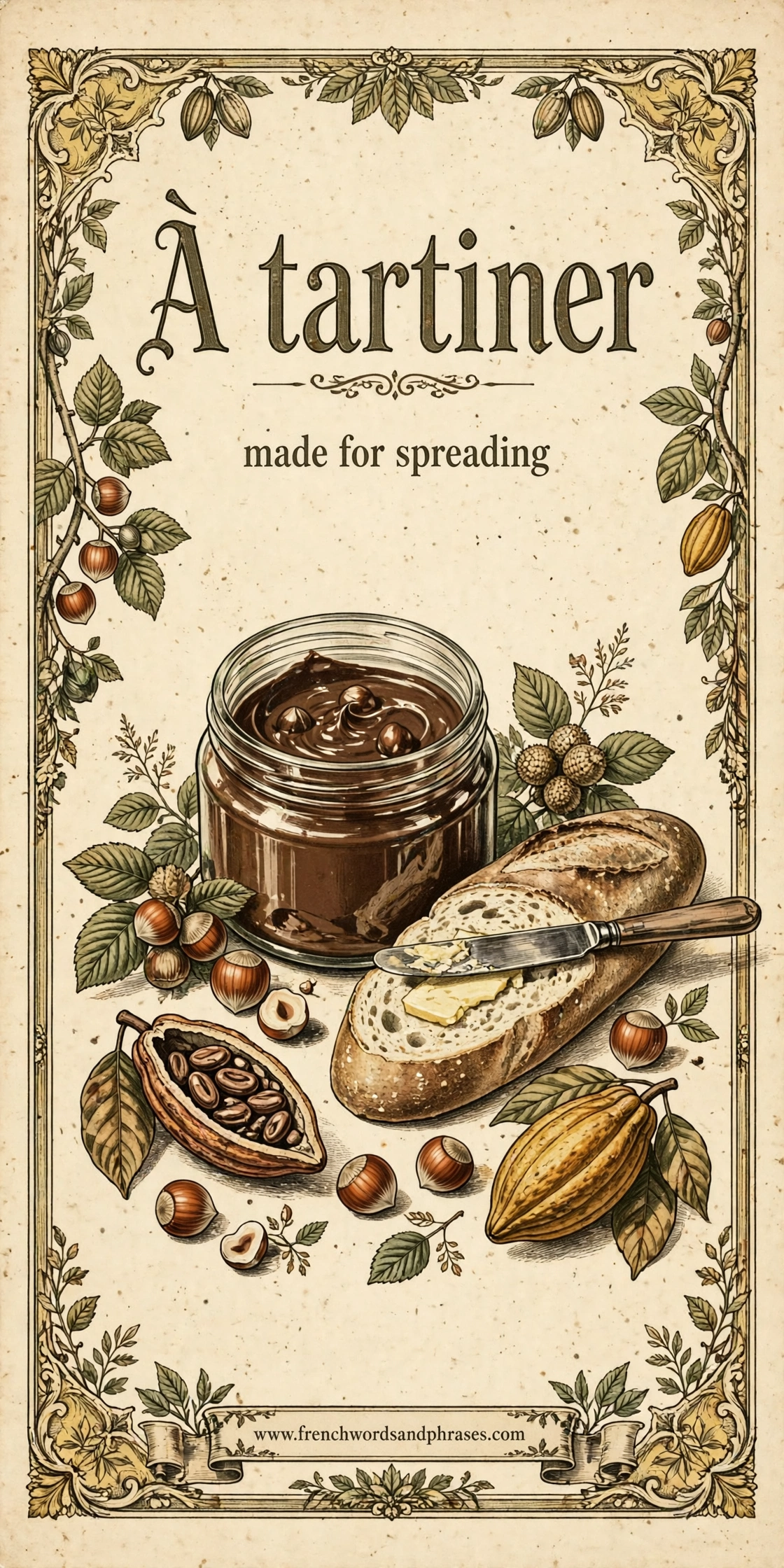
À tartiner means spreadable — made to be spread on bread, of cheese, pâté and chocolate spreads.
Breakfast in a French kitchen: toast, a knife, and the two jars that start the day — one of jam, one of chocolate spread. On the supermarket shelf the labels use the same two words for a whole family of jars and tubs: « pâte à tartiner », « fromage à tartiner ». Whatever spreads, French files it under one label.
Let’s explore how à tartiner works in French, beginning with the whole phrase on one card.
Understanding the French Phrase À tartiner
À tartiner is a French phrase built from à and tartiner (to spread — on bread). It works as an adjective for foods made to be spread: le fromage à tartiner (spreadable cheese), la pâte à tartiner (chocolate or nut spread). The pattern à + infinitive marks what a thing is for.
It means spreadable, for spreading. A tartine is a slice of bread with something on it, and tartiner is the act of spreading it — so à tartiner labels everything designed for that act: soft cheeses in tubs, chocolate-hazelnut spread, fish pâtés, vegetable spreads. On a French supermarket shelf it is a whole category, from breakfast jars to apéritif tubs.
Type: Phrase used as an adjective — food (à + infinitive of purpose)
Answers the need: Saying a food is spreadable, made to be spread on bread
Register: Neutral — labels, shopping, everyday kitchen talk
Strength: Practical — it names a use, not a flavour; the knife does the rest
One important usage detail: à tartiner never changes and follows its noun — du fromage à tartiner, des pâtes à tartiner. It belongs to the great French family of purpose phrases with à + infinitive: une machine à laver (washing machine), un fer à repasser (iron), une salle à manger (dining room).
Experience the Word
À tartiner is the breakfast table in two words — bread waiting, knife ready, jar open.
Imagine the French petit déjeuner at its most serious: the tartine held like a document, the spread applied with a craftsman’s care, edge to edge, no corner left bare. A whole national ritual hides inside this small label — the morning’s first skilled act, performed half-asleep and never botched.
The phrase also quietly maps the supermarket. Where English invents product names, French sorts by purpose: if it spreads, it is à tartiner.
How to Use À tartiner in French: Complete Guide
Let’s explore how à tartiner works in French, beginning with the whole phrase on one card.
À tartiner at a Glance
The Whole Phrase on One Card
Real meaning, literal picture, English twin and register — à tartiner in five lines.
| Point | À tartiner |
|---|---|
| What it really means | spreadable — made to be spread on bread |
| Word for word | for spreading — tartiner is to spread (on a tartine) |
| English equivalent | spreadable / a spread (for the noun phrases) |
| Register | neutral — labels, shopping, kitchen talk |
| Use it for | spreadable cheese, chocolate spread, pâtés and savoury spreads |
Example
Elle achète du fromage à tartiner pour les enfants.
She buys spreadable cheese for the children.
Word by Word: Building the Spread
Two small pieces — take them one by one and the knife starts moving.
| Word | Literal meaning | Its job in the phrase |
|---|---|---|
| à | for | the preposition of purpose — it says what the food is for |
| tartiner | to spread | to spread something on a tartine, a slice of bread — the breakfast verb |
Example
La pâte à tartiner est sur l’étagère du haut.
The chocolate spread is on the top shelf.
Quick Quiz 1
What is a tartine, the word inside tartiner?
Reveal the answer
A slice of bread with something spread on it — the open sandwich of French breakfasts. Tartiner is the spreading; à tartiner labels what is made for it.
Une tartine de confiture, et le matin commence.
A slice of bread with jam, and the morning begins.
When You Say It: The Spreading Moments
À tartiner fires at moments like these — breakfast tables, shopping lists and apéritif trays.
| Situation | Example |
|---|---|
| At breakfast | passe-moi la pâte à tartiner, s’il te plaît — pass me the chocolate spread, please |
| At the supermarket | le fromage à tartiner est au rayon frais — the spreadable cheese is in the chiller aisle |
| On a shopping list | n’oublie pas les rillettes à tartiner — don’t forget the spreadable rillettes |
| At the apéritif | des toasts et un fromage à tartiner aux herbes — toasts and a herb spreadable cheese |
| For children | une pâte à tartiner sans huile de palme — a palm-oil-free chocolate spread |
Example
Pour l’apéritif, elle sert un fromage à tartiner aux noix.
For the apéritif, she serves a walnut spreadable cheese.
Make It Yours: The Phrase in Its Frames
The label never changes — the jar it sticks to does.
| Form | French | In English |
|---|---|---|
| Cheese | du fromage à tartiner | spreadable cheese |
| Chocolate spread | de la pâte à tartiner | chocolate (hazelnut) spread |
| The verb | tartiner | to spread (on bread) |
| The result | une tartine | a slice of bread with a spread on it |
| Purpose cousins | une machine à laver | a washing machine — à + infinitive of purpose |
| Another cousin | un fer à repasser | an iron (for ironing) |
Example
Il tartine sa pâte à tartiner jusqu’aux bords de la tartine.
He spreads his chocolate spread right to the edges of the slice.
Quick Quiz 2
Which pattern do fromage à tartiner and machine à laver share?
Reveal the answer
À + infinitive of purpose — the à-phrase says what the thing is for: cheese for spreading, a machine for washing.
La salle à manger est à côté de la cuisine.
The dining room is next to the kitchen.
Everyday Expressions: Building on the Spread
À tartiner slots into these everyday frames — each one ready to use as it stands.
| Frame | In English |
|---|---|
| du fromage à tartiner | spreadable cheese |
| de la pâte à tartiner | chocolate or nut spread |
| tartiner une tartine | to spread a slice of bread |
| une tartine de confiture | a slice of bread with jam |
| à tartiner sur du pain grillé | to spread on toast |
Example
Elle tartine sa confiture sur du pain grillé encore chaud.
She spreads her jam on still-warm toast.
Close Cousins: The Other À-Purpose Phrases
French has a whole shelf of à + infinitive phrases — this one feeds breakfast; its cousins run the house.
| Expression | The difference |
|---|---|
| à tartiner | for spreading — foods made to go on bread |
| à laver | for washing — une machine à laver, the household giant of the family |
| à repasser | for ironing — un fer à repasser |
| à manger | for eating — une salle à manger, a dining room; also ‘to eat’ in lists |
| à boire | to drink — quelque chose à boire, something to drink |
Example
Quelque chose à boire, et du fromage à tartiner : l’apéritif est prêt.
Something to drink, and spreadable cheese: the apéritif is ready.
Quick Quiz 3
You want the chocolate-hazelnut spread by name. Pâte à tartiner or fromage à tartiner?
Reveal the answer
Pâte à tartiner — the chocolate and nut spreads. Fromage à tartiner is the soft cheese in a tub.
Les enfants réclament la pâte à tartiner au petit déjeuner.
The children demand the chocolate spread at breakfast.
À tartiner and Its Neighbours
The breakfast shelf around the phrase — bread, butter, jam and the knife.
| French | In English |
|---|---|
| une tartine | a slice of bread with a spread |
| tartiner | to spread (on bread) |
| le beurre | butter |
| la confiture | jam |
| la pâte à tartiner | chocolate or nut spread |
| un couteau | a knife — the tool of the whole operation |
Example
Beurre, confiture ou pâte à tartiner : chacun sa tartine.
Butter, jam or chocolate spread: to each their slice.
Watch Out: The Traps Around À tartiner
The traps: agreement that never happens, butter that takes another road, and a verb that is not ‘to toast’.
| Trap | The truth |
|---|---|
| à tartiner never agrees | des pâtes à tartiner, du fromage à tartiner — the à + infinitive label is fixed |
| butter is not à tartiner | butter spreads, but French simply says du beurre — the à tartiner label belongs to prepared spreads and tub cheeses |
| tartiner is not to toast | to toast bread is faire griller du pain; tartiner is the spreading that comes after |
| pâte is not pasta here | la pâte à tartiner is a spread (a paste); pasta is les pâtes — context and the à tartiner keep them apart |
Example
Du pain grillé, du beurre, et la pâte à tartiner des enfants.
Toast, butter, and the children’s chocolate spread.
Quick Quiz 4
True or false: tartiner means to toast bread.
Reveal the answer
False — tartiner is to spread. Toasting is faire griller; the tartine receives the spread after the bread is ready.
D’abord on grille le pain, ensuite on tartine.
First you toast the bread, then you spread.
À tartiner in Everyday French: Real-Life Examples
Now that you know the word, let’s see how à tartiner appears in everyday French.
Example 1 — At breakfast
Passe-moi la pâte à tartiner, s’il te plaît.
Pass me the chocolate spread, please.
Example 2 — At the supermarket
Le fromage à tartiner est au rayon frais, à côté des yaourts.
The spreadable cheese is in the chiller aisle, next to the yoghurts.
Example 3 — The shopping list
N’oublie pas le fromage à tartiner aux herbes.
Don’t forget the herb spreadable cheese.
Example 4 — The apéritif
Elle prépare des toasts au fromage à tartiner.
She is making toasts with spreadable cheese.
Example 5 — The children’s jar
La pâte à tartiner est presque finie, il en reste pour une tartine.
The chocolate spread is nearly finished; there’s enough left for one slice.
Example 6 — Spreading properly
Il tartine toujours jusqu’aux bords, sans exception.
He always spreads right to the edges, without exception.
Beyond Translation: The Meaning of À tartiner
English names its spreads by brand and ingredient — cream cheese, peanut butter, a famous hazelnut jar. French keeps the act in the name: à tartiner, for spreading, a label that describes the breakfast ritual itself rather than any one product.
À tartiner belongs to French’s great purpose family — à laver, à repasser, à manger — where things are named by what they are for.
Learn the pattern on the breakfast jar, and a hundred household labels across France start reading themselves.
How to Remember the French Phrase À tartiner
Remember it this way: À tartiner is the breakfast label — if it is made to be spread on bread, French files it under these two words.
- You picture the tartine — a slice of bread, a knife, and a spread applied edge to edge.
- You hear the purpose pattern — à + infinitive says what a thing is for: à laver, à repasser, à tartiner.
- You keep it frozen — du fromage à tartiner, des pâtes à tartiner, the label never agrees.
The key idea is à tartiner means spreadable — made to be spread on bread.
Test Your Knowledge of À tartiner
Let’s see how much you’ve learned. Try answering these questions before revealing the answers.
Question 1
What does à tartiner mean?
Reveal the answer
Spreadable — made to be spread on bread: fromage à tartiner, pâte à tartiner.
Question 2
What is a tartine?
Reveal the answer
A slice of bread with something spread on it — the open sandwich of French breakfasts.
Question 3
Which pattern does à tartiner belong to?
Reveal the answer
À + infinitive of purpose — like machine à laver and fer à repasser: the phrase says what the thing is for.
Question 4
Does à tartiner agree with plural nouns?
Reveal the answer
No — it is invariable: des pâtes à tartiner.
Question 5
Complete the sentence:
Elle achète du fromage à ______. (She buys spreadable cheese.)
Reveal the answer
tartiner
Elle achète du fromage à tartiner.
She buys spreadable cheese.
Your Final Challenge
Can You Use It?
How would you say this in French?
“She buys spreadable cheese for the children’s breakfast.”
Reveal the answer
Elle achète du fromage à tartiner pour le petit déjeuner des enfants.
She buys spreadable cheese for the children’s breakfast.
A little French. A little curiosity. A richer everyday life.
LEARN FRENCH ONE WORD AT A TIME