A French Word to Live By
Translate Lave-vaisselle to English
/lav.vɛ.sɛl/
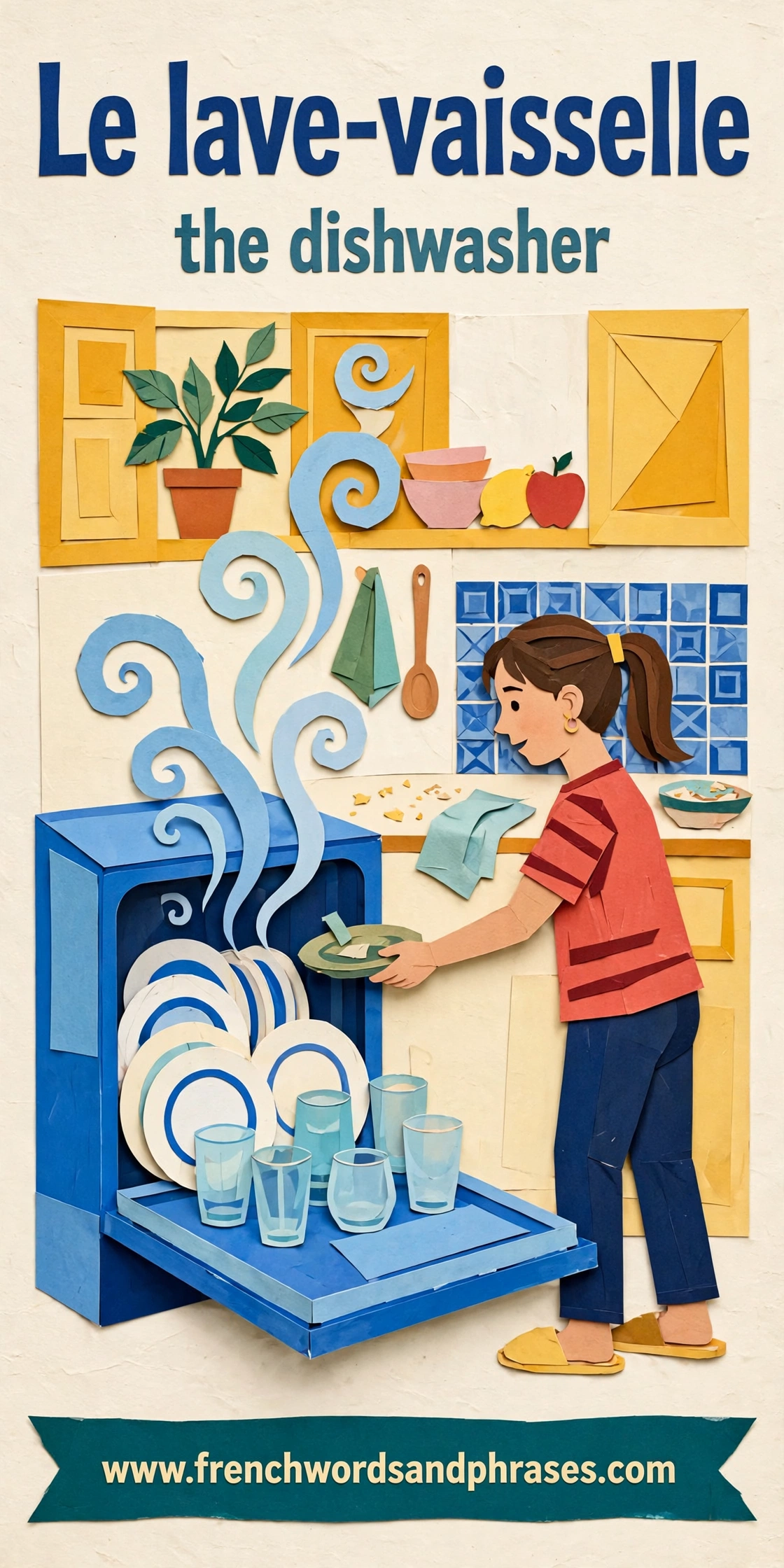
Le lave-vaisselle means the dishwasher.
The dinner guests have gone, the table is a landscape of plates and glasses — and one machine swallows the whole mess, sighs with steam, and starts to hum: le lave-vaisselle.
In this guide, you’ll learn what lave-vaisselle means in English, how to use it with its articles, how to form its plural, and how it appears in everyday French. Explore French examples, English translations, and practice quizzes.
Understanding the French Noun Lave-vaisselle
Lave-vaisselle is a masculine French compound noun, learned with its article: le lave-vaisselle, un lave-vaisselle. It is built from laver (to wash) and la vaisselle (the dishes) — the machine that washes the dishes. It never changes in the plural: des lave-vaisselle. It is the kitchen twin of le lave-linge, the washing machine.
It means the dishwasher — the appliance that washes plates, glasses and cutlery with hot water and une pastille (a tablet). In French kitchens it hides under the worktop, and the great household debate follows it everywhere: who loads it, who empties it, and whether the bowls really belong on the top rack.
Gender: Masculine
Formation: laver (to wash) + vaisselle (the dishes) — it washes the dishes
Definite article: le — le lave-vaisselle (the dishwasher)
Indefinite article: un — un lave-vaisselle (a dishwasher)
Plural: les lave-vaisselle — invariable, no -s is added
English equivalents: The dishwasher (the machine).
One important usage detail: lave-vaisselle is invariable — deux lave-vaisselle, never « lave-vaisselles ». English speakers, beware a friendly trap: in French the machine is le lave-vaisselle, but the person who washes dishes by hand in a restaurant is le plongeur — and the washing-up itself is la vaisselle: faire la vaisselle, to do the dishes.
Experience the Word
Lave-vaisselle is more than an appliance. It is the machine that ended the oldest argument in domestic life — whose turn it is to stand at the sink after a dinner for eight.
Imagine the end of the evening: plates stacked, glasses nested, one tablet, one button, and the kitchen falls silent while the steam does the work behind the door.
You have not just washed up. You have delegated — lavé sans les mains, the lave-vaisselle’s way.
How to Use Lave-vaisselle in French: Complete Guide
Let’s explore how lave-vaisselle works in French, beginning with its articles — and remember, this compound never changes in the plural.
Lave-vaisselle with the Definite Article (Le, Les)
Used for the dishwasher you both know — the one under the kitchen worktop.
| Form | French |
|---|---|
| Masculine singular | le lave-vaisselle |
| Plural | les lave-vaisselle |
Example
Le lave-vaisselle tourne pendant la nuit, c’est moins cher.
The dishwasher runs during the night; it’s cheaper.
Lave-vaisselle with the Indefinite Article (Un, Des)
Used for a dishwasher in general — and note des lave-vaisselle, with no extra -s.
| Form | French |
|---|---|
| Masculine singular | un lave-vaisselle |
| Plural | des lave-vaisselle |
Example
Un lave-vaisselle moderne consomme très peu d’eau.
A modern dishwasher uses very little water.
In the Kitchen with the Lave-vaisselle: Words of the Dishes
Racks, tablets and sparkling glasses — the vocabulary that surrounds the lave-vaisselle.
| French | In English |
|---|---|
| la vaisselle | the dishes, the washing-up |
| l’assiette | the plate |
| le verre | the glass |
| les couverts | the cutlery |
| la pastille | the tablet (detergent) |
| vider | to empty, to unload |
Example
Mets les assiettes dans le lave-vaisselle après le dîner.
Put the plates in the dishwasher after dinner.
Quick Quiz 1
Complete the sentence:
______ lave-vaisselle est plein, mets-le en route. (The)
Reveal the answer
Le
Le lave-vaisselle est plein, mets-le en route.
The dishwasher is full — switch it on. Lave-vaisselle is masculine, so le.
The Plural of Lave-vaisselle
Lave-vaisselle is invariable — the plural looks exactly like the singular.
| Number | French |
|---|---|
| Singular | le lave-vaisselle |
| Plural | les lave-vaisselle |
Example
Les lave-vaisselle d’aujourd’hui sont presque silencieux.
Today’s dishwashers are almost silent.
Lave-vaisselle with Possessive Adjectives (Mon, Ton, Son…)
Possessives agree with the noun — lave-vaisselle is masculine, so it takes mon, ton, son.
| Owner | French |
|---|---|
| my | mon lave-vaisselle |
| your (tu) | ton lave-vaisselle |
| his / her | son lave-vaisselle |
| our | notre lave-vaisselle |
| your (vous) | votre lave-vaisselle |
| their | leur lave-vaisselle |
Example
Notre lave-vaisselle a rendu l’âme après quinze ans de service.
Our dishwasher gave up the ghost after fifteen years of service.
Quick Quiz 2
True or false: the plural of lave-vaisselle is « lave-vaisselles ».
Reveal the answer
False — lave-vaisselle is invariable: deux lave-vaisselle, with no -s anywhere.
Lave-vaisselle with Demonstrative Adjectives (Ce, Ces)
Used to point at the machine in the kitchen showroom.
| Form | French |
|---|---|
| Masculine singular | ce lave-vaisselle |
| Plural | ces lave-vaisselle |
Example
Ce lave-vaisselle peut laver quatorze couverts d’un coup.
This dishwasher can wash fourteen place settings at once.
Lave-vaisselle with Adjectives
Adjectives agree with lave-vaisselle, masculine — silencieux, encastrable and plein at work.
| Adjective | With Lave-vaisselle |
|---|---|
| silencieux (quiet) | un lave-vaisselle silencieux |
| encastrable (built-in) | un lave-vaisselle encastrable |
| plein (full) | le lave-vaisselle plein |
| neuf (new) | un lave-vaisselle neuf |
| économe (economical) | un lave-vaisselle économe |
Example
Un lave-vaisselle encastrable et silencieux disparaît dans la cuisine.
A built-in, silent dishwasher disappears into the kitchen.
Quick Quiz 3
Complete the sentence:
Qui vide ______ lave-vaisselle ce matin ? (the)
Reveal the answer
le
Qui vide le lave-vaisselle ce matin ?
Who is emptying the dishwasher this morning?
Everyday Expressions with Lave-vaisselle
Dinner parties and morning routines — the lave-vaisselle phrases of daily life.
| Expression | In English |
|---|---|
| remplir le lave-vaisselle | to load the dishwasher |
| vider le lave-vaisselle | to unload the dishwasher |
| mettre en route le lave-vaisselle | to switch the dishwasher on |
| faire la vaisselle | to do the washing-up (by hand or machine) |
| ça ne passe pas au lave-vaisselle | that doesn’t go in the dishwasher |
Example
Remplis le lave-vaisselle et mets-le en route avant de partir.
Load the dishwasher and switch it on before you leave.
Words from the Same Family as Lave-vaisselle
Washing and kitchens — the words that travel with lave-vaisselle.
| French | In English |
|---|---|
| laver | to wash |
| la vaisselle | the dishes, the washing-up |
| le lave-linge | the washing machine |
| l’évier | the kitchen sink |
| la cuisine | the kitchen; also cooking |
| le plongeur | the washer-up (in a restaurant) |
Example
Sans lave-vaisselle, on fait la vaisselle dans l’évier.
Without a dishwasher, you do the washing-up in the sink.
Quick Quiz 4
What does faire la vaisselle mean?
Reveal the answer
To do the washing-up — the dishes themselves are la vaisselle.
Ce soir, c’est toi qui fais la vaisselle !
Tonight, you’re doing the washing-up!
Lave-vaisselle in Everyday French: Real-Life Examples
Now that you know the word, let’s see how lave-vaisselle appears in everyday French.
Example 1 — After dinner
Le lave-vaisselle avale toute la vaisselle du dîner.
The dishwasher swallows all the dinner dishes.
Example 2 — The eternal question
Qui a vidé le lave-vaisselle ce matin ? Personne.
Who emptied the dishwasher this morning? Nobody.
Example 3 — At the shop
Ce lave-vaisselle est garanti trois ans, pièces et main-d’œuvre.
This dishwasher is guaranteed for three years, parts and labour.
Example 4 — A hand-wash warning
Ces verres en cristal ne passent pas au lave-vaisselle.
These crystal glasses don’t go in the dishwasher.
Example 5 — Night programme
Le lave-vaisselle tourne la nuit pour économiser l’électricité.
The dishwasher runs at night to save electricity.
Example 6 — New flat
La cuisine est petite, mais il y a un lave-vaisselle.
The kitchen is small, but there is a dishwasher.
Beyond Translation: The Meaning of Lave-vaisselle
The lave-vaisselle completed the trio of French lave- machines that transformed the home in the twentieth century — lave-linge for the laundry, lave-vaisselle for the dishes, and their drying partner the sèche-linge. French built all their names the same transparent way: verb plus object, the machine confessing its job in its name. Around the lave-vaisselle a whole modern etiquette has grown — the loading strategies debated like chess openings, the tablet placed just so, and the household peace treaty of who empties it in the morning.
To say lave-vaisselle is to hear the dinner party end in steam and silence.
It evokes stacked plates and sparkling glasses, the last guest gone, and a kitchen that puts itself to rights while everyone sleeps.
How to Remember the French Noun Lave-vaisselle
Remember it this way: Lave-vaisselle is the dishwasher — laver (to wash) plus vaisselle (the dishes): the machine that washes the dishes, twin of the lave-linge.
- You see the verb — laver, to wash, shared with the lave-linge.
- You see the load — la vaisselle, the dishes piling up after dinner.
- You freeze the plural — des lave-vaisselle, invariable, never an -s.
The key idea is le lave-vaisselle — the dish-washer, invariable in the plural.
Test Your Knowledge of Lave-vaisselle
Let’s see how much you’ve learned. Try answering these questions before revealing the answers.
Question 1
Is lave-vaisselle masculine or feminine?
Reveal the answer
Masculine — le lave-vaisselle, un lave-vaisselle.
Question 2
What is the plural of le lave-vaisselle?
Reveal the answer
Les lave-vaisselle — the word is invariable and adds no -s.
Question 3
Translate: The dishwasher is full.
Reveal the answer
Le lave-vaisselle est plein.
Question 4
What does vaisselle mean on its own?
Reveal the answer
The dishes, the washing-up — the load the machine washes.
Question 5
Complete the sentence:
______ lave-vaisselle fait un bruit bizarre. (His)
Reveal the answer
Son
Son lave-vaisselle fait un bruit bizarre.
His dishwasher is making a strange noise.
Your Final Challenge
Can You Use It?
How would you say this in French?
“The dishwasher washes the dishes after dinner.”
Reveal the answer
Le lave-vaisselle lave la vaisselle après le dîner.
The dishwasher washes the dishes after dinner.
A little French. A little curiosity. A richer everyday life.
LEARN FRENCH ONE WORD AT A TIME