A French Word to Live By
Translate Jugement to English
/ʒyʒ.mɑ̃/
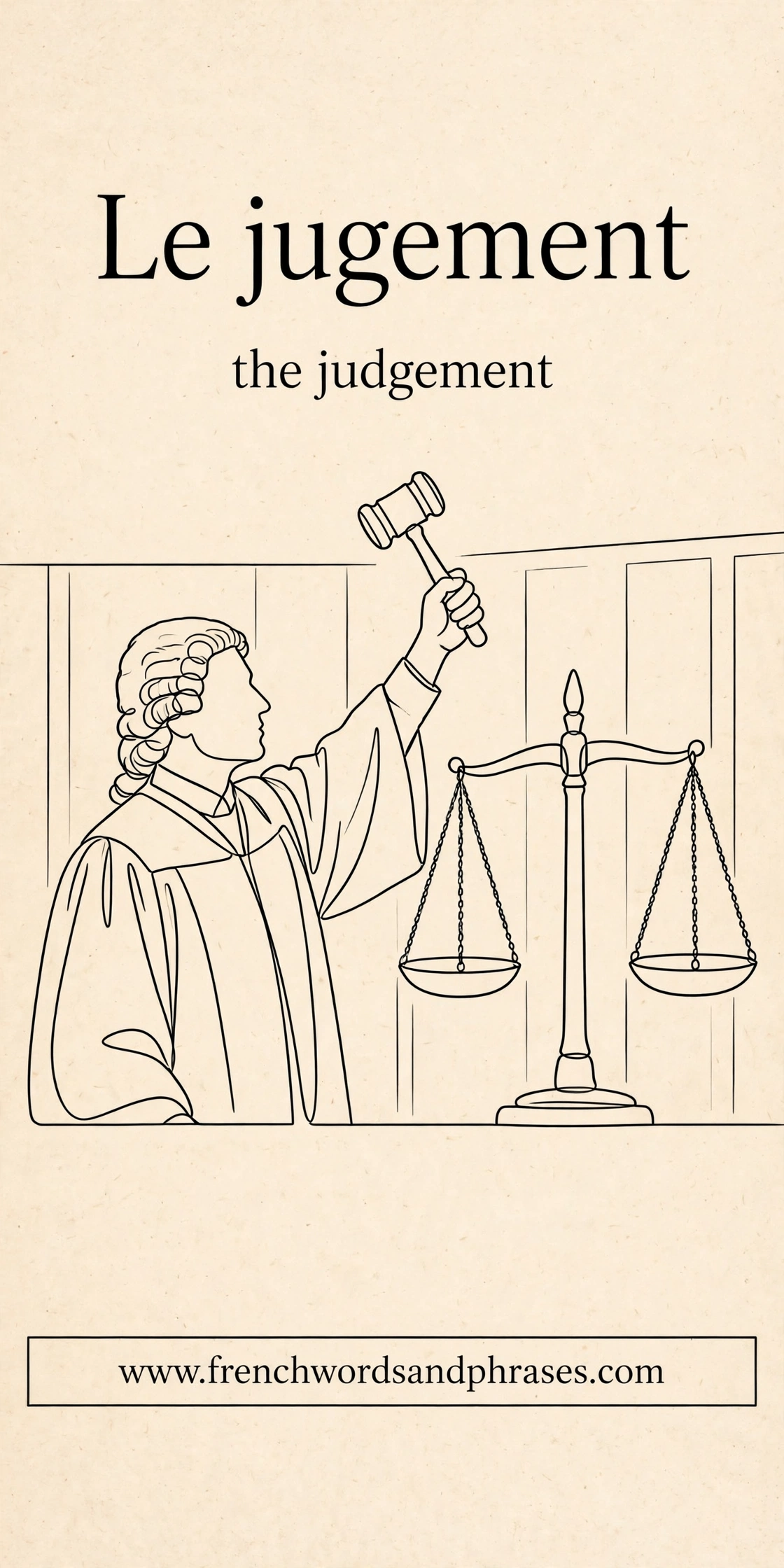
Le jugement means the judgement.
The courtroom falls silent, the judge straightens her papers, and everyone holds their breath for a single word — the verdict, le jugement.
In this guide, you’ll learn what jugement means in English, how to use it with its articles, how to form its plural, and how it appears in everyday French. Explore French examples, English translations, and practice quizzes.
Understanding the French Noun Jugement
Jugement is a masculine French noun, learned with its article: le jugement, un jugement. Like nearly every noun ending in -ment, it is masculine. It names both the decision handed down in court and the faculty inside us that weighs things up.
It means the judgement — the official decision of a court, as in le jugement du tribunal (the court’s judgement), and also sound judgement, the ability to weigh a situation well: avoir du jugement, to have good judgement. From the courtroom it spread into everyday speech, where porter un jugement sur quelqu’un means to pass judgement on someone.
Gender: Masculine
Definite article: le — le jugement (the judgement)
Indefinite article: un — un jugement (a judgement)
Partitive article: du — du jugement (some judgement, good sense)
Plural: les jugements
English equivalents: The judgement; a verdict, a ruling.
One important usage detail: jugement covers two English ideas at once — the legal verdict and personal good sense. Un jugement sévère can be a harsh sentence from a judge or a harsh opinion from a friend. Watch also the famous pair le Jugement dernier, the Last Judgement of paintings and sermons.
Experience the Word
Jugement is more than a courtroom word. It is the pause before the decision, the moment when everything heard is weighed and one side of the scale finally sinks.
Imagine the small daily judgements too: a parent judging a quarrel between children, a cook judging whether the sauce is ready, a friend judging that it is time to speak — or to stay silent.
You have not just reached a conclusion. You have weighed, measured and decided — jugé, the French way.
How to Use Jugement in French: Complete Guide
Let’s explore how jugement works in French, beginning with its articles — and remember, the ending -ment is a reliable sign of a masculine noun.
Jugement with the Definite Article (Le, Les)
Used for the judgement everyone is waiting for — the specific one, already announced or already known.
| Form | French |
|---|---|
| Masculine singular | le jugement |
| Plural | les jugements |
Example
Le jugement du tribunal est tombé hier matin.
The court’s judgement came down yesterday morning.
Jugement with the Indefinite Article (Un, Des)
Used for a judgement in general — any ruling, any opinion formed.
| Form | French |
|---|---|
| Masculine singular | un jugement |
| Plural | des jugements |
Example
C’est un jugement très sévère pour une première erreur.
That is a very harsh judgement for a first mistake.
Jugement with the Partitive Article (Du)
With du, jugement stops being a verdict and becomes the quality itself — good sense, in some quantity.
| Form | French |
|---|---|
| Partitive | du jugement |
| With a negative | pas de jugement |
Example
Il faut du jugement pour gérer une équipe.
You need judgement to manage a team.
Quick Quiz 1
Complete the sentence:
______ jugement de la cour surprend tout le monde.
Reveal the answer
Le
Le jugement de la cour surprend tout le monde.
The court’s judgement surprises everyone — one specific judgement, so le.
The Plural of Jugement
Jugement adds an -s in the plural — les jugements, the rulings of a court or the opinions of a lifetime.
| Number | French |
|---|---|
| Singular | le jugement |
| Plural | les jugements |
Example
Les jugements de ce tribunal font souvent la une des journaux.
This court’s judgements often make the front page.
Jugement with Possessive Adjectives (Mon, Ton, Son…)
Possessives agree with the noun, not with the owner — jugement is masculine, so it takes mon, ton, son.
| Owner | French |
|---|---|
| my | mon jugement |
| your (tu) | ton jugement |
| his / her | son jugement |
| our | notre jugement |
| your (vous) | votre jugement |
| their | leur jugement |
Example
Je te fais confiance, je respecte ton jugement.
I trust you, I respect your judgement.
Quick Quiz 2
Complete the sentence:
Elle doute de ______ jugement depuis l’erreur de mars. (her)
Reveal the answer
son
Elle doute de son jugement depuis l’erreur de mars.
She has doubted her judgement since the March mistake — son, because jugement is masculine.
Jugement with Demonstrative Adjectives (Ce, Ces)
Used to point at one particular ruling: ce jugement, this judgement.
| Form | French |
|---|---|
| Masculine singular | ce jugement |
| Plural | ces jugements |
Example
Ce jugement va changer la vie de toute la famille.
This judgement is going to change the whole family’s life.
Jugement with Adjectives
Adjectives agree with jugement — masculine singular, so sévère stays, juste stays, bon keeps its shape.
| Adjective | With Jugement |
|---|---|
| sévère (harsh) | un jugement sévère |
| juste (fair) | un jugement juste |
| bon (good, sound) | un bon jugement |
| dernier (last, final) | le Jugement dernier |
| rapide (quick) | un jugement rapide |
Example
Un jugement juste demande du temps et du calme.
A fair judgement takes time and calm.
Quick Quiz 3
Complete the sentence:
Ne porte pas un jugement trop ______ sur lui. (harsh)
Reveal the answer
sévère
Ne porte pas un jugement trop sévère sur lui.
Don’t pass too harsh a judgement on him.
Everyday Expressions with Jugement
Courtrooms and dinner tables — the jugement phrases of daily life.
| Expression | In English |
|---|---|
| porter un jugement sur quelqu’un | to pass judgement on someone |
| avoir du jugement | to have good judgement |
| le jugement du tribunal | the court’s judgement, the verdict |
| en mon jugement | in my judgement, in my opinion |
| le Jugement dernier | the Last Judgement |
| faire preuve de jugement | to show judgement |
Example
Avant de porter un jugement, écoute les deux versions.
Before passing judgement, listen to both sides.
Words from the Same Family as Jugement
Judges, trials and opinions — the words that travel with jugement.
| French | In English |
|---|---|
| juger | to judge |
| le juge | the judge |
| le procès | the trial |
| la justice | justice |
| un préjugé | a prejudice, a preconceived judgement |
| le jugement de valeur | a value judgement |
Example
Le juge écoute les témoins avant de rendre son jugement.
The judge listens to the witnesses before delivering his judgement.
Quick Quiz 4
What does avoir du jugement mean?
Reveal the answer
To have good judgement — sound sense, the ability to weigh things well.
Pour ce travail, il faut du jugement et de la patience.
For this job, you need judgement and patience.
Jugement in Everyday French: Real-Life Examples
Now that you know the word, let’s see how jugement appears in everyday French.
Example 1 — In court
Le jugement sera rendu la semaine prochaine.
The judgement will be delivered next week.
Example 2 — At work
Son jugement est respecté par toute l’équipe.
His judgement is respected by the whole team.
Example 3 — A warning
Ne juge pas les gens sur un seul jugement rapide.
Don’t judge people on a single quick judgement.
Example 4 — Good sense
Elle a beaucoup de jugement pour son âge.
She has a lot of judgement for her age.
Example 5 — In the news
Le jugement de l’affaire fait la une ce matin.
The judgement in the case is front-page news this morning.
Example 6 — Doubt
Je doute de mon jugement, demande un autre avis.
I doubt my judgement — ask for a second opinion.
Beyond Translation: The Meaning of Jugement
Jugement carries the whole weight of French justice in a single word: the robed judges, the hushed salle d’audience, the formula « Au nom du peuple français ». But the French also made it intimate — the jugement you trust in a friend, the jugement a grandmother applies to a soup. Law and wisdom share one noun.
To say jugement is to name the moment when weighing becomes deciding.
It evokes the gavel and the quiet conscience alike — the verdict read aloud, and the small inner voice that tells you, before anyone else does, whether you chose well.
How to Remember the French Noun Jugement
Remember it this way: Jugement is the judgement — a verdict in court, and good sense in a person; the -ment ending makes it masculine: le jugement.
- You wait in court — le jugement du tribunal tombe.
- You trust a friend — il a du jugement, his sense is sound.
- You hold back — ne porte pas un jugement trop rapide.
The key idea is le jugement — the verdict, and the good sense to reach it.
Test Your Knowledge of Jugement
Let’s see how much you’ve learned. Try answering these questions before revealing the answers.
Question 1
Is jugement masculine or feminine?
Reveal the answer
Masculine — le jugement, un jugement. Nouns in -ment are almost always masculine.
Question 2
How do you say the court’s judgement?
Reveal the answer
Le jugement du tribunal — the verdict, the ruling handed down.
Question 3
Translate: She has good judgement.
Reveal the answer
Elle a du jugement. — literally, she has some judgement.
Question 4
What is un préjugé?
Reveal the answer
A prejudice — a judgement formed in advance, from the same family as jugement.
Question 5
Complete the sentence:
Nous attendons ______ jugement depuis trois mois.
Reveal the answer
le
Nous attendons le jugement depuis trois mois.
We have been waiting for the judgement for three months.
Your Final Challenge
Can You Use It?
How would you say this in French?
“The judge delivers his judgement.”
Reveal the answer
Le juge rend son jugement.
The judge delivers his judgement.
A little French. A little curiosity. A richer everyday life.
LEARN FRENCH ONE WORD AT A TIME