A French Word to Live By
Translate Événement to English
/e.vɛn.mɑ̃/
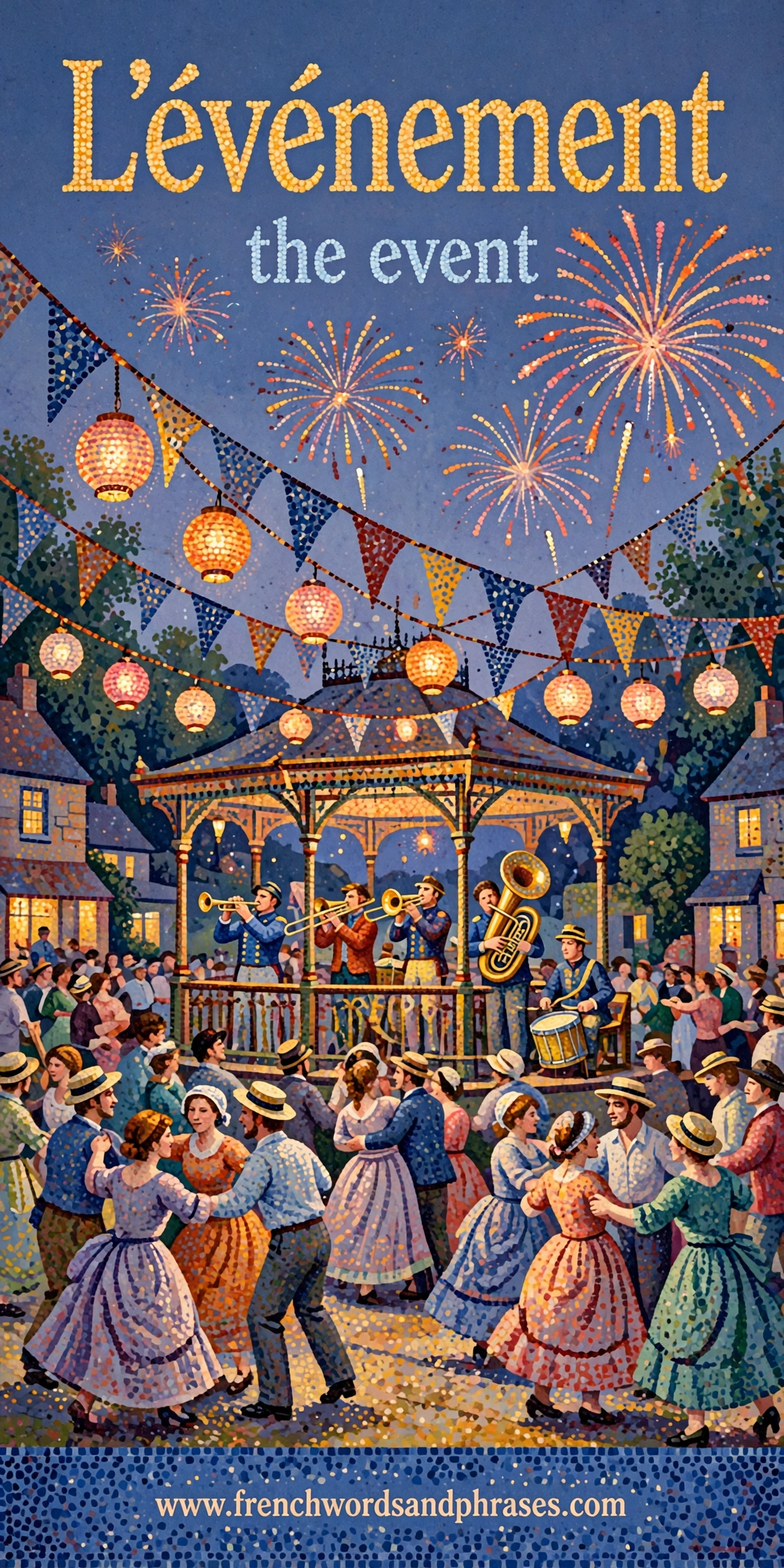
L’événement means the event.
Posters are going up all over town — a festival, three days of music in the old castle grounds. The baker is already talking about it: this year, it is going to be l’événement of the summer.
In this guide, you’ll learn what événement means in English, how to use it with its articles, how to form its plural, and how it appears in everyday French. Explore French examples, English translations, and practice quizzes.
Understanding the French Noun Événement
Événement is a masculine French noun. It begins with a vowel, so the article shrinks: l’événement. In the indefinite it is un événement, and like every noun ending in -ment, it is masculine. Older spelling books write évènement with a grave accent; both spellings are accepted, and événement remains the most common.
It means the event — something important or remarkable that happens: un événement historique, un événement sportif, un événement familial like a wedding or a birth. It is also the organiser’s word: concerts, festivals and conferences are all des événements, and the industry behind them is l’événementiel, events management.
Gender: Masculine
Ending: -ment — nouns with this ending are masculine
Definite article: l’ — l’événement (the event)
Indefinite article: un — un événement (an event)
Plural: les événements
English equivalents: The event; a happening, an occasion.
One important usage detail: you may meet the spelling évènement, with è. The 1990 spelling reform proposed it to match the way the word sounds, and both forms are correct — but événement, the traditional spelling, is the one you will see most often.
Experience the Word
Événement is more than something that happens. It is the happening that matters — the day people circle on the calendar, the news that stops conversations, the birth announced with a phone call at dawn.
Imagine the village square on festival night, the lights strung overhead and three generations dancing: for everyone there, c’est un événement.
You have not just noted a date. You have marked the moment everyone will remember — l’événement.
How to Use Événement in French: Complete Guide
Let’s explore how événement works in French, beginning with its articles — and watch le shrink to l’ before the vowel.
Événement with the Definite Article (L’, Les)
Événement begins with a vowel, so le becomes l’ — l’événement, the happening everyone is awaiting.
| Form | French |
|---|---|
| Masculine singular | l’événement |
| Plural | les événements |
Example
L’événement de l’année aura lieu en septembre.
The event of the year will take place in September.
Événement with the Indefinite Article (Un, Des)
Used for an event in general — un événement, one happening among others.
| Form | French |
|---|---|
| Masculine singular | un événement |
| Plural | des événements |
Example
Un événement important se prépare dans la région.
An important event is being prepared in the region.
Kinds of Événements
History, sport and family life — every scale of happening.
| French | In English |
|---|---|
| un événement historique | a historic event |
| un événement sportif | a sporting event |
| un événement culturel | a cultural event |
| un heureux événement | a happy event (a birth) |
| un événement familial | a family occasion |
| les événements actuels | current events |
Example
La naissance de leur fille est un heureux événement.
The birth of their daughter is a happy event.
Quick Quiz 1
Complete the sentence:
______ événement a rassemblé des milliers de spectateurs.
Reveal the answer
L’
L’événement a rassemblé des milliers de spectateurs.
The event brought together thousands of spectators — l’, because événement begins with a vowel.
The Plural of Événement
Événement adds an -s in the plural — les événements, the news of the day or a season of festivals.
| Number | French |
|---|---|
| Singular | l’événement |
| Plural | les événements |
Example
Les événements de mai sont dans tous les livres d’histoire.
The events of May are in all the history books.
Événement with Possessive Adjectives (Mon, Ton, Son…)
Before a vowel, ma becomes mon — mon événement, your own big day.
| Owner | French |
|---|---|
| my | mon événement |
| your (tu) | ton événement |
| his / her | son événement |
| our | notre événement |
| your (vous) | votre événement |
| their | leur événement |
Example
Son événement préféré de l’année est le festival de jazz.
Her favourite event of the year is the jazz festival.
Quick Quiz 2
Complete the sentence:
______ événement aura lieu au château. (Our)
Reveal the answer
Notre
Notre événement aura lieu au château.
Our event will take place at the castle.
Événement with Demonstrative Adjectives (Cet, Ces)
Used to point: cet événement — with cet, not ce, because of the opening vowel.
| Form | French |
|---|---|
| Masculine singular | cet événement |
| Plural | ces événements |
Example
Cet événement restera dans les mémoires.
This event will be remembered for a long time.
Événement with Adjectives
Adjectives agree with the masculine noun: historique, important, culturel.
| Adjective | With Événement |
|---|---|
| historique (historic) | un événement historique |
| important (important) | un événement important |
| culturel (cultural) | un événement culturel |
| nouveau (new) | un nouvel événement |
| heureux (happy) | un heureux événement |
Example
C’est un événement historique pour le pays.
It is a historic event for the country.
Quick Quiz 3
What is un heureux événement, in the classic announcement?
Reveal the answer
A birth — the traditional, smiling way to announce that a baby has arrived.
Ils attendent un heureux événement pour le printemps.
They are expecting a happy event in the spring.
Everyday Expressions with Événement
Calendars, headlines and family news — the événement phrases of daily life.
| Expression | In English |
|---|---|
| organiser un événement | to organise an event |
| un événement à ne pas manquer | an event not to be missed |
| faire événement | to be a sensation, to make a splash |
| les événements | the news, current events |
| en cas d’événement | in case something happens |
| un heureux événement | a happy event (a birth) |
Example
Ce concert est un événement à ne pas manquer.
This concert is an event not to be missed.
Words from the Same Family as Événement
Coming, happening and organising — the words that travel with événement.
| French | In English |
|---|---|
| l’événementiel | events management, the events industry |
| événementiel | event-related (adjective) |
| venir | to come |
| devenir | to become |
| un avènement | an accession, a coming (to power) |
| l’actualité | the news, current affairs |
Example
Elle travaille dans l’événementiel depuis dix ans.
She has worked in events management for ten years.
Quick Quiz 4
What is l’événementiel?
Reveal the answer
The events industry — organising concerts, weddings, conferences and festivals for a living.
L’événementiel demande beaucoup d’organisation.
Events management requires a lot of organisation.
Événement in Everyday French: Real-Life Examples
Now that you know the word, let’s see how événement appears in everyday French.
Example 1 — In town
L’événement de ce week-end est le marché de Noël.
This weekend’s event is the Christmas market.
Example 2 — Family news
Le mariage de leur fils est l’événement de l’année.
Their son’s wedding is the event of the year.
Example 3 — Sport
Un événement sportif mondial commence demain.
A world sporting event starts tomorrow.
Example 4 — Organising
Elle organise un événement pour cent personnes.
She is organising an event for a hundred people.
Example 5 — History
Cet événement a changé l’histoire du pays.
This event changed the country’s history.
Example 6 — A birth
Ils annoncent un heureux événement pour novembre.
They are announcing a happy event for November.
Beyond Translation: The Meaning of Événement
Événement comes from the Latin for « what comes out » — what emerges from the flow of ordinary days. French history gives the word extra weight: les événements is how people spoke of the great upheavals, and « les événements de mai 68 » still means one spring in Paris without any year needing to be said.
To say événement is to separate the days that pass from the days that count.
It evokes the festival posters on the bakery window, the headline that stops the café’s conversation, the baby’s name texted at dawn — happenings, large and small, that everyone remembers together.
How to Remember the French Noun Événement
Remember it this way: Événement is the event — a masculine -ment noun that starts with a vowel, so le shrinks to l’événement.
- You see the big day — l’événement de l’année.
- You hear happy news — un heureux événement, a birth.
- You point at it — cet événement, with a -t for the vowel.
The key idea is l’événement — the day that counts.
Test Your Knowledge of Événement
Let’s see how much you’ve learned. Try answering these questions before revealing the answers.
Question 1
Is événement masculine or feminine?
Reveal the answer
Masculine — un événement, cet événement, like all nouns ending in -ment.
Question 2
What does un heureux événement usually announce?
Reveal the answer
A birth — the classic happy event.
Question 3
Translate: The event will take place in September.
Reveal the answer
L’événement aura lieu en septembre.
Question 4
Is the spelling évènement wrong?
Reveal the answer
No — both événement and évènement are accepted; événement is the more common spelling.
Question 5
Complete the sentence:
______ événement restera dans les mémoires. (This)
Reveal the answer
Cet
Cet événement restera dans les mémoires.
This event will be remembered.
Your Final Challenge
Can You Use It?
How would you say this in French?
“The event will take place in September.”
Reveal the answer
L’événement aura lieu en septembre.
The event will take place in September.
A little French. A little curiosity. A richer everyday life.
LEARN FRENCH ONE WORD AT A TIME