A French Word to Live By
Translate Document to English
/dɔ.ky.mɑ̃/
Le document means the document.
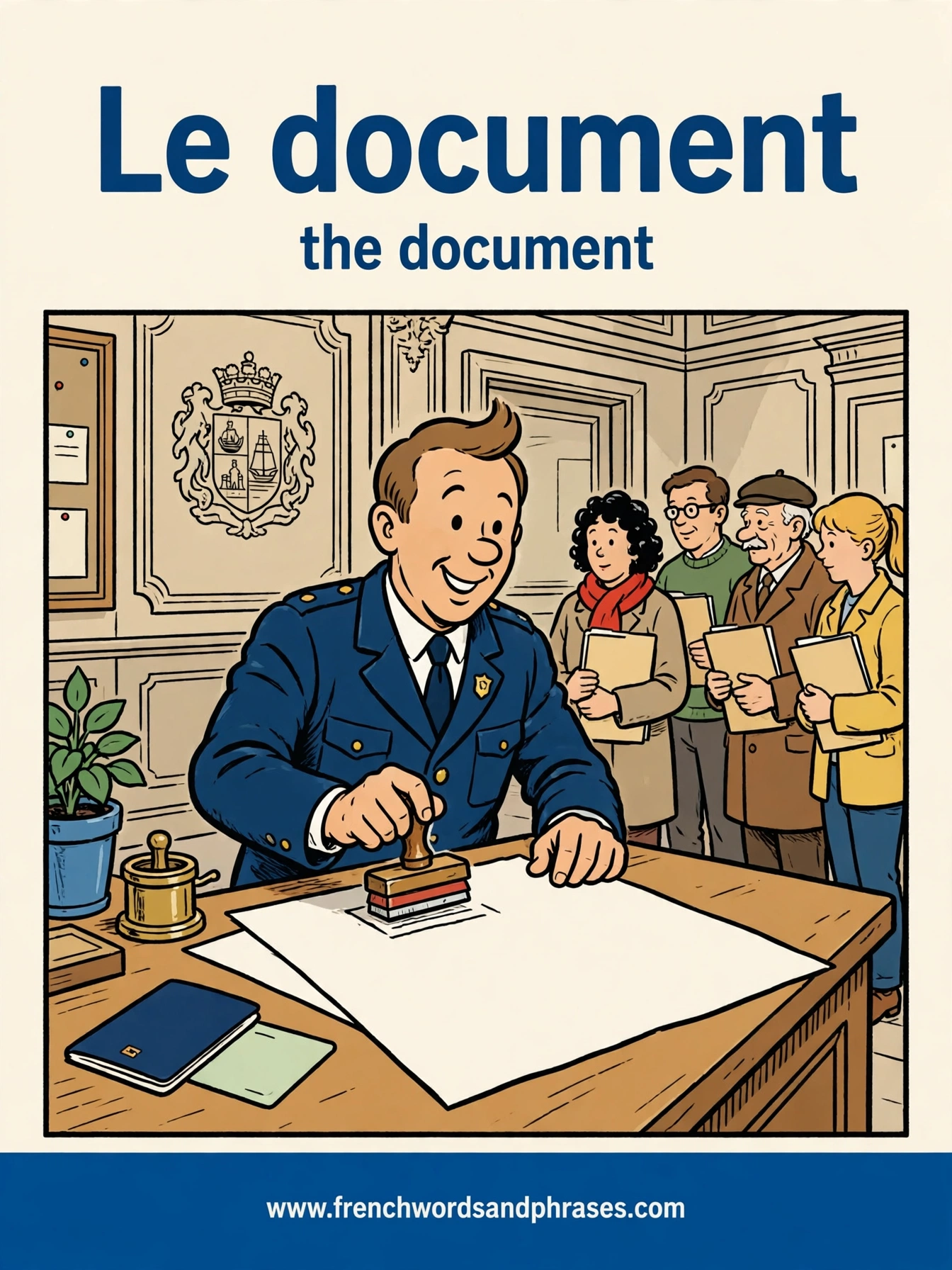
At the prefecture counter, the clerk does not look up. « Vos documents, s’il vous plaît. » You open the folder on your knees — passport, photos, forms — because in France, everything begins with le document.
In this guide, you’ll learn what document means in English, how to use it with its articles, how to form its plural, and how it appears in everyday French. Explore French examples, English translations, and practice quizzes.
Understanding the French Noun Document
Document is a masculine French noun, learned with its article: le document, un document. Like every noun ending in -ment, it is masculine — no exceptions to memorise.
It means the document — any paper or file that proves, explains or records something. Un document d’identité is an ID document, un document officiel an official document, and on your computer a text file is simply un document. At borders and counters, French often uses the plural: « vos documents, s’il vous plaît » — your papers, please.
Gender: Masculine
Ending: -ment — nouns with this ending are masculine
Definite article: le — le document (the document)
Indefinite article: un — un document (a document)
Plural: les documents
English equivalents: The document; a paper, a file.
One important usage detail: at an official counter, expect the plural. « Vos documents » means your papers — passport, licence, forms, the whole folder. A single sheet is un document; your official identity set is vos documents or vos papiers.
Experience the Word
Document is more than a sheet of paper. In French administrative life, the document is king — stamped, signed, photocopied in triplicate, and kept forever in a folder at home.
Imagine the scene everyone in France knows: the queue, the numbered ticket, the clerk’s window, and the quiet panic of the missing document at the bottom of the bag.
You have not just shown a paper. You have proved who you are — documents à l’appui.
How to Use Document in French: Complete Guide
Let’s explore how document works in French, beginning with its articles.
Document with the Definite Article (Le, Les)
Used when the document is known — the one on the desk, the one in the file.
| Form | French |
|---|---|
| Masculine singular | le document |
| Plural | les documents |
Example
Le document est sur le bureau de la secrétaire.
The document is on the secretary’s desk.
Document with the Indefinite Article (Un, Des)
Used for a document in general — un document, any document.
| Form | French |
|---|---|
| Masculine singular | un document |
| Plural | des documents |
Example
Il me faut un document signé par le directeur.
I need a document signed by the director.
Kinds of Documents
Official, secret, digital — the documents of French daily life.
| French | In English |
|---|---|
| un document d’identité | an ID document |
| un document officiel | an official document |
| un document secret | a secret document |
| un document signé | a signed document |
| un document en ligne | an online document |
| les documents de voyage | travel documents |
Example
Présentez un document d’identité à l’accueil.
Show an ID document at reception.
Quick Quiz 1
Complete the sentence:
______ document est confidentiel, ne le partagez pas.
Reveal the answer
Ce works for pointing, and Le for the known document: Le document est confidentiel.
The document is confidential — document is masculine, so le, un, ce.
The Plural of Document
Document adds an -s in the plural — les documents, your papers at the counter.
| Number | French |
|---|---|
| Singular | le document |
| Plural | les documents |
Example
Gardez vos documents dans un endroit sûr.
Keep your documents in a safe place.
Document with Possessive Adjectives (Mon, Ton, Son…)
Possessives agree with the noun: document is masculine, so it takes mon, ton, son.
| Owner | French |
|---|---|
| my | mon document |
| your (tu) | ton document |
| his / her | son document |
| our | notre document |
| your (vous) | votre document |
| their | leur document |
Example
J’ai oublié mon document à la maison.
I left my document at home.
Quick Quiz 2
Complete the sentence:
Elle a perdu ______ documents de voyage. (her)
Reveal the answer
ses
Elle a perdu ses documents de voyage.
She has lost her travel documents — ses, the plural of son/sa.
Document with Demonstrative Adjectives (Ce, Ces)
Used to point: ce document, this document in your hand.
| Form | French |
|---|---|
| Masculine singular | ce document |
| Plural | ces documents |
Example
Ce document date de 1998.
This document dates from 1998.
Document with Adjectives
Adjectives agree with the masculine noun: officiel, important, signé.
| Adjective | With Document |
|---|---|
| officiel (official) | un document officiel |
| important (important) | un document important |
| signé (signed) | le document signé |
| ancien (old) | un ancien document |
| numérique (digital) | un document numérique |
Example
C’est un document officiel, gardez-le précieusement.
It is an official document, keep it safe.
Quick Quiz 3
Complete the sentence:
Je cherche un document ______. (official)
Reveal the answer
officiel
Je cherche un document officiel.
I am looking for an official document — officiel stays in its masculine form with document.
Everyday Expressions with Document
Counters, printers and folders — the document phrases of daily life.
| Expression | In English |
|---|---|
| vos documents, s’il vous plaît | your papers, please |
| signer un document | to sign a document |
| imprimer un document | to print a document |
| un document d’identité | an ID document |
| remplir un document | to fill in a document |
| classer les documents | to file the documents |
Example
Signez le document en bas de la page.
Sign the document at the bottom of the page.
Words from the Same Family as Document
Research, archives and television — the words that travel with document.
| French | In English |
|---|---|
| documenter | to document |
| se documenter | to do research, to read up |
| la documentation | documentation, reference material |
| un documentaire | a documentary (film) |
| documentaire | documentary (adjective) |
| l’archive | the archive |
Example
Elle se documente avant d’écrire son article.
She does her research before writing her article.
Quick Quiz 4
What is un documentaire?
Reveal the answer
A documentary — a film that documents real life, from the same family as document.
Nous avons regardé un documentaire sur les océans.
We watched a documentary about the oceans.
Document in Everyday French: Real-Life Examples
Now that you know the word, let’s see how document appears in everyday French.
Example 1 — At the counter
Vos documents, s’il vous plaît, madame.
Your papers, please, madam.
Example 2 — At the office
Le document est prêt, je vous l’envoie par mail.
The document is ready, I’ll email it to you.
Example 3 — A missing paper
Il manque un document dans le dossier.
There is a document missing from the file.
Example 4 — Printing
Imprime le document en deux exemplaires.
Print the document in two copies.
Example 5 — Travel
Vérifie tes documents avant de partir à l’aéroport.
Check your documents before leaving for the airport.
Example 6 — Signing
Lisez le document attentivement avant de signer.
Read the document carefully before signing.
Beyond Translation: The Meaning of Document
France runs on documents. The folder of papers every household keeps — birth certificates, tax notices, pay slips going back decades — is a national institution, and the administration’s love of the stamped original is famous enough to be a running joke.
To say document is to touch the paper heart of French life.
It evokes the queue at the prefecture, the blue folder in the drawer, the sigh of relief when the right document is, at last, in the right hands.
How to Remember the French Noun Document
Remember it this way: Document is the document — a masculine -ment noun, and at official counters it usually arrives in the plural: vos documents.
- You see one paper — le document, un document officiel.
- You stand at a counter — vos documents, s’il vous plaît.
- You remember the ending — -ment is masculine, always le, un, mon.
The key idea is le document — vos documents, s’il vous plaît.
Test Your Knowledge of Document
Let’s see how much you’ve learned. Try answering these questions before revealing the answers.
Question 1
Is document masculine or feminine?
Reveal the answer
Masculine — le document, like all nouns ending in -ment.
Question 2
What does the clerk mean by « Vos documents, s’il vous plaît »?
Reveal the answer
Your papers, please — your passport, forms and ID, the whole set.
Question 3
Translate: I need a signed document.
Reveal the answer
Il me faut un document signé.
Question 4
What is un document d’identité?
Reveal the answer
An ID document — a passport or identity card that proves who you are.
Question 5
Complete the sentence:
Elle classe ______ documents dans un dossier bleu.
Reveal the answer
ses
Elle classe ses documents dans un dossier bleu.
She files her documents in a blue folder.
Your Final Challenge
Can You Use It?
How would you say this in French?
“Your papers, please.”
Reveal the answer
Vos documents, s’il vous plaît.
Your papers, please.
A little French. A little curiosity. A richer everyday life.
LEARN FRENCH ONE WORD AT A TIME