A French Word to Live By
Translate Ciment to English
/si.mɑ̃/
Le ciment means cement.
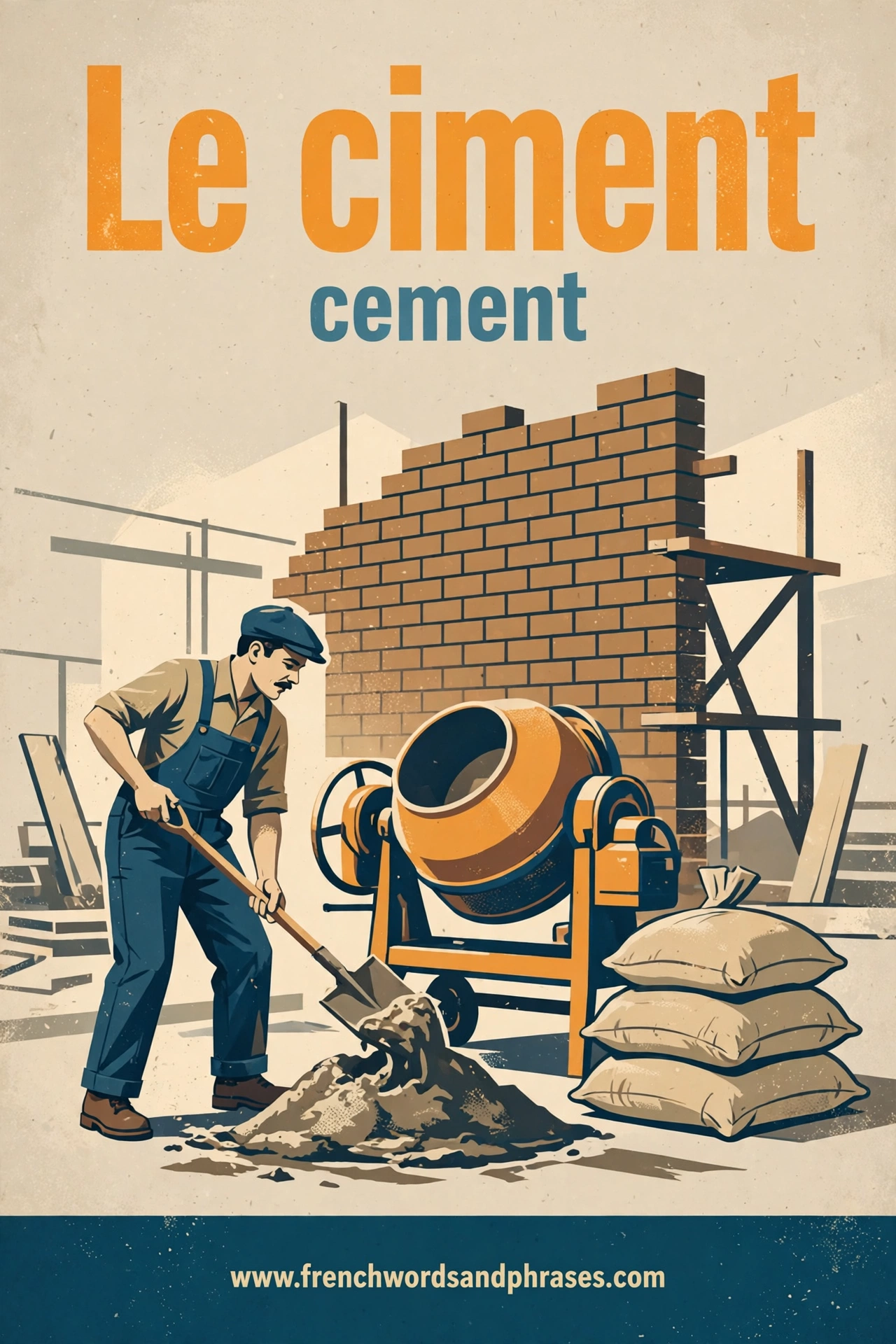
The mixer turns, the grey powder meets the water, and within the hour the liquid stone will hold a wall for a century. Handle it quickly — le ciment waits for nobody.
In this guide, you’ll learn what ciment means in English, how to use it with its articles, how to form its plural, and how it appears in everyday French. Explore French examples, English translations, and practice quizzes.
Understanding the French Noun Ciment
Ciment is a masculine French noun, learned with its article: le ciment, un ciment. It ends in -ment and is masculine like its family. As a material it is usually uncountable: you work with du ciment, some cement, not a pile of « ciments ».
It means cement — the grey powder that, mixed with water, sand and gravel, becomes le béton (concrete) and binds les briques (bricks) into walls. Un sac de ciment weighs twenty-five kilos, le ciment frais is workable for a short time, and when it has set — le ciment a pris — it is stone for good.
Gender: Masculine
Definite article: le — le ciment (cement)
Indefinite article: un — un ciment (a cement, a type of cement)
Partitive: du — du ciment (some cement)
Plural: les ciments (types of cement; the material itself is uncountable)
English equivalents: Cement.
One important usage detail: English speakers often say « cement » for the finished grey material of pavements — in French that finished material is usually le béton (concrete), while le ciment is the powder and the binder. For quantities, French uses the partitive: acheter du ciment, mélanger du ciment.
Experience the Word
Ciment is more than a powder. It is the promise that what is built today will still be standing for your grandchildren — grey, modest and nearly eternal.
Imagine the Saturday builder with his mixer in the garden: the dust, the turning drum, the race against the setting, and by evening a terrace where there was grass at breakfast.
You have not just mixed a material. You have made stone — fabriqué de la pierre, in an afternoon.
How to Use Ciment in French: Complete Guide
Let’s explore how ciment works in French, beginning with its articles — and its partitive, du ciment, the form you will use most.
Ciment with the Definite Article (Le, Les)
Used for cement in general, or the particular cement of a job — le ciment, the cements of the catalogue.
| Form | French |
|---|---|
| Masculine singular | le ciment |
| Plural | les ciments (types) |
Example
Le ciment sèche vite sous le soleil d’été.
Cement dries quickly under the summer sun.
Ciment with the Indefinite and Partitive Articles (Un, Du)
Un ciment is one type of cement; for the material itself, French uses du ciment — some cement.
| Form | French |
|---|---|
| Masculine singular | un ciment (a type) |
| Partitive | du ciment (some) |
Example
Il achète du ciment et du sable au magasin de bricolage.
He buys cement and sand at the DIY shop.
Around the Ciment: Words of Building Materials
Concrete, mortar and bricks — the vocabulary that surrounds the ciment.
| French | In English |
|---|---|
| le béton | concrete |
| le sable | sand |
| le mortier | mortar |
| la brique | the brick |
| le plâtre | plaster |
| mélanger | to mix |
Example
On mélange le ciment avec le sable pour faire le mortier.
You mix the cement with sand to make mortar.
Quick Quiz 1
Complete the sentence:
Il faut ______ ciment pour finir le mur. (some)
Reveal the answer
du
Il faut du ciment pour finir le mur.
We need some cement to finish the wall — du, the partitive, for an uncountable material.
The Plural of Ciment
The plural les ciments exists for types and brands; the material itself stays uncountable.
| Number | French |
|---|---|
| Singular | le ciment |
| Plural | les ciments (types of cement) |
Example
Le magasin propose plusieurs ciments pour les travaux extérieurs.
The shop offers several cements for outdoor work.
Ciment with Possessive Adjectives (Mon, Ton, Son…)
Possessives agree with the noun: ciment is masculine, so it takes mon, ton, son.
| Owner | French |
|---|---|
| my | mon ciment |
| your (tu) | ton ciment |
| his / her | son ciment |
| our | notre ciment |
| your (vous) | votre ciment |
| their | leur ciment |
Example
Mon ciment est resté au sec dans le garage.
My cement stayed dry in the garage.
Quick Quiz 2
Complete the sentence:
______ ciment est déjà dur comme de la pierre. (This)
Reveal the answer
Ce
Ce ciment est déjà dur comme de la pierre.
This cement is already hard as stone — ce, because ciment is masculine and starts with a consonant.
Ciment with Demonstrative Adjectives (Ce, Ces)
Used to point: ce ciment, this cement — the batch in the mixer, the bag by the wall.
| Form | French |
|---|---|
| Masculine singular | ce ciment |
| Plural | ces ciments |
Example
Ce ciment prend trop vite, ajoute un peu d’eau.
This cement is setting too quickly; add a little water.
Ciment with Adjectives
Adjectives agree with ciment: masculine forms.
| Adjective | With Ciment |
|---|---|
| frais (fresh, wet) | le ciment frais |
| sec (dry) | un ciment sec |
| rapide (quick-setting) | un ciment rapide |
| nouveau (new) | un nouveau ciment |
| gris (grey) | du ciment gris |
Example
Le ciment frais porte encore l’empreinte des pas du chat.
The wet cement still bears the cat’s paw prints.
Quick Quiz 3
Complete the sentence:
Attention, le ciment est encore ______. (wet, fresh)
Reveal the answer
frais
Attention, le ciment est encore frais.
Careful, the cement is still wet — frais, masculine, to match ciment.
Everyday Expressions with Ciment
Sacks, mixers and setting times — the ciment phrases of daily life.
| Expression | In English |
|---|---|
| un sac de ciment | a bag of cement |
| couler du ciment | to pour cement |
| le ciment frais | wet cement |
| un mur en ciment | a cement wall |
| mélanger le ciment | to mix the cement |
| le ciment a pris | the cement has set |
Example
Ils coulent du ciment pour la terrasse ce matin.
They are pouring cement for the terrace this morning.
Words from the Same Family as Ciment
Cement works, concrete and setting — the words that travel with ciment.
| French | In English |
|---|---|
| cimenter | to cement, to seal with cement |
| la cimenterie | the cement works |
| le béton | concrete |
| le mortier | mortar |
| durcir | to harden, to set |
| le maçon | the builder |
Example
La cimenterie de la région emploie deux cents personnes.
The region’s cement works employs two hundred people.
Quick Quiz 4
What is the difference between le ciment and le béton?
Reveal the answer
Le ciment is the powder; le béton is the concrete made from it, mixed with sand, gravel and water.
Le pont est construit en béton armé.
The bridge is built of reinforced concrete.
Ciment in Everyday French: Real-Life Examples
Now that you know the word, let’s see how ciment appears in everyday French.
Example 1 — At the shop
Il achète trois sacs de ciment pour le week-end.
He buys three bags of cement for the weekend.
Example 2 — Mixing
Elle mélange le ciment avec le sable et l’eau.
She mixes the cement with sand and water.
Example 3 — A warning
Ne marchez pas sur le ciment frais !
Don’t walk on the wet cement!
Example 4 — The terrace
Le ciment de la terrasse a pris pendant la nuit.
The terrace cement set overnight.
Example 5 — Repairs
Un peu de ciment suffit pour boucher le trou.
A little cement is enough to fill the hole.
Example 6 — Industry
Les camions de ciment partent de l’usine dès l’aube.
The cement lorries leave the factory at dawn.
Beyond Translation: The Meaning of Ciment
Ciment carries Rome in its name: it descends from the Latin caementum, the rough stone of Roman concrete — the material of the Pantheon’s dome, still the largest of its kind. France made it modern: the great cimenteries of the south, and Louis Vicat, the engineer who unlocked artificial cement and refused to patent it, giving his discovery to everyone.
To say ciment is to name the grey glue of the modern world.
It evokes the turning mixer, the paw prints preserved in the fresh terrace, and the quiet satisfaction of a thing built to outlast its builder.
How to Remember the French Noun Ciment
Remember it this way: Ciment is cement — masculine in -ment, mostly uncountable, and du ciment is the form you will use every day.
- You see the ending — -ment, so the noun is masculine.
- You reach for the partitive — du ciment, some cement.
- You separate the brothers — ciment the powder, béton the concrete.
The key idea is le ciment — du ciment, never a pile of ciments.
Test Your Knowledge of Ciment
Let’s see how much you’ve learned. Try answering these questions before revealing the answers.
Question 1
Is ciment masculine or feminine?
Reveal the answer
Masculine — le ciment, du ciment.
Question 2
How do you say some cement?
Reveal the answer
Du ciment — the partitive, because cement is uncountable.
Question 3
Translate: He buys two bags of cement.
Reveal the answer
Il achète deux sacs de ciment.
Question 4
What is le béton?
Reveal the answer
Concrete — the material made by mixing ciment with sand, gravel and water.
Question 5
Complete the sentence:
______ ciment sèche trop vite au soleil.
Reveal the answer
Le
Le ciment sèche trop vite au soleil.
Cement dries too quickly in the sun.
Your Final Challenge
Can You Use It?
How would you say this in French?
“A little cement is enough to repair the wall.”
Reveal the answer
Un peu de ciment suffit pour réparer le mur.
A little cement is enough to repair the wall.
A little French. A little curiosity. A richer everyday life.
LEARN FRENCH ONE WORD AT A TIME