A French Word to Live By
Translate Accouchement to English
/a.kuʃ.mɑ̃/
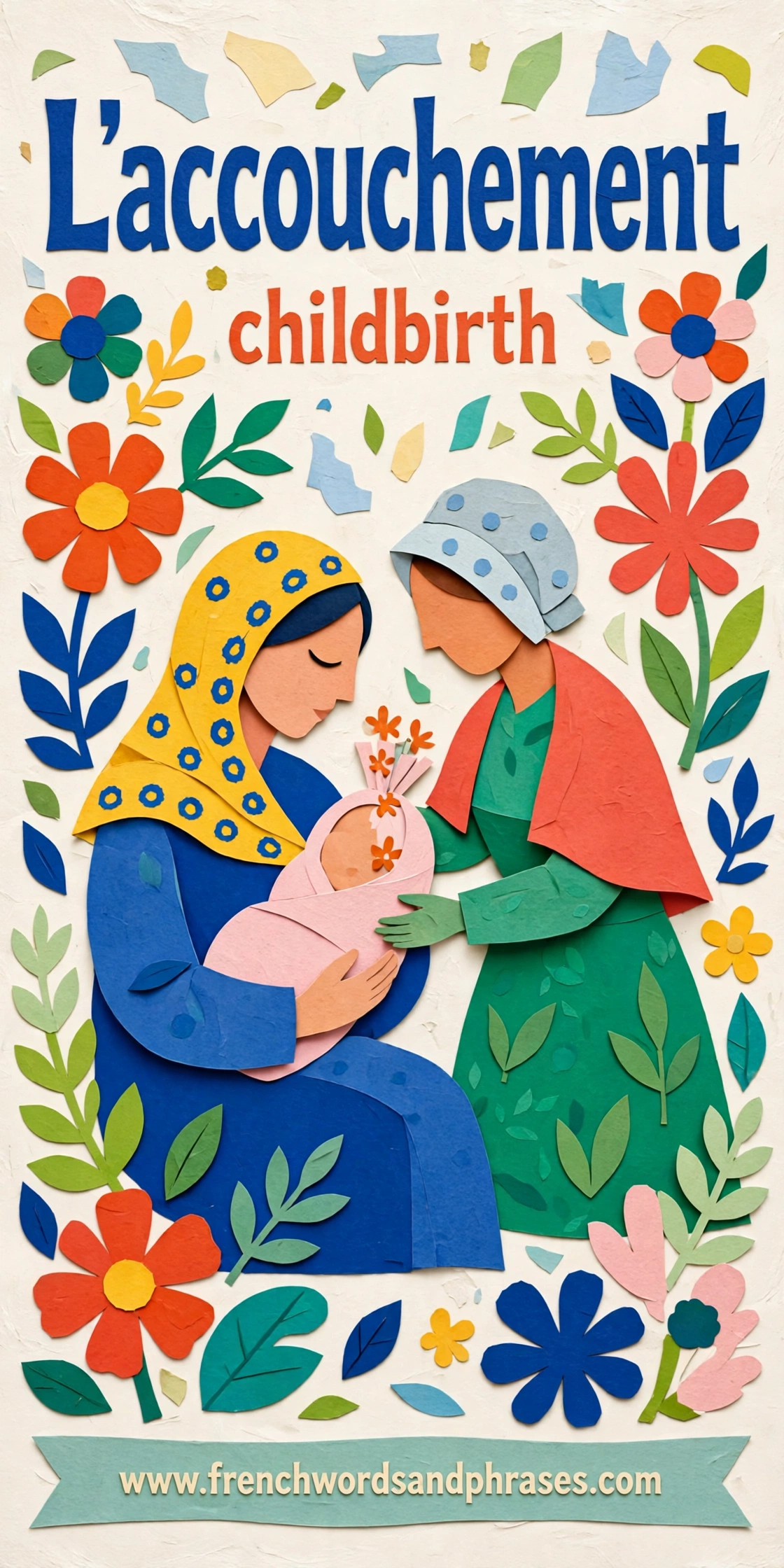
L’accouchement means childbirth.
The bags are packed by the door, the car is facing the street, and the whole family is waiting for one phone call. The great day has a name in French: l’accouchement.
In this guide, you’ll learn what accouchement means in English, how to use it with its articles, how to form its plural, and how it appears in everyday French. Explore French examples, English translations, and practice quizzes.
Understanding the French Noun Accouchement
Accouchement is a masculine French noun, learned with its article: l’accouchement, un accouchement — l’, because it begins with a vowel. It is built from the verb accoucher (to give birth) with the ending -ment, and it behaves as a general, uncountable idea — childbirth — as much as a single event.
It means childbirth — the birth of a baby, the whole event from the first contractions to the first cry. It happens at la maternité (the maternity ward), guided by la sage-femme (the midwife), and it ends with la naissance (the birth) of le nouveau-né (the newborn).
Gender: Masculine
Definite article: l’ — l’accouchement (childbirth)
Indefinite article: un — un accouchement (a birth, one delivery)
Plural: les accouchements
Built from: the verb accoucher (to give birth) + -ment
English equivalents: Childbirth; a delivery, labour.
One important usage detail: the mother accouche — elle accouche d’une petite fille — while the midwife or doctor delivers her. English needs two verbs, French manages with one family: accoucher, l’accouchement. And for the general idea, French uses the bare noun: la préparation à l’accouchement, childbirth preparation classes.
Experience the Word
Accouchement is more than a medical event. It is the day a family changes shape — the day grandparents are made and a new name enters the family story.
Imagine the maternity ward at dawn: the quiet corridor, the midwife’s calm voice, and then the first cry that makes everyone in the room laugh and cry at once.
You have not just witnessed a birth. You have welcomed — accueilli, a new life.
How to Use Accouchement in French: Complete Guide
Let’s explore how accouchement works in French, beginning with its articles — l’ in the singular, because of the opening vowel.
Accouchement with the Definite Article (L’, Les)
Accouchement begins with a vowel, so the definite article is l’ in the singular and les in the plural.
| Form | French |
|---|---|
| Masculine singular | l’accouchement |
| Plural | les accouchements |
Example
L’accouchement est prévu pour la fin du mois.
The birth is due at the end of the month.
Accouchement with the Indefinite Article (Un, Des)
Used for one particular birth — un accouchement rapide, un accouchement difficile.
| Form | French |
|---|---|
| Masculine singular | un accouchement |
| Plural | des accouchements |
Example
Ce fut un accouchement rapide et sans complications.
It was a quick birth with no complications.
Around the Accouchement: Words of the Birth
Midwives, contractions and newborns — the vocabulary that surrounds the accouchement.
| French | In English |
|---|---|
| la maternité | the maternity ward |
| la sage-femme | the midwife |
| les contractions | the contractions |
| le bébé | the baby |
| la naissance | the birth |
| le nouveau-né | the newborn |
Example
La sage-femme accompagne la mère pendant tout l’accouchement.
The midwife supports the mother throughout the birth.
Quick Quiz 1
Complete the sentence:
______ accouchement s’est très bien passé, le bébé va bien.
Reveal the answer
L’
L’accouchement s’est très bien passé, le bébé va bien.
The birth went very well; the baby is fine — l’, because accouchement begins with a vowel.
The Plural of Accouchement
Accouchement adds an -s in the plural — les accouchements, the births a midwife attends across a career.
| Number | French |
|---|---|
| Singular | l’accouchement |
| Plural | les accouchements |
Example
Cette sage-femme a assisté à des centaines d’accouchements.
This midwife has attended hundreds of births.
Accouchement with Possessive Adjectives (Mon, Ton, Son…)
Possessives agree with the noun: accouchement is masculine, so it takes mon, ton, son.
| Owner | French |
|---|---|
| my | mon accouchement |
| your (tu) | ton accouchement |
| his / her | son accouchement |
| our | notre accouchement |
| your (vous) | votre accouchement |
| their | leur accouchement |
Example
Elle raconte son accouchement à toutes ses amies.
She tells all her friends about her labour.
Quick Quiz 2
Complete the sentence:
______ accouchement est prévu pour mardi. (Her)
Reveal the answer
Son
Son accouchement est prévu pour mardi.
Her delivery is scheduled for Tuesday — son, because accouchement is masculine.
Accouchement with Demonstrative Adjectives (Cet, Ces)
Used to point: cet accouchement — cet, not ce, because of the opening vowel.
| Form | French |
|---|---|
| Masculine singular | cet accouchement |
| Plural | ces accouchements |
Example
Cet accouchement restera un souvenir inoubliable pour la famille.
This birth will remain an unforgettable memory for the family.
Accouchement with Adjectives
Adjectives agree with accouchement: masculine forms, with -s in the plural.
| Adjective | With Accouchement |
|---|---|
| naturel (natural) | un accouchement naturel |
| difficile (difficult) | un accouchement difficile |
| long (long) | un accouchement long |
| rapide (quick) | un accouchement rapide |
| prématuré (premature) | un accouchement prématuré |
Example
Elle souhaite un accouchement naturel, sans péridurale.
She wants a natural birth, without an epidural.
Quick Quiz 3
Complete the sentence:
Ce fut un accouchement ______, mais le bébé est en pleine forme. (long)
Reveal the answer
long
Ce fut un accouchement long, mais le bébé est en pleine forme.
It was a long labour, but the baby is perfectly healthy.
Everyday Expressions with Accouchement
Due dates and delivery rooms — the accouchement phrases of daily life.
| Expression | In English |
|---|---|
| un accouchement naturel | a natural birth |
| le jour de l’accouchement | the day of the birth |
| un accouchement par césarienne | a caesarean delivery |
| la salle d’accouchement | the delivery room |
| un accouchement prématuré | a premature birth |
| la préparation à l’accouchement | childbirth preparation classes |
Example
Les cours de préparation à l’accouchement commencent le mois prochain.
The childbirth preparation classes start next month.
Words from the Same Family as Accouchement
Births, babies and midwives — the words that travel with accouchement.
| French | In English |
|---|---|
| accoucher | to give birth |
| la naissance | the birth |
| la sage-femme | the midwife |
| le nouveau-né | the newborn baby |
| la maternité | the maternity ward |
| enceinte | pregnant |
Example
Elle a accouché d’un petit garçon à la maternité.
She gave birth to a baby boy at the maternity ward.
Quick Quiz 4
What is la sage-femme?
Reveal the answer
The midwife — literally the « wise woman », the specialist who guides the accouchement.
La sage-femme arrive dès les premières contractions.
The midwife arrives at the first contractions.
Accouchement in Everyday French: Real-Life Examples
Now that you know the word, let’s see how accouchement appears in everyday French.
Example 1 — The due date
L’accouchement est prévu pour le quinze juin.
The birth is due on the fifteenth of June.
Example 2 — Good news
L’accouchement s’est bien passé, c’est une petite fille.
The birth went well; it’s a little girl.
Example 3 — At the ward
La salle d’accouchement se trouve au deuxième étage.
The delivery room is on the second floor.
Example 4 — A long night
Après un accouchement long, la mère se repose enfin.
After a long labour, the mother is finally resting.
Example 5 — Preparation
Le couple suit des cours de préparation à l’accouchement.
The couple is taking childbirth preparation classes.
Example 6 — The midwife speaks
La sage-femme a assisté à trois accouchements cette nuit.
The midwife attended three births last night.
Beyond Translation: The Meaning of Accouchement
French wraps childbirth in a word of beautiful literalness: la sage-femme, the wise woman, has guided l’accouchement for centuries, long before maternity wards existed. And the French state celebrates the event — every naissance brings its livret de famille, the little book where the family’s story is officially written, one birth at a time.
To say accouchement is to name the day everything changes.
It evokes the packed bag by the door, the midnight drive, the corridor of the maternité — and the first cry, which in French households is greeted with the words « Bienvenue au monde ».
How to Remember the French Noun Accouchement
Remember it this way: Accouchement is childbirth — accoucher with the ending -ment, masculine, and l’ in front because of the opening vowel.
- You hear the verb inside it — accoucher, to give birth.
- You see the ending — -ment, so the noun is masculine.
- You meet its partner — la sage-femme, the midwife who guides it.
The key idea is accoucher + -ment = l’accouchement, childbirth.
Test Your Knowledge of Accouchement
Let’s see how much you’ve learned. Try answering these questions before revealing the answers.
Question 1
Is accouchement masculine or feminine?
Reveal the answer
Masculine — un accouchement, l’accouchement.
Question 2
What verb is accouchement built from?
Reveal the answer
Accoucher — to give birth.
Question 3
Translate: The birth went very well.
Reveal the answer
L’accouchement s’est très bien passé.
Question 4
What is la maternité?
Reveal the answer
The maternity ward — the hospital department where l’accouchement takes place.
Question 5
Complete the sentence:
Elle prépare ______ accouchement avec la sage-femme.
Reveal the answer
son
Elle prépare son accouchement avec la sage-femme.
She is preparing for her delivery with the midwife.
Your Final Challenge
Can You Use It?
How would you say this in French?
“The birth went well and the baby is healthy.”
Reveal the answer
L’accouchement s’est bien passé et le bébé est en bonne santé.
The birth went well and the baby is healthy.
A little French. A little curiosity. A richer everyday life.
LEARN FRENCH ONE WORD AT A TIME