A French Word to Live By
Translate Aboiement to English
/a.bwa.mɑ̃/
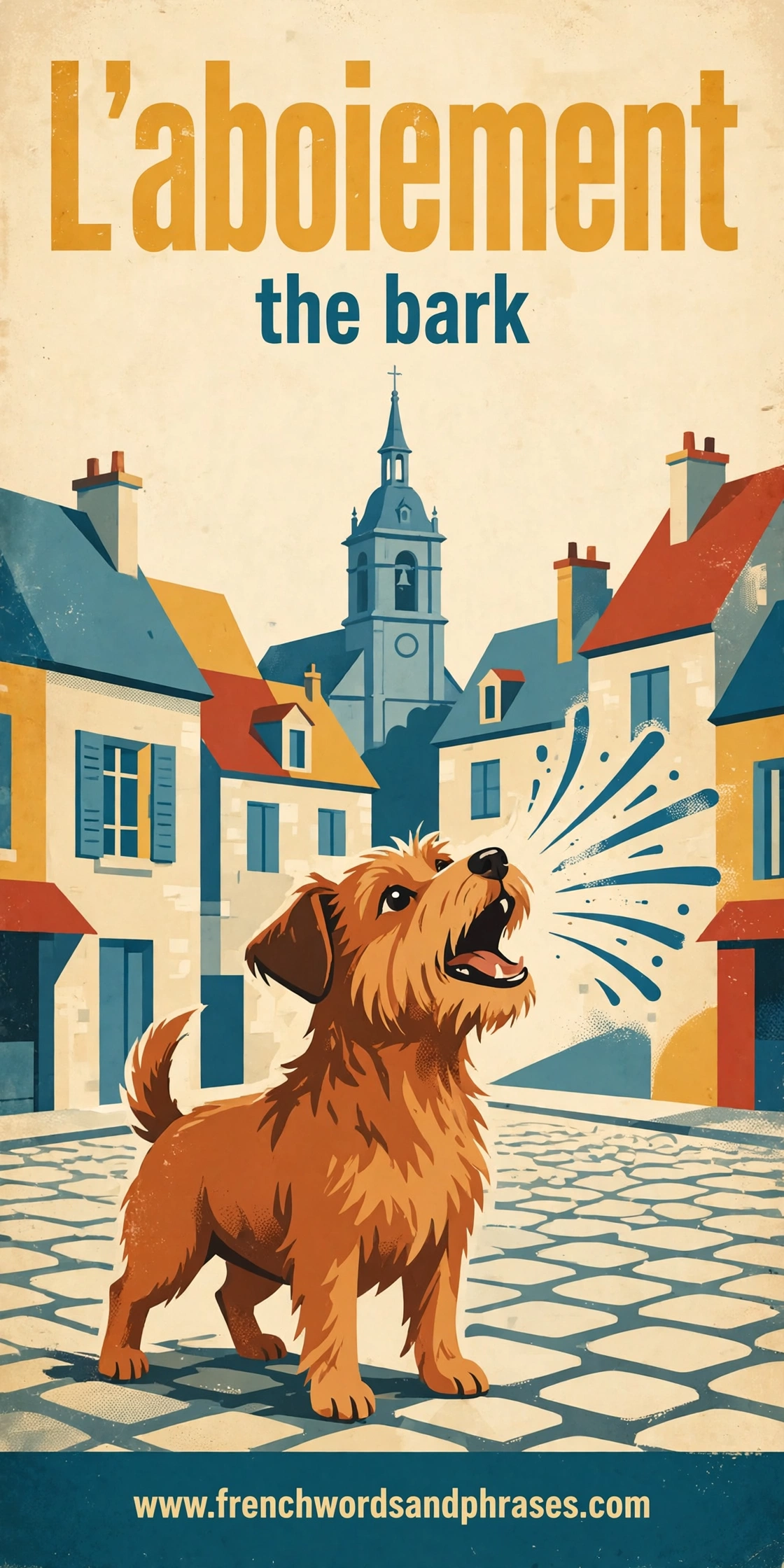
L’aboiement means the bark.
It is three in the morning, the street is silent, and suddenly the whole neighbourhood knows a cat has crossed the garden. One sharp sound started it all: l’aboiement du chien d’à côté.
In this guide, you’ll learn what aboiement means in English, how to use it with its articles, how to form its plural, and how it appears in everyday French. Explore French examples, English translations, and practice quizzes.
Understanding the French Noun Aboiement
Aboiement is a masculine French noun, learned with its article: l’aboiement, un aboiement — because it begins with a vowel, le shrinks to l’. It is built from the verb aboyer (to bark) with the ending -ment, and nouns in -ment are almost always masculine.
It means the bark — the short, sharp sound a dog makes, and barking in general. One bark is un aboiement; a whole chorus from the street is les aboiements. The dog itself is le chien, its softer protest is le grognement (the growl), and its long night song is le hurlement (the howl).
Gender: Masculine
Definite article: l’ — l’aboiement (the bark)
Indefinite article: un — un aboiement (a bark)
Plural: les aboiements
Built from: the verb aboyer (to bark) + -ment
English equivalents: The bark; barking.
One important usage detail: because aboiement starts with a vowel, you never say « le aboiement » — always l’aboiement, and possessives follow suit in the plural-friendly forms mon, ton, son. To say a dog is barking, French usually prefers the verb: le chien aboie.
Experience the Word
Aboiement is more than a noise. It is the dog’s whole vocabulary in one syllable — joy, warning, boredom and welcome, all announced at full volume.
Imagine the country lane at dusk: one dog starts behind a gate, then another answers across the field, and the news travels from farm to farm in aboiements.
You have not just heard a sound. You have been announced — signalé, the dog’s way.
How to Use Aboiement in French: Complete Guide
Let’s explore how aboiement works in French, beginning with its articles — and remember, the vowel start means l’ everywhere le or la would stand.
Aboiement with the Definite Article (L’, Les)
Aboiement begins with a vowel, so the definite article is l’ in the singular and les in the plural.
| Form | French |
|---|---|
| Masculine singular | l’aboiement |
| Plural | les aboiements |
Example
L’aboiement du chien réveille tout le quartier.
The dog’s barking wakes up the whole neighbourhood.
Aboiement with the Indefinite Article (Un, Des)
Used for one bark, or barking in general — un aboiement, des aboiements.
| Form | French |
|---|---|
| Masculine singular | un aboiement |
| Plural | des aboiements |
Example
Un aboiement soudain fait sursauter le bébé.
A sudden bark makes the baby jump.
Around the Aboiement: Words of the Dog
Barks, growls and wagging tails — the vocabulary that surrounds the aboiement.
| French | In English |
|---|---|
| le chien | the dog |
| aboyer | to bark |
| le grognement | the growl |
| le hurlement | the howl |
| la niche | the kennel |
| remuer la queue | to wag its tail |
Example
Le chien remue la queue avant de lancer un aboiement joyeux.
The dog wags its tail before letting out a joyful bark.
Quick Quiz 1
Complete the sentence:
______ aboiement du chien des voisins me réveille chaque matin.
Reveal the answer
L’
L’aboiement du chien des voisins me réveille chaque matin.
The neighbours’ dog’s barking wakes me every morning — l’, because aboiement begins with a vowel.
The Plural of Aboiement
Aboiement adds an -s in the plural — les aboiements, a whole concert of barks.
| Number | French |
|---|---|
| Singular | l’aboiement |
| Plural | les aboiements |
Example
On entend les aboiements des chiens du village toute la nuit.
You can hear the barking of the village dogs all night.
Aboiement with Possessive Adjectives (Mon, Ton, Son…)
Possessives agree with the noun: aboiement is masculine, so it takes mon, ton, son.
| Owner | French |
|---|---|
| my | mon aboiement |
| your (tu) | ton aboiement |
| his / her | son aboiement |
| our | notre aboiement |
| your (vous) | votre aboiement |
| their | leur aboiement |
Example
Leur chien est calme ; son aboiement est rare et bref.
Their dog is calm; its barking is rare and brief.
Quick Quiz 2
Complete the sentence:
______ aboiements viennent du jardin d’à côté. (These)
Reveal the answer
Ces
Ces aboiements viennent du jardin d’à côté.
That barking is coming from the garden next door — ces for the plural.
Aboiement with Demonstrative Adjectives (Cet, Ces)
Used to point: cet aboiement — cet, not ce, because of the opening vowel.
| Form | French |
|---|---|
| Masculine singular | cet aboiement |
| Plural | ces aboiements |
Example
Cet aboiement, c’est celui de Médor, je le reconnais.
That bark — that’s Médor’s, I recognise it.
Aboiement with Adjectives
Adjectives agree with aboiement: masculine forms, with -s in the plural.
| Adjective | With Aboiement |
|---|---|
| fort (loud) | un aboiement fort |
| joyeux (joyful) | un aboiement joyeux |
| soudain (sudden) | un aboiement soudain |
| lointain (distant) | un aboiement lointain |
| incessant (non-stop) | des aboiements incessants |
Example
Un aboiement joyeux accueille les enfants à la grille.
A joyful bark greets the children at the gate.
Quick Quiz 3
Complete the sentence:
Un aboiement ______ a réveillé le bébé. (sudden)
Reveal the answer
soudain
Un aboiement soudain a réveillé le bébé.
A sudden bark woke the baby — soudain, masculine, to match aboiement.
Everyday Expressions with Aboiement
Greetings, alarms and night noises — the aboiement phrases of daily life.
| Expression | In English |
|---|---|
| un aboiement de joie | a bark of joy |
| les aboiements du voisinage | the neighbourhood’s barking |
| au premier aboiement | at the first bark |
| un aboiement sec | a sharp bark |
| entendre un aboiement | to hear a bark |
| pousser un aboiement | to let out a bark |
Example
Au premier aboiement, le facteur recule d’un pas.
At the first bark, the postman steps back.
Words from the Same Family as Aboiement
Barking, growling and howling — the words that travel with aboiement.
| French | In English |
|---|---|
| aboyer | to bark |
| grogner | to growl |
| le grognement | the growl |
| hurler | to howl |
| le museau | the muzzle, the snout |
| la laisse | the lead, the leash |
Example
Le chien aboie, grogne, puis hurle à la lune.
The dog barks, growls, then howls at the moon.
Quick Quiz 4
What is the verb hidden inside aboiement?
Reveal the answer
Aboyer — to bark. Aboiement is aboyer dressed up as a noun with the ending -ment.
Le chien aboie dès qu’il voit un chat.
The dog barks as soon as it sees a cat.
Aboiement in Everyday French: Real-Life Examples
Now that you know the word, let’s see how aboiement appears in everyday French.
Example 1 — At the gate
Un aboiement joyeux accueille les invités.
A joyful bark greets the guests.
Example 2 — In the night
L’aboiement d’un chien lointain traverse la campagne.
A distant dog’s bark carries across the countryside.
Example 3 — A complaint
Les aboiements du chien des voisins durent depuis une heure.
The neighbours’ dog has been barking for an hour.
Example 4 — Training
Le dresseur récompense le chien après chaque aboiement sur commande.
The trainer rewards the dog after every bark on command.
Example 5 — Surprise
Un aboiement sec fait sursauter le chat endormi.
A sharp bark startles the sleeping cat.
Example 6 — Recognition
Je reconnais cet aboiement : c’est le chien du boulanger.
I recognise that bark: it’s the baker’s dog.
Beyond Translation: The Meaning of Aboiement
The aboiement is the soundtrack of French village life — every farm gate has its voice, and postmen learn each one by heart. French even measures character by it: un chien qui aboie beaucoup rarely bites, and the old proverb says « chien qui aboie ne mord pas » — the dog that barks does not bite.
To say aboiement is to hear the gate, the lane and the whole village answering back.
It evokes the letterbox rattling, the cat on the wall, the dusk chorus from farm to farm — one small word built from a verb, carrying a whole countryside inside it.
How to Remember the French Noun Aboiement
Remember it this way: Aboiement is the bark — the verb aboyer with the noun ending -ment, and an l’ in front because it starts with a vowel.
- You hear the verb inside it — aboyer, to bark.
- You see the ending — -ment, so the noun is masculine.
- You watch the vowel start — l’aboiement, never « le aboiement ».
The key idea is aboyer + -ment = l’aboiement, the bark.
Test Your Knowledge of Aboiement
Let’s see how much you’ve learned. Try answering these questions before revealing the answers.
Question 1
Is aboiement masculine or feminine?
Reveal the answer
Masculine — un aboiement, l’aboiement; nouns in -ment are almost always masculine.
Question 2
What verb is aboiement built from?
Reveal the answer
Aboyer — to bark.
Question 3
Translate: The dog’s barking wakes the baby.
Reveal the answer
L’aboiement du chien réveille le bébé.
Question 4
What is le grognement?
Reveal the answer
The growl — the dog’s lower, grumpier sound.
Question 5
Complete the sentence:
On entend ______ aboiement au loin.
Reveal the answer
un
On entend un aboiement au loin.
You can hear a bark in the distance.
Your Final Challenge
Can You Use It?
How would you say this in French?
“The dog lets out a joyful bark.”
Reveal the answer
Le chien pousse un aboiement joyeux.
The dog lets out a joyful bark.
A little French. A little curiosity. A richer everyday life.
LEARN FRENCH ONE WORD AT A TIME