A French Word to Live By
Translate Ça m’est égal to English
/sa mɛ.te.ɡal/
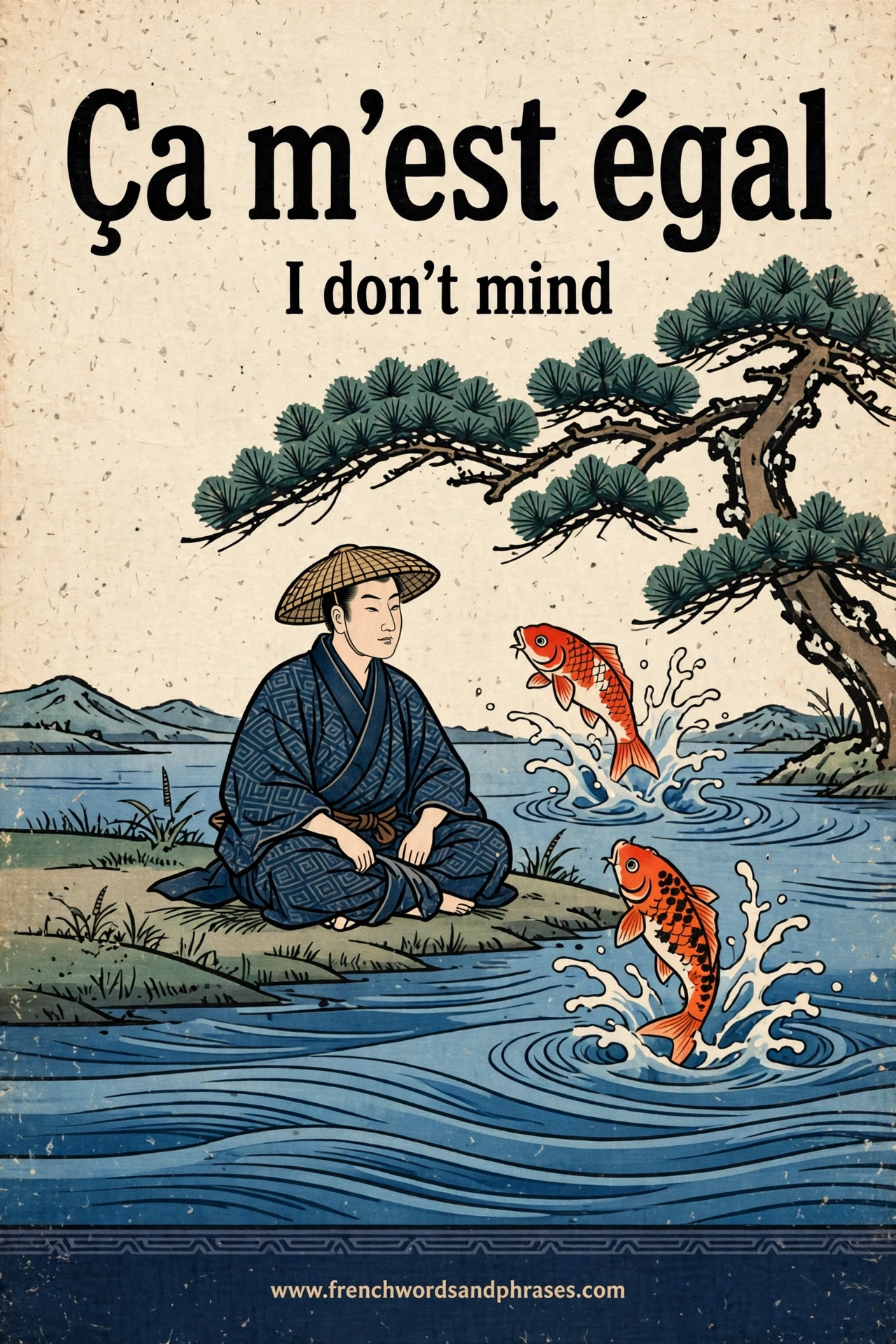
Ça m’est égal means I don’t mind — it’s all the same to me, either way is fine.
The waiter hovers with his pencil: « La terrasse ou l’intérieur, madame ? » Outside, sun; inside, shade and quiet. Your aunt, who is happy anywhere as long as there is lunch, waves the question away with a smile: « Ça m’est égal, choisissez pour moi. »
Let’s explore how ça m’est égal works in French, beginning with the whole phrase on one card.
Understanding the French Phrase Ça m’est égal
Ça m’est égal is a French idiomatic expression built from ça (that), me (to me), est (is) and égal (equal). Word for word, the two options weigh exactly the same in your scales — neither pan goes down.
It means I don’t mind — it’s all the same to me, either way is fine. It is the polite, civil way to have no preference: about tables, times, films and menus. Warmer than contempt and cooler than enthusiasm, it sits in the friendly middle — well below it on the rudeness ladder sit je m’en fiche and rien à cirer.
Type: Idiomatic expression — indifference (ça + être + égal)
Answers the need: Saying you have no preference — either option suits you
Register: Neutral to polite — safe everywhere, even at work
Strength: Mild — no preference, not contempt; the rude versions live elsewhere
One important usage detail: égal belongs to ça, never to the person — ça m’est égal, ça lui est égal, ça nous est égal, and a woman says exactly the same words as a man. To ask someone else, turn it round: « Ça t’est égal si on part à huit heures ? » — do you mind if we leave at eight?
Experience the Word
Ça m’est égal is the sound of a person who is easy to be with — the scales come out, both pans level, and the afternoon is saved.
Imagine the couple who ruin every holiday choosing restaurants. Now imagine the other couple: « La montagne ou la mer ? — Ça m’est égal, je te suis. » The sentence is small, but whole marriages are built on it: preference surrendered without a sigh.
French keeps a whole ladder of not-caring, from this polite level pan down to the shrug of je m’en fiche. Ça m’est égal is the rung you can use with anyone.
How to Use Ça m’est égal in French: Complete Guide
Let’s explore how ça m’est égal works in French, beginning with the whole phrase on one card.
Ça m’est égal at a Glance
The Whole Phrase on One Card
Real meaning, literal picture, English twin and register — ça m’est égal in five lines.
| Point | Ça m’est égal |
|---|---|
| What it really means | I don’t mind — it’s all the same to me, either way is fine |
| Word for word | that is equal to me |
| English equivalent | I don’t mind / it’s all the same to me / either way |
| Register | neutral to polite — safe everywhere |
| Use it for | choices of table, time, film, menu — anywhere you are happy either way |
Example
Le train ou la voiture ? Ça m’est égal.
The train or the car? I don’t mind.
Word by Word: Building the Level Scales
Four small pieces — take them one by one and the two pans settle level.
| Word | Literal meaning | Its job in the phrase |
|---|---|---|
| ça | that, it | the situation or choice being weighed — the true subject of the sentence |
| m’ | to me | the person doing the weighing — me, you, him, all slide into this slot |
| est | is | the little verb that holds the scales still |
| égal | equal, level | the verdict: both options weigh the same — from maths, where deux et deux font quatre, two and two are four |
Example
Ça lui est égal, il suit le groupe.
He doesn’t mind, he goes along with the group.
Quick Quiz 1
Literally, what is ‘equal’ in ça m’est égal?
Reveal the answer
The two options — they weigh exactly the same in your scales, so neither one wins.
Mer ou montagne ? Ça m’est égal, les deux me plaisent.
Sea or mountains? I don’t mind, I like both.
When You Say It: The No-Preference Moments
Ça m’est égal fires at moments like these — wherever a choice is offered and you are genuinely happy either way.
| Situation | Example |
|---|---|
| Choosing a table | terrasse ou intérieur ? ça m’est égal — terrace or inside? I don’t mind |
| Setting a time | huit heures ou neuf heures, ça m’est égal — eight or nine o’clock, it’s all the same to me |
| Picking a film | comédie ou drame ? ça m’est égal, choisis — comedy or drama? I don’t mind, you choose |
| Train or car | le train ou la voiture, ça m’est égal — train or car, either way |
| The menu | poisson ou viande, ça m’est complètement égal — fish or meat, I really don’t mind |
Example
Samedi ou dimanche, ça m’est égal : je suis libre.
Saturday or Sunday, I don’t mind: I’m free.
Make It Yours: The Scales for Every Person
The person slides through the middle of the phrase — and égal never moves a millimetre.
| Form | French | In English |
|---|---|---|
| I don’t mind | ça m’est égal | I don’t mind |
| Do you mind? | ça t’est égal ? | do you mind? / is it all the same to you? |
| He doesn’t mind | ça lui est égal | he doesn’t mind |
| We don’t mind | ça nous est égal | we don’t mind |
| Completely | ça m’est complètement égal | I really don’t mind at all |
| Asking permission | ça t’est égal si on part à huit heures ? | do you mind if we leave at eight? |
Example
Ça vous est égal si je m’assieds ici ?
Do you mind if I sit here?
Quick Quiz 2
A woman is speaking. Must she say ça m’est égale?
Reveal the answer
No — égal agrees with ça, not with the speaker. Ça m’est égal is the phrase for everyone.
Elle répond : « Ça m’est égal », comme tout le monde.
She answers: ‘I don’t mind’, like everyone else.
Everyday Expressions: Building on the Scales
Ça m’est égal slots into these everyday frames — each one ready to use as it stands.
| Frame | In English |
|---|---|
| ça m’est égal | I don’t mind |
| ça m’est égal, choisis | I don’t mind, you choose |
| ça m’est complètement égal | I really don’t mind at all |
| si ça t’est égal | if you don’t mind / if it’s all the same to you |
| ça m’est bien égal | it’s all the same to me — a firmer shrug |
Example
Si ça t’est égal, on prendra le train de midi.
If you don’t mind, we’ll take the midday train.
Close Cousins: The Ladder of Not Caring
French has a whole ladder of indifference — ça m’est égal stands on the polite rung; its cousins climb down towards the shrug.
| Expression | The difference |
|---|---|
| ça m’est égal | I don’t mind — polite, level scales, safe anywhere |
| peu importe | it hardly matters — a touch firmer, a touch cooler |
| comme tu veux | as you like — hands the choice itself to the other person |
| ça ne me dérange pas | it doesn’t bother me — the answer to a request for permission |
| je m’en fiche | I don’t care — familiar, and rude in the wrong room |
Example
Peu importe le film, ça m’est égal, comme tu veux.
Never mind the film, I don’t mind, as you like.
Quick Quiz 3
Which cousin is too rude to say to your boss — ça m’est égal or je m’en fiche?
Reveal the answer
Je m’en fiche — it dismisses the matter entirely. Ça m’est égal stays polite: the scales are level, the speaker is easy.
Au bureau, on dit « ça m’est égal », jamais « je m’en fiche ».
At the office, you say ‘I don’t mind’, never ‘I don’t care’.
Ça m’est égal and Its Neighbours
The indifference shelf around the phrase — choices, permissions and old slang for sameness.
| French | In English |
|---|---|
| indifférent | indifferent |
| une préférence | a preference |
| choisir | to choose |
| peu importe | it hardly matters |
| kif-kif | all the same — old slang, from Arabic, beloved of grandfathers |
| bonnet blanc et blanc bonnet | six of one and half a dozen of the other — literally white cap and cap white |
Example
Train ou voiture ? Kif-kif, ça m’est égal.
Train or car? All the same, I don’t mind.
Watch Out: The Traps Around Ça m’est égal
The traps: an agreement that never happens, a legal lookalike one letter away, and a tone that can freeze a warm phrase.
| Trap | The truth |
|---|---|
| the agreement trap | ça m’est égale does not exist — égal belongs to ça and never changes for the speaker |
| the legal lookalike | égal means equal; légal means legal — one letter moves you from the scales to the courtroom |
| tone decides | said with a smile it means ‘I’m easy’; said flat, it can sound dismissive — the voice loads the scales |
| not for strong feelings | if you truly hate one option, ça m’est égal is a lie — French will find out, and so will your host |
Example
Ce n’est pas légal, et non, ça ne m’est pas égal.
That is not legal, and no, I do mind.
Quick Quiz 4
True or false: égal changes to égale when the speaker is a woman.
Reveal the answer
False — égal agrees with ça, the subject of the sentence, and ça is the same for everyone.
Ça m’est égal, dit-elle en souriant.
I don’t mind, she says, smiling.
Ça m’est égal in Everyday French: Real-Life Examples
Now that you know the word, let’s see how ça m’est égal appears in everyday French.
Example 1 — At the restaurant
Terrasse ou intérieur ? Ça m’est égal, choisissez.
Terrace or inside? I don’t mind, you choose.
Example 2 — Setting the time
Huit heures ou neuf heures, ça m’est égal.
Eight o’clock or nine, I don’t mind.
Example 3 — The film
Comédie ou drame, ça m’est complètement égal.
Comedy or drama, I really don’t mind.
Example 4 — Asking permission
Ça t’est égal si j’ouvre la fenêtre ?
Do you mind if I open the window?
Example 5 — The journey
Le train ou la voiture, ça nous est égal.
The train or the car, we don’t mind.
Example 6 — Handing over
Si ça t’est égal, je préfère partir tôt.
If you don’t mind, I’d rather leave early.
Beyond Translation: The Meaning of Ça m’est égal
English ‘I don’t mind’ denies a bother — a small negative. French weighs the matter instead: the two options go into the pans of a scale, the needle settles in the middle, and the verdict is equality.
Ça m’est égal turns indifference into arithmetic — nothing is dismissed, everything is balanced.
That is why the phrase stays welcome everywhere: it refuses nothing, it merely declines to choose.
How to Remember the French Phrase Ça m’est égal
Remember it this way: Ça m’est égal is a pair of scales at rest — both pans level, the needle in the middle, lunch saved.
- You picture the scales — the two options weigh the same, so neither pan goes down.
- You freeze égal — it belongs to ça, never to the speaker: the same words for everyone.
- You stay on the polite rung — je m’en fiche is the rude cousin waiting below.
The key idea is ça m’est égal means I don’t mind — the options weigh the same in your scales.
Test Your Knowledge of Ça m’est égal
Let’s see how much you’ve learned. Try answering these questions before revealing the answers.
Question 1
What does ça m’est égal mean?
Reveal the answer
I don’t mind — it’s all the same to me, either way is fine.
Question 2
What is the literal picture inside the phrase?
Reveal the answer
A pair of level scales — the two options weigh exactly the same to you.
Question 3
Does égal change when a woman speaks?
Reveal the answer
No — égal agrees with ça, not with the speaker. Ça m’est égal for everyone.
Question 4
Which cousin is too rude for the office?
Reveal the answer
Je m’en fiche — I don’t care. Ça m’est égal is the polite rung of the ladder.
Question 5
Complete the sentence:
Le train ou la voiture ? Ça m’est ______. (The train or the car? I don’t mind.)
Reveal the answer
égal
Le train ou la voiture ? Ça m’est égal.
The train or the car? I don’t mind.
Your Final Challenge
Can You Use It?
How would you say this in French?
“I don’t mind — you choose.”
Reveal the answer
Ça m’est égal — choisis, toi.
I don’t mind — you choose.
A little French. A little curiosity. A richer everyday life.
LEARN FRENCH ONE WORD AT A TIME