A French Word to Live By
Translate Un tête-à-tête to English
/œ̃ tɛt a tɛt/
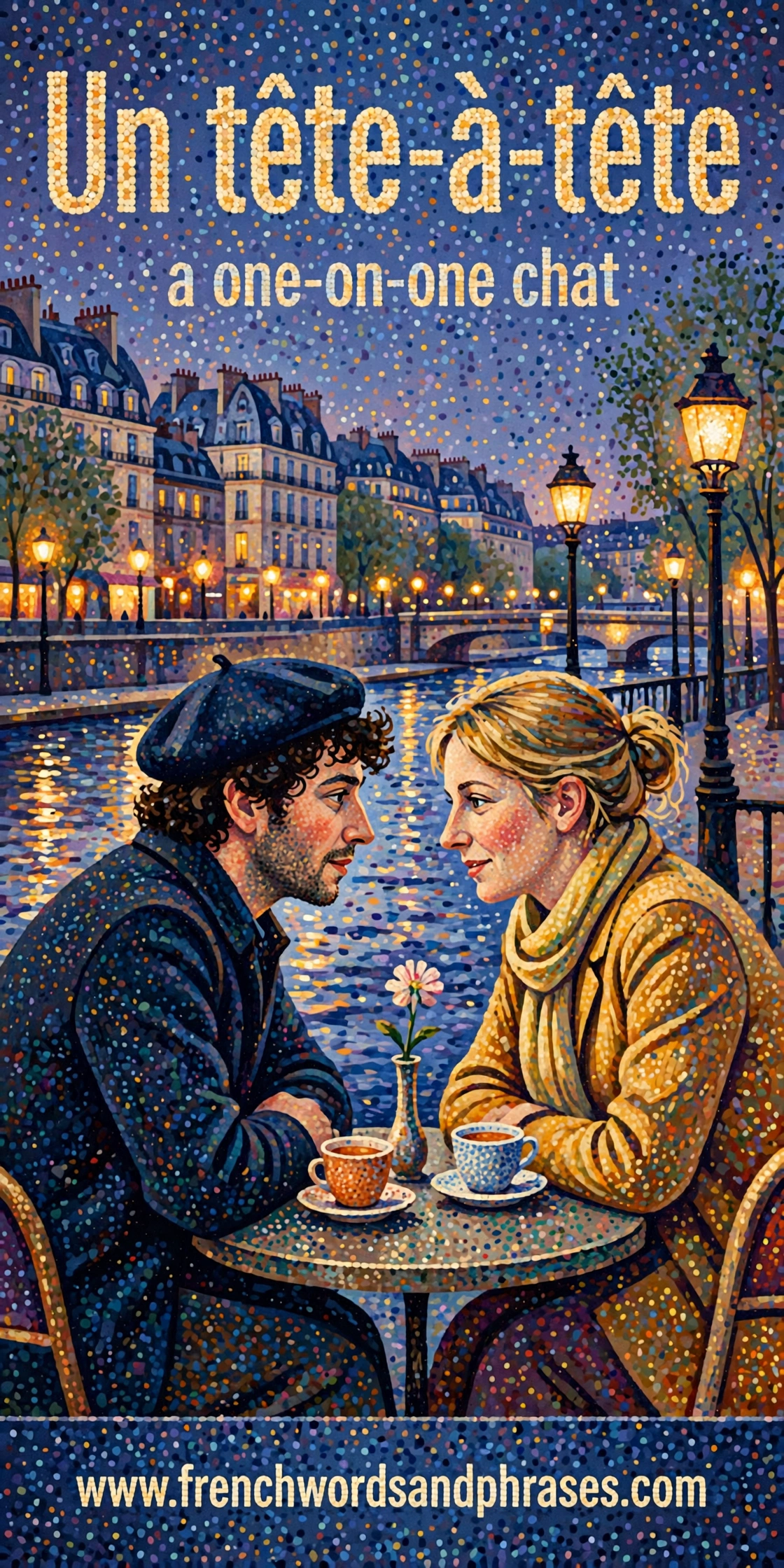
Un tête-à-tête means a one-on-one chat — a private conversation between two people.
The whole team has been dancing around the problem for a week in group meetings that solve nothing. Finally your manager closes her door, pulls up a second chair, and says the words that change the temperature: « On va discuter en tête-à-tête. »
Let’s explore how un tête-à-tête works in French, beginning with the whole phrase on one card.
Understanding the French Phrase Un tête-à-tête
Un tête-à-tête is a French idiomatic expression built from tête (head) twice, joined by à — head to head. As a noun it is a private conversation between two people; as an adverb, en tête-à-tête, it means alone together, just the two of you. English borrowed the phrase whole, accents and all.
It means a one-on-one chat — a private, face-to-face conversation between exactly two people. Nobody is touching heads: the picture is of two heads close together, talking quietly, with the rest of the world shut out. It can be romantic — a dinner for two — or serious: the private talk where the real things finally get said.
Type: Idiomatic expression — conversation (a noun, and an adverb: en tête-à-tête)
Answers the need: Naming a private talk between exactly two people
Register: Neutral to elegant — safe everywhere, with a slightly refined flavour
Strength: Intimate — privacy is the whole point; a third person breaks the spell
One important usage detail: tête-à-tête never changes — it is invariable, with its two hyphens always in place, in the plural too: des tête-à-tête. It works two ways: as a noun, un tête-à-tête, for the meeting itself, and as an adverb after en — dîner en tête-à-tête, to dine just the two of you. English borrowed it unchanged, so the French and English phrases are the same words.
Experience the Word
Un tête-à-tête is the conversation with the doors closed — two heads close, and the truth finally at normal volume.
Imagine how many things are only said this way: the apology, the proposal, the confession, the real reason for leaving. Groups perform; pairs confess. The French phrase keeps the picture physical — two heads leaning in — because privacy, in the end, is a distance measured in centimetres.
It is also the most hopeful phrase in an office. When the meeting of twelve fails, the tête-à-tête of two decides.
How to Use Un tête-à-tête in French: Complete Guide
Let’s explore how un tête-à-tête works in French, beginning with the whole phrase on one card.
Un tête-à-tête at a Glance
The Whole Phrase on One Card
Real meaning, literal picture, English twin and register — un tête-à-tête in five lines.
| Point | Un tête-à-tête |
|---|---|
| What it really means | a one-on-one chat — a private conversation between two people |
| Word for word | a head-to-head |
| English equivalent | a tête-à-tête (borrowed unchanged) / a one-on-one / a private chat |
| Register | neutral to elegant — safe everywhere |
| Use it for | private talks, serious conversations, dinners for two |
Example
Elle lui a demandé un tête-à-tête pour tout lui expliquer.
She asked him for a one-on-one to explain everything to him.
Word by Word: Building the Two Heads
Three small pieces — take them one by one and the two heads lean together.
| Word | Literal meaning | Its job in the phrase |
|---|---|---|
| tête | head | the first head — one of the two people, present in body and attention |
| à | to | the little link that turns the heads towards each other |
| tête | head | the second head — the partner in the conversation, equally close |
Example
Tête contre tête, ils ont parlé jusqu’à minuit.
Head against head, they talked until midnight.
Quick Quiz 1
How many people are in a tête-à-tête?
Reveal the answer
Exactly two — a third person ends it. The two heads are the whole definition.
Un tête-à-tête, c’est deux personnes, pas trois.
A one-on-one is two people, not three.
When You Say It: The Private-Talk Moments
Un tête-à-tête fires at moments like these — something needs saying that only works between two.
| Situation | Example |
|---|---|
| At work | un tête-à-tête avec la directrice — a one-on-one with the director |
| A serious talk | il faut qu’on se parle en tête-à-tête — we need to talk one-on-one |
| A romantic dinner | un dîner en tête-à-tête — a dinner just for two |
| A confession | en tête-à-tête, elle lui a tout avoué — alone together, she confessed everything to him |
| Sorting out a problem | réglons ça en tête-à-tête — let’s sort this out one-on-one |
Example
Réglons ce malentendu en tête-à-tête, calmement.
Let’s sort out this misunderstanding one-on-one, calmly.
Make It Yours: The Talk in Every Frame
The phrase itself never changes — the frames around it carry the grammar.
| Form | French | In English |
|---|---|---|
| The meeting | un tête-à-tête | a one-on-one, a private chat |
| Alone together | en tête-à-tête | one-on-one, just the two of us |
| To have one | avoir un tête-à-tête avec quelqu’un | to have a one-on-one with someone |
| Dining for two | dîner en tête-à-tête | to have a romantic dinner for two |
| Plural | des tête-à-tête | one-on-one meetings (the phrase never changes) |
| Request | je voudrais un tête-à-tête | I would like a private word |
Example
Ce soir, ils dînent en tête-à-tête pour leur anniversaire.
Tonight they’re having a dinner for two for their anniversary.
Quick Quiz 2
What is the plural of un tête-à-tête — des têtes-à-têtes or des tête-à-tête?
Reveal the answer
Des tête-à-tête — the phrase is invariable: hyphens fixed, no s anywhere.
Elle a enchaîné trois tête-à-tête dans la matinée.
She had three one-on-ones back to back in the morning.
Everyday Expressions: Building on the Two Heads
Un tête-à-tête slots into these everyday frames — each one ready to use as it stands.
| Frame | In English |
|---|---|
| un tête-à-tête | a one-on-one chat |
| en tête-à-tête | one-on-one, alone together |
| avoir un tête-à-tête avec quelqu’un | to have a private word with someone |
| dîner en tête-à-tête | to dine just the two of you |
| se retrouver en tête-à-tête | to find yourselves alone together |
Example
Ils se sont retrouvés en tête-à-tête pour la première fois.
They found themselves alone together for the first time.
Close Cousins: The Other Private Talks
French has a small shelf of two-person phrases — the tête-à-tête is the elegant one; its cousins are plainer, more secret or more formal.
| Expression | The difference |
|---|---|
| un tête-à-tête | a one-on-one chat — private, elegant, romantic or serious |
| en privé | in private — the plain, neutral version, no picture attached |
| entre quatre yeux | between four eyes — the same privacy, more familiar and more secretive |
| un entretien | an interview, a formal meeting — the office word, no intimacy promised |
| un rendez-vous | an appointment, a date — the meeting itself, whatever its size |
| en amoureux | as a couple in love — the romantic frame, without the conversation |
Example
Entre quatre yeux ou en tête-à-tête, il fallait lui parler seul.
Between four eyes or one-on-one, he had to speak to him alone.
Quick Quiz 3
Which cousin counts the eyes instead of the heads — entre quatre yeux or un entretien?
Reveal the answer
Entre quatre yeux — ‘between four eyes’: two people, four eyes, total privacy. Un entretien is a formal interview.
Je te dirai ça entre quatre yeux.
I’ll tell you that between you and me.
Un tête-à-tête and Its Neighbours
The privacy shelf around the phrase — the talk, the place, and the secret.
| French | In English |
|---|---|
| une conversation | a conversation |
| discuter | to discuss, to chat |
| un secret | a secret — what tête-à-têtes are for |
| seul à seul | alone together, one to one |
| une confidence | a confidence, a secret told |
| écouter | to listen — the second head’s main job |
Example
En tête-à-tête, les confidences viennent toutes seules.
In a one-on-one, confidences come all by themselves.
Watch Out: The Traps Around Un tête-à-tête
The traps: hyphens that must not move, an s that never comes, and a sofa with the same name.
| Trap | The truth |
|---|---|
| the invariable trap | tête-à-tête never changes — no plural s, hyphens always: des tête-à-tête, en tête-à-tête |
| the furniture trap | un tête-à-tête is also an old-fashioned S-shaped double chair for two — charming, but in modern speech the conversation wins |
| not a confrontation | despite the two heads facing each other, the phrase is not a clash — it is privacy, which can be tender as easily as serious |
| word for word in English | English borrowed it whole — tête-à-tête, accents included; a rare free gift between the two languages |
Example
Ce n’est pas un affrontement, c’est un tête-à-tête.
It’s not a confrontation, it’s a one-on-one.
Quick Quiz 4
True or false: a tête-à-tête can include three people if one of them stays quiet.
Reveal the answer
False — two people, by definition. A quiet third person still makes it a meeting, not a tête-à-tête.
À trois, ce n’est plus un tête-à-tête.
With three, it’s no longer a one-on-one.
Un tête-à-tête in Everyday French: Real-Life Examples
Now that you know the word, let’s see how un tête-à-tête appears in everyday French.
Example 1 — At work
Elle a demandé un tête-à-tête avec sa directrice.
She asked for a one-on-one with her director.
Example 2 — The serious talk
Il faut qu’on se parle en tête-à-tête ce soir.
We need to talk one-on-one tonight.
Example 3 — The anniversary dinner
Ils ont réservé une petite table pour un dîner en tête-à-tête.
They booked a little table for a dinner for two.
Example 4 — Sorting it out
Réglons ce problème en tête-à-tête, sans les autres.
Let’s sort out this problem one-on-one, without the others.
Example 5 — The confession
En tête-à-tête, il lui a enfin dit la vérité.
Alone together, he finally told her the truth.
Example 6 — Back to back
Trois tête-à-tête dans la matinée, elle est épuisée.
Three one-on-ones in the morning, she’s exhausted.
Beyond Translation: The Meaning of Un tête-à-tête
Most languages describe privacy by what it excludes — alone, in private, behind closed doors. French describes it by what it includes: two heads, close together. The picture is tender and exact, which is why English stole it without changing a letter — some phrases are already perfect in their first language.
A tête-à-tête is the smallest possible public: two people, and the world asked to wait outside.
Serious or romantic, it is the unit in which the real conversations of a life are counted.
How to Remember the French Phrase Un tête-à-tête
Remember it this way: Un tête-à-tête is two heads leaning close — the smallest public there is, and the world asked to wait outside.
- You count the heads — exactly two people; a third turns it into a meeting.
- You keep it frozen — tête-à-tête never changes: hyphens fixed, no plural s, ever.
- You use both shapes — the noun un tête-à-tête for the talk, en tête-à-tête for being alone together.
The key idea is un tête-à-tête means a one-on-one chat — a private conversation between exactly two people.
Test Your Knowledge of Un tête-à-tête
Let’s see how much you’ve learned. Try answering these questions before revealing the answers.
Question 1
What does un tête-à-tête mean?
Reveal the answer
A one-on-one chat — a private conversation between exactly two people.
Question 2
What is the literal, word-for-word meaning?
Reveal the answer
A head-to-head — two heads close together, with the rest of the world shut out.
Question 3
How do you say ‘a dinner for two’?
Reveal the answer
Un dîner en tête-à-tête — en tête-à-tête works as an adverb: alone together.
Question 4
What is the difference between un tête-à-tête and entre quatre yeux?
Reveal the answer
Almost none in meaning — both are private, between two. Entre quatre yeux is more familiar and secretive; tête-à-tête is the elegant one.
Question 5
Complete the sentence:
Je voudrais un ______ avec toi. (I would like a one-on-one with you.)
Reveal the answer
tête-à-tête
Je voudrais un tête-à-tête avec toi.
I would like a one-on-one with you.
Your Final Challenge
Can You Use It?
How would you say this in French?
“We need a one-on-one chat.”
Reveal the answer
Il nous faut un tête-à-tête.
We need a one-on-one chat.
A little French. A little curiosity. A richer everyday life.
LEARN FRENCH ONE WORD AT A TIME