A French Word to Live By
Translate Passer du coq à l’âne to English
/pa.se dy kɔk a lan/
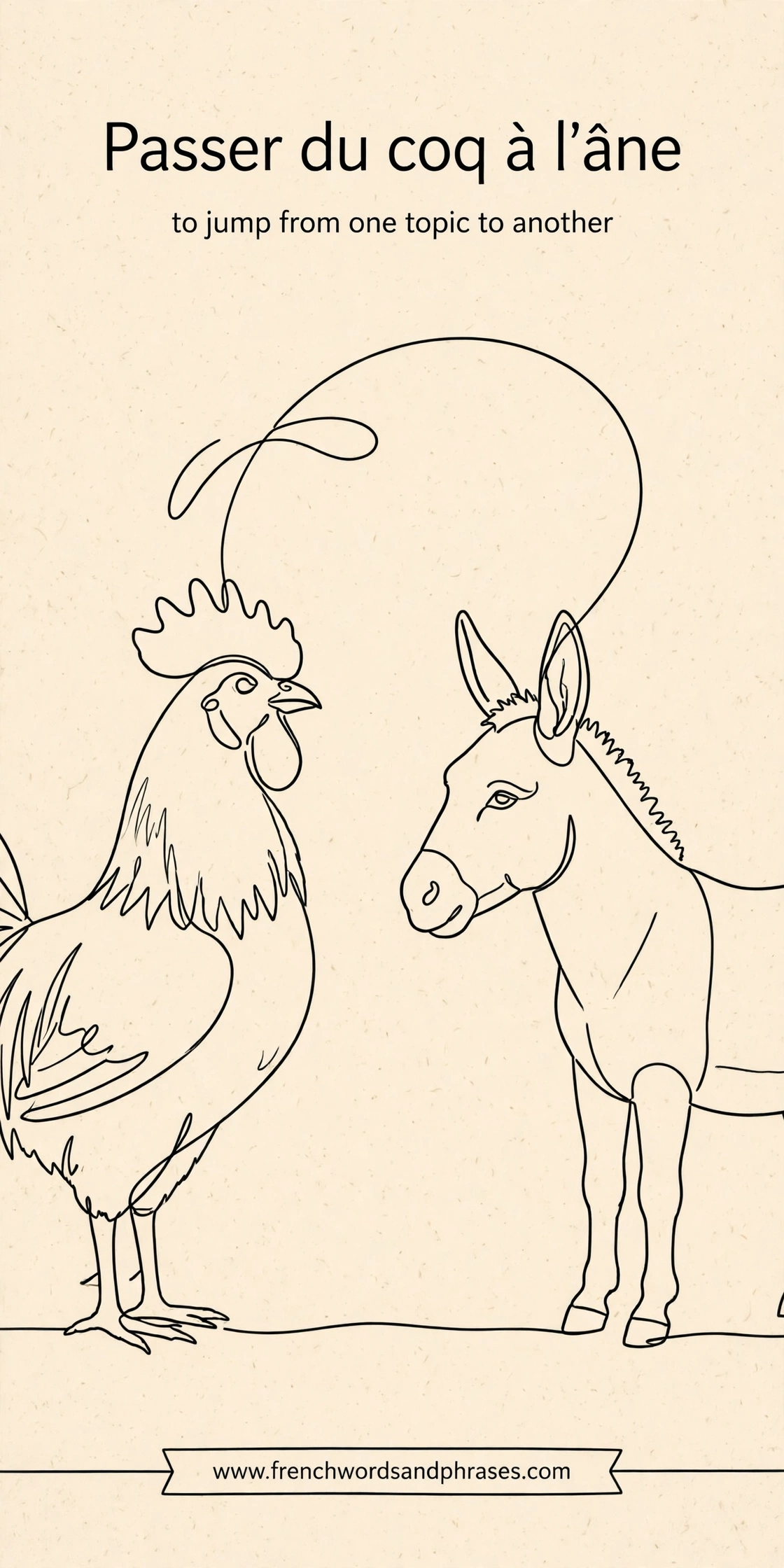
Passer du coq à l’âne means to jump from one subject to another — to change topic with no link at all.
Your grandfather is explaining the new roof. Within one breath the roof becomes the war, the war becomes a recipe for soup, and the soup becomes the price of petrol in 1974. Your aunt smiles at you across the table and mouths the old verdict: « Il passe du coq à l’âne. »
Let’s explore how passer du coq à l’âne works in French, beginning with the whole phrase on one card.
Understanding the French Phrase Passer du coq à l’âne
Passer du coq à l’âne is a French idiomatic expression built from passer (to pass, to move), le coq (the rooster) and l’âne (the donkey). It describes conversation that leaps from one subject to a completely unrelated one, with no bridge between them.
It means to jump from one subject to another — to change topic abruptly, mid-conversation, with no link at all. The picture is a farmyard leap: one moment you are on the rooster, the next on the donkey, and nobody saw the jump. The variant sauter du coq à l’âne — to leap rather than pass — paints exactly the same jump with a livelier verb.
Type: Idiomatic expression — conversation (verb + two farm animals)
Answers the need: Saying a speaker keeps leaping between unrelated topics
Register: Neutral to informal — affectionate teasing more often than real criticism
Strength: Vivid but gentle — it mocks the jump, not the jumper
One important usage detail: the variant sauter du coq à l’âne is the same expression with sauter, to jump, in place of passer — many speakers treat them as one phrase with two doors. Use either; the animals never change, and the jump must always be linkless: a logical transition is not a coq-à-l’âne, however fast it is.
Experience the Word
Passer du coq à l’âne is the phrase French keeps for its favourite talkers — the uncles, grandmothers and radio hosts whose minds move by trampoline.
Imagine a Sunday lunch where the conversation visits the harvest, a divorce, the moon landing and a lost umbrella inside ten minutes. Nobody minds; the leaps are the entertainment. The phrase is said with a smile, because a family that jumps from rooster to donkey is never boring.
French could have called it changing the subject. Instead it staged the change as a farmyard leap, and made it charming.
How to Use Passer du coq à l’âne in French: Complete Guide
Let’s explore how passer du coq à l’âne works in French, beginning with the whole phrase on one card.
Passer du coq à l’âne at a Glance
The Whole Phrase on One Card
Real meaning, literal picture, English twin and register — passer du coq à l’âne in five lines.
| Point | Passer du coq à l’âne |
|---|---|
| What it really means | to jump from one subject to another, with no link between them |
| Word for word | to pass from the rooster to the donkey — a farmyard leap mid-sentence |
| English equivalent | to jump from one topic to another / to change the subject abruptly |
| Register | neutral to informal — usually affectionate teasing |
| Use it for | rambling stories, wandering meetings, grandparents at lunch |
Example
Il passe du coq à l’âne toutes les deux minutes.
He jumps from one subject to another every two minutes.
Word by Word: Building the Leap
Five small pieces — take them one by one and the conversation leaves the ground.
| Word | Literal meaning | Its job in the phrase |
|---|---|---|
| passer | to pass, to move over | the travelling verb — the conversation moves house without packing |
| du | from the | the departure gate: the topic you are leaving |
| coq | rooster | topic one — proud, noisy, impossible to predict |
| à | to | the whole journey in one small word — there is no road, only the leap |
| l’âne | the donkey | topic two — unrelated to topic one in every way that matters |
Example
Du coq à l’âne, sans prévenir, c’est sa spécialité.
From the rooster to the donkey, without warning — that’s his speciality.
Quick Quiz 1
What must be missing between the two topics in passer du coq à l’âne?
Reveal the answer
Any link at all — a logical bridge makes it a normal transition; the idiom requires the jump to be bare.
De la météo aux impôts, du coq à l’âne.
From the weather to taxes — rooster to donkey.
When You Say It: The Wandering-Talk Moments
Passer du coq à l’âne fires at moments like these — the conversation has left its subject, and everyone noticed the exact second it happened.
| Situation | Example |
|---|---|
| About a storyteller | il passe du coq à l’âne, on ne suit plus — he jumps about, we’ve lost the thread |
| In a meeting | on passe du coq à l’âne, revenons au budget — we’re jumping around, back to the budget |
| About yourself | pardon, je passe du coq à l’âne — sorry, I’m jumping from topic to topic |
| About a grandparent | mamie passe du coq à l’âne, mais ses histoires sont belles — granny jumps about, but her stories are lovely |
| About an interview | le candidat passe du coq à l’âne, c’est mauvais signe — the candidate keeps jumping topics, a bad sign |
Example
Ce professeur passe du coq à l’âne, les élèves adorent ça.
This teacher jumps from topic to topic, the students love it.
Make It Yours: The Leap in Every Tense
Passer conjugates regularly — and the variant swaps in sauter without changing a single animal.
| Form | French | In English |
|---|---|---|
| Present | il passe du coq à l’âne | he jumps from topic to topic |
| The variant | il saute du coq à l’âne | he leaps from topic to topic — same idiom |
| Past | elle est passée du coq à l’âne | she jumped from topic to topic |
| Habit | tu passes toujours du coq à l’âne | you always jump from topic to topic |
| As a noun | un vrai coq-à-l’âne | a real piece of topic-jumping |
| Question | pourquoi tu passes du coq à l’âne ? | why do you keep jumping topics? |
Example
En cinq minutes, elle est passée du coq à l’âne trois fois.
In five minutes, she jumped from topic to topic three times.
Quick Quiz 2
What changes in the variant sauter du coq à l’âne?
Reveal the answer
Only the verb — sauter, to jump, replaces passer. The rooster, the donkey and the missing link all stay the same.
Il saute du coq à l’âne dès qu’il est fatigué.
He leaps from topic to topic as soon as he’s tired.
Everyday Expressions: Building on the Leap
Passer du coq à l’âne slots into these everyday frames — each one ready to use as it stands.
| Frame | In English |
|---|---|
| passer du coq à l’âne | to jump from one subject to another |
| sauter du coq à l’âne | to leap from one subject to another — the variant |
| un coq-à-l’âne | a piece of topic-jumping — the leap turned into a noun |
| passer sans arrêt du coq à l’âne | to jump about non-stop |
| du coq à l’âne en une phrase | from rooster to donkey in a single sentence |
Example
Son discours est un vrai coq-à-l’âne du début à la fin.
His speech is one long piece of topic-jumping from start to finish.
Close Cousins: The Other Wandering Talks
French has a whole shelf of wandering-conversation phrases — the coq-à-l’âne is the charming one; its cousins judge the wandering more strictly.
| Expression | The difference |
|---|---|
| passer du coq à l’âne | to jump between unrelated topics — vivid, usually affectionate |
| changer de sujet | to change the subject — plain and neutral, the jump may be deliberate and smooth |
| partir dans tous les sens | to go off in all directions — the talk scatters, not just jumps |
| faire une digression | to make a digression — one planned detour, a touch formal |
| perdre le fil | to lose the thread — the speaker themselves gets lost, not just the topic |
Example
Il a changé de sujet si vite que personne n’a vu le coq ni l’âne.
He changed the subject so fast that nobody saw the rooster or the donkey.
Quick Quiz 3
A speaker smoothly moves from prices to delivery times with a clear link. Is that passer du coq à l’âne?
Reveal the answer
No — that is changer de sujet, a normal transition. The coq-à-l’âne demands the link be missing.
Il change de sujet proprement, sans coq-à-l’âne.
He changes the subject cleanly, with no topic-jumping.
Passer du coq à l’âne and Its Neighbours
The conversation shelf around the phrase — from the thread itself to losing it entirely.
| French | In English |
|---|---|
| un sujet | a subject, a topic |
| le fil de la conversation | the thread of the conversation |
| changer de sujet | to change the subject |
| passer du coq à l’âne | to jump from topic to topic |
| une digression | a digression |
| perdre le fil | to lose the thread |
Example
Gardons le fil : pas de coq-à-l’âne pendant la réunion.
Let’s keep the thread: no topic-jumping during the meeting.
Watch Out: The Traps Around Passer du coq à l’âne
The traps: animals that stay fixed, a jump that needs its missing link, and criticism that is usually a caress.
| Trap | The truth |
|---|---|
| the animal trap | the pair is fixed — coq and âne, in that order; swapping in other animals destroys the idiom |
| the link trap | if listeners can see why topic two followed topic one, it is not a coq-à-l’âne — the missing bridge is the whole point |
| tone is usually warm | the phrase teases more than it accuses — said of a beloved storyteller, it is almost a compliment |
| the noun wears hyphens | as a noun it is written un coq-à-l’âne, with hyphens gluing the leap together |
Example
Ce n’est pas un reproche : son coq-à-l’âne fait son charme.
It’s not a criticism: his topic-jumping is part of his charm.
Quick Quiz 4
True or false: passer du coq à l’âne is always an insult.
Reveal the answer
False — it is usually affectionate teasing, said of storytellers whose leaps entertain more than they annoy.
Il passe du coq à l’âne, et on l’écouterait des heures.
He jumps from topic to topic, and we’d listen to him for hours.
Passer du coq à l’âne in Everyday French: Real-Life Examples
Now that you know the word, let’s see how passer du coq à l’âne appears in everyday French.
Example 1 — At lunch
Grand-père passe du coq à l’âne, mais on adore ses histoires.
Grandad jumps from topic to topic, but we love his stories.
Example 2 — In a meeting
On passe du coq à l’âne, revenons à l’ordre du jour.
We’re jumping about, let’s get back to the agenda.
Example 3 — About yourself
Pardon, je passe du coq à l’âne, je reprends mon histoire.
Sorry, I’m jumping topics, let me get back to my story.
Example 4 — The variant
Elle saute du coq à l’âne dès qu’elle est excitée.
She leaps from topic to topic as soon as she’s excited.
Example 5 — About a podcast
Ce podcast passe du coq à l’âne, on ne s’ennuie jamais.
This podcast jumps from topic to topic, you’re never bored.
Example 6 — As a noun
Son explication est un vrai coq-à-l’âne.
His explanation is a real piece of topic-jumping.
Beyond Translation: The Meaning of Passer du coq à l’âne
English changes the subject — flat, administrative, like a clerk stamping a form. French crosses a farmyard in one leap, from the proudest bird to the stubbornest beast, and the whole table can see the jump.
To passer du coq à l’âne is to make conversation a sport — the landing matters less than the air time.
That is why the phrase survives every generation of talkers: as long as uncles tell stories, there will be roosters, donkeys, and no visible road between them.
How to Remember the French Phrase Passer du coq à l’âne
Remember it this way: Passer du coq à l’âne is conversation as a farmyard leap — rooster, donkey, and absolutely no road between them.
- You picture the leap — one topic is the coq, the next is the âne, and the jump is the whole story.
- You check for the missing link — if the bridge exists, it is just changer de sujet.
- You keep the variant in your pocket — sauter du coq à l’âne is the same leap with a springier verb.
The key idea is passer du coq à l’âne means to jump from one subject to another — a farmyard leap with no bridge.
Test Your Knowledge of Passer du coq à l’âne
Let’s see how much you’ve learned. Try answering these questions before revealing the answers.
Question 1
What does passer du coq à l’âne mean?
Reveal the answer
To jump from one subject to another — to change topic abruptly, with no link between the two.
Question 2
What is the variant of the phrase?
Reveal the answer
Sauter du coq à l’âne — the same idiom with sauter, to jump, in place of passer.
Question 3
How do you say ‘he keeps jumping from topic to topic’?
Reveal the answer
Il passe du coq à l’âne — or il saute du coq à l’âne, with the variant verb.
Question 4
What does perdre le fil mean, and how is it different?
Reveal the answer
To lose the thread — there the speaker gets lost; in a coq-à-l’âne, the speaker lands perfectly, just somewhere unrelated.
Question 5
Complete the sentence:
Il passe du ______ à l’âne toutes les deux minutes. (He jumps from one subject to another every two minutes.)
Reveal the answer
coq
Il passe du coq à l’âne toutes les deux minutes.
He jumps from one subject to another every two minutes.
Your Final Challenge
Can You Use It?
How would you say this in French?
“He keeps jumping from one subject to another.”
Reveal the answer
Il passe sans arrêt du coq à l’âne.
He keeps jumping from one subject to another.
A little French. A little curiosity. A richer everyday life.
LEARN FRENCH ONE WORD AT A TIME