A French Word to Live By
Translate Il n’y a pas le feu to English
/il ni a pa lə fø/
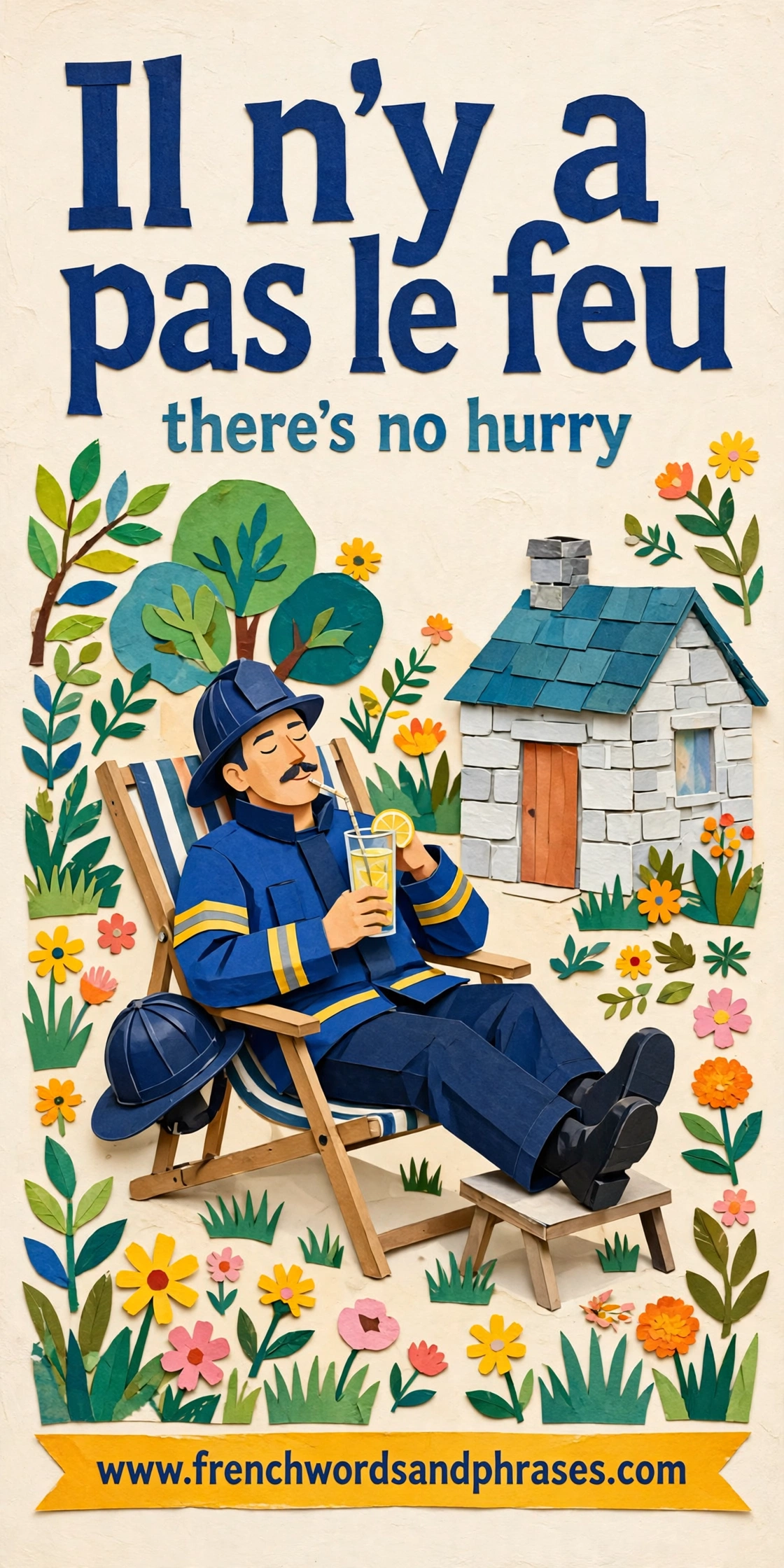
Il n’y a pas le feu means there’s no hurry — no need to rush.
Your friend is hopping from foot to foot at the door, keys in hand, bag half-zipped, convinced you are both late. You look at the clock, then at the calm street outside, and pour the coffee anyway: « Il n’y a pas le feu, le train est dans une heure. »
Let’s explore how il n’y a pas le feu works in French, beginning with the whole phrase on one card.
Understanding the French Phrase Il n’y a pas le feu
Il n’y a pas le feu is a French idiomatic expression built from il n’y a pas (there is no, there isn’t) and le feu (the fire). It is the standard French way to slow somebody down: nothing is burning, so nothing needs to be rushed.
It means there’s no hurry — no need to rush. The picture is a fire that is not there: if the house were burning, you would run; since it is not, you can finish your coffee. The longer variant, il n’y a pas le feu au lac — there’s no fire on the lake — stretches the joke further: a lake could not catch fire anyway, so the calm is total.
Type: Idiomatic expression — time and calm (negative impersonal phrase)
Answers the need: Telling someone there is no rush, they can slow down
Register: Neutral to informal — everyday speech, friendly and reassuring
Strength: Gentle — a calming hand on the shoulder, never an order
One important usage detail: the variant il n’y a pas le feu au lac is the same phrase with the joke turned up — the lake was never going to burn, so the hurry is even more absurd. Reach for the short form to reassure, and the lake form to tease a friend who panics professionally.
Experience the Word
Il n’y a pas le feu is the sound of a French afternoon defending itself — five words that lower the heart rate of a whole room.
Imagine a village bakery queue moving at the speed of conversation. A visitor shuffles, checks his watch, sighs. The woman behind the counter smiles the smile of ten thousand mornings and delivers the local philosophy: il n’y a pas le feu. The bread will still be there. So will he, calmer.
French keeps a whole shelf of these little brakes. This one is the kindest, because it begins by agreeing that a fire would be a reason to run.
How to Use Il n’y a pas le feu in French: Complete Guide
Let’s explore how il n’y a pas le feu works in French, beginning with the whole phrase on one card.
Il n’y a pas le feu at a Glance
The Whole Phrase on One Card
Real meaning, literal picture, English twin and register — il n’y a pas le feu in five lines.
| Point | Il n’y a pas le feu |
|---|---|
| What it really means | there’s no hurry — no need to rush |
| Word for word | there is no fire — nothing is burning, so nothing is urgent |
| English equivalent | there’s no hurry / there’s no rush / take your time |
| Register | neutral to informal — friendly reassurance, safe almost everywhere |
| Use it for | calming a panicker, slowing a plan, defending a coffee break |
Example
Doucement, il n’y a pas le feu, on a tout le temps.
Easy, there’s no hurry, we have all the time in the world.
Word by Word: Building the Calm
Four small pieces — take them one by one and the urgency drains away.
| Word | Literal meaning | Its job in the phrase |
|---|---|---|
| il | it | the impersonal il of il y a — it sets the scene rather than naming a person |
| n’y a pas | there is not, there isn’t | the negation that empties the scene of its emergency |
| le feu | the fire | the imaginary disaster whose absence proves there is no rush |
| au lac (variant) | on the lake | the joke extension — a fire on a lake is impossible, so the calm is absolute |
Example
Il n’y a pas le feu au lac, finis ton café.
There’s no fire on the lake, finish your coffee.
Quick Quiz 1
What disaster is not happening in il n’y a pas le feu?
Reveal the answer
A fire — nothing is burning, so nothing justifies rushing.
La maison ne brûle pas, il n’y a pas le feu.
The house is not on fire, there’s no hurry.
When You Say It: The Slowing-Down Moments
Il n’y a pas le feu fires at moments like these — someone is rushing, and the situation simply does not deserve it.
| Situation | Example |
|---|---|
| Before a departure | il n’y a pas le feu, le train est dans une heure — there’s no hurry, the train is in an hour |
| To a stressed colleague | il n’y a pas le feu, le rapport peut attendre demain — there’s no rush, the report can wait until tomorrow |
| At the table | mange doucement, il n’y a pas le feu — eat slowly, there’s no hurry |
| Teasing a panicker | il n’y a pas le feu au lac, respire — there’s no fire on the lake, breathe |
| About a reply | il n’y a pas le feu, réponds quand tu peux — no rush, reply when you can |
Example
Il n’y a pas le feu, le magasin ferme à huit heures.
There’s no hurry, the shop closes at eight.
Make It Yours: The Calm in Every Form
The phrase is fixed — but it dresses up with the lake, the reason, and the person it is calming.
| Form | French | In English |
|---|---|---|
| The classic | il n’y a pas le feu | there’s no hurry |
| The lake variant | il n’y a pas le feu au lac | there’s no fire on the lake — even calmer, with a tease |
| With the reason | il n’y a pas le feu, on est en avance | there’s no hurry, we’re ahead of time |
| As advice | il n’y a pas le feu, prends ton temps | no rush, take your time |
| Softened as a question | il n’y a pas le feu, si ? | there’s no hurry, is there? |
| To a group | il n’y a pas le feu, les amis | no hurry, everyone |
Example
Il n’y a pas le feu, les amis, le film commence à neuf heures.
No hurry, everyone, the film starts at nine.
Quick Quiz 2
What does the variant au lac add to il n’y a pas le feu?
Reveal the answer
A joke about impossibility — a lake cannot catch fire, so the absence of fire is doubly certain, and the teasing is gentler for it.
Il n’y a pas le feu au lac, on finit notre partie.
There’s no fire on the lake, we’re finishing our game.
Everyday Expressions: Building on the Calm
Il n’y a pas le feu slots into these everyday frames — each one ready to use as it stands.
| Frame | In English |
|---|---|
| il n’y a pas le feu | there’s no hurry |
| il n’y a pas le feu au lac | there’s no fire on the lake — the teasing long form |
| il n’y a pas le feu, on a le temps | there’s no hurry, we have time |
| il n’y a pas le feu pour répondre | there’s no rush to reply |
| il n’y a jamais le feu | there’s never any hurry — a philosophy, not just a remark |
Example
Chez elle, il n’y a jamais le feu, et tout se fait quand même.
At her place, there’s never any hurry, and everything still gets done.
Close Cousins: The Other Brakes
French has a whole shelf of slowing-down phrases — il n’y a pas le feu is the gentlest; its cousins press the brake with different feet.
| Expression | The difference |
|---|---|
| il n’y a pas le feu | there’s no hurry — the classic, pictured with the absent fire |
| ça ne presse pas | it’s not urgent — plain and practical, about a task or a deadline |
| on a le temps | we have time — states the reason rather than the absent emergency |
| rien ne presse | nothing is urgent — a touch more formal, almost written |
| doucement | gently, slow down — one word, said to hands and feet as much as to plans |
Example
Ça ne presse pas, le dossier partira lundi.
It’s not urgent, the file will go out on Monday.
Quick Quiz 3
A colleague asks if the report is urgent. Which cousin answers about the task itself — il n’y a pas le feu or ça ne presse pas?
Reveal the answer
Ça ne presse pas — it speaks of the task’s urgency. Il n’y a pas le feu calms the person, not the paperwork.
Non, ça ne presse pas, finis d’abord l’autre dossier.
No, it’s not urgent, finish the other file first.
Il n’y a pas le feu and Its Neighbours
The calm shelf around the phrase — from the deadline itself to the shrug that greets it.
| French | In English |
|---|---|
| une urgence | an emergency |
| être en retard | to be late |
| se dépêcher | to hurry |
| il n’y a pas le feu | there’s no hurry |
| prendre son temps | to take your time |
| tranquille | calm, unhurried |
Example
Pas d’urgence : il n’y a pas le feu, on prend notre temps.
No emergency: there’s no hurry, we’re taking our time.
Watch Out: The Traps Around Il n’y a pas le feu
The traps: a real fire that needs the other sentence, a negation that must stay whole, and reassurance that can sound dismissive.
| Trap | The truth |
|---|---|
| the real-fire trap | if something is actually burning, French says il y a le feu or au feu ! — the idiom only works because the fire is imaginary |
| the broken negation | the phrase needs its full n’y a pas — il y a le feu means the opposite: there IS a fire |
| the dismissive tone | said to someone with a genuine deadline, the phrase can sound like you are not listening — add the reason: on a le temps, on est en avance |
| not a command to stop | it slows a person down; it does not forbid the task — the work still gets done, just without the panic |
Example
Il n’y a pas le feu, mais le travail sera fini ce soir.
There’s no hurry, but the work will be finished this evening.
Quick Quiz 4
True or false: il y a le feu means the same as il n’y a pas le feu.
Reveal the answer
False — without the negation, il y a le feu announces a real fire. The little n’y a pas carries the whole calm of the idiom.
Au feu ! Il y a le feu à la cuisine !
Fire! There’s a fire in the kitchen!
Il n’y a pas le feu in Everyday French: Real-Life Examples
Now that you know the word, let’s see how il n’y a pas le feu appears in everyday French.
Example 1 — At the door
Il n’y a pas le feu, le train part dans une heure.
There’s no hurry, the train leaves in an hour.
Example 2 — At work
Il n’y a pas le feu, ce rapport peut attendre demain.
There’s no rush, this report can wait until tomorrow.
Example 3 — At the table
Mange doucement, il n’y a pas le feu.
Eat slowly, there’s no hurry.
Example 4 — Teasing a friend
Il n’y a pas le feu au lac, respire un peu.
There’s no fire on the lake, breathe a little.
Example 5 — About a message
Il n’y a pas le feu, réponds-moi quand tu peux.
No rush, reply to me when you can.
Example 6 — On holiday
Ici, il n’y a jamais le feu, c’est les vacances.
Here, there’s never any hurry, it’s the holidays.
Beyond Translation: The Meaning of Il n’y a pas le feu
English says there’s no hurry — a plain statement about time. French stages a small absence: a fire that is not burning, in a house that is not in danger. The reassurance works because it first admits what a real reason to run would look like.
To say il n’y a pas le feu is to hold up the picture of an emergency — and let everyone relax into its absence.
The lake variant pushes the logic into pure comedy: il n’y a pas le feu au lac. Of course there is no fire on the lake. There never could be. That is exactly how unhurried you are allowed to be.
How to Remember the French Phrase Il n’y a pas le feu
Remember it this way: Il n’y a pas le feu is calm proved by an absent disaster — no fire, no run; and the lake version makes the fire impossible as well as absent.
- You picture the empty hearth — le feu is the fire that would justify running, and it is not there.
- You guard the negation — il n’y a pas le feu is calm; il y a le feu is an emergency.
- You add the lake to tease — au lac makes the fire impossible, for champion panickers only.
The key idea is il n’y a pas le feu means there’s no hurry — nothing is burning, so nobody needs to run.
Test Your Knowledge of Il n’y a pas le feu
Let’s see how much you’ve learned. Try answering these questions before revealing the answers.
Question 1
What does il n’y a pas le feu mean?
Reveal the answer
There’s no hurry — no need to rush, said to calm someone down.
Question 2
What is the variant with the lake?
Reveal the answer
Il n’y a pas le feu au lac — there’s no fire on the lake: the same reassurance with the joke turned up, since a lake cannot burn.
Question 3
How do you announce a real fire in French?
Reveal the answer
Il y a le feu or au feu ! — without the negation, the sentence reports an actual fire.
Question 4
What does ça ne presse pas mean?
Reveal the answer
It’s not urgent — the practical cousin, said about a task or a deadline rather than to calm a person.
Question 5
Complete the sentence:
Il n’y a pas le ______, le train est dans une heure. (There’s no hurry, the train is in an hour.)
Reveal the answer
feu
Il n’y a pas le feu, le train est dans une heure.
There’s no hurry, the train is in an hour.
Your Final Challenge
Can You Use It?
How would you say this in French?
“There’s no hurry, the train leaves at noon.”
Reveal the answer
Il n’y a pas le feu, le train part à midi.
There’s no hurry, the train leaves at noon.
A little French. A little curiosity. A richer everyday life.
LEARN FRENCH ONE WORD AT A TIME