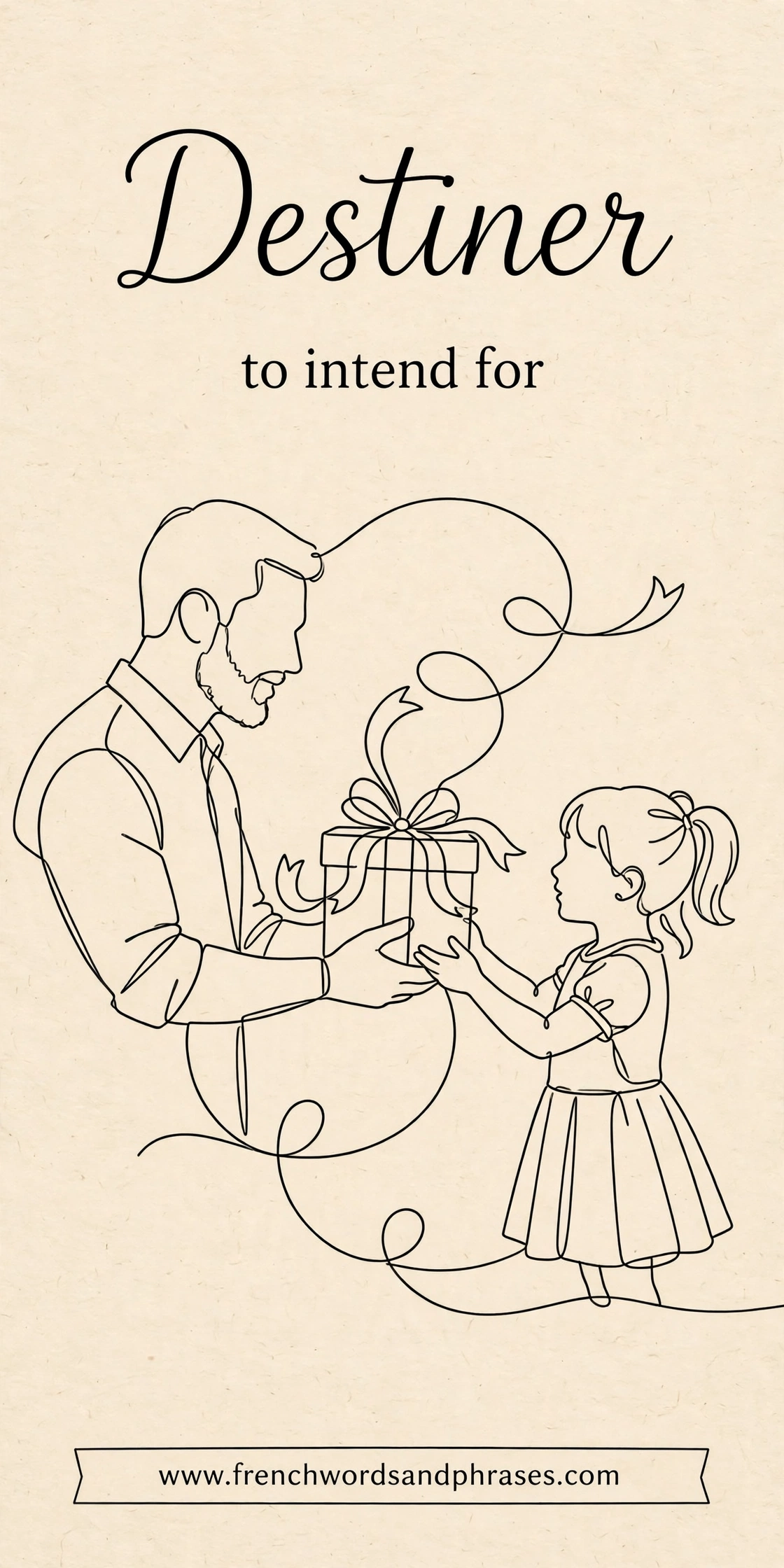
A French Word to Live By
How to Conjugate Destiner in French
/dɛs.ti.ne/
Destiner means to intend for — to set something aside for a person or a purpose, and to mark out the future it is heading for.
A letter addressed and sealed for one reader only, money put aside for a child’s studies, a young officer marked out for high command — destiner is the verb of purposes assigned in advance: this thing, this sum, this life is intended for that destination.
In this guide, you’ll learn how to conjugate destiner in all the major French tenses and moods. Explore complete conjugation tables, French examples, English translations, and practice quizzes.
Understanding the French Verb Destiner
Destiner is a regular French verb belonging to the first group of verbs, those ending in-er.
It means to intend for. It runs from the post office to philosophy: parcels and letters are destinés à an address, funds are destinés à a purpose, careers are destinées à a trade (that is the reflexive se destiner à), and in the passive the verb shades into fate itself — destiné à régner, born to rule; destiné à disparaître, doomed to vanish. The noun le destin, destiny, is never far behind.
Verb classification: First group (-er)
Auxiliary verb: Avoir
Past participle: destiné
Present participle: destinant
English equivalents: To intend for, to destine, to earmark; destiner quelque chose à quelqu’un — to intend something for someone; destiner une somme à un projet — to earmark a sum for a project; être destiné à — to be intended for, to be bound to; un colis destiné à l’étranger — a parcel destined for abroad; ce livre est destiné aux enfants — this book is intended for children.
One important detail: destiner is governed by à, always — destiner quelque chose à quelqu’un, destiner quelqu’un à quelque chose: elle destine cette lettre à son fils; on le destine à la marine. The passive twin is a French workhorse: être destiné à + noun or infinitive means both to be intended for (un livre destiné aux débutants) and to be bound to (un projet destiné à échouer, a project doomed to fail). The verb itself is a calm regular -er: je destine, nous destinons, past participle destiné: un livre destiné aux enfants, a book destined for children.
Experience the Word
Destiner is the verb of the addressed envelope — everything it touches has a name and a purpose written on it in advance.
Imagine a grandmother in Lyon writing a long letter she will never send to the grandson she has never met. On the envelope, one line: elle destine cette lettre à l’enfant de sa fille — intended for him alone, to be opened when he is twenty.
The letter waits in a drawer, patient as fate. It is intended for him — destinée, sealed with a destination.
How to Conjugate Destiner: Complete French Conjugation Guide
Let’s explore every major conjugation of destiner, beginning with the indicative mood.
How to Conjugate Destiner in the Indicative Mood
The indicative mood is used to express facts, observations, actions, and events.
How to Conjugate Destiner in the Present Tense (Présent)
Used for actions happening now, habitual actions, and general truths.
| Subject | Conjugation |
|---|---|
| je | destine |
| tu | destines |
| il / elle | destine |
| nous | destinons |
| vous | destinez |
| ils / elles | destinent |
Example
Elle destine cette somme à ses petits-enfants.
She is earmarking this sum for her grandchildren.
Quick Quiz 1
Complete the sentence:
Nous ______ ces fonds à la rénovation de l’école.
Reveal the answer
destinons
Nous destinons ces fonds à la rénovation de l’école.
We are earmarking these funds for renovating the school.
How to Conjugate Destiner in the Passé Composé
Used for completed actions in the past. Destiner takes the auxiliary verb avoir.
| Subject | Conjugation |
|---|---|
| j’ | ai destiné |
| tu | as destiné |
| il / elle | a destiné |
| nous | avons destiné |
| vous | avez destiné |
| ils / elles | ont destiné |
Example
L’auteur a destiné son livre aux jeunes lecteurs.
The author intended his book for young readers.
How to Conjugate Destiner in the Imparfait (Imperfect Tense)
Used for habitual past actions, descriptions, and ongoing situations in the past.
| Subject | Conjugation |
|---|---|
| je | destinais |
| tu | destinais |
| il / elle | destinait |
| nous | destinions |
| vous | destiniez |
| ils / elles | destinaient |
Example
Autrefois, on destinait les fils cadets à l’armée ou à l’Église.
In the old days, younger sons were destined for the army or the Church.
Quick Quiz 2
Choose the correct form:
The author intended his book for children.
L’auteur ______ son livre aux enfants. (a destiné / est destiné)
Reveal the answer
a destiné
L’auteur a destiné son livre aux enfants.
Destiner takes avoir.
How to Conjugate Destiner in the Plus-que-parfait
Used to describe an action that had already been completed before another past event.
| Subject | Conjugation |
|---|---|
| j’ | avais destiné |
| tu | avais destiné |
| il / elle | avait destiné |
| nous | avions destiné |
| vous | aviez destiné |
| ils / elles | avaient destiné |
Example
Il avait destiné son héritage à la fondation.
He had earmarked his inheritance for the foundation.
How to Conjugate Destiner in the Passé Simple
Primarily used in formal writing, literature, and historical narratives. It is rarely used in everyday conversation.
| Subject | Conjugation |
|---|---|
| je | destinai |
| tu | destinas |
| il / elle | destina |
| nous | destinâmes |
| vous | destinâtes |
| ils / elles | destinèrent |
Example
Le roi destina le prince à un grand mariage.
The king destined the prince for a great marriage.
How to Conjugate Destiner in the Passé Antérieur
A literary tense used to express an action completed immediately before another past action, generally in the passé simple.
| Subject | Conjugation |
|---|---|
| j’ | eus destiné |
| tu | eus destiné |
| il / elle | eut destiné |
| nous | eûmes destiné |
| vous | eûtes destiné |
| ils / elles | eurent destiné |
Example
Quand elle eut destiné la lettre à son fils, elle la cacheta.
When she had addressed the letter to her son, she sealed it.
How to Conjugate Destiner in the Future Tense (Futur Simple)
Used to describe actions that will take place in the future.
| Subject | Conjugation |
|---|---|
| je | destinerai |
| tu | destineras |
| il / elle | destinera |
| nous | destinerons |
| vous | destinerez |
| ils / elles | destineront |
Example
Nous destinerons ces fonds à la rénovation de l’école.
We will earmark these funds for renovating the school.
How to Conjugate Destiner in the Futur Antérieur (Future Perfect)
Used for an action that will have been completed before a particular point in the future.
| Subject | Conjugation |
|---|---|
| j’ | aurai destiné |
| tu | auras destiné |
| il / elle | aura destiné |
| nous | aurons destiné |
| vous | aurez destiné |
| ils / elles | auront destiné |
Example
À sa mort, elle aura destiné chaque objet à un héritier précis.
By her death, she will have assigned every object to a specific heir.
How to Conjugate Destiner in the Near Future (Futur Proche)
Used to describe something that is going to happen soon. Formed with aller + infinitive.
| Subject | Conjugation |
|---|---|
| je | vais destiner |
| tu | vas destiner |
| il / elle | va destiner |
| nous | allons destiner |
| vous | allez destiner |
| ils / elles | vont destiner |
Example
Je vais destiner ce colis à notre bureau de Tokyo.
I am going to send this parcel to our Tokyo office.
How to Conjugate Destiner in the Conditional Mood
The conditional mood expresses what would happen under certain circumstances. It is also frequently used to make polite requests or express wishes.
How to Conjugate Destiner in the Present Conditional
| Subject | Conjugation |
|---|---|
| je | destinerais |
| tu | destinerais |
| il / elle | destinerait |
| nous | destinerions |
| vous | destineriez |
| ils / elles | destineraient |
Example
À ta place, je destinerais cet argent à tes études.
In your place, I would earmark this money for your studies.
How to Conjugate Destiner in the Past Conditional
| Subject | Conjugation |
|---|---|
| j’ | aurais destiné |
| tu | aurais destiné |
| il / elle | aurait destiné |
| nous | aurions destiné |
| vous | auriez destiné |
| ils / elles | auraient destiné |
Example
Ils auraient destiné le terrain à un jardin public sans ce promoteur.
They would have earmarked the land for a public garden without this developer.
Destiner in the Literary Past Conditional Form
This less common literary form uses the imperfect subjunctive of avoir.
| Subject | Conjugation |
|---|---|
| j’ | eusse destiné |
| tu | eusses destiné |
| il / elle | eût destiné |
| nous | eussions destiné |
| vous | eussiez destiné |
| ils / elles | eussent destiné |
Example
Le père eût destiné son fils à la marine, selon l’usage ancien.
The father would have destined his son for the navy, following the old custom.
How to Conjugate Destiner in the Subjunctive Mood
The subjunctive is used to express wishes, emotions, doubts, necessity, and uncertainty. It frequently follows expressions such as il faut que (it is necessary that) or bien que (although).
How to Conjugate Destiner in the Present Subjunctive
| Subject | Conjugation |
|---|---|
| que je | destine |
| que tu | destines |
| qu’il / qu’elle | destine |
| que nous | destinions |
| que vous | destiniez |
| qu’ils / qu’elles | destinent |
Example
Il faut que tu destines ce cadeau à ta sœur, pas à moi.
You must intend this present for your sister, not for me.
Quick Quiz 3
Complete the sentence using the subjunctive:
Il faut que vous ______ ce colis à Tokyo.
Reveal the answer
destiniez
Il faut que vous destiniez ce colis à Tokyo.
You must send this parcel to Tokyo.
How to Conjugate Destiner in the Imperfect Subjunctive
A literary tense, rarely encountered in modern spoken French.
| Subject | Conjugation |
|---|---|
| que je | destinasse |
| que tu | destinasses |
| qu’il / qu’elle | destinât |
| que nous | destinassions |
| que vous | destinassiez |
| qu’ils / qu’elles | destinassent |
Example
Le testament demandait qu’on destinât la maison à une œuvre de charité.
The will required the house to be left to a charity.
How to Conjugate Destiner in the Pluperfect Subjunctive
A literary construction used to express an action completed before another past action.
| Subject | Conjugation |
|---|---|
| que j’ | eusse destiné |
| que tu | eusses destiné |
| qu’il / qu’elle | eût destiné |
| que nous | eussions destiné |
| que vous | eussiez destiné |
| qu’ils / qu’elles | eussent destiné |
Example
On disait que le roi eût destiné le prince à un mariage étranger.
It was said the king had destined the prince for a foreign marriage.
How to Conjugate Destiner in the Past Subjunctive
| Subject | Conjugation |
|---|---|
| que j’ | aie destiné |
| que tu | aies destiné |
| qu’il / qu’elle | ait destiné |
| que nous | ayons destiné |
| que vous | ayez destiné |
| qu’ils / qu’elles | aient destiné |
Example
Je suis touché que tu aies destiné ce poème à ta mère.
I am touched you intended this poem for your mother.
How to Conjugate Destiner in the Imperative
The imperative is used to give commands, instructions, invitations, or suggestions. Subject pronouns are omitted.
How to Conjugate Destiner in the Present Imperative
| Person | Conjugation |
|---|---|
| (tu) | destine |
| (nous) | destinons |
| (vous) | destinez |
Example
Destine cette lettre à ton frère et à personne d’autre !
Address this letter to your brother and to nobody else!
Quick Quiz 4
How would you say Earmark this money for your studies (tu form)?
Reveal the answer
Destine cet argent à tes études !
French Participles of Destiner
Participles are verb forms that can be used in compound tenses and other grammatical constructions.
Present Participle of Destiner
destinant
En destinant ses économies à ses enfants, elle leur a tout donné d’avance.
By earmarking her savings for her children, she gave them everything in advance.
Past Participle of Destiner
destiné
Destinée aux enfants, cette histoire enchante aussi les parents.
Intended for children, this story delights parents too.
Destiner in Everyday French: Real-Life Examples
Now that you know the conjugations, let’s see how destiner appears in everyday French.
Example 1 — Present
Elle destine cette somme à ses petits-enfants.
She is earmarking this sum for her grandchildren.
Example 2 — Passé composé
L’auteur a destiné son livre aux enfants.
The author intended his book for children.
Example 3 — Imparfait
On destinait les cadets à l’armée.
Younger sons were destined for the army.
Example 4 — Future
Nous destinerons ces fonds à l’école.
We will earmark these funds for the school.
Example 5 — Conditional
Je destinerais cet argent à tes études.
I would earmark this money for your studies.
Example 6 — Imperative
Destinez ce colis à Tokyo !
Send this parcel to Tokyo!
Beyond Translation: The Meaning of Destiner
English destine survives mostly in the passive — destined for greatness — while French destiner is alive and active every day, addressing parcels and earmarking budgets.
Destiny, with paperwork.
That is the French genius of the word: le destin may be written in the stars, but destiner is written on envelopes, in wills and in budgets — destiné à is fate you can put a stamp on.
How to Remember the French Verb Destiner
Remember it this way: Destiner is about the sealed letter addressed to one reader, waiting in a drawer.
- Always with à: destiner quelque chose À quelqu’un — the destination takes à.
- Être destiné à means both intended for and bound to: destiné à échouer, doomed to fail.
- Regular -er: je destine, nous destinons, past participle destiné.
The key idea is the sealed letter addressed to one reader, waiting in a drawer.
Test Your Knowledge of Destiner
Let’s see how much you’ve learned. Try answering these questions before revealing the answers.
Question 1
Which preposition governs destiner?
Reveal the answer
À — destiner quelque chose à quelqu’un, destiner une somme à un projet.
Question 2
How do you say She earmarks this sum for her grandchildren in French?
Reveal the answer
Elle destine cette somme à ses petits-enfants.
Question 3
Translate: This book is intended for children.
Reveal the answer
Ce livre est destiné aux enfants.
Question 4
What is the past participle of destiner?
Reveal the answer
Destiné.
Question 5
Complete the sentence:
Il faut que tu ______ ce cadeau à ta sœur.
Reveal the answer
destines
Il faut que tu destines ce cadeau à ta sœur.
You must intend this present for your sister.
Your Final Challenge
Can You Use It?
How would you say this in French?
She addresses her letter to the child she does not yet know, and the future will do the rest.
Reveal the answer
Elle destine sa lettre à l’enfant qu’elle ne connaît pas encore, et l’avenir fera le reste.
She addresses her letter to the child she does not yet know, and the future will do the rest.
A little French. A little curiosity. A richer everyday life.
LEARN FRENCH ONE WORD AT A TIME