A French Word to Live By
How to Conjugate Dessiner in French
/de.si.ne/
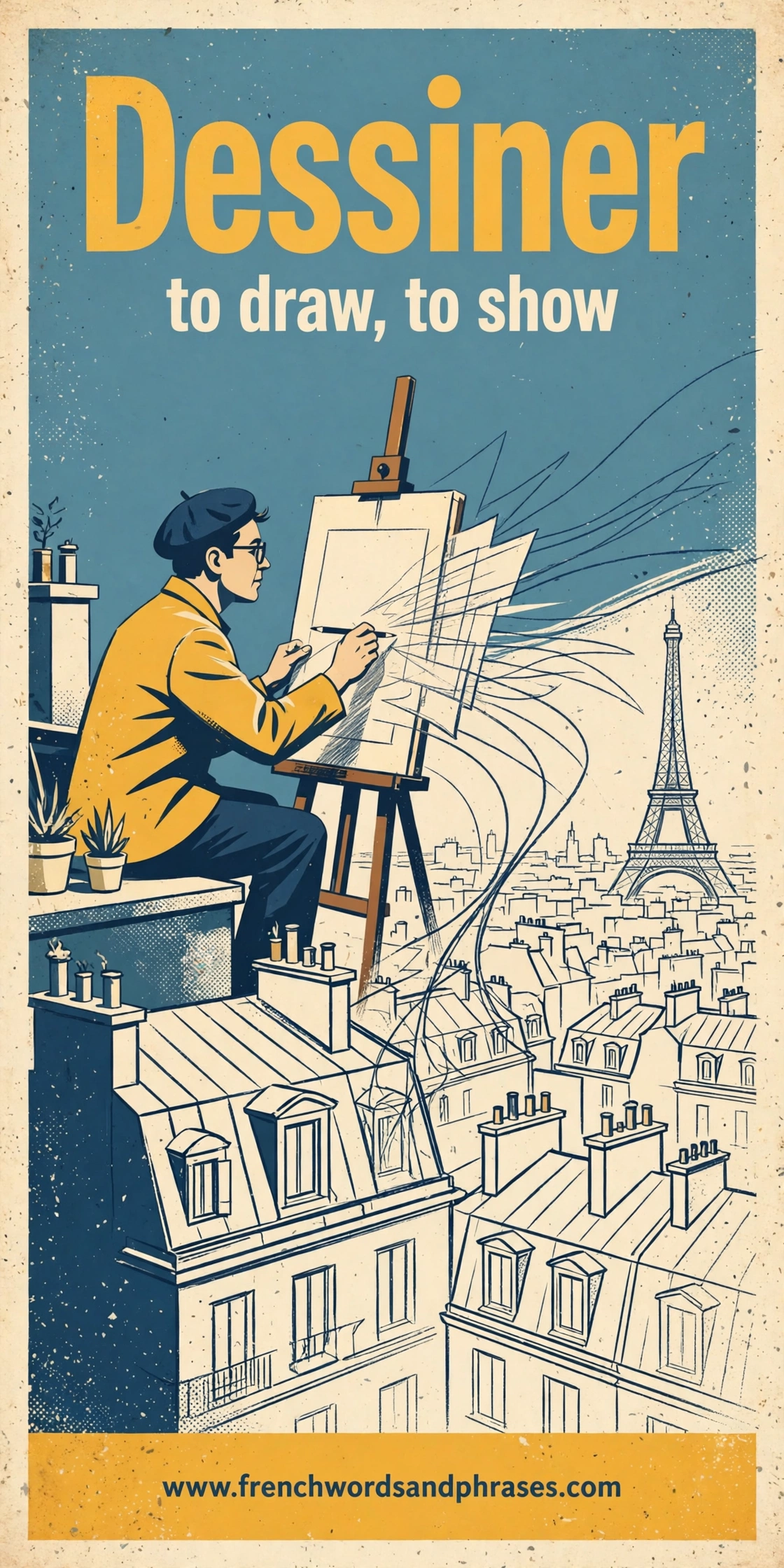
Dessiner means to draw, to show — to trace lines on paper, and to let a shape stand out and show itself against the light.
A child’s first house with a smoking chimney, an architect’s tower rising from a blank page, a mountain ridge drawn black against the sunset — dessiner is the verb of the line: everything that takes shape under a pencil, or against the sky, is dessiné.
In this guide, you’ll learn how to conjugate dessiner in all the major French tenses and moods. Explore complete conjugation tables, French examples, English translations, and practice quizzes.
Understanding the French Verb Dessiner
Dessiner is a regular French verb belonging to the first group of verbs, those ending in-er.
It means to draw, to show. It covers the whole range of drawing: children’s sketches, technical plans, fashion design (dessiner une robe is to design a dress) and the shapes that landscapes and clothes draw by themselves. Its reflexive twin, se dessiner, takes over when the shape appears on its own — a silhouette, a smile, a trend — without any artist at all.
Verb classification: First group (-er)
Auxiliary verb: Avoir
Past participle: dessiné
Present participle: dessinant
English equivalents: To draw, to sketch, to design, to show; dessiner un portrait — to draw a portrait; dessiner les plans d’une maison — to draw up the plans of a house; dessiner à main levée — to draw freehand; un dessin — a drawing; la robe dessine sa silhouette — the dress shows off her figure.
One important detail: dessiner is a perfectly regular -er verb — je dessine, nous dessinons, ils dessinent, past participle dessiné — and it is the parent of a whole atelier: un dessin, a drawing; un dessinateur, a draughtsman or cartoonist; un dessin animé, a cartoon film; la bande dessinée, the comic strip. Do not confuse it with its false friend dessigner (a misspelling of désigner, to designate) — the artist dessine with one s after the prefix and no g anywhere. Beyond the pencil, the verb also means to show a shape clearly: la robe dessine ses formes, and mountains dessinent their ridge on the sky.
Experience the Word
Dessiner is the verb of the first line — the moment a blank page, or a blank sky, receives a shape.
Imagine a café terrace in Paris. Between two sips of coffee, a young architect turns her napkin over and dessine — three strokes for the tower, two for the roof, one long line for the street — and a whole building stands there in blue ink before the coffee is cold.
Five lines and a napkin. She has drawn — dessiné — a building out of nothing.
How to Conjugate Dessiner: Complete French Conjugation Guide
Let’s explore every major conjugation of dessiner, beginning with the indicative mood.
How to Conjugate Dessiner in the Indicative Mood
The indicative mood is used to express facts, observations, actions, and events.
How to Conjugate Dessiner in the Present Tense (Présent)
Used for actions happening now, habitual actions, and general truths.
| Subject | Conjugation |
|---|---|
| je | dessine |
| tu | dessines |
| il / elle | dessine |
| nous | dessinons |
| vous | dessinez |
| ils / elles | dessinent |
Example
L’enfant dessine une maison avec un grand soleil.
The child is drawing a house with a big sun.
Quick Quiz 1
Complete the sentence:
Nous ______ les plans de la nouvelle cuisine.
Reveal the answer
dessinons
Nous dessinons les plans de la nouvelle cuisine.
We are drawing the plans for the new kitchen.
How to Conjugate Dessiner in the Passé Composé
Used for completed actions in the past. Dessiner takes the auxiliary verb avoir.
| Subject | Conjugation |
|---|---|
| j’ | ai dessiné |
| tu | as dessiné |
| il / elle | a dessiné |
| nous | avons dessiné |
| vous | avez dessiné |
| ils / elles | ont dessiné |
Example
L’architecte a dessiné les plans de l’école.
The architect drew the plans of the school.
How to Conjugate Dessiner in the Imparfait (Imperfect Tense)
Used for habitual past actions, descriptions, and ongoing situations in the past.
| Subject | Conjugation |
|---|---|
| je | dessinais |
| tu | dessinais |
| il / elle | dessinait |
| nous | dessinions |
| vous | dessiniez |
| ils / elles | dessinaient |
Example
Petit, il dessinait sur tous ses cahiers.
As a boy, he used to draw on all his exercise books.
Quick Quiz 2
Choose the correct form:
She designed the dress.
Elle ______ la robe. (a dessiné / est dessinée)
Reveal the answer
a dessiné
Elle a dessiné la robe.
Dessiner takes avoir.
How to Conjugate Dessiner in the Plus-que-parfait
Used to describe an action that had already been completed before another past event.
| Subject | Conjugation |
|---|---|
| j’ | avais dessiné |
| tu | avais dessiné |
| il / elle | avait dessiné |
| nous | avions dessiné |
| vous | aviez dessiné |
| ils / elles | avaient dessiné |
Example
Elle avait dessiné la robe avant de la coudre.
She had designed the dress before sewing it.
How to Conjugate Dessiner in the Passé Simple
Primarily used in formal writing, literature, and historical narratives. It is rarely used in everyday conversation.
| Subject | Conjugation |
|---|---|
| je | dessinai |
| tu | dessinas |
| il / elle | dessina |
| nous | dessinâmes |
| vous | dessinâtes |
| ils / elles | dessinèrent |
Example
Le peintre dessina le portrait en une heure.
The painter drew the portrait in one hour.
How to Conjugate Dessiner in the Passé Antérieur
A literary tense used to express an action completed immediately before another past action, generally in the passé simple.
| Subject | Conjugation |
|---|---|
| j’ | eus dessiné |
| tu | eus dessiné |
| il / elle | eut dessiné |
| nous | eûmes dessiné |
| vous | eûtes dessiné |
| ils / elles | eurent dessiné |
Example
Quand il eut dessiné le plan, les maçons commencèrent.
When he had drawn the plan, the builders began.
How to Conjugate Dessiner in the Future Tense (Futur Simple)
Used to describe actions that will take place in the future.
| Subject | Conjugation |
|---|---|
| je | dessinerai |
| tu | dessineras |
| il / elle | dessinera |
| nous | dessinerons |
| vous | dessinerez |
| ils / elles | dessineront |
Example
Demain, nous dessinerons la carte du trésor.
Tomorrow, we will draw the treasure map.
How to Conjugate Dessiner in the Futur Antérieur (Future Perfect)
Used for an action that will have been completed before a particular point in the future.
| Subject | Conjugation |
|---|---|
| j’ | aurai dessiné |
| tu | auras dessiné |
| il / elle | aura dessiné |
| nous | aurons dessiné |
| vous | aurez dessiné |
| ils / elles | auront dessiné |
Example
À la fin du cours, vous aurez dessiné dix croquis.
By the end of the class, you will have drawn ten sketches.
How to Conjugate Dessiner in the Near Future (Futur Proche)
Used to describe something that is going to happen soon. Formed with aller + infinitive.
| Subject | Conjugation |
|---|---|
| je | vais dessiner |
| tu | vas dessiner |
| il / elle | va dessiner |
| nous | allons dessiner |
| vous | allez dessiner |
| ils / elles | vont dessiner |
Example
Je vais dessiner ton portrait, ne bouge pas.
I am going to draw your portrait, do not move.
How to Conjugate Dessiner in the Conditional Mood
The conditional mood expresses what would happen under certain circumstances. It is also frequently used to make polite requests or express wishes.
How to Conjugate Dessiner in the Present Conditional
| Subject | Conjugation |
|---|---|
| je | dessinerais |
| tu | dessinerais |
| il / elle | dessinerait |
| nous | dessinerions |
| vous | dessineriez |
| ils / elles | dessineraient |
Example
Avec un meilleur crayon, elle dessinerait plus finement.
With a better pencil, she would draw more finely.
How to Conjugate Dessiner in the Past Conditional
| Subject | Conjugation |
|---|---|
| j’ | aurais dessiné |
| tu | aurais dessiné |
| il / elle | aurait dessiné |
| nous | aurions dessiné |
| vous | auriez dessiné |
| ils / elles | auraient dessiné |
Example
Tu aurais dessiné une plus belle maison avec une règle.
You would have drawn a finer house with a ruler.
Dessiner in the Literary Past Conditional Form
This less common literary form uses the imperfect subjunctive of avoir.
| Subject | Conjugation |
|---|---|
| j’ | eusse dessiné |
| tu | eusses dessiné |
| il / elle | eût dessiné |
| nous | eussions dessiné |
| vous | eussiez dessiné |
| ils / elles | eussent dessiné |
Example
L’artiste eût dessiné la ville entière en un hiver.
The artist would have drawn the whole city in one winter.
How to Conjugate Dessiner in the Subjunctive Mood
The subjunctive is used to express wishes, emotions, doubts, necessity, and uncertainty. It frequently follows expressions such as il faut que (it is necessary that) or bien que (although).
How to Conjugate Dessiner in the Present Subjunctive
| Subject | Conjugation |
|---|---|
| que je | dessine |
| que tu | dessines |
| qu’il / qu’elle | dessine |
| que nous | dessinions |
| que vous | dessiniez |
| qu’ils / qu’elles | dessinent |
Example
Il faut que tu dessines la carte avant de partir.
You must draw the map before leaving.
Quick Quiz 3
Complete the sentence using the subjunctive:
Il faut que vous ______ à main levée.
Reveal the answer
dessiniez
Il faut que vous dessiniez à main levée.
You must draw freehand.
How to Conjugate Dessiner in the Imperfect Subjunctive
A literary tense, rarely encountered in modern spoken French.
| Subject | Conjugation |
|---|---|
| que je | dessinasse |
| que tu | dessinasses |
| qu’il / qu’elle | dessinât |
| que nous | dessinassions |
| que vous | dessinassiez |
| qu’ils / qu’elles | dessinassent |
Example
Le professeur voulait que les élèves dessinassent à main levée.
The teacher wanted the pupils to draw freehand.
How to Conjugate Dessiner in the Pluperfect Subjunctive
A literary construction used to express an action completed before another past action.
| Subject | Conjugation |
|---|---|
| que j’ | eusse dessiné |
| que tu | eusses dessiné |
| qu’il / qu’elle | eût dessiné |
| que nous | eussions dessiné |
| que vous | eussiez dessiné |
| qu’ils / qu’elles | eussent dessiné |
Example
On admirait qu’il eût dessiné ce palais à vingt ans.
People admired that he had designed this palace at twenty.
How to Conjugate Dessiner in the Past Subjunctive
| Subject | Conjugation |
|---|---|
| que j’ | aie dessiné |
| que tu | aies dessiné |
| qu’il / qu’elle | ait dessiné |
| que nous | ayons dessiné |
| que vous | ayez dessiné |
| qu’ils / elles | aient dessiné |
Example
Je suis content que tu aies dessiné cette affiche.
I am glad you drew this poster.
How to Conjugate Dessiner in the Imperative
The imperative is used to give commands, instructions, invitations, or suggestions. Subject pronouns are omitted.
How to Conjugate Dessiner in the Present Imperative
| Person | Conjugation |
|---|---|
| (tu) | dessine |
| (nous) | dessinons |
| (vous) | dessinez |
Example
Dessine un arbre à côté de la maison !
Draw a tree next to the house!
Quick Quiz 4
How would you say Draw a tree (tu form)?
Reveal the answer
Dessine un arbre !
French Participles of Dessiner
Participles are verb forms that can be used in compound tenses and other grammatical constructions.
Present Participle of Dessiner
dessinant
En dessinant chaque soir, elle a fait de vrais progrès.
By drawing every evening, she has made real progress.
Past Participle of Dessiner
dessiné
Dessinée au fusain, la montagne semble presque réelle.
Drawn in charcoal, the mountain looks almost real.
Dessiner in Everyday French: Real-Life Examples
Now that you know the conjugations, let’s see how dessiner appears in everyday French.
Example 1 — Present
L’enfant dessine une maison.
The child is drawing a house.
Example 2 — Passé composé
L’architecte a dessiné les plans.
The architect drew the plans.
Example 3 — Imparfait
Il dessinait sur tous ses cahiers.
He used to draw on all his exercise books.
Example 4 — Future
Nous dessinerons la carte du trésor.
We will draw the treasure map.
Example 5 — Conditional
Elle dessinerait plus finement avec un meilleur crayon.
She would draw more finely with a better pencil.
Example 6 — Imperative
Dessine ton portrait, ne bouge pas !
Draw your portrait, do not move!
Beyond Translation: The Meaning of Dessiner
English design and draw split what French dessiner keeps together — and English borrowed design from this very family, through Italian disegno, the drawing that is also a plan.
Every design begins as a drawing.
The child’s house, the architect’s tower and the couturier’s dress all start the same way: on dessine. And when no hand is involved, French hands the verb to the world itself — the ridge, the dress, the smile — in the reflexive se dessiner.
How to Remember the French Verb Dessiner
Remember it this way: Dessiner is about the architect’s tower rising in blue ink on a café napkin.
- Un dessin is a drawing; dessiner is to make one — paper, plans and dresses alike.
- Regular -er: je dessine, nous dessinons, past participle dessiné.
- Its family runs the atelier: dessinateur, dessin animé, bande dessinée.
The key idea is the architect’s tower rising in blue ink on a café napkin.
Test Your Knowledge of Dessiner
Let’s see how much you’ve learned. Try answering these questions before revealing the answers.
Question 1
What is a bande dessinée, and which verb is it built on?
Reveal the answer
A comic strip — literally a drawn strip, built on dessiner, to draw.
Question 2
How do you say The child is drawing a house in French?
Reveal the answer
L’enfant dessine une maison.
Question 3
Translate: The architect drew the plans of the school.
Reveal the answer
L’architecte a dessiné les plans de l’école.
Question 4
What is the past participle of dessiner?
Reveal the answer
Dessiné.
Question 5
Complete the sentence:
Il faut que tu ______ la carte avant de partir.
Reveal the answer
dessines
Il faut que tu dessines la carte avant de partir.
You must draw the map before leaving.
Your Final Challenge
Can You Use It?
How would you say this in French?
He draws the mountain with a sure line, and in the evening watches it rise before him.
Reveal the answer
Il dessine la montagne d’un trait sûr, et le soir la regarde se lever devant lui.
He draws the mountain with a sure line, and in the evening watches it rise before him.
A little French. A little curiosity. A richer everyday life.
LEARN FRENCH ONE WORD AT A TIME