A French Word to Live By
How to Conjugate Dessangler in French
/de.sɑ̃.ɡle/
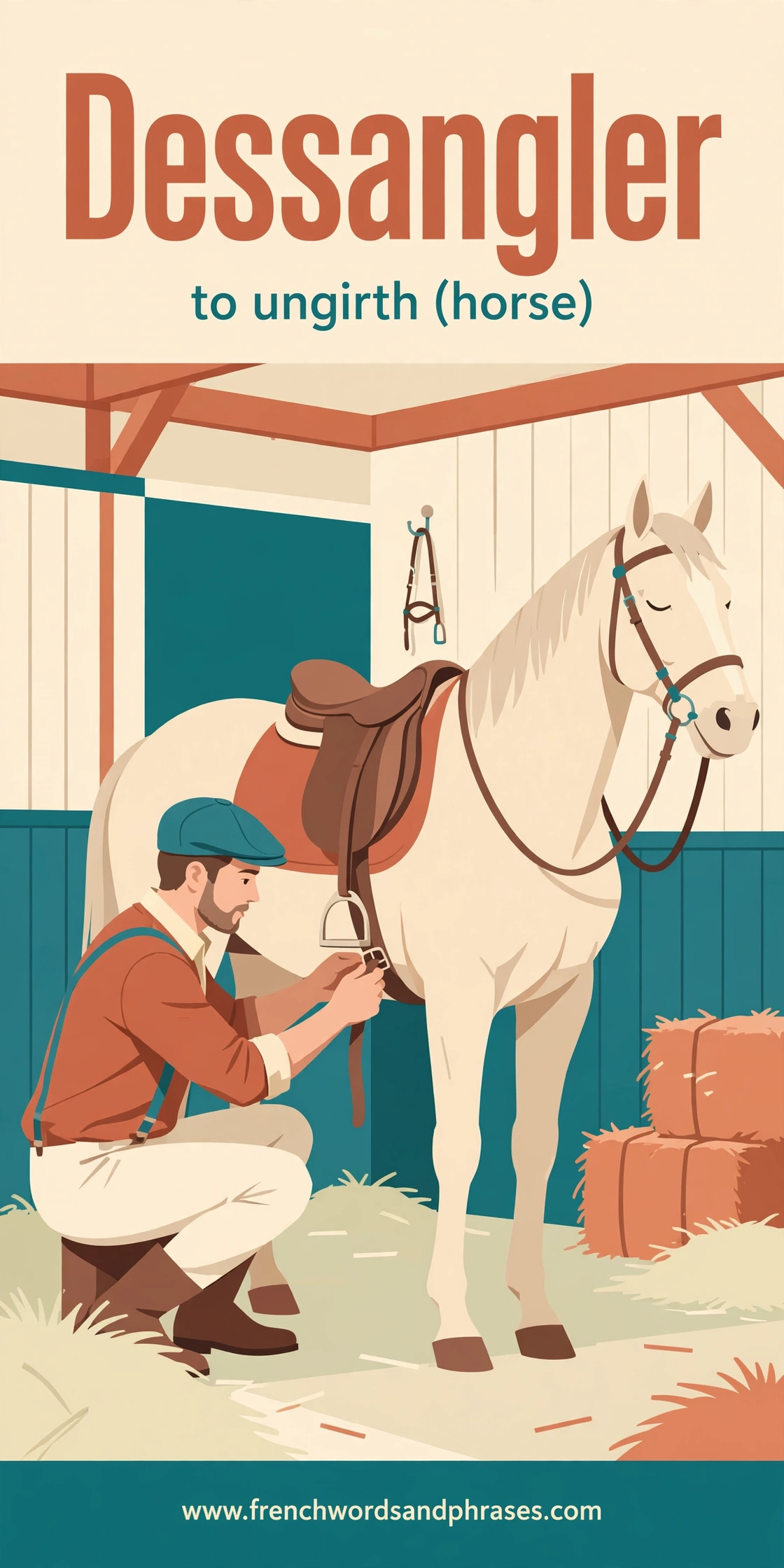
Dessangler means to ungirth a horse — to loosen and undo the strap that holds the saddle in place after a ride.
Back at the stable, the rider runs a hand under the horse’s belly and frees the girth strap, hole by hole — dessangler is the stable verb of unstrapping: the saddle’s belt comes off, and the horse can finally breathe out.
In this guide, you’ll learn how to conjugate dessangler in all the major French tenses and moods. Explore complete conjugation tables, French examples, English translations, and practice quizzes.
Understanding the French Verb Dessangler
Dessangler is a regular French verb belonging to the first group of verbs, those ending in-er.
It means to ungirth (horse). It belongs entirely to the stable yard: you dessanglez a horse after work, before removing the saddle (desseller), and a careful rider dessangle in stages while the horse cools down. The same root serves luggage and furniture — sangler is to strap anything tight — but dessangler keeps its horse.
Verb classification: First group (-er)
Auxiliary verb: Avoir
Past participle: dessanglé
Present participle: dessanglant
English equivalents: To ungirth, to loosen the girth; dessangler un cheval — to ungirth a horse; dessangler la selle — to undo the saddle’s girth strap; la sangle — the girth, the strap; sangler — to girth up, to strap tight.
One important detail: dessangler is sangler undone — la sangle is the wide strap, the girth, that circles the horse’s belly and holds the saddle on. Riders are taught to dessangler gradually, one hole at a time, and never to rip the strap off a hot horse. The verb is a perfectly regular -er: je dessangle, nous dessanglons, ils dessanglent, past participle dessanglé — and the gl is pronounced as one cluster, /ɡl/, as in sangle itself.
Experience the Word
Dessangler is the verb of the first breath after work — the strap loosens, and the horse sighs.
Imagine the end of a long ride in the Camargue. The gardian leads his horse into the shade, slips two fingers under the sangle, and dessangle slowly, trou par trou, while the horse blows out its nostrils and shakes the dust from its coat.
The saddle is still on, but the work is over. The horse is ungirthed — dessanglé, breathing free at last.
How to Conjugate Dessangler: Complete French Conjugation Guide
Let’s explore every major conjugation of dessangler, beginning with the indicative mood.
How to Conjugate Dessangler in the Indicative Mood
The indicative mood is used to express facts, observations, actions, and events.
How to Conjugate Dessangler in the Present Tense (Présent)
Used for actions happening now, habitual actions, and general truths.
| Subject | Conjugation |
|---|---|
| je | dessangle |
| tu | dessangles |
| il / elle | dessangle |
| nous | dessanglons |
| vous | dessanglez |
| ils / elles | dessanglent |
Example
Le cavalier dessangle son cheval dès le retour à l’écurie.
The rider ungirths his horse as soon as they return to the stable.
Quick Quiz 1
Complete the sentence:
Nous ______ les chevaux avant de les brosser.
Reveal the answer
dessanglons
Nous dessanglons les chevaux avant de les brosser.
We ungirth the horses before grooming them.
How to Conjugate Dessangler in the Passé Composé
Used for completed actions in the past. Dessangler takes the auxiliary verb avoir.
| Subject | Conjugation |
|---|---|
| j’ | ai dessanglé |
| tu | as dessanglé |
| il / elle | a dessanglé |
| nous | avons dessanglé |
| vous | avez dessanglé |
| ils / elles | ont dessanglé |
Example
Elle a dessanglé la jument avant de la brosser.
She ungirthed the mare before grooming her.
How to Conjugate Dessangler in the Imparfait (Imperfect Tense)
Used for habitual past actions, descriptions, and ongoing situations in the past.
| Subject | Conjugation |
|---|---|
| je | dessanglais |
| tu | dessanglais |
| il / elle | dessanglait |
| nous | dessanglions |
| vous | dessangliez |
| ils / elles | dessanglaient |
Example
Le palefrenier dessanglait les chevaux un à un.
The groom used to ungirth the horses one by one.
Quick Quiz 2
Choose the correct form:
She ungirthed the mare.
Elle ______ la jument. (a dessanglé / est dessanglée)
Reveal the answer
a dessanglé
Elle a dessanglé la jument.
Dessangler takes avoir.
How to Conjugate Dessangler in the Plus-que-parfait
Used to describe an action that had already been completed before another past event.
| Subject | Conjugation |
|---|---|
| j’ | avais dessanglé |
| tu | avais dessanglé |
| il / elle | avait dessanglé |
| nous | avions dessanglé |
| vous | aviez dessanglé |
| ils / elles | avaient dessanglé |
Example
Il avait dessanglé le cheval avant de le desseller.
He had ungirthed the horse before unsaddling it.
How to Conjugate Dessangler in the Passé Simple
Primarily used in formal writing, literature, and historical narratives. It is rarely used in everyday conversation.
| Subject | Conjugation |
|---|---|
| je | dessanglai |
| tu | dessanglas |
| il / elle | dessangla |
| nous | dessanglâmes |
| vous | dessanglâtes |
| ils / elles | dessanglèrent |
Example
Le gardian dessangla son cheval à l’ombre des pins.
The Camargue cowboy ungirthed his horse in the shade of the pines.
How to Conjugate Dessangler in the Passé Antérieur
A literary tense used to express an action completed immediately before another past action, generally in the passé simple.
| Subject | Conjugation |
|---|---|
| j’ | eus dessanglé |
| tu | eus dessanglé |
| il / elle | eut dessanglé |
| nous | eûmes dessanglé |
| vous | eûtes dessanglé |
| ils / elles | eurent dessanglé |
Example
Quand elle eut dessanglé le hongre, elle le mena à l’abreuvoir.
When she had ungirthed the gelding, she led him to the water trough.
How to Conjugate Dessangler in the Future Tense (Futur Simple)
Used to describe actions that will take place in the future.
| Subject | Conjugation |
|---|---|
| je | dessanglerai |
| tu | dessangleras |
| il / elle | dessanglera |
| nous | dessanglerons |
| vous | dessanglerez |
| ils / elles | dessangleront |
Example
Tu dessangleras le cheval dès que nous serons rentrés.
You will ungirth the horse as soon as we get back.
How to Conjugate Dessangler in the Futur Antérieur (Future Perfect)
Used for an action that will have been completed before a particular point in the future.
| Subject | Conjugation |
|---|---|
| j’ | aurai dessanglé |
| tu | auras dessanglé |
| il / elle | aura dessanglé |
| nous | aurons dessanglé |
| vous | aurez dessanglé |
| ils / elles | auront dessanglé |
Example
À midi, le palefrenier aura dessanglé tous les chevaux du matin.
By noon, the groom will have ungirthed all the morning horses.
How to Conjugate Dessangler in the Near Future (Futur Proche)
Used to describe something that is going to happen soon. Formed with aller + infinitive.
| Subject | Conjugation |
|---|---|
| je | vais dessangler |
| tu | vas dessangler |
| il / elle | va dessangler |
| nous | allons dessangler |
| vous | allez dessangler |
| ils / elles | vont dessangler |
Example
Je vais dessangler la jument, elle a bien travaillé.
I am going to ungirth the mare, she has worked well.
How to Conjugate Dessangler in the Conditional Mood
The conditional mood expresses what would happen under certain circumstances. It is also frequently used to make polite requests or express wishes.
How to Conjugate Dessangler in the Present Conditional
| Subject | Conjugation |
|---|---|
| je | dessanglerais |
| tu | dessanglerais |
| il / elle | dessanglerait |
| nous | dessanglerions |
| vous | dessangleriez |
| ils / elles | dessangleraient |
Example
Un bon cavalier dessanglerait progressivement, trou par trou.
A good rider would loosen the girth gradually, hole by hole.
How to Conjugate Dessangler in the Past Conditional
| Subject | Conjugation |
|---|---|
| j’ | aurais dessanglé |
| tu | aurais dessanglé |
| il / elle | aurait dessanglé |
| nous | aurions dessanglé |
| vous | auriez dessanglé |
| ils / elles | auraient dessanglé |
Example
Tu aurais dessanglé le cheval si tu avais pensé à son confort.
You would have ungirthed the horse if you had thought of its comfort.
Dessangler in the Literary Past Conditional Form
This less common literary form uses the imperfect subjunctive of avoir.
| Subject | Conjugation |
|---|---|
| j’ | eusse dessanglé |
| tu | eusses dessanglé |
| il / elle | eût dessanglé |
| nous | eussions dessanglé |
| vous | eussiez dessanglé |
| ils / elles | eussent dessanglé |
Example
Le cavalier eût dessanglé sa monture avant même de boire.
The rider would have ungirthed his mount before even drinking.
How to Conjugate Dessangler in the Subjunctive Mood
The subjunctive is used to express wishes, emotions, doubts, necessity, and uncertainty. It frequently follows expressions such as il faut que (it is necessary that) or bien que (although).
How to Conjugate Dessangler in the Present Subjunctive
| Subject | Conjugation |
|---|---|
| que je | dessangle |
| que tu | dessangles |
| qu’il / qu’elle | dessangle |
| que nous | dessanglions |
| que vous | dessangliez |
| qu’ils / qu’elles | dessanglent |
Example
Il faut que tu dessangles le cheval avant de le lâcher.
You must ungirth the horse before turning it loose.
Quick Quiz 3
Complete the sentence using the subjunctive:
Il faut que vous ______ vos chevaux vous-mêmes.
Reveal the answer
dessangliez
Il faut que vous dessangliez vos chevaux vous-mêmes.
You must ungirth your horses yourselves.
How to Conjugate Dessangler in the Imperfect Subjunctive
A literary tense, rarely encountered in modern spoken French.
| Subject | Conjugation |
|---|---|
| que je | dessanglasse |
| que tu | dessanglasses |
| qu’il / qu’elle | dessanglât |
| que nous | dessanglassions |
| que vous | dessanglassiez |
| qu’ils / qu’elles | dessanglassent |
Example
Le moniteur exigeait que les élèves dessanglassent leurs chevaux eux-mêmes.
The instructor required the pupils to ungirth their own horses.
How to Conjugate Dessangler in the Pluperfect Subjunctive
A literary construction used to express an action completed before another past action.
| Subject | Conjugation |
|---|---|
| que j’ | eusse dessanglé |
| que tu | eusses dessanglé |
| qu’il / qu’elle | eût dessanglé |
| que nous | eussions dessanglé |
| que vous | eussiez dessanglé |
| qu’ils / qu’elles | eussent dessanglé |
Example
On racontait que le gardian eût dessanglé son cheval en pleine course.
It was said the cowboy had ungirthed his horse at a full gallop.
How to Conjugate Dessangler in the Past Subjunctive
| Subject | Conjugation |
|---|---|
| que j’ | aie dessanglé |
| que tu | aies dessanglé |
| qu’il / qu’elle | ait dessanglé |
| que nous | ayons dessanglé |
| que vous | ayez dessanglé |
| qu’ils / qu’elles | aient dessanglé |
Example
Je suis content que tu aies dessanglé la jument doucement.
I am glad you ungirthed the mare gently.
How to Conjugate Dessangler in the Imperative
The imperative is used to give commands, instructions, invitations, or suggestions. Subject pronouns are omitted.
How to Conjugate Dessangler in the Present Imperative
| Person | Conjugation |
|---|---|
| (tu) | dessangle |
| (nous) | dessanglons |
| (vous) | dessanglez |
Example
Dessangle le cheval, trou par trou !
Loosen the girth, hole by hole!
Quick Quiz 4
How would you say Ungirth the horse (tu form)?
Reveal the answer
Dessangle le cheval !
French Participles of Dessangler
Participles are verb forms that can be used in compound tenses and other grammatical constructions.
Present Participle of Dessangler
dessanglant
En dessanglant le cheval, elle remarqua une blessure sous la sangle.
While ungirthing the horse, she noticed a sore under the girth.
Past Participle of Dessangler
dessanglé
Dessanglé et dessellé, le cheval se roula dans la poussière.
Ungirthed and unsaddled, the horse rolled in the dust.
Dessangler in Everyday French: Real-Life Examples
Now that you know the conjugations, let’s see how dessangler appears in everyday French.
Example 1 — Present
Le cavalier dessangle son cheval.
The rider ungirths his horse.
Example 2 — Passé composé
Elle a dessanglé la jument.
She ungirthed the mare.
Example 3 — Imparfait
Le palefrenier dessanglait les chevaux un à un.
The groom used to ungirth the horses one by one.
Example 4 — Future
Tu dessangleras le cheval au retour.
You will ungirth the horse when we get back.
Example 5 — Conditional
Un bon cavalier dessanglerait trou par trou.
A good rider would loosen the girth hole by hole.
Example 6 — Imperative
Dessanglez vos chevaux, les enfants !
Ungirth your horses, children!
Beyond Translation: The Meaning of Dessangler
English stable language has the plain word ungirth, but French dessangler shows its workings: la sangle is any wide strap, and the same family straps suitcases, secures loads and even, in slang, dresses someone down.
First the girth, then the saddle.
The order is a small liturgy of the stable: dessangler, then desseller — loosen the strap, then lift the saddle — and a horse person hearing the verb knows exactly where they are in the ritual.
How to Remember the French Verb Dessangler
Remember it this way: Dessangler is about the rider loosening the girth strap in the stable shade.
- La sangle is the girth strap; dessangler is to undo it after the ride.
- Loosen trou par trou — hole by hole — never all at once.
- Regular -er: je dessangle, nous dessanglons, past participle dessanglé.
The key idea is the rider loosening the girth strap in the stable shade.
Test Your Knowledge of Dessangler
Let’s see how much you’ve learned. Try answering these questions before revealing the answers.
Question 1
What is la sangle, and why does it matter for this verb?
Reveal the answer
The girth — the wide strap round the horse’s belly that holds the saddle; dessangler is undoing it.
Question 2
How do you say The rider ungirths his horse in French?
Reveal the answer
Le cavalier dessangle son cheval.
Question 3
Translate: She ungirthed the mare before grooming her.
Reveal the answer
Elle a dessanglé la jument avant de la brosser.
Question 4
What is the past participle of dessangler?
Reveal the answer
Dessanglé.
Question 5
Complete the sentence:
Il faut que tu ______ le cheval avant de le lâcher.
Reveal the answer
dessangles
Il faut que tu dessangles le cheval avant de le lâcher.
You must ungirth the horse before turning it loose.
Your Final Challenge
Can You Use It?
How would you say this in French?
He loosens his horse’s girth hole by hole, and the animal finally breathes out, free beneath the pines.
Reveal the answer
Il dessangle son cheval trou par trou, et l’animal souffle enfin, libre sous les pins.
He loosens his horse’s girth hole by hole, and the animal finally breathes out, free beneath the pines.
A little French. A little curiosity. A richer everyday life.
LEARN FRENCH ONE WORD AT A TIME