A French Word to Live By
How to Conjugate Desquamer in French
/de.skwa.me/
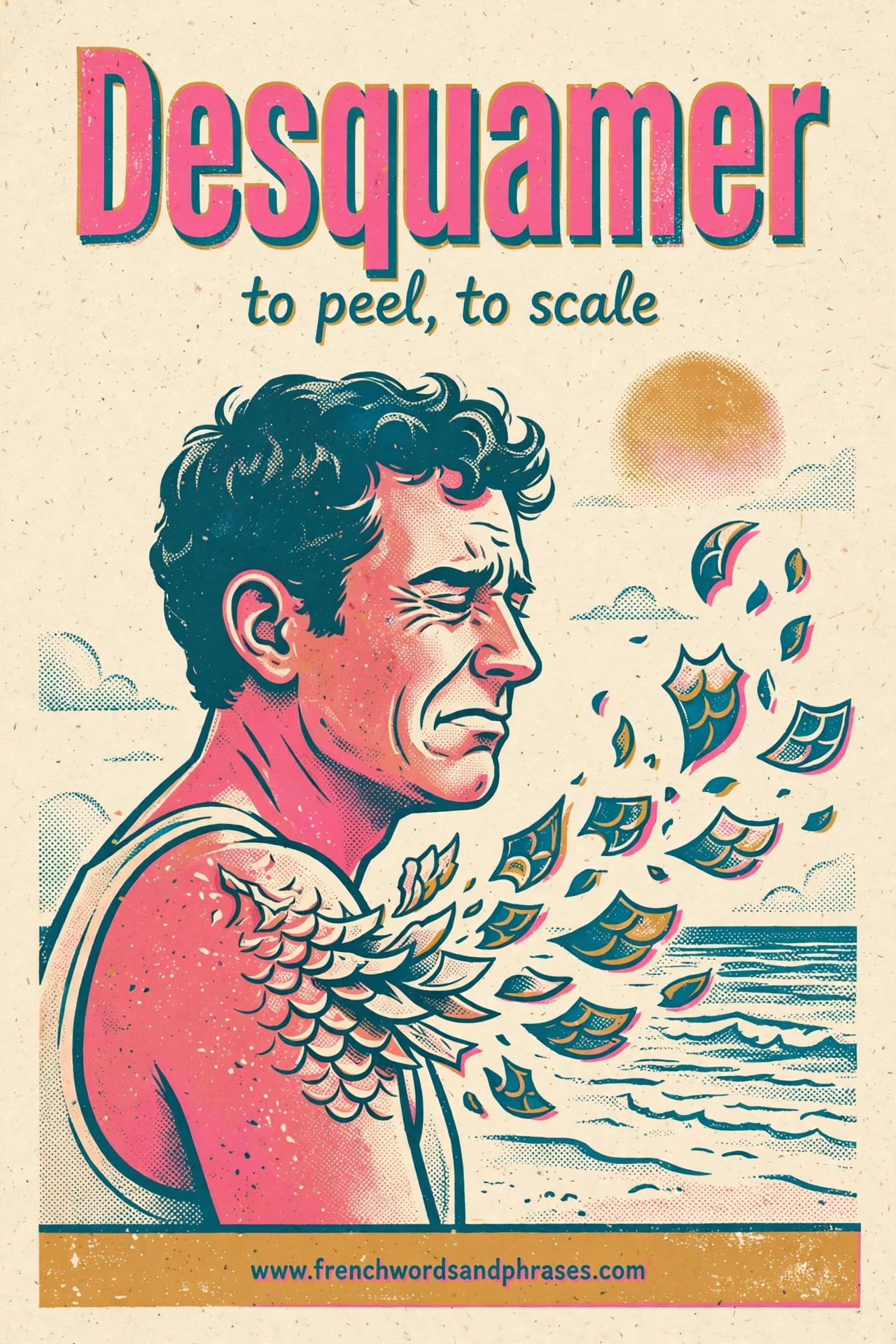
Desquamer means to peel, to scale — for skin or a surface to shed its outer layer in thin flakes, as after sunburn or in dry weather.
Shoulders after a day at the beach, a wall whose paint lifts in scales, a fish losing its shine — desquamer is the quiet dermatological verb of the shedding surface: the top layer lets go, flake by flake, and a new skin waits underneath.
In this guide, you’ll learn how to conjugate desquamer in all the major French tenses and moods. Explore complete conjugation tables, French examples, English translations, and practice quizzes.
Understanding the French Verb Desquamer
Desquamer is a regular French verb belonging to the first group of verbs, those ending in-er.
It means to peel, to scale. It is commonly used in dermatology and everyday health talk for skin peeling after sunburn, in dryness or in certain illnesses, and by extension for paint, plaster and bark flaking off a surface. A medical, slightly formal word — the beach version of it is more often peler: je pèle après la plage.
Verb classification: First group (-er)
Auxiliary verb: Avoir
Past participle: desquamé
Present participle: desquamant
English equivalents: To peel, to scale, to flake off; la peau desquame — the skin peels; desquamer après un coup de soleil — to peel after sunburn; la desquamation — peeling, desquamation (the medical noun); une peinture qui desquame — paint that is flaking off.
One important detail: desquamer comes from the Latin squama, a scale — the scale of a fish or a snake — and its spelling keeps the hard qu of that ancestry: je desquame, nous desquamons, ils desquament, past participle desquamé. It is most at home as an intransitive verb of skins and surfaces: la peau desquame, la peinture desquame — the thing sheds; nobody needs to peel it. Doctors pair it with its noun, la desquamation, the shedding itself, and the verb is regular -er in every form.
Experience the Word
Desquamer is the verb of the loosening layer — the old surface signing off, one flake at a time.
Imagine the third day after a beach holiday. The sunburn has cooled, and now the skin across your shoulders lifts in pale flakes, comme un vieux papier peint. La peau desquame — underneath, pink and new, the summer’s second skin is already waiting.
Nothing hurts any more. The skin is simply peeling — elle desquame — shedding the holiday layer by layer.
How to Conjugate Desquamer: Complete French Conjugation Guide
Let’s explore every major conjugation of desquamer, beginning with the indicative mood.
How to Conjugate Desquamer in the Indicative Mood
The indicative mood is used to express facts, observations, actions, and events.
How to Conjugate Desquamer in the Present Tense (Présent)
Used for actions happening now, habitual actions, and general truths.
| Subject | Conjugation |
|---|---|
| je | desquame |
| tu | desquames |
| il / elle | desquame |
| nous | desquamons |
| vous | desquamez |
| ils / elles | desquament |
Example
Après un coup de soleil, la peau desquame pendant des jours.
After a sunburn, the skin peels for days.
Quick Quiz 1
Complete the sentence:
En hiver, nos mains ______ à cause du froid.
Reveal the answer
desquament
En hiver, nos mains desquament à cause du froid.
In winter, our hands flake because of the cold.
How to Conjugate Desquamer in the Passé Composé
Used for completed actions in the past. Desquamer takes the auxiliary verb avoir.
| Subject | Conjugation |
|---|---|
| j’ | ai desquamé |
| tu | as desquamé |
| il / elle | a desquamé |
| nous | avons desquamé |
| vous | avez desquamé |
| ils / elles | ont desquamé |
Example
Son dos a desquamé après la semaine à la plage.
His back peeled after the week at the beach.
How to Conjugate Desquamer in the Imparfait (Imperfect Tense)
Used for habitual past actions, descriptions, and ongoing situations in the past.
| Subject | Conjugation |
|---|---|
| je | desquamais |
| tu | desquamais |
| il / elle | desquamait |
| nous | desquamions |
| vous | desquamiez |
| ils / elles | desquamaient |
Example
En hiver, ses mains desquamaient à cause du froid.
In winter, her hands used to flake because of the cold.
Quick Quiz 2
Choose the correct form:
His back peeled after the beach.
Son dos ______ après la plage. (a desquamé / est desquamé)
Reveal the answer
a desquamé
Son dos a desquamé après la plage.
Desquamer takes avoir.
How to Conjugate Desquamer in the Plus-que-parfait
Used to describe an action that had already been completed before another past event.
| Subject | Conjugation |
|---|---|
| j’ | avais desquamé |
| tu | avais desquamé |
| il / elle | avait desquamé |
| nous | avions desquamé |
| vous | aviez desquamé |
| ils / elles | avaient desquamé |
Example
La peinture avait desquamé sur toute la façade nord.
The paint had flaked off across the whole north wall.
How to Conjugate Desquamer in the Passé Simple
Primarily used in formal writing, literature, and historical narratives. It is rarely used in everyday conversation.
| Subject | Conjugation |
|---|---|
| je | desquamai |
| tu | desquamas |
| il / elle | desquama |
| nous | desquamâmes |
| vous | desquamâtes |
| ils / elles | desquamèrent |
Example
Au bout d’une semaine, l’épaule desquama entièrement.
After a week, the shoulder peeled completely.
How to Conjugate Desquamer in the Passé Antérieur
A literary tense used to express an action completed immediately before another past action, generally in the passé simple.
| Subject | Conjugation |
|---|---|
| j’ | eus desquamé |
| tu | eus desquamé |
| il / elle | eut desquamé |
| nous | eûmes desquamé |
| vous | eûtes desquamé |
| ils / elles | eurent desquamé |
Example
Quand la peau eut desquamé, elle apparut rose et neuve.
When the skin had peeled, it appeared pink and new.
How to Conjugate Desquamer in the Future Tense (Futur Simple)
Used to describe actions that will take place in the future.
| Subject | Conjugation |
|---|---|
| je | desquamerai |
| tu | desquameras |
| il / elle | desquamera |
| nous | desquamerons |
| vous | desquamerez |
| ils / elles | desquameront |
Example
Sans crème, ton nez desquamera dès demain.
Without cream, your nose will peel from tomorrow.
How to Conjugate Desquamer in the Futur Antérieur (Future Perfect)
Used for an action that will have been completed before a particular point in the future.
| Subject | Conjugation |
|---|---|
| j’ | aurai desquamé |
| tu | auras desquamé |
| il / elle | aura desquamé |
| nous | aurons desquamé |
| vous | aurez desquamé |
| ils / elles | auront desquamé |
Example
À la fin des vacances, son dos aura desquamé deux fois.
By the end of the holidays, his back will have peeled twice.
How to Conjugate Desquamer in the Near Future (Futur Proche)
Used to describe something that is going to happen soon. Formed with aller + infinitive.
| Subject | Conjugation |
|---|---|
| je | vais desquamer |
| tu | vas desquamer |
| il / elle | va desquamer |
| nous | allons desquamer |
| vous | allez desquamer |
| ils / elles | vont desquamer |
Example
Regarde tes épaules : la peau va desquamer.
Look at your shoulders: the skin is going to peel.
How to Conjugate Desquamer in the Conditional Mood
The conditional mood expresses what would happen under certain circumstances. It is also frequently used to make polite requests or express wishes.
How to Conjugate Desquamer in the Present Conditional
| Subject | Conjugation |
|---|---|
| je | desquamerais |
| tu | desquamerais |
| il / elle | desquamerait |
| nous | desquamerions |
| vous | desquameriez |
| ils / elles | desquameraient |
Example
Avec une bonne crème, la peau desquamerait moins.
With a good cream, the skin would peel less.
How to Conjugate Desquamer in the Past Conditional
| Subject | Conjugation |
|---|---|
| j’ | aurais desquamé |
| tu | aurais desquamé |
| il / elle | aurait desquamé |
| nous | aurions desquamé |
| vous | auriez desquamé |
| ils / elles | auraient desquamé |
Example
Elle aurait desquamé davantage sans l’ombre du parasol.
She would have peeled more without the parasol’s shade.
Desquamer in the Literary Past Conditional Form
This less common literary form uses the imperfect subjunctive of avoir.
| Subject | Conjugation |
|---|---|
| j’ | eusse desquamé |
| tu | eusses desquamé |
| il / elle | eût desquamé |
| nous | eussions desquamé |
| vous | eussiez desquamé |
| ils / elles | eussent desquamé |
Example
La façade eût desquamé sans la couche de chaux.
The wall would have flaked without the coat of limewash.
How to Conjugate Desquamer in the Subjunctive Mood
The subjunctive is used to express wishes, emotions, doubts, necessity, and uncertainty. It frequently follows expressions such as il faut que (it is necessary that) or bien que (although).
How to Conjugate Desquamer in the Present Subjunctive
| Subject | Conjugation |
|---|---|
| que je | desquame |
| que tu | desquames |
| qu’il / qu’elle | desquame |
| que nous | desquamions |
| que vous | desquamiez |
| qu’ils / qu’elles | desquament |
Example
Il est normal que la peau desquame après un tel coup de soleil.
It is normal for the skin to peel after such a sunburn.
Quick Quiz 3
Complete the sentence using the subjunctive:
Il est normal que vos épaules ______ après ce coup de soleil.
Reveal the answer
desquament
Il est normal que vos épaules desquament après ce coup de soleil.
It is normal for your shoulders to peel after this sunburn.
How to Conjugate Desquamer in the Imperfect Subjunctive
A literary tense, rarely encountered in modern spoken French.
| Subject | Conjugation |
|---|---|
| que je | desquamasse |
| que tu | desquamasses |
| qu’il / qu’elle | desquamât |
| que nous | desquamassions |
| que vous | desquamassiez |
| qu’ils / qu’elles | desquamassent |
Example
Le médecin expliqua pourquoi la peau desquamât ainsi.
The doctor explained why the skin was peeling like that.
How to Conjugate Desquamer in the Pluperfect Subjunctive
A literary construction used to express an action completed before another past action.
| Subject | Conjugation |
|---|---|
| que j’ | eusse desquamé |
| que tu | eusses desquamé |
| qu’il / qu’elle | eût desquamé |
| que nous | eussions desquamé |
| que vous | eussiez desquamé |
| qu’ils / qu’elles | eussent desquamé |
Example
On constata que la peinture eût desquamé en un seul hiver.
It was observed that the paint had flaked off in a single winter.
How to Conjugate Desquamer in the Past Subjunctive
| Subject | Conjugation |
|---|---|
| que j’ | aie desquamé |
| que tu | aies desquamé |
| qu’il / qu’elle | ait desquamé |
| que nous | ayons desquamé |
| que vous | ayez desquamé |
| qu’ils / qu’elles | aient desquamé |
Example
Je suis étonné que son dos ait desquamé si vite.
I am amazed his back peeled so quickly.
How to Conjugate Desquamer in the Imperative
The imperative is used to give commands, instructions, invitations, or suggestions. Subject pronouns are omitted.
How to Conjugate Desquamer in the Present Imperative
| Person | Conjugation |
|---|---|
| (tu) | desquame |
| (nous) | desquamons |
| (vous) | desquamez |
Example
Ne laisse pas ta peau desquamer, mets de la crème !
Do not let your skin peel, put some cream on!
Quick Quiz 4
How would you say Do not let your skin peel (tu form)?
Reveal the answer
Ne laisse pas ta peau desquamer !
French Participles of Desquamer
Participles are verb forms that can be used in compound tenses and other grammatical constructions.
Present Participle of Desquamer
desquamant
En desquamant, la peau révèle une couche plus jeune.
In peeling, the skin reveals a younger layer.
Past Participle of Desquamer
desquamé
Desquamée par le soleil, son épaule était sensible au toucher.
Peeled by the sun, her shoulder was sensitive to the touch.
Desquamer in Everyday French: Real-Life Examples
Now that you know the conjugations, let’s see how desquamer appears in everyday French.
Example 1 — Present
Après un coup de soleil, la peau desquame.
After a sunburn, the skin peels.
Example 2 — Passé composé
Son dos a desquamé après la plage.
His back peeled after the beach.
Example 3 — Imparfait
Ses mains desquamaient à cause du froid.
Her hands used to flake because of the cold.
Example 4 — Future
Ton nez desquamera sans crème.
Your nose will peel without cream.
Example 5 — Conditional
La peau desquamerait moins avec une bonne crème.
The skin would peel less with a good cream.
Example 6 — Imperative
Ne laisse pas ta peau desquamer !
Do not let your skin peel!
Beyond Translation: The Meaning of Desquamer
English desquamate exists in medical Latin and nowhere else; French desquamer escaped the clinic and lives at the beach — the doctor’s word that every holidaymaker ends up needing.
Its root is a scale.
Squama gave French both the fish’s écaille and this verb of flaking skin: to desquamer is to do, slowly and in flakes, what the snake does all at once — leave the old surface behind.
How to Remember the French Verb Desquamer
Remember it this way: Desquamer is about the shoulders shedding the holiday, flake by flake.
- From Latin squama, a scale: desquamer is skin or paint shedding in flakes — la peau desquame.
- Usually intransitive: the surface peels by itself — je pèle is the beach word, desquamer the doctor’s.
- Regular -er: je desquame, nous desquamons, past participle desquamé; the noun is la desquamation.
The key idea is the shoulders shedding the holiday, flake by flake.
Test Your Knowledge of Desquamer
Let’s see how much you’ve learned. Try answering these questions before revealing the answers.
Question 1
What Latin word does desquamer come from, and what did it mean?
Reveal the answer
Squama — a scale, as of a fish or snake; desquamer is to shed the surface in flakes.
Question 2
How do you say After a sunburn, the skin peels for days in French?
Reveal the answer
Après un coup de soleil, la peau desquame pendant des jours.
Question 3
Translate: His back peeled after the week at the beach.
Reveal the answer
Son dos a desquamé après la semaine à la plage.
Question 4
What is the past participle of desquamer?
Reveal the answer
Desquamé — and the process itself is la desquamation.
Question 5
Complete the sentence:
Il est normal que la peau ______ après un tel coup de soleil.
Reveal the answer
desquame
Il est normal que la peau desquame après un tel coup de soleil.
It is normal for the skin to peel after such a sunburn.
Your Final Challenge
Can You Use It?
How would you say this in French?
To peel after the summer is the skin turning the page on the holidays.
Reveal the answer
Desquamer après l’été, c’est la peau qui tourne la page des vacances.
To peel after the summer is the skin turning the page on the holidays.
A little French. A little curiosity. A richer everyday life.
LEARN FRENCH ONE WORD AT A TIME