A French Word to Live By
How to Conjugate Désorienter in French
/de.zɔ.ʁjɑ̃.te/
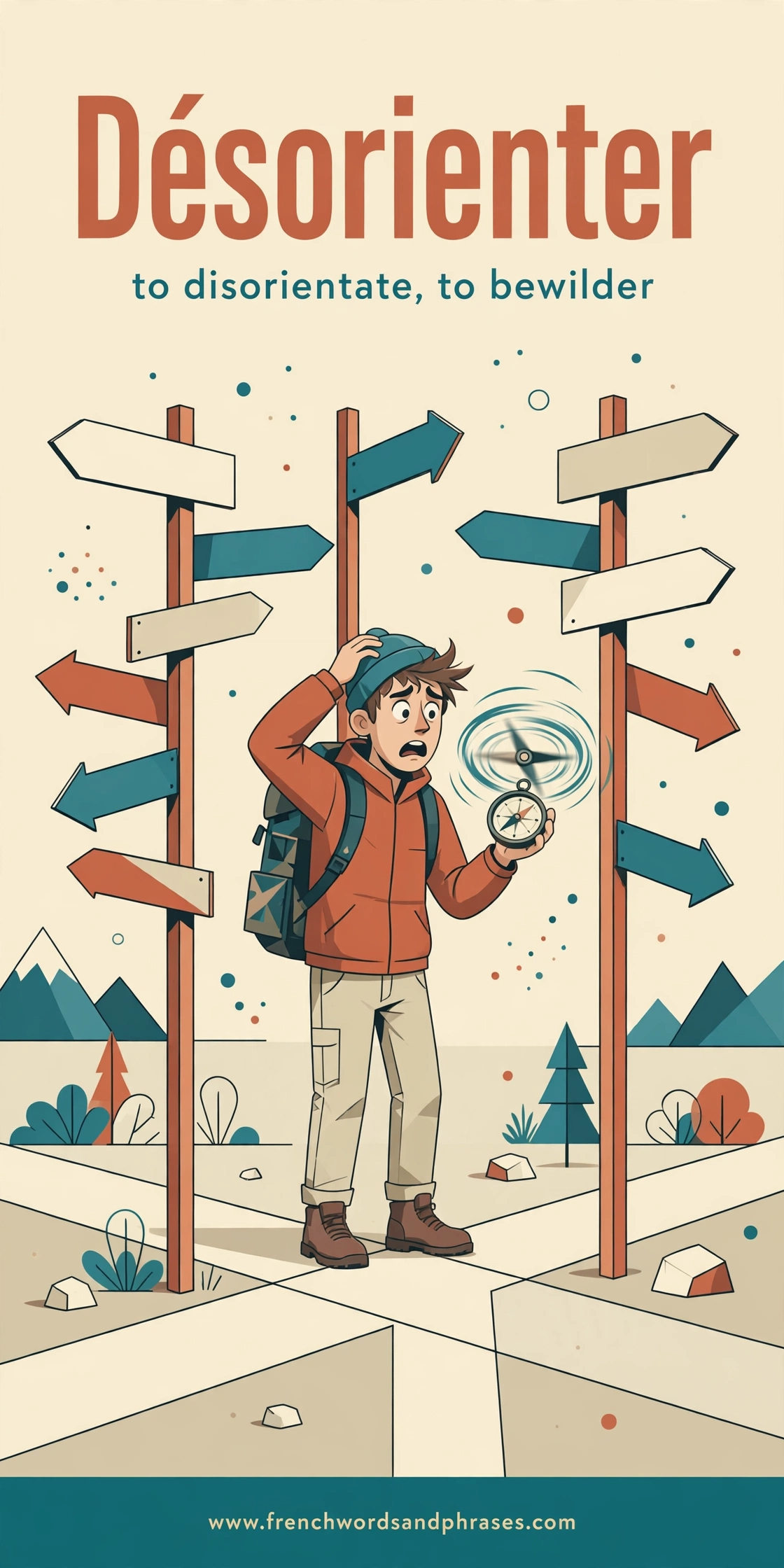
Désorienter means to disorientate, to bewilder — to take away someone’s bearings, on a map or in the mind, until they no longer know where they stand.
A hiker in fog who has lost the path, a student bewildered by a new school, a driver whose landmarks have all been demolished — désorienter is the verb of lost bearings: the world has not moved, but the compass inside you spins.
In this guide, you’ll learn how to conjugate désorienter in all the major French tenses and moods. Explore complete conjugation tables, French examples, English translations, and practice quizzes.
Understanding the French Verb Désorienter
Désorienter is a regular French verb belonging to the first group of verbs, those ending in-er.
It means to disorientate, to bewilder. It is commonly used of places, fog and changes that make people lose their bearings, in psychology and education for bewilderment and loss of direction — un jeune désorienté is a young person who has lost his way in life — and in sport and debate for throwing an opponent off balance.
Verb classification: First group (-er)
Auxiliary verb: Avoir
Past participle: désorienté
Present participle: désorientant
English equivalents: To disorientate, to bewilder, to throw off course; désorienter un voyageur — to disorient a traveller; être désorienté — to be disoriented, lost; désorienter l’adversaire — to throw the opponent off balance; un élève désorienté — a pupil unsure of his direction (in studies and in life).
One important detail: désorienter is built on l’orient — the east, the direction of the rising sun by which travellers once steered — with the undoing prefix dés-: to désorienter someone is literally to take their east away. The verb is regular: je désoriente, nous désorientons, ils désorientent, past participle désorienté, and its commonest form is the adjective: être désorienté — lost, bewildered, all at sea. Watch the middle of the word: -orient- keeps its i — désorienter, never désorenter.
Experience the Word
Désorienter is the verb of the stolen compass — the place is the same, but you can no longer read it.
Imagine a hiker above the tree line when the fog comes down in a minute. The cairns vanish, the path vanishes, even the slope feels wrong. Le brouillard le désoriente completely — he stops, breathes, and waits, because a désorienté walker who keeps walking walks in circles.
The mountain has not moved an inch. He has been disoriented — désorienté — his east taken away by the fog.
How to Conjugate Désorienter: Complete French Conjugation Guide
Let’s explore every major conjugation of désorienter, beginning with the indicative mood.
How to Conjugate Désorienter in the Indicative Mood
The indicative mood is used to express facts, observations, actions, and events.
How to Conjugate Désorienter in the Present Tense (Présent)
Used for actions happening now, habitual actions, and general truths.
| Subject | Conjugation |
|---|---|
| je | désoriente |
| tu | désorientes |
| il / elle | désoriente |
| nous | désorientons |
| vous | désorientez |
| ils / elles | désorientent |
Example
Le brouillard désoriente les randonneurs les plus prudents.
The fog disorients even the most careful hikers.
Quick Quiz 1
Complete the sentence:
Nous ______ les touristes avec ce plan faux.
Reveal the answer
désorientons
Nous désorientons les touristes avec ce plan faux.
We are disorienting the tourists with this wrong map.
How to Conjugate Désorienter in the Passé Composé
Used for completed actions in the past. Désorienter takes the auxiliary verb avoir.
| Subject | Conjugation |
|---|---|
| j’ | ai désorienté |
| tu | as désorienté |
| il / elle | a désorienté |
| nous | avons désorienté |
| vous | avez désorienté |
| ils / elles | ont désorienté |
Example
Ces travaux ont désorienté tous les automobilistes du quartier.
These roadworks disoriented all the drivers in the neighbourhood.
How to Conjugate Désorienter in the Imparfait (Imperfect Tense)
Used for habitual past actions, descriptions, and ongoing situations in the past.
| Subject | Conjugation |
|---|---|
| je | désorientais |
| tu | désorientais |
| il / elle | désorientait |
| nous | désorientions |
| vous | désorientiez |
| ils / elles | désorientaient |
Example
La nuit désorientait les marins sans étoiles.
The night used to disorient sailors when there were no stars.
Quick Quiz 2
Choose the correct form:
The storm disoriented the crew.
La tempête ______ l’équipage. (a désorienté / est désorienté)
Reveal the answer
a désorienté
La tempête a désorienté l’équipage.
Désorienter takes avoir.
How to Conjugate Désorienter in the Plus-que-parfait
Used to describe an action that had already been completed before another past event.
| Subject | Conjugation |
|---|---|
| j’ | avais désorienté |
| tu | avais désorienté |
| il / elle | avait désorienté |
| nous | avions désorienté |
| vous | aviez désorienté |
| ils / elles | avaient désorienté |
Example
Le changement d’horaire avait désorienté les voyageurs.
The timetable change had disoriented the travellers.
How to Conjugate Désorienter in the Passé Simple
Primarily used in formal writing, literature, and historical narratives. It is rarely used in everyday conversation.
| Subject | Conjugation |
|---|---|
| je | désorientai |
| tu | désorientas |
| il / elle | désorienta |
| nous | désorientâmes |
| vous | désorientâtes |
| ils / elles | désorientèrent |
Example
La tempête désorienta l’équipage pendant deux jours.
The storm disoriented the crew for two days.
How to Conjugate Désorienter in the Passé Antérieur
A literary tense used to express an action completed immediately before another past action, generally in the passé simple.
| Subject | Conjugation |
|---|---|
| j’ | eus désorienté |
| tu | eus désorienté |
| il / elle | eut désorienté |
| nous | eûmes désorienté |
| vous | eûtes désorienté |
| ils / elles | eurent désorienté |
Example
Quand la brume eut désorienté la patrouille, elle s’arrêta.
When the mist had disoriented the patrol, it stopped.
How to Conjugate Désorienter in the Future Tense (Futur Simple)
Used to describe actions that will take place in the future.
| Subject | Conjugation |
|---|---|
| je | désorienterai |
| tu | désorienteras |
| il / elle | désorientera |
| nous | désorienterons |
| vous | désorienterez |
| ils / elles | désorienteront |
Example
Cette nouvelle carte désorientera les habitués du parc.
This new map will bewilder the park regulars.
How to Conjugate Désorienter in the Futur Antérieur (Future Perfect)
Used for an action that will have been completed before a particular point in the future.
| Subject | Conjugation |
|---|---|
| j’ | aurai désorienté |
| tu | auras désorienté |
| il / elle | aura désorienté |
| nous | aurons désorienté |
| vous | aurez désorienté |
| ils / elles | auront désorienté |
Example
À la rentrée, ce déménagement aura désorienté bien des élèves.
By the start of term, this move will have disoriented many pupils.
How to Conjugate Désorienter in the Near Future (Futur Proche)
Used to describe something that is going to happen soon. Formed with aller + infinitive.
| Subject | Conjugation |
|---|---|
| je | vais désorienter |
| tu | vas désorienter |
| il / elle | va désorienter |
| nous | allons désorienter |
| vous | allez désorienter |
| ils / elles | vont désorienter |
Example
Attention, ce carrefour va désorienter les touristes.
Careful, this junction is going to disorient the tourists.
How to Conjugate Désorienter in the Conditional Mood
The conditional mood expresses what would happen under certain circumstances. It is also frequently used to make polite requests or express wishes.
How to Conjugate Désorienter in the Present Conditional
| Subject | Conjugation |
|---|---|
| je | désorienterais |
| tu | désorienterais |
| il / elle | désorienterait |
| nous | désorienterions |
| vous | désorienteriez |
| ils / elles | désorienteraient |
Example
Un seul panneau désorienterait moins les visiteurs.
A single sign would bewilder the visitors less.
How to Conjugate Désorienter in the Past Conditional
| Subject | Conjugation |
|---|---|
| j’ | aurais désorienté |
| tu | aurais désorienté |
| il / elle | aurait désorienté |
| nous | aurions désorienté |
| vous | auriez désorienté |
| ils / elles | auraient désorienté |
Example
Sans le brouillard, rien n’aurait désorienté les randonneurs.
Without the fog, nothing would have disoriented the hikers.
Désorienter in the Literary Past Conditional Form
This less common literary form uses the imperfect subjunctive of avoir.
| Subject | Conjugation |
|---|---|
| j’ | eusse désorienté |
| tu | eusses désorienté |
| il / elle | eût désorienté |
| nous | eussions désorienté |
| vous | eussiez désorienté |
| ils / elles | eussent désorienté |
Example
La forêt eût désorienté le voyageur sans la rivière.
The forest would have disoriented the traveller without the river.
How to Conjugate Désorienter in the Subjunctive Mood
The subjunctive is used to express wishes, emotions, doubts, necessity, and uncertainty. It frequently follows expressions such as il faut que (it is necessary that) or bien que (although).
How to Conjugate Désorienter in the Present Subjunctive
| Subject | Conjugation |
|---|---|
| que je | désoriente |
| que tu | désorientes |
| qu’il / qu’elle | désoriente |
| que nous | désorientions |
| que vous | désorientiez |
| qu’ils / qu’elles | désorientent |
Example
Il est facile que cette ville désoriente les nouveaux arrivants.
This town easily disorients new arrivals.
Quick Quiz 3
Complete the sentence using the subjunctive:
Il est facile que cette ville ______ les nouveaux arrivants.
Reveal the answer
désoriente
Il est facile que cette ville désoriente les nouveaux arrivants.
This town easily disorients new arrivals.
How to Conjugate Désorienter in the Imperfect Subjunctive
A literary tense, rarely encountered in modern spoken French.
| Subject | Conjugation |
|---|---|
| que je | désorientasse |
| que tu | désorientasses |
| qu’il / qu’elle | désorientât |
| que nous | désorientassions |
| que vous | désorientassiez |
| qu’ils / qu’elles | désorientassent |
Example
On balisa le sentier pour que rien ne désorientât les marcheurs.
They marked the path so that nothing would disorient the walkers.
How to Conjugate Désorienter in the Pluperfect Subjunctive
A literary construction used to express an action completed before another past action.
| Subject | Conjugation |
|---|---|
| que j’ | eusse désorienté |
| que tu | eusses désorienté |
| qu’il / qu’elle | eût désorienté |
| que nous | eussions désorienté |
| que vous | eussiez désorienté |
| qu’ils / qu’elles | eussent désorienté |
Example
On racontait que la tempête eût désorienté la flotte entière.
People said the storm had disoriented the entire fleet.
How to Conjugate Désorienter in the Past Subjunctive
| Subject | Conjugation |
|---|---|
| que j’ | aie désorienté |
| que tu | aies désorienté |
| qu’il / qu’elle | ait désorienté |
| que nous | ayons désorienté |
| que vous | ayez désorienté |
| qu’ils / qu’elles | aient désorienté |
Example
Je suis étonné que ce plan ait désorienté tant de monde.
I am amazed this map disoriented so many people.
How to Conjugate Désorienter in the Imperative
The imperative is used to give commands, instructions, invitations, or suggestions. Subject pronouns are omitted.
How to Conjugate Désorienter in the Present Imperative
| Person | Conjugation |
|---|---|
| (tu) | désoriente |
| (nous) | désorientons |
| (vous) | désorientez |
Example
Ne désoriente pas les visiteurs avec tes indications fausses !
Do not disorient the visitors with your wrong directions!
Quick Quiz 4
How would you say Do not disorient the visitors (tu form)?
Reveal the answer
Ne désoriente pas les visiteurs !
French Participles of Désorienter
Participles are verb forms that can be used in compound tenses and other grammatical constructions.
Present Participle of Désorienter
désorientant
En désorientant l’adversaire, le boxeur a gagné le round.
By throwing his opponent off balance, the boxer won the round.
Past Participle of Désorienter
désorienté
Désorienté par le brouillard, le pilote a demandé de l’aide.
Disoriented by the fog, the pilot asked for help.
Désorienter in Everyday French: Real-Life Examples
Now that you know the conjugations, let’s see how désorienter appears in everyday French.
Example 1 — Present
Le brouillard désoriente les randonneurs.
The fog disorients the hikers.
Example 2 — Passé composé
Ces travaux ont désorienté les automobilistes.
These roadworks disoriented the drivers.
Example 3 — Imparfait
La nuit désorientait les marins sans étoiles.
The night used to disorient sailors with no stars.
Example 4 — Future
Cette carte désorientera les habitués.
This map will bewilder the regulars.
Example 5 — Conditional
Un panneau désorienterait moins les visiteurs.
A sign would bewilder the visitors less.
Example 6 — Imperative
Ne désoriente pas les visiteurs !
Do not disorient the visitors!
Beyond Translation: The Meaning of Désorienter
English disorient and French désorienter share the same beautiful secret: both are built on the Orient, the east — the direction of sunrise, the first landmark of every ancient traveller.
To be disoriented is to have lost the east.
French keeps the poetry visible, and adds a human sense English mostly lacks: un élève désorienté is not lost in a corridor but in his life — which is why French schools employ des conseillers d’orientation, counsellors of east-finding.
How to Remember the French Verb Désorienter
Remember it this way: Désorienter is about the hiker in the fog, his east stolen.
- Built on l’orient, the east: désorienter is to take someone’s east away — je désoriente, nous désorientons.
- Être désorienté is the everyday form: lost, bewildered, all at sea — for hikers and for lost students alike.
- Mind the spelling: -orient- keeps its i — désorienter, désorienté, never désorenter.
The key idea is the hiker in the fog, his east stolen.
Test Your Knowledge of Désorienter
Let’s see how much you’ve learned. Try answering these questions before revealing the answers.
Question 1
What direction hides inside désorienter, and why?
Reveal the answer
L’orient — the east, the sunrise direction travellers steered by; to désorienter is to take someone’s east away.
Question 2
How do you say The fog disorients even the most careful hikers in French?
Reveal the answer
Le brouillard désoriente les randonneurs les plus prudents.
Question 3
Translate: These roadworks disoriented all the drivers.
Reveal the answer
Ces travaux ont désorienté tous les automobilistes.
Question 4
What is the past participle of désorienter?
Reveal the answer
Désorienté — être désorienté, to be disoriented.
Question 5
Complete the sentence:
Je suis étonné que ce plan ______ tant de monde.
Reveal the answer
ait désorienté
Je suis étonné que ce plan ait désorienté tant de monde.
I am amazed this map disoriented so many people.
Your Final Challenge
Can You Use It?
How would you say this in French?
To disorient a traveller takes only a fog; to reorient him takes a star.
Reveal the answer
Désorienter un voyageur ne demande qu’un brouillard ; le réorienter demande une étoile.
To disorient a traveller takes only a fog; to reorient him takes a star.
A little French. A little curiosity. A richer everyday life.
LEARN FRENCH ONE WORD AT A TIME