A French Word to Live By
How to Conjugate Se désincarner in French
/sə de.zɛ̃.kaʁ.ne/
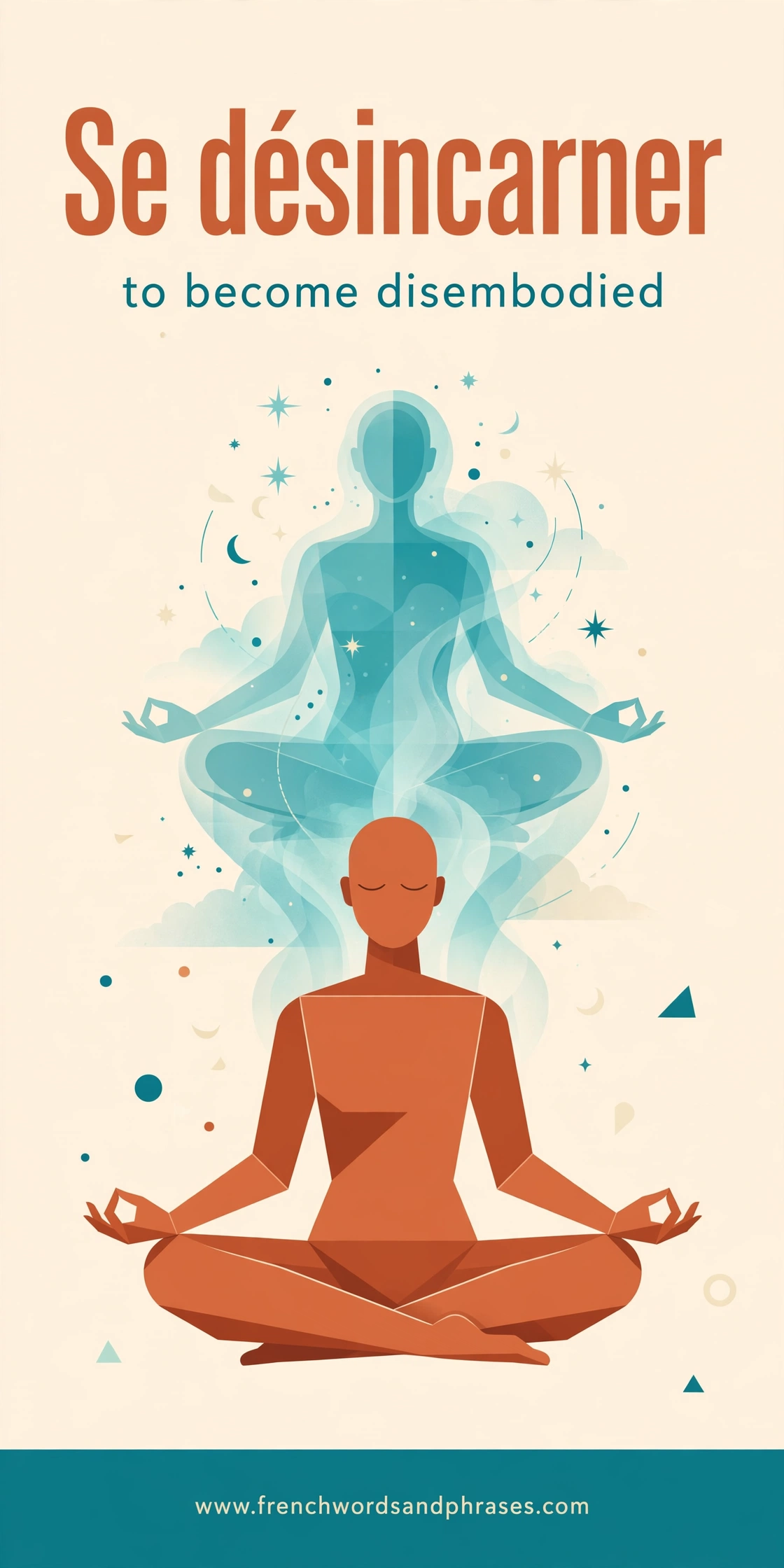
Se désincarner means to become disembodied — for a soul or spirit to leave the body behind and exist without flesh.
A soul rising from a sleeping body in an old engraving, a voice on a recording that outlives the singer — se désincarner belongs to mystics, poets and philosophers: it is the moment the spirit slips out of the flesh and goes on without it.
In this guide, you’ll learn how to conjugate se désincarner in all the major French tenses and moods. Explore complete conjugation tables, French examples, English translations, and practice quizzes.
Understanding the French Verb Se désincarner
Se désincarner is a regular French verb belonging to the first group of verbs, those ending in-er.
It means to become disembodied. It is a rare, elevated verb — at home in theology, spiritualism and literary criticism rather than in conversation — used of souls leaving bodies, and figuratively of voices, ideas and art cut loose from any living presence.
Verb classification: First group (-er), reflexive
Auxiliary verb: Être
Past participle: désincarné
Present participle: désincarnant
English equivalents: To become disembodied; l’âme se désincarne — the soul leaves the body; un esprit désincarné — a disembodied spirit; s’incarner — to become incarnate, its exact opposite; la réincarnation — reincarnation.
One important detail: se désincarner is the exact opposite of s’incarner — where s’incarner means a spirit taking flesh, se désincarner is the spirit leaving it. Being reflexive, it takes être in every compound tense and the past participle agrees with the subject: elle s’est désincarnée, ils se sont désincarnés. The family is theological: l’Incarnation is Christ taking flesh, and the adjective désincarné also describes anything bloodless and abstract — une poésie désincarnée, poetry with no flesh on it.
Experience the Word
Se désincarner is the verb of the great departure — the spirit steps out of the body the way a guest steps out of a house.
Imagine a medieval miniature: a sleeper in a blue robe, and above him his soul, drawn as a small naked figure, rising toward a band of angels. L’âme se désincarne — the painter shows the exact second when the person stops being a body and becomes a traveller.
The body sleeps on, unchanged. The soul has become disembodied — désincarnée — and the picture needs no words.
How to Conjugate Se désincarner: Complete French Conjugation Guide
Let’s explore every major conjugation of se désincarner, beginning with the indicative mood.
How to Conjugate Se désincarner in the Indicative Mood
The indicative mood is used to express facts, observations, actions, and events.
How to Conjugate Se désincarner in the Present Tense (Présent)
Used for actions happening now, habitual actions, and general truths.
| Subject | Conjugation |
|---|---|
| je | me désincarne |
| tu | te désincarnes |
| il / elle | se désincarne |
| nous | nous désincarnons |
| vous | vous désincarnez |
| ils / elles | se désincarnent |
Example
Dans ce récit, l’âme se désincarne pendant le sommeil.
In this tale, the soul leaves the body during sleep.
Quick Quiz 1
Complete the sentence:
Dans ce poème, nous nous ______ en rêve chaque nuit.
Reveal the answer
désincarnons
Dans ce poème, nous nous désincarnons en rêve chaque nuit.
In this poem, we leave our bodies in dreams every night.
How to Conjugate Se désincarner in the Passé Composé
Used for completed actions in the past. Se désincarner takes the auxiliary verb être.
| Subject | Conjugation |
|---|---|
| je | me suis désincarné / me suis désincarnée |
| tu | t’es désincarné / t’es désincarnée |
| il / elle | s’est désincarné / s’est désincarnée |
| nous | nous sommes désincarnés / nous sommes désincarnées |
| vous | vous êtes désincarnés / vous êtes désincarnées / vous êtes désincarné / vous êtes désincarnée |
| ils / elles | se sont désincarnés / se sont désincarnées |
Example
Son esprit s’est désincarné dans la lumière, dit le poème.
His spirit became disembodied in the light, says the poem.
How to Conjugate Se désincarner in the Imparfait (Imperfect Tense)
Used for habitual past actions, descriptions, and ongoing situations in the past.
| Subject | Conjugation |
|---|---|
| je | me désincarnais |
| tu | te désincarnais |
| il / elle | se désincarnait |
| nous | nous désincarnions |
| vous | vous désincarniez |
| ils / elles | se désincarnaient |
Example
Chaque nuit, le héros se désincarnait et voyageait au loin.
Every night, the hero would leave his body and travel far away.
Quick Quiz 2
Choose the correct form:
The soul left the body before dawn.
L’âme ______ avant l’aube. (s’est désincarnée / a désincarné)
Reveal the answer
s’est désincarnée
L’âme s’est désincarnée avant l’aube.
Se désincarner is reflexive, takes être, and the participle agrees: désincarnée.
How to Conjugate Se désincarner in the Plus-que-parfait
Used to describe an action that had already been completed before another past event.
| Subject | Conjugation |
|---|---|
| je | m’étais désincarné / m’étais désincarnée |
| tu | t’étais désincarné / t’étais désincarnée |
| il / elle | s’était désincarné / s’était désincarnée |
| nous | nous étions désincarnés / nous étions désincarnées |
| vous | vous étiez désincarnés / vous étiez désincarnées / vous étiez désincarné / vous étiez désincarnée |
| ils / elles | s’étaient désincarnés / s’étaient désincarnées |
Example
L’âme s’était désincarnée avant l’aube, selon la légende.
The soul had left the body before dawn, according to the legend.
How to Conjugate Se désincarner in the Passé Simple
Primarily used in formal writing, literature, and historical narratives. It is rarely used in everyday conversation.
| Subject | Conjugation |
|---|---|
| je | me désincarnai |
| tu | te désincarnas |
| il / elle | se désincarna |
| nous | nous désincarnâmes |
| vous | vous désincarnâtes |
| ils / elles | se désincarnèrent |
Example
À minuit, l’esprit se désincarna et monta vers les étoiles.
At midnight, the spirit became disembodied and rose toward the stars.
How to Conjugate Se désincarner in the Passé Antérieur
A literary tense used to express an action completed immediately before another past action, generally in the passé simple.
| Subject | Conjugation |
|---|---|
| je | me fus désincarné / me fus désincarnée |
| tu | te fus désincarné / te fus désincarnée |
| il / elle | se fut désincarné / se fut désincarnée |
| nous | nous fûmes désincarnés / nous fûmes désincarnées |
| vous | vous fûtes désincarnés / vous fûtes désincarnées / vous fûtes désincarné / vous fûtes désincarnée |
| ils / elles | se furent désincarnés / se furent désincarnées |
Example
Quand l’âme se fut désincarnée, le corps devint froid.
When the soul had left the body, the body grew cold.
How to Conjugate Se désincarner in the Future Tense (Futur Simple)
Used to describe actions that will take place in the future.
| Subject | Conjugation |
|---|---|
| je | me désincarnerai |
| tu | te désincarneras |
| il / elle | se désincarnera |
| nous | nous désincarnerons |
| vous | vous désincarnerez |
| ils / elles | se désincarneront |
Example
Un jour, dit le sage, tu te désincarneras sans peur.
One day, says the sage, you will leave your body without fear.
How to Conjugate Se désincarner in the Futur Antérieur (Future Perfect)
Used for an action that will have been completed before a particular point in the future.
| Subject | Conjugation |
|---|---|
| je | me serai désincarné / me serai désincarnée |
| tu | te seras désincarné / te seras désincarnée |
| il / elle | se sera désincarné / se sera désincarnée |
| nous | nous serons désincarnés / nous serons désincarnées |
| vous | vous serez désincarnés / vous serez désincarnées / vous serez désincarné / vous serez désincarnée |
| ils / elles | se seront désincarnés / se seront désincarnées |
Example
À l’aube, l’âme se sera désincarnée depuis longtemps.
By dawn, the soul will long since have left the body.
How to Conjugate Se désincarner in the Near Future (Futur Proche)
Used to describe something that is going to happen soon. Formed with aller + infinitive.
| Subject | Conjugation |
|---|---|
| je | vais me désincarner |
| tu | vas te désincarner |
| il / elle | va se désincarner |
| nous | allons nous désincarner |
| vous | allez vous désincarner |
| ils / elles | vont se désincarner |
Example
Écoute ce silence : on dirait que la voix va se désincarner.
Listen to this silence: it is as if the voice were about to become disembodied.
How to Conjugate Se désincarner in the Conditional Mood
The conditional mood expresses what would happen under certain circumstances. It is also frequently used to make polite requests or express wishes.
How to Conjugate Se désincarner in the Present Conditional
| Subject | Conjugation |
|---|---|
| je | me désincarnerais |
| tu | te désincarnerais |
| il / elle | se désincarnerait |
| nous | nous désincarnerions |
| vous | vous désincarneriez |
| ils / elles | se désincarneraient |
Example
Sans ce corps fragile, l’âme se désincarnerait librement.
Without this fragile body, the soul would leave it freely.
How to Conjugate Se désincarner in the Past Conditional
| Subject | Conjugation |
|---|---|
| je | me serais désincarné / me serais désincarnée |
| tu | te serais désincarné / te serais désincarnée |
| il / elle | se serait désincarné / se serait désincarnée |
| nous | nous serions désincarnés / nous serions désincarnées |
| vous | vous seriez désincarnés / vous seriez désincarnées / vous seriez désincarné / vous seriez désincarnée |
| ils / elles | se seraient désincarnés / se seraient désincarnées |
Example
Le héros se serait désincarné plus tôt sans l’amour qui le retenait.
The hero would have left his body sooner without the love that held him back.
Se désincarner in the Literary Past Conditional Form
This less common literary form uses the imperfect subjunctive of être.
| Subject | Conjugation |
|---|---|
| je | me fusse désincarné / me fusse désincarnée |
| tu | te fusses désincarné / te fusses désincarnée |
| il / elle | se fût désincarné / se fût désincarnée |
| nous | nous fussions désincarnés / nous fussions désincarnées |
| vous | vous fussiez désincarnés / vous fussiez désincarnées / vous fussiez désincarné / vous fussiez désincarnée |
| ils / elles | se fussent désincarnés / se fussent désincarnées |
Example
L’âme se fût désincarnée dès le premier soir sans la prière.
The soul would have left the body on the very first evening without the prayer.
How to Conjugate Se désincarner in the Subjunctive Mood
The subjunctive is used to express wishes, emotions, doubts, necessity, and uncertainty. It frequently follows expressions such as il faut que (it is necessary that) or bien que (although).
How to Conjugate Se désincarner in the Present Subjunctive
| Subject | Conjugation |
|---|---|
| que je | me désincarne |
| que tu | te désincarnes |
| qu’il / qu’elle | se désincarne |
| que nous | nous désincarnions |
| que vous | vous désincarniez |
| qu’ils / qu’elles | se désincarnent |
Example
Le conte veut que l’âme se désincarne à minuit.
The tale requires the soul to leave the body at midnight.
Quick Quiz 3
Complete the sentence using the subjunctive:
Le conte veut que tu te ______ sans bruit.
Reveal the answer
désincarnes
Le conte veut que tu te désincarnes sans bruit.
The tale requires you to leave your body silently.
How to Conjugate Se désincarner in the Imperfect Subjunctive
A literary tense, rarely encountered in modern spoken French.
| Subject | Conjugation |
|---|---|
| que je | me désincarnasse |
| que tu | te désincarnasses |
| qu’il / qu’elle | se désincarnât |
| que nous | nous désincarnassions |
| que vous | vous désincarnassiez |
| qu’ils / qu’elles | se désincarnassent |
Example
La légende racontait qu’il se désincarnât chaque nuit.
The legend told that he left his body every night.
How to Conjugate Se désincarner in the Pluperfect Subjunctive
A literary construction used to express an action completed before another past action.
| Subject | Conjugation |
|---|---|
| que je | me fusse désincarné / me fusse désincarnée |
| que tu | te fusses désincarné / te fusses désincarnée |
| qu’il / qu’elle | se fût désincarné / se fût désincarnée |
| que nous | nous fussions désincarnés / nous fussions désincarnées |
| que vous | vous fussiez désincarnés / vous fussiez désincarnées / vous fussiez désincarné / vous fussiez désincarnée |
| qu’ils / qu’elles | se fussent désincarnés / se fussent désincarnées |
Example
Les moines croyaient qu’elle se fût désincarnée en priant.
The monks believed she had left her body while praying.
How to Conjugate Se désincarner in the Past Subjunctive
| Subject | Conjugation |
|---|---|
| que je | me sois désincarné / me sois désincarnée |
| que tu | te sois désincarné / te sois désincarnée |
| qu’il / qu’elle | se soit désincarné / se soit désincarnée |
| que nous | nous soyons désincarnés / nous soyons désincarnées |
| que vous | vous soyez désincarnés / vous soyez désincarnées / vous soyez désincarné / vous soyez désincarnée |
| qu’ils / qu’elles | se soient désincarnés / se soient désincarnées |
Example
Il est étrange que la voix se soit désincarnée ainsi.
It is strange that the voice became disembodied like that.
How to Conjugate Se désincarner in the Imperative
The imperative is used to give commands, instructions, invitations, or suggestions. Subject pronouns are omitted.
How to Conjugate Se désincarner in the Present Imperative
| Person | Conjugation |
|---|---|
| (tu) | désincarne-toi |
| (nous) | désincarnons-nous |
| (vous) | désincarnez-vous |
Example
Ne te désincarne pas encore, le voyage n’est pas fini !
Do not leave your body yet, the journey is not over!
Quick Quiz 4
How would you say Do not leave your body yet (tu form)?
Reveal the answer
Ne te désincarne pas encore !
French Participles of Se désincarner
Participles are verb forms that can be used in compound tenses and other grammatical constructions.
Present Participle of Se désincarner
désincarnant
En se désincarnant, l’âme du poème traverse les siècles.
By becoming disembodied, the soul of the poem crosses the centuries.
Past Participle of Se désincarner
désincarné
Désincarnée, la voix du chanteur flotte encore dans la salle.
Disembodied, the singer’s voice still floats in the hall.
Se désincarner in Everyday French: Real-Life Examples
Now that you know the conjugations, let’s see how se désincarner appears in everyday French.
Example 1 — Present
L’âme se désincarne pendant le sommeil.
The soul leaves the body during sleep.
Example 2 — Passé composé
Son esprit s’est désincarné dans la lumière.
His spirit became disembodied in the light.
Example 3 — Imparfait
Le héros se désincarnait chaque nuit.
The hero would leave his body every night.
Example 4 — Future
Tu te désincarneras sans peur, dit le sage.
You will leave your body without fear, says the sage.
Example 5 — Conditional
L’âme se désincarnerait librement sans ce corps.
The soul would leave this body freely without it.
Example 6 — Imperative
Ne te désincarne pas encore !
Do not leave your body yet!
Beyond Translation: The Meaning of Se désincarner
The word is built on Latin caro, carnis — flesh — the same root as incarnation and carnaval.
It lives at the border of theology and poetry.
Critics borrow it for anything that has lost its body: une voix désincarnée on an old recording, un amour désincarné that never touched the ground — the flesh gone, the presence somehow remaining.
How to Remember the French Verb Se désincarner
Remember it this way: Se désincarner is about the medieval miniature — the little soul rising out of the sleeper.
- The exact opposite of s’incarner: s’incarner takes flesh, se désincarner leaves it.
- Always être, and the participle agrees: elle s’est désincarnée, ils se sont désincarnés.
- Regular -er underneath: je me désincarne, nous nous désincarnons, participle désincarné.
The key idea is the medieval miniature — the little soul rising out of the sleeper.
Test Your Knowledge of Se désincarner
Let’s see how much you’ve learned. Try answering these questions before revealing the answers.
Question 1
Which auxiliary does se désincarner use, and why?
Reveal the answer
Être — it is a reflexive verb: elle s’est désincarnée.
Question 2
How do you say The soul leaves the body during sleep in French?
Reveal the answer
L’âme se désincarne pendant le sommeil.
Question 3
Translate: His spirit became disembodied in the light.
Reveal the answer
Son esprit s’est désincarné dans la lumière.
Question 4
What is the past participle of se désincarner, for a woman?
Reveal the answer
Désincarnée — elle s’est désincarnée.
Question 5
Complete the sentence:
Le conte veut que l’âme se ______ à minuit.
Reveal the answer
désincarne
Le conte veut que l’âme se désincarne à minuit.
The tale requires the soul to leave the body at midnight.
Your Final Challenge
Can You Use It?
How would you say this in French?
In the old tales, the soul leaves the body at night and returns before dawn, laden with unknown countries.
Reveal the answer
Dans les vieux contes, l’âme se désincarne la nuit et revient avant l’aube, chargée de pays inconnus.
In the old tales, the soul leaves the body at night and returns before dawn, laden with unknown countries.
A little French. A little curiosity. A richer everyday life.
LEARN FRENCH ONE WORD AT A TIME