A French Word to Live By
How to Conjugate Déshydrater in French
/de.zi.dʁa.te/
Déshydrater means to dehydrate — to drain the water out of a body, a fruit or a soil until only the dry matter remains.
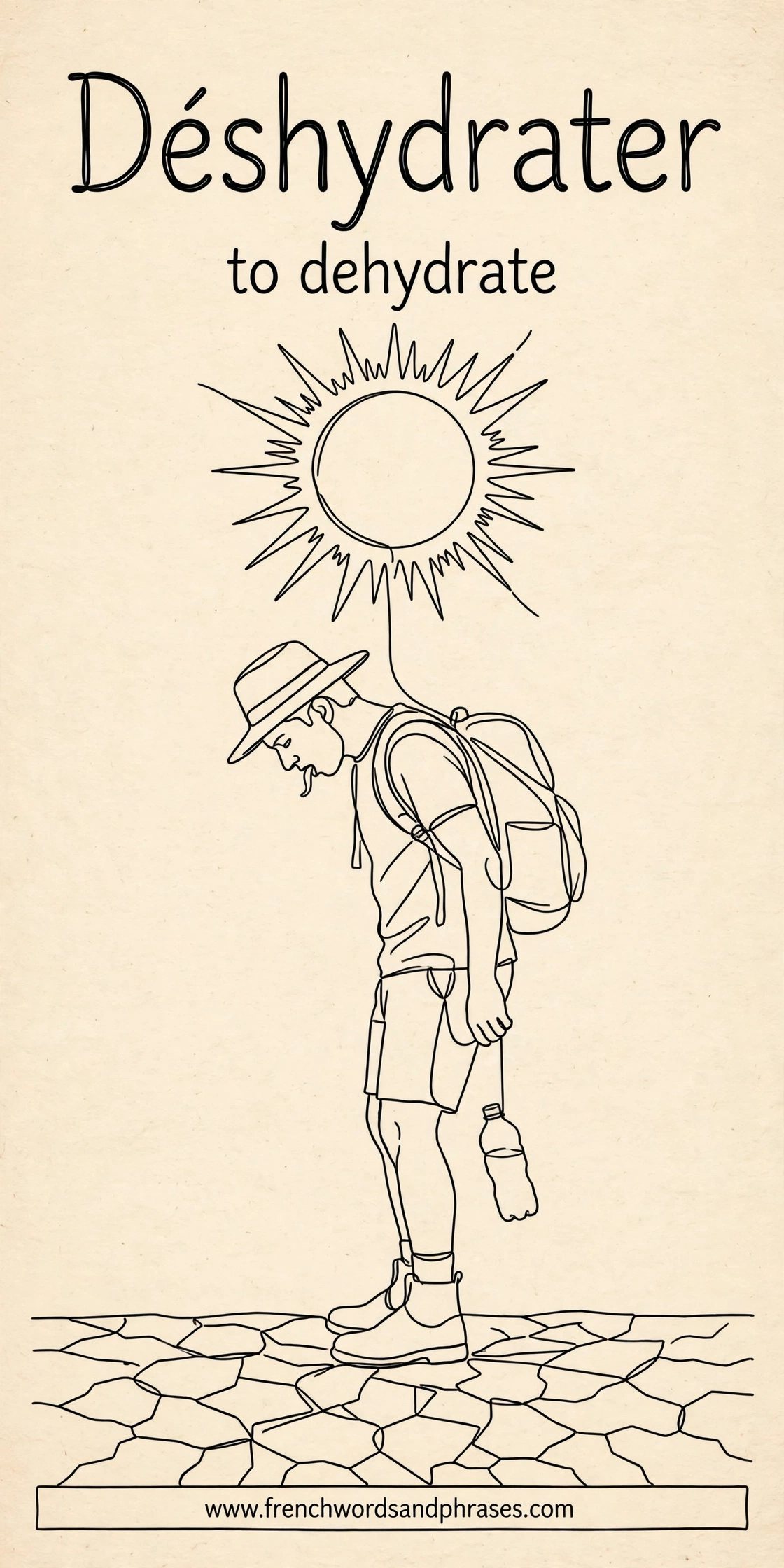
A runner swaying at the marathon’s last kilometre, apricots shrinking in the sun, a hiker’s lips cracking in the desert wind — déshydrater is the verb of water leaving: from bodies, from food, from earth.
In this guide, you’ll learn how to conjugate déshydrater in all the major French tenses and moods. Explore complete conjugation tables, French examples, English translations, and practice quizzes.
Understanding the French Verb Déshydrater
Déshydrater is a regular French verb belonging to the first group of verbs, those ending in-er.
It means to dehydrate. It is commonly used in sport and medicine for the body losing water, in cooking for dried fruit, vegetables and soups, and in chemistry and farming for any material drained of its moisture.
Verb classification: First group (-er)
Auxiliary verb: Avoir
Past participle: déshydraté
Present participle: déshydratant
English equivalents: To dehydrate; déshydrater des fruits — to dehydrate fruit; le soleil déshydrate la peau — the sun dehydrates the skin; des légumes déshydratés — dehydrated vegetables; la déshydratation — dehydration.
One important detail: déshydrater is the undoing of hydrater — where hydrater puts water in (une crème hydratante), déshydrater takes it out. It is a regular -er verb: je déshydrate, nous déshydratons, past participle déshydraté. Things that dry out by themselves often appear in the reflexive form in everyday speech — les champignons se déshydratent au soleil — but the plain verb here is the transitive workhorse: the sun, the heat and the machine do the dehydrating.
Experience the Word
Déshydrater is the verb of the departing water — what remains is lighter, harder, and in danger if it is a body.
Imagine a tray of apricots on a Provençal roof in August. Morning: plump, golden, heavy with juice. Evening: wrinkled little suns, sweet as honey and light as paper. Le soleil les a déshydratés — and in exchange for their water, they will keep all winter.
The apricots have lost almost everything they were. Dehydrated — déshydratés — they have become pure flavour.
How to Conjugate Déshydrater: Complete French Conjugation Guide
Let’s explore every major conjugation of déshydrater, beginning with the indicative mood.
How to Conjugate Déshydrater in the Indicative Mood
The indicative mood is used to express facts, observations, actions, and events.
How to Conjugate Déshydrater in the Present Tense (Présent)
Used for actions happening now, habitual actions, and general truths.
| Subject | Conjugation |
|---|---|
| je | déshydrate |
| tu | déshydrates |
| il / elle | déshydrate |
| nous | déshydratons |
| vous | déshydratez |
| ils / elles | déshydratent |
Example
Le soleil déshydrate les fruits sur le toit.
The sun dehydrates the fruit on the roof.
Quick Quiz 1
Complete the sentence:
Nous ______ les champignons pour l’hiver.
Reveal the answer
déshydratons
Nous déshydratons les champignons pour l’hiver.
We are dehydrating the mushrooms for the winter.
How to Conjugate Déshydrater in the Passé Composé
Used for completed actions in the past. Déshydrater takes the auxiliary verb avoir.
| Subject | Conjugation |
|---|---|
| j’ | ai déshydraté |
| tu | as déshydraté |
| il / elle | a déshydraté |
| nous | avons déshydraté |
| vous | avez déshydraté |
| ils / elles | ont déshydraté |
Example
La fièvre a déshydraté le malade en deux jours.
The fever dehydrated the patient in two days.
How to Conjugate Déshydrater in the Imparfait (Imperfect Tense)
Used for habitual past actions, descriptions, and ongoing situations in the past.
| Subject | Conjugation |
|---|---|
| je | déshydratais |
| tu | déshydratais |
| il / elle | déshydratait |
| nous | déshydrations |
| vous | déshydratiez |
| ils / elles | déshydrataient |
Example
Le vent du désert déshydratait les voyageurs.
The desert wind was dehydrating the travellers.
Quick Quiz 2
Choose the correct form:
The fever dehydrated the patient.
La fièvre ______ le malade. (a déshydraté / est déshydraté)
Reveal the answer
a déshydraté
La fièvre a déshydraté le malade.
Déshydrater takes avoir.
How to Conjugate Déshydrater in the Plus-que-parfait
Used to describe an action that had already been completed before another past event.
| Subject | Conjugation |
|---|---|
| j’ | avais déshydraté |
| tu | avais déshydraté |
| il / elle | avait déshydraté |
| nous | avions déshydraté |
| vous | aviez déshydraté |
| ils / elles | avaient déshydraté |
Example
La machine avait déshydraté les champignons pendant la nuit.
The machine had dehydrated the mushrooms during the night.
How to Conjugate Déshydrater in the Passé Simple
Primarily used in formal writing, literature, and historical narratives. It is rarely used in everyday conversation.
| Subject | Conjugation |
|---|---|
| je | déshydratai |
| tu | déshydratas |
| il / elle | déshydrata |
| nous | déshydratâmes |
| vous | déshydratâtes |
| ils / elles | déshydratèrent |
Example
La chaleur déshydrata les raisins sur la vigne.
The heat dehydrated the grapes on the vine.
How to Conjugate Déshydrater in the Passé Antérieur
A literary tense used to express an action completed immediately before another past action, generally in the passé simple.
| Subject | Conjugation |
|---|---|
| j’ | eus déshydraté |
| tu | eus déshydraté |
| il / elle | eut déshydraté |
| nous | eûmes déshydraté |
| vous | eûtes déshydraté |
| ils / elles | eurent déshydraté |
Example
Quand le four eut déshydraté les herbes, elle les rangea en bocaux.
When the oven had dehydrated the herbs, she stored them in jars.
How to Conjugate Déshydrater in the Future Tense (Futur Simple)
Used to describe actions that will take place in the future.
| Subject | Conjugation |
|---|---|
| je | déshydraterai |
| tu | déshydrateras |
| il / elle | déshydratera |
| nous | déshydraterons |
| vous | déshydraterez |
| ils / elles | déshydrateront |
Example
Ce déshydrateur déshydratera les pommes en six heures.
This dehydrator will dehydrate the apples in six hours.
How to Conjugate Déshydrater in the Futur Antérieur (Future Perfect)
Used for an action that will have been completed before a particular point in the future.
| Subject | Conjugation |
|---|---|
| j’ | aurai déshydraté |
| tu | auras déshydraté |
| il / elle | aura déshydraté |
| nous | aurons déshydraté |
| vous | aurez déshydraté |
| ils / elles | auront déshydraté |
Example
À midi, le soleil aura déshydraté la terre du jardin.
By noon, the sun will have dehydrated the garden soil.
How to Conjugate Déshydrater in the Near Future (Futur Proche)
Used to describe something that is going to happen soon. Formed with aller + infinitive.
| Subject | Conjugation |
|---|---|
| je | vais déshydrater |
| tu | vas déshydrater |
| il / elle | va déshydrater |
| nous | allons déshydrater |
| vous | allez déshydrater |
| ils / elles | vont déshydrater |
Example
Cette chaleur va déshydrater les coureurs, donnez-leur de l’eau.
This heat is going to dehydrate the runners, give them water.
How to Conjugate Déshydrater in the Conditional Mood
The conditional mood expresses what would happen under certain circumstances. It is also frequently used to make polite requests or express wishes.
How to Conjugate Déshydrater in the Present Conditional
| Subject | Conjugation |
|---|---|
| je | déshydraterais |
| tu | déshydraterais |
| il / elle | déshydraterait |
| nous | déshydraterions |
| vous | déshydrateriez |
| ils / elles | déshydrateraient |
Example
Sans ombre, le vent déshydraterait les plantes en un jour.
Without shade, the wind would dehydrate the plants in a day.
How to Conjugate Déshydrater in the Past Conditional
| Subject | Conjugation |
|---|---|
| j’ | aurais déshydraté |
| tu | aurais déshydraté |
| il / elle | aurait déshydraté |
| nous | aurions déshydraté |
| vous | auriez déshydraté |
| ils / elles | auraient déshydraté |
Example
La fièvre aurait déshydraté le malade sans la perfusion.
The fever would have dehydrated the patient without the drip.
Déshydrater in the Literary Past Conditional Form
This less common literary form uses the imperfect subjunctive of avoir.
| Subject | Conjugation |
|---|---|
| j’ | eusse déshydraté |
| tu | eusses déshydraté |
| il / elle | eût déshydraté |
| nous | eussions déshydraté |
| vous | eussiez déshydraté |
| ils / elles | eussent déshydraté |
Example
Le sirocco eût déshydraté la caravane entière sans les outres.
The sirocco would have dehydrated the whole caravan without the water skins.
How to Conjugate Déshydrater in the Subjunctive Mood
The subjunctive is used to express wishes, emotions, doubts, necessity, and uncertainty. It frequently follows expressions such as il faut que (it is necessary that) or bien que (although).
How to Conjugate Déshydrater in the Present Subjunctive
| Subject | Conjugation |
|---|---|
| que je | déshydrate |
| que tu | déshydrates |
| qu’il / qu’elle | déshydrate |
| que nous | déshydrations |
| que vous | déshydratiez |
| qu’ils / qu’elles | déshydratent |
Example
Il faut que tu déshydrates les tomates avant les pluies.
You must dehydrate the tomatoes before the rains.
Quick Quiz 3
Complete the sentence using the subjunctive:
Il faut que vous ______ les herbes avant la pluie.
Reveal the answer
déshydratiez
Il faut que vous déshydratiez les herbes avant la pluie.
You must dehydrate the herbs before the rain.
How to Conjugate Déshydrater in the Imperfect Subjunctive
A literary tense, rarely encountered in modern spoken French.
| Subject | Conjugation |
|---|---|
| que je | déshydratasse |
| que tu | déshydratasses |
| qu’il / qu’elle | déshydratât |
| que nous | déshydratassions |
| que vous | déshydratassiez |
| qu’ils / qu’elles | déshydratassent |
Example
On craignait que la fièvre déshydratât l’enfant.
People feared the fever might dehydrate the child.
How to Conjugate Déshydrater in the Pluperfect Subjunctive
A literary construction used to express an action completed before another past action.
| Subject | Conjugation |
|---|---|
| que j’ | eusse déshydraté |
| que tu | eusses déshydraté |
| qu’il / qu’elle | eût déshydraté |
| que nous | eussions déshydraté |
| que vous | eussiez déshydraté |
| qu’ils / qu’elles | eussent déshydraté |
Example
Le médecin vérifia que la chaleur eût déshydraté le coureur.
The doctor checked that the heat had dehydrated the runner.
How to Conjugate Déshydrater in the Past Subjunctive
| Subject | Conjugation |
|---|---|
| que j’ | aie déshydraté |
| que tu | aies déshydraté |
| qu’il / qu’elle | ait déshydraté |
| que nous | ayons déshydraté |
| que vous | ayez déshydraté |
| qu’ils / qu’elles | aient déshydraté |
Example
Je suis content que tu aies déshydraté les herbes à temps.
I am glad you dehydrated the herbs in time.
How to Conjugate Déshydrater in the Imperative
The imperative is used to give commands, instructions, invitations, or suggestions. Subject pronouns are omitted.
How to Conjugate Déshydrater in the Present Imperative
| Person | Conjugation |
|---|---|
| (tu) | déshydrate |
| (nous) | déshydratons |
| (vous) | déshydratez |
Example
Déshydratez les abricots avant la fin de la semaine !
Dehydrate the apricots before the end of the week!
Quick Quiz 4
How would you say Dehydrate the apricots (tu form)?
Reveal the answer
Déshydrate les abricots !
French Participles of Déshydrater
Participles are verb forms that can be used in compound tenses and other grammatical constructions.
Present Participle of Déshydrater
déshydratant
En déshydratant les fruits, on les conserve tout l’hiver.
By dehydrating fruit, you keep it all winter.
Past Participle of Déshydrater
déshydraté
Déshydratés au soleil, les raisins deviennent des trésors de sucre.
Dehydrated in the sun, the grapes become treasures of sugar.
Déshydrater in Everyday French: Real-Life Examples
Now that you know the conjugations, let’s see how déshydrater appears in everyday French.
Example 1 — Present
Le soleil déshydrate les fruits.
The sun dehydrates the fruit.
Example 2 — Passé composé
La fièvre a déshydraté le malade.
The fever dehydrated the patient.
Example 3 — Imparfait
Le vent déshydratait les voyageurs.
The wind was dehydrating the travellers.
Example 4 — Future
La machine déshydratera les pommes en six heures.
The machine will dehydrate the apples in six hours.
Example 5 — Conditional
Le vent déshydraterait les plantes sans ombre.
The wind would dehydrate the plants without shade.
Example 6 — Imperative
Déshydrate les tomates avant les pluies !
Dehydrate the tomatoes before the rains!
Beyond Translation: The Meaning of Déshydrater
English dehydrate shares the Greek root hydro-, water — and French makes the pair beautifully plain: hydrater puts the water in, déshydrater takes it out.
One verb, two worlds.
In the kitchen it is a blessing — dried apricots, dried mushrooms, soup powders; in the hospital it is an alarm — la déshydratation sends babies and marathon runners to the emergency ward.
How to Remember the French Verb Déshydrater
Remember it this way: Déshydrater is about apricots on a hot roof — the water leaves, the sweetness stays.
- Hydro- is water: hydrater fills, déshydrater empties.
- The sun, the fever and the machine déshydratent; the dried result is déshydraté.
- Regular -er: je déshydrate, nous déshydratons, past participle déshydraté.
The key idea is apricots on a hot roof — the water leaves, the sweetness stays.
Test Your Knowledge of Déshydrater
Let’s see how much you’ve learned. Try answering these questions before revealing the answers.
Question 1
What is the opposite of déshydrater?
Reveal the answer
Hydrater — to put water in; déshydrater takes it out.
Question 2
How do you say The sun dehydrates the fruit in French?
Reveal the answer
Le soleil déshydrate les fruits.
Question 3
Translate: The fever dehydrated the patient.
Reveal the answer
La fièvre a déshydraté le malade.
Question 4
What is the past participle of déshydrater?
Reveal the answer
Déshydraté.
Question 5
Complete the sentence:
Il faut que tu ______ les tomates avant les pluies.
Reveal the answer
déshydrates
Il faut que tu déshydrates les tomates avant les pluies.
You must dehydrate the tomatoes before the rains.
Your Final Challenge
Can You Use It?
How would you say this in French?
The Provençal sun dehydrates the apricots, and every wrinkled fruit keeps the summer in store.
Reveal the answer
Le soleil de Provence déshydrate les abricots, et chaque fruit ridé garde l’été en réserve.
The Provençal sun dehydrates the apricots, and every wrinkled fruit keeps the summer in store.
A little French. A little curiosity. A richer everyday life.
LEARN FRENCH ONE WORD AT A TIME