A French Word to Live By
How to Conjugate Déshumaniser in French
/de.zy.ma.ni.ze/
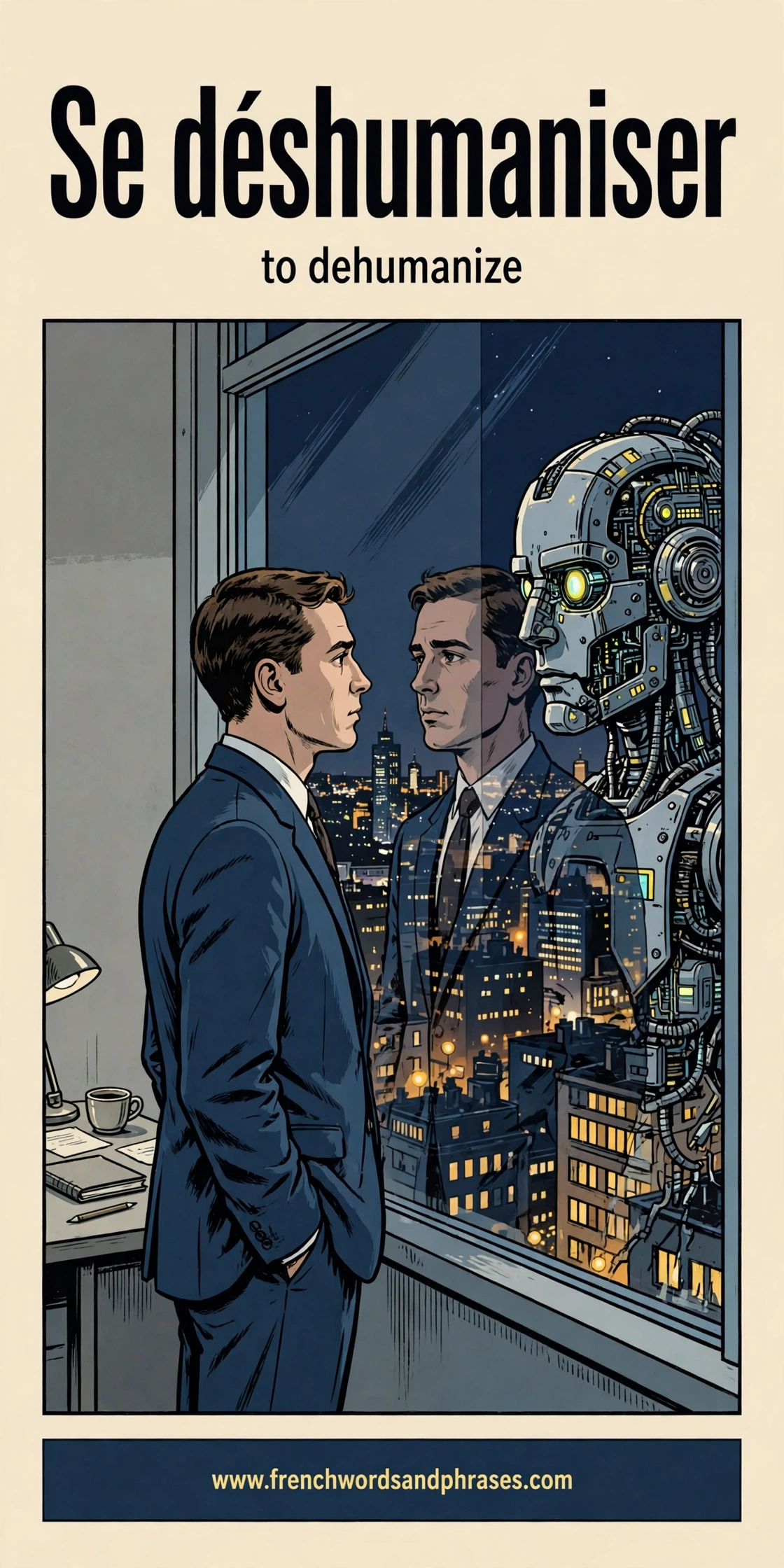
Déshumaniser means to dehumanize — to strip people of their dignity, their names and their feelings, until they are treated as numbers or things.
A prisoner reduced to a number, a worker treated as a machine part, an enemy described as vermin — déshumaniser is the dark verb of removing the human from the human being, and French reaches for it whenever dignity is taken away.
In this guide, you’ll learn how to conjugate déshumaniser in all the major French tenses and moods. Explore complete conjugation tables, French examples, English translations, and practice quizzes.
Understanding the French Verb Déshumaniser
Déshumaniser is a regular French verb belonging to the first group of verbs, those ending in-er.
It means to dehumanize. It is commonly used of war propaganda that turns an enemy into a monster, of work and technology that reduce people to functions, and of institutions — prisons, camps, bureaucracies — that treat human beings as files and numbers.
Verb classification: First group (-er)
Auxiliary verb: Avoir
Past participle: déshumanisé
Present participle: déshumanisant
English equivalents: To dehumanize; déshumaniser l’ennemi — to dehumanize the enemy; déshumaniser le travail — to dehumanize work; des conditions qui déshumanisent — conditions that dehumanize; la déshumanisation — dehumanization.
One important detail: déshumaniser is built with the undoing prefix dés- on humaniser, and it is a perfectly regular -er verb: je déshumanise, nous déshumanisons, past participle déshumanisé. Watch the h — it is silent, so the word flows as one stream of sound, and the noun beside it is la déshumanisation. Do not confuse it with its reflexive twin se déshumaniser, to lose one’s own humanity, which has its own page.
Experience the Word
Déshumaniser is the verb of the stolen face — first the name goes, then the story, then the dignity.
Imagine a propaganda poster in wartime. The enemy soldier is drawn with claws and fangs, nothing human left in the face. The poster déshumanise deliberately: it is far easier to send young men against monsters than against other people’s sons.
The drawing has done its work. The man has been dehumanized — déshumanisé — before a single shot is fired.
How to Conjugate Déshumaniser: Complete French Conjugation Guide
Let’s explore every major conjugation of déshumaniser, beginning with the indicative mood.
How to Conjugate Déshumaniser in the Indicative Mood
The indicative mood is used to express facts, observations, actions, and events.
How to Conjugate Déshumaniser in the Present Tense (Présent)
Used for actions happening now, habitual actions, and general truths.
| Subject | Conjugation |
|---|---|
| je | déshumanise |
| tu | déshumanises |
| il / elle | déshumanise |
| nous | déshumanisons |
| vous | déshumanisez |
| ils / elles | déshumanisent |
Example
La propagande déshumanise l’ennemi pour préparer la guerre.
Propaganda dehumanizes the enemy to prepare for war.
Quick Quiz 1
Complete the sentence:
Nous refusons que ce système ______ les employés.
Reveal the answer
déshumanise
Nous refusons que ce système déshumanise les employés.
We refuse to let this system dehumanize the employees.
How to Conjugate Déshumaniser in the Passé Composé
Used for completed actions in the past. Déshumaniser takes the auxiliary verb avoir.
| Subject | Conjugation |
|---|---|
| j’ | ai déshumanisé |
| tu | as déshumanisé |
| il / elle | a déshumanisé |
| nous | avons déshumanisé |
| vous | avez déshumanisé |
| ils / elles | ont déshumanisé |
Example
Ce système a déshumanisé les employés en dix ans.
This system dehumanized the employees in ten years.
How to Conjugate Déshumaniser in the Imparfait (Imperfect Tense)
Used for habitual past actions, descriptions, and ongoing situations in the past.
| Subject | Conjugation |
|---|---|
| je | déshumanisais |
| tu | déshumanisais |
| il / elle | déshumanisait |
| nous | déshumanisions |
| vous | déshumanisiez |
| ils / elles | déshumanisaient |
Example
L’usine déshumanisait les ouvriers à petit feu.
The factory was slowly dehumanizing the workers.
Quick Quiz 2
Choose the correct form:
The war dehumanized the soldiers.
La guerre ______ les soldats. (a déshumanisé / est déshumanisé)
Reveal the answer
a déshumanisé
La guerre a déshumanisé les soldats.
Déshumaniser takes avoir.
How to Conjugate Déshumaniser in the Plus-que-parfait
Used to describe an action that had already been completed before another past event.
| Subject | Conjugation |
|---|---|
| j’ | avais déshumanisé |
| tu | avais déshumanisé |
| il / elle | avait déshumanisé |
| nous | avions déshumanisé |
| vous | aviez déshumanisé |
| ils / elles | avaient déshumanisé |
Example
Le régime avait déshumanisé tout un peuple dans ses discours.
The regime had dehumanized a whole people in its speeches.
How to Conjugate Déshumaniser in the Passé Simple
Primarily used in formal writing, literature, and historical narratives. It is rarely used in everyday conversation.
| Subject | Conjugation |
|---|---|
| je | déshumanisai |
| tu | déshumanisas |
| il / elle | déshumanisa |
| nous | déshumanisâmes |
| vous | déshumanisâtes |
| ils / elles | déshumanisèrent |
Example
La guerre déshumanisa les soldats des deux camps.
The war dehumanized the soldiers of both camps.
How to Conjugate Déshumaniser in the Passé Antérieur
A literary tense used to express an action completed immediately before another past action, generally in the passé simple.
| Subject | Conjugation |
|---|---|
| j’ | eus déshumanisé |
| tu | eus déshumanisé |
| il / elle | eut déshumanisé |
| nous | eûmes déshumanisé |
| vous | eûtes déshumanisé |
| ils / elles | eurent déshumanisé |
Example
Quand la machine eut déshumanisé l’atelier, les anciens partirent.
When the machine had dehumanized the workshop, the old hands left.
How to Conjugate Déshumaniser in the Future Tense (Futur Simple)
Used to describe actions that will take place in the future.
| Subject | Conjugation |
|---|---|
| je | déshumaniserai |
| tu | déshumaniseras |
| il / elle | déshumanisera |
| nous | déshumaniserons |
| vous | déshumaniserez |
| ils / elles | déshumaniseront |
Example
Un écran ne déshumanisera jamais un vrai sourire.
A screen will never dehumanize a real smile.
How to Conjugate Déshumaniser in the Futur Antérieur (Future Perfect)
Used for an action that will have been completed before a particular point in the future.
| Subject | Conjugation |
|---|---|
| j’ | aurai déshumanisé |
| tu | auras déshumanisé |
| il / elle | aura déshumanisé |
| nous | aurons déshumanisé |
| vous | aurez déshumanisé |
| ils / elles | auront déshumanisé |
Example
À force de chiffres, ils auront déshumanisé le service entier.
With all their figures, they will have dehumanized the whole department.
How to Conjugate Déshumaniser in the Near Future (Futur Proche)
Used to describe something that is going to happen soon. Formed with aller + infinitive.
| Subject | Conjugation |
|---|---|
| je | vais déshumaniser |
| tu | vas déshumaniser |
| il / elle | va déshumaniser |
| nous | allons déshumaniser |
| vous | allez déshumaniser |
| ils / elles | vont déshumaniser |
Example
Ce logiciel va déshumaniser les relations avec les clients.
This software is going to dehumanize relations with customers.
How to Conjugate Déshumaniser in the Conditional Mood
The conditional mood expresses what would happen under certain circumstances. It is also frequently used to make polite requests or express wishes.
How to Conjugate Déshumaniser in the Present Conditional
| Subject | Conjugation |
|---|---|
| je | déshumaniserais |
| tu | déshumaniserais |
| il / elle | déshumaniserait |
| nous | déshumaniserions |
| vous | déshumaniseriez |
| ils / elles | déshumaniseraient |
Example
Sans contact humain, ce métier déshumaniserait vite.
Without human contact, this job would quickly dehumanize.
How to Conjugate Déshumaniser in the Past Conditional
| Subject | Conjugation |
|---|---|
| j’ | aurais déshumanisé |
| tu | aurais déshumanisé |
| il / elle | aurait déshumanisé |
| nous | aurions déshumanisé |
| vous | auriez déshumanisé |
| ils / elles | auraient déshumanisé |
Example
La prison l’aurait déshumanisé sans les livres.
Prison would have dehumanized him without books.
Déshumaniser in the Literary Past Conditional Form
This less common literary form uses the imperfect subjunctive of avoir.
| Subject | Conjugation |
|---|---|
| j’ | eusse déshumanisé |
| tu | eusses déshumanisé |
| il / elle | eût déshumanisé |
| nous | eussions déshumanisé |
| vous | eussiez déshumanisé |
| ils / elles | eussent déshumanisé |
Example
Le camp eût déshumanisé les plus forts sans l’amitié.
The camp would have dehumanized the strongest without friendship.
How to Conjugate Déshumaniser in the Subjunctive Mood
The subjunctive is used to express wishes, emotions, doubts, necessity, and uncertainty. It frequently follows expressions such as il faut que (it is necessary that) or bien que (although).
How to Conjugate Déshumaniser in the Present Subjunctive
| Subject | Conjugation |
|---|---|
| que je | déshumanise |
| que tu | déshumanises |
| qu’il / qu’elle | déshumanise |
| que nous | déshumanisions |
| que vous | déshumanisiez |
| qu’ils / qu’elles | déshumanisent |
Example
Il est dangereux qu’un discours déshumanise un groupe entier.
It is dangerous for a speech to dehumanize a whole group.
Quick Quiz 3
Complete the sentence using the subjunctive:
Il est dangereux que la propagande ______ l’ennemi.
Reveal the answer
déshumanise
Il est dangereux que la propagande déshumanise l’ennemi.
It is dangerous for propaganda to dehumanize the enemy.
How to Conjugate Déshumaniser in the Imperfect Subjunctive
A literary tense, rarely encountered in modern spoken French.
| Subject | Conjugation |
|---|---|
| que je | déshumanisasse |
| que tu | déshumanisasses |
| qu’il / qu’elle | déshumanisât |
| que nous | déshumanisassions |
| que vous | déshumanisassiez |
| qu’ils / qu’elles | déshumanisassent |
Example
On craignait que la guerre déshumanisât même les médecins.
People feared the war might dehumanize even the doctors.
How to Conjugate Déshumaniser in the Pluperfect Subjunctive
A literary construction used to express an action completed before another past action.
| Subject | Conjugation |
|---|---|
| que j’ | eusse déshumanisé |
| que tu | eusses déshumanisé |
| qu’il / qu’elle | eût déshumanisé |
| que nous | eussions déshumanisé |
| que vous | eussiez déshumanisé |
| qu’ils / qu’elles | eussent déshumanisé |
Example
On disait que le système eût déshumanisé trois générations d’ouvriers.
People said the system had dehumanized three generations of workers.
How to Conjugate Déshumaniser in the Past Subjunctive
| Subject | Conjugation |
|---|---|
| que j’ | aie déshumanisé |
| que tu | aies déshumanisé |
| qu’il / qu’elle | ait déshumanisé |
| que nous | ayons déshumanisé |
| que vous | ayez déshumanisé |
| qu’ils / qu’elles | aient déshumanisé |
Example
Je regrette que ce travail ait déshumanisé tant de gens.
I regret that this work dehumanized so many people.
How to Conjugate Déshumaniser in the Imperative
The imperative is used to give commands, instructions, invitations, or suggestions. Subject pronouns are omitted.
How to Conjugate Déshumaniser in the Present Imperative
| Person | Conjugation |
|---|---|
| (tu) | déshumanise |
| (nous) | déshumanisons |
| (vous) | déshumanisez |
Example
Ne déshumanisez jamais un adversaire, même en colère.
Never dehumanize an opponent, even in anger.
Quick Quiz 4
How would you say Never dehumanize an opponent (tu form)?
Reveal the answer
Ne déshumanise jamais un adversaire !
French Participles of Déshumaniser
Participles are verb forms that can be used in compound tenses and other grammatical constructions.
Present Participle of Déshumaniser
déshumanisant
En déshumanisant les patients, cet hôpital a perdu leur confiance.
By dehumanizing the patients, this hospital lost their trust.
Past Participle of Déshumaniser
déshumanisé
Déshumanisés par des années de guerre, les soldats peinaient à sourire.
Dehumanized by years of war, the soldiers struggled to smile.
Déshumaniser in Everyday French: Real-Life Examples
Now that you know the conjugations, let’s see how déshumaniser appears in everyday French.
Example 1 — Present
La propagande déshumanise l’ennemi.
Propaganda dehumanizes the enemy.
Example 2 — Passé composé
Ce travail a déshumanisé les employés.
This work dehumanized the employees.
Example 3 — Imparfait
L’usine déshumanisait les ouvriers.
The factory used to dehumanize the workers.
Example 4 — Future
La technologie ne déshumanisera pas nos métiers.
Technology will not dehumanize our trades.
Example 5 — Conditional
Sans musique, la prison déshumaniserait les détenus.
Without music, prison would dehumanize the inmates.
Example 6 — Imperative
Ne déshumanise personne dans tes discours !
Do not dehumanize anyone in your speeches!
Beyond Translation: The Meaning of Déshumaniser
English dehumanize is the exact twin, built the same way — the undoing prefix on human.
French uses it with a moral shiver.
To say ce discours déshumanise is not a neutral observation: it accuses. The word belongs to essays, history lessons and human-rights reports, wherever someone insists that a person is never a number.
How to Remember the French Verb Déshumaniser
Remember it this way: Déshumaniser is about the poster that draws a man with claws — the human removed.
- Dés- undoes humaniser: to dehumanize is to take the human away.
- Its favourite subjects are propaganda, war, prisons and machines — whatever treats people as things.
- Regular -er: je déshumanise, nous déshumanisons, past participle déshumanisé.
The key idea is the poster that draws a man with claws — the human removed.
Test Your Knowledge of Déshumaniser
Let’s see how much you’ve learned. Try answering these questions before revealing the answers.
Question 1
What does the prefix dés- do in déshumaniser?
Reveal the answer
It undoes — déshumaniser takes the human out of humaniser, to dehumanize.
Question 2
How do you say Propaganda dehumanizes the enemy in French?
Reveal the answer
La propagande déshumanise l’ennemi.
Question 3
Translate: This system dehumanized the employees.
Reveal the answer
Ce système a déshumanisé les employés.
Question 4
What is the past participle of déshumaniser?
Reveal the answer
Déshumanisé.
Question 5
Complete the sentence:
Il est dangereux qu’un discours ______ un groupe entier.
Reveal the answer
déshumanise
Il est dangereux qu’un discours déshumanise un groupe entier.
It is dangerous for a speech to dehumanize a whole group.
Your Final Challenge
Can You Use It?
How would you say this in French?
No speech should dehumanize a man: behind every enemy there is a son, a father, a name.
Reveal the answer
Aucun discours ne devrait déshumaniser un homme : derrière chaque ennemi, il y a un fils, un père, un nom.
No speech should dehumanize a man: behind every enemy there is a son, a father, a name.
A little French. A little curiosity. A richer everyday life.
LEARN FRENCH ONE WORD AT A TIME