A French Word to Live By
How to Conjugate Déshabiller in French
/de.za.bi.je/
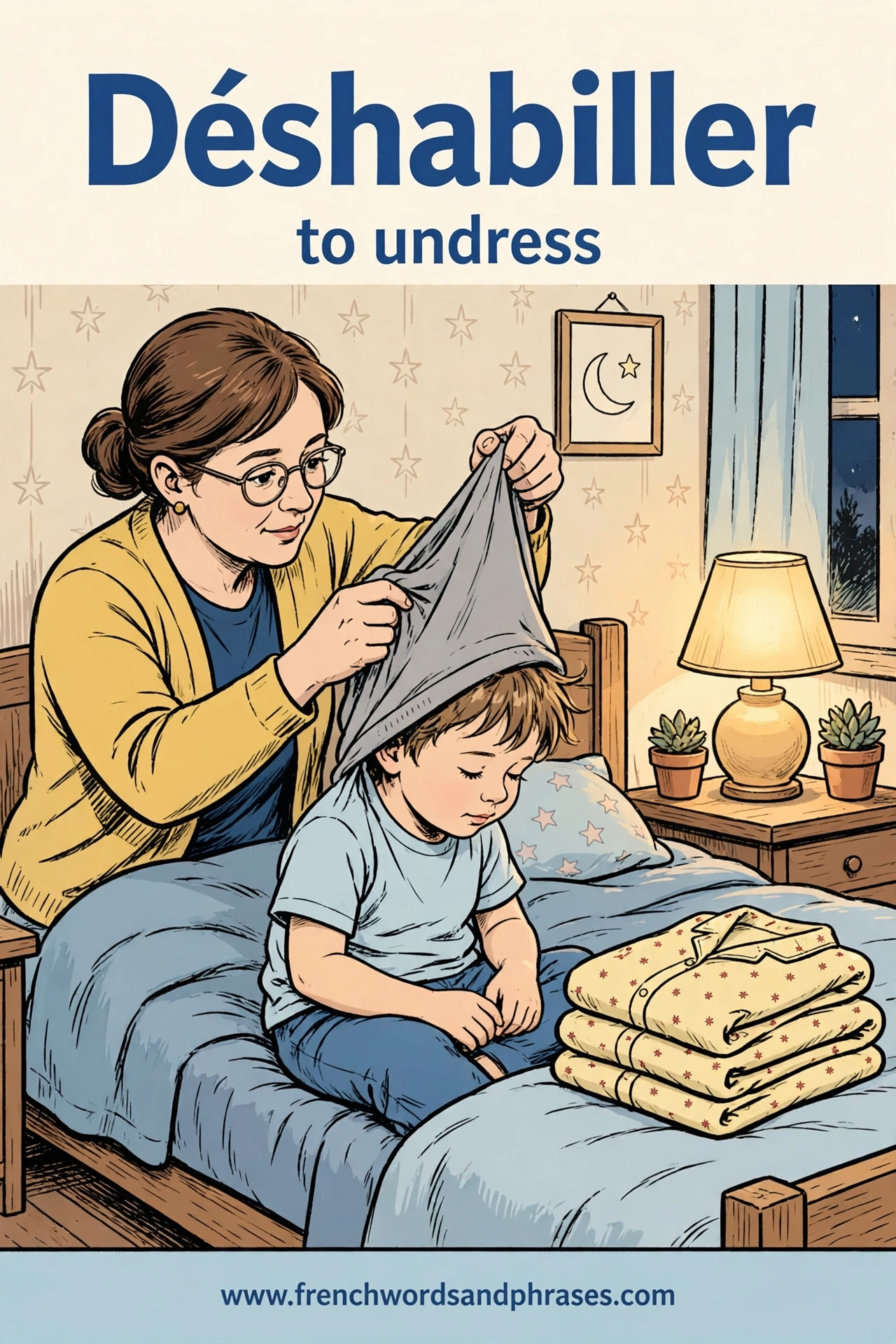
Déshabiller means to undress — to take the clothes off someone else: a child at bedtime, a patient, a doll, a model.
A mother unbuttoning a sleepy toddler at bedtime, a nurse helping a patient out of his shirt before the examination, a little girl undressing her doll for the night — déshabiller is the verb of undressing someone else: where habiller dresses them, déshabiller takes the clothes back off, garment by garment.
In this guide, you’ll learn how to conjugate déshabiller in all the major French tenses and moods. Explore complete conjugation tables, French examples, English translations, and practice quizzes.
Understanding the French Verb Déshabiller
Déshabiller is a regular French verb belonging to the first group of verbs, those ending in-er.
It means to undress. It belongs to nurseries, hospitals and bedrooms: parents déshabillent children, carers déshabillent patients, children déshabillent dolls. Figuratively, un regard can déshabiller someone, and the old proverb déshabiller Pierre pour habiller Paul is French for robbing Peter to pay Paul.
Verb classification: First group (-er)
Auxiliary verb: Avoir
Past participle: déshabillé
Present participle: déshabillant
English equivalents: To undress (someone); déshabiller un enfant — to undress a child; déshabiller un malade — to undress a patient; déshabiller une poupée — to undress a doll; déshabiller quelqu’un du regard — to undress someone with one’s eyes; le contraire : habiller — to dress.
One important detail: déshabiller is transitive — it undresses someone else: elle déshabille le bébé. To undress yourself you need the reflexive twin, se déshabiller: elle se déshabille. The h is silent and the verb is regular: je déshabille, nous déshabillons, ils déshabillent, past participle déshabillé. The family is transparent: les habits are clothes, habiller puts them on, déshabiller takes them off.
Experience the Word
Déshabiller is the verb of small buttons and sleepy arms — the evening ritual of taking the day off someone you love.
Imagine a bathroom in a small flat at seven in the evening. The little boy stands on a stool, arms raised like a tiny goalkeeper, while his mother pulls the jumper over his head and unbuttons his shirt — elle le déshabille pour le bain, chatting all the while, until he stands laughing in his underpants, ready for the water.
It takes two minutes and happens ten thousand times in a childhood. He has been undressed — déshabillé — by the safest hands in the world.
How to Conjugate Déshabiller: Complete French Conjugation Guide
Let’s explore every major conjugation of déshabiller, beginning with the indicative mood.
How to Conjugate Déshabiller in the Indicative Mood
The indicative mood is used to express facts, observations, actions, and events.
How to Conjugate Déshabiller in the Present Tense (Présent)
Used for actions happening now, habitual actions, and general truths.
| Subject | Conjugation |
|---|---|
| je | déshabille |
| tu | déshabilles |
| il / elle | déshabille |
| nous | déshabillons |
| vous | déshabillez |
| ils / elles | déshabillent |
Example
Elle déshabille le bébé avant le bain.
She undresses the baby before the bath.
Quick Quiz 1
Complete the sentence:
Nous ______ les enfants avant le coucher.
Reveal the answer
déshabillons
Nous déshabillons les enfants avant le coucher.
We undress the children before bedtime.
How to Conjugate Déshabiller in the Passé Composé
Used for completed actions in the past. Déshabiller takes the auxiliary verb avoir.
| Subject | Conjugation |
|---|---|
| j’ | ai déshabillé |
| tu | as déshabillé |
| il / elle | a déshabillé |
| nous | avons déshabillé |
| vous | avez déshabillé |
| ils / elles | ont déshabillé |
Example
L’infirmière a déshabillé le malade avec douceur.
The nurse undressed the patient gently.
How to Conjugate Déshabiller in the Imparfait (Imperfect Tense)
Used for habitual past actions, descriptions, and ongoing situations in the past.
| Subject | Conjugation |
|---|---|
| je | déshabillais |
| tu | déshabillais |
| il / elle | déshabillait |
| nous | déshabillions |
| vous | déshabilliez |
| ils / elles | déshabillaient |
Example
Chaque soir, elle déshabillait ses poupées avant de dormir.
Every evening, she used to undress her dolls before going to sleep.
Quick Quiz 2
Choose the correct form:
The nurse undressed the patient.
L’infirmière ______ le malade. (a déshabillé / s’est déshabillée)
Reveal the answer
a déshabillé
L’infirmière a déshabillé le malade.
Déshabiller is transitive and takes avoir — she undressed someone else.
How to Conjugate Déshabiller in the Plus-que-parfait
Used to describe an action that had already been completed before another past event.
| Subject | Conjugation |
|---|---|
| j’ | avais déshabillé |
| tu | avais déshabillé |
| il / elle | avait déshabillé |
| nous | avions déshabillé |
| vous | aviez déshabillé |
| ils / elles | avaient déshabillé |
Example
Il avait déshabillé l’enfant avant l’arrivée du médecin.
He had undressed the child before the doctor arrived.
How to Conjugate Déshabiller in the Passé Simple
Primarily used in formal writing, literature, and historical narratives. It is rarely used in everyday conversation.
| Subject | Conjugation |
|---|---|
| je | déshabillai |
| tu | déshabillas |
| il / elle | déshabilla |
| nous | déshabillâmes |
| vous | déshabillâtes |
| ils / elles | déshabillèrent |
Example
La mère déshabilla le petit garçon et le mit au lit.
The mother undressed the little boy and put him to bed.
How to Conjugate Déshabiller in the Passé Antérieur
A literary tense used to express an action completed immediately before another past action, generally in the passé simple.
| Subject | Conjugation |
|---|---|
| j’ | eus déshabillé |
| tu | eus déshabillé |
| il / elle | eut déshabillé |
| nous | eûmes déshabillé |
| vous | eûtes déshabillé |
| ils / elles | eurent déshabillé |
Example
Quand elle eut déshabillé le bébé, elle le plongea dans l’eau tiède.
When she had undressed the baby, she lowered him into the warm water.
How to Conjugate Déshabiller in the Future Tense (Futur Simple)
Used to describe actions that will take place in the future.
| Subject | Conjugation |
|---|---|
| je | déshabillerai |
| tu | déshabilleras |
| il / elle | déshabillera |
| nous | déshabillerons |
| vous | déshabillerez |
| ils / elles | déshabilleront |
Example
Tu déshabilleras la poupée, moi je préparerai son lit.
You will undress the doll, and I will prepare her bed.
How to Conjugate Déshabiller in the Futur Antérieur (Future Perfect)
Used for an action that will have been completed before a particular point in the future.
| Subject | Conjugation |
|---|---|
| j’ | aurai déshabillé |
| tu | auras déshabillé |
| il / elle | aura déshabillé |
| nous | aurons déshabillé |
| vous | aurez déshabillé |
| ils / elles | auront déshabillé |
Example
À huit heures, elle aura déshabillé les deux enfants.
By eight o’clock, she will have undressed both children.
How to Conjugate Déshabiller in the Near Future (Futur Proche)
Used to describe something that is going to happen soon. Formed with aller + infinitive.
| Subject | Conjugation |
|---|---|
| je | vais déshabiller |
| tu | vas déshabiller |
| il / elle | va déshabiller |
| nous | allons déshabiller |
| vous | allez déshabiller |
| ils / elles | vont déshabiller |
Example
Le médecin va déshabiller le patient pour l’examen.
The doctor is going to undress the patient for the examination.
How to Conjugate Déshabiller in the Conditional Mood
The conditional mood expresses what would happen under certain circumstances. It is also frequently used to make polite requests or express wishes.
How to Conjugate Déshabiller in the Present Conditional
| Subject | Conjugation |
|---|---|
| je | déshabillerais |
| tu | déshabillerais |
| il / elle | déshabillerait |
| nous | déshabillerions |
| vous | déshabilleriez |
| ils / elles | déshabilleraient |
Example
Sans aide, elle ne déshabillerait pas le malade si vite.
Without help, she would not undress the patient so quickly.
How to Conjugate Déshabiller in the Past Conditional
| Subject | Conjugation |
|---|---|
| j’ | aurais déshabillé |
| tu | aurais déshabillé |
| il / elle | aurait déshabillé |
| nous | aurions déshabillé |
| vous | auriez déshabillé |
| ils / elles | auraient déshabillé |
Example
J’aurais déshabillé l’enfant plus tôt s’il n’avait pas protesté.
I would have undressed the child earlier if he had not protested.
Déshabiller in the Literary Past Conditional Form
This less common literary form uses the imperfect subjunctive of avoir.
| Subject | Conjugation |
|---|---|
| j’ | eusse déshabillé |
| tu | eusses déshabillé |
| il / elle | eût déshabillé |
| nous | eussions déshabillé |
| vous | eussiez déshabillé |
| ils / elles | eussent déshabillé |
Example
La nourrice eût déshabillé l’enfant sans le réveiller.
The nanny would have undressed the child without waking him.
How to Conjugate Déshabiller in the Subjunctive Mood
The subjunctive is used to express wishes, emotions, doubts, necessity, and uncertainty. It frequently follows expressions such as il faut que (it is necessary that) or bien que (although).
How to Conjugate Déshabiller in the Present Subjunctive
| Subject | Conjugation |
|---|---|
| que je | déshabille |
| que tu | déshabilles |
| qu’il / qu’elle | déshabille |
| que nous | déshabillions |
| que vous | déshabilliez |
| qu’ils / qu’elles | déshabillent |
Example
Il faut que tu déshabilles le bébé avant le bain.
You must undress the baby before the bath.
Quick Quiz 3
Complete the sentence using the subjunctive:
Il faut que vous ______ le bébé doucement.
Reveal the answer
déshabilliez
Il faut que vous déshabilliez le bébé doucement.
You must undress the baby gently.
How to Conjugate Déshabiller in the Imperfect Subjunctive
A literary tense, rarely encountered in modern spoken French.
| Subject | Conjugation |
|---|---|
| que je | déshabillasse |
| que tu | déshabillasses |
| qu’il / qu’elle | déshabillât |
| que nous | déshabillassions |
| que vous | déshabillassiez |
| qu’ils / qu’elles | déshabillassent |
Example
Elle voulait que je déshabillasse la poupée comme elle.
She wanted me to undress the doll just like her.
How to Conjugate Déshabiller in the Pluperfect Subjunctive
A literary construction used to express an action completed before another past action.
| Subject | Conjugation |
|---|---|
| que j’ | eusse déshabillé |
| que tu | eusses déshabillé |
| qu’il / qu’elle | eût déshabillé |
| nous | eussions déshabillé |
| que vous | eussiez déshabillé |
| qu’ils / qu’elles | eussent déshabillé |
Example
On racontait qu’elle eût déshabillé le mannequin en une minute.
People said she had undressed the mannequin in one minute.
How to Conjugate Déshabiller in the Past Subjunctive
| Subject | Conjugation |
|---|---|
| que j’ | aie déshabillé |
| tu | aies déshabillé |
| qu’il / qu’elle | ait déshabillé |
| que nous | ayons déshabillé |
| que vous | ayez déshabillé |
| qu’ils / qu’elles | aient déshabillé |
Example
Je suis content qu’elle ait déshabillé l’enfant à temps.
I am glad she undressed the child in time.
How to Conjugate Déshabiller in the Imperative
The imperative is used to give commands, instructions, invitations, or suggestions. Subject pronouns are omitted.
How to Conjugate Déshabiller in the Present Imperative
| Person | Conjugation |
|---|---|
| (tu) | déshabille |
| (nous) | déshabillons |
| (vous) | déshabillez |
Example
Déshabille le bébé, il est l’heure du bain !
Undress the baby, it is bath time!
Quick Quiz 4
How would you say Undress the baby (tu form)?
Reveal the answer
Déshabille le bébé !
French Participles of Déshabiller
Participles are verb forms that can be used in compound tenses and other grammatical constructions.
Present Participle of Déshabiller
déshabillant
En déshabillant le malade, l’infirmière remarqua la blessure.
While undressing the patient, the nurse noticed the wound.
Past Participle of Déshabiller
déshabillé
Déshabillé par sa mère, le bébé rit dans la baignoire.
Undressed by his mother, the baby laughs in the bath.
Déshabiller in Everyday French: Real-Life Examples
Now that you know the conjugations, let’s see how déshabiller appears in everyday French.
Example 1 — Present
Elle déshabille le bébé avant le bain.
She undresses the baby before the bath.
Example 2 — Passé composé
L’infirmière a déshabillé le malade.
The nurse undressed the patient.
Example 3 — Imparfait
Elle déshabillait ses poupées chaque soir.
She used to undress her dolls every evening.
Example 4 — Future
Tu déshabilleras la poupée ce soir.
You will undress the doll this evening.
Example 5 — Conditional
Je déshabillerais l’enfant s’il était fatigué.
I would undress the child if he were tired.
Example 6 — Imperative
Déshabille le bébé !
Undress the baby!
Beyond Translation: The Meaning of Déshabiller
English undress does both jobs — yourself and others; French déshabiller insists on the distinction: déshabiller quelqu’un is done to another, se déshabiller is done to oneself.
It hides in a famous proverb.
Déshabiller Pierre pour habiller Paul — to undress Peter to dress Paul — is the French robbing Peter to pay Paul, and it shows the verb’s heart: clothes move from back to back, and someone always ends up déshabillé.
How to Remember the French Verb Déshabiller
Remember it this way: Déshabiller is about the mother at bath time, unbuttoning the sleepy toddler.
- Transitive: déshabiller undresses someone else — the baby, the patient, the doll. For yourself: se déshabiller.
- Les habits are clothes: habiller puts them on, déshabiller takes them off.
- Regular -er with silent h: je déshabille, nous déshabillons, past participle déshabillé.
The key idea is the mother at bath time, unbuttoning the sleepy toddler.
Test Your Knowledge of Déshabiller
Let’s see how much you’ve learned. Try answering these questions before revealing the answers.
Question 1
What is the difference between déshabiller and se déshabiller?
Reveal the answer
Déshabiller undresses someone else — elle déshabille le bébé; se déshabiller is to undress oneself.
Question 2
How do you say She undresses the baby before the bath in French?
Reveal the answer
Elle déshabille le bébé avant le bain.
Question 3
Translate: The nurse undressed the patient gently.
Reveal the answer
L’infirmière a déshabillé le malade avec douceur.
Question 4
What is the past participle of déshabiller?
Reveal the answer
Déshabillé.
Question 5
Complete the sentence:
Il faut que tu ______ le bébé avant le bain.
Reveal the answer
déshabilles
Il faut que tu déshabilles le bébé avant le bain.
You must undress the baby before the bath.
Your Final Challenge
Can You Use It?
How would you say this in French?
Every evening, she undresses the baby while singing, and the bath becomes a party.
Reveal the answer
Chaque soir, elle déshabille le bébé en chantant, et le bain devient une fête.
Every evening, she undresses the baby while singing, and the bath becomes a party.
A little French. A little curiosity. A richer everyday life.
LEARN FRENCH ONE WORD AT A TIME