A French Word to Live By
How to Conjugate Désencadrer in French
/de.zɑ̃.ka.dʁe/
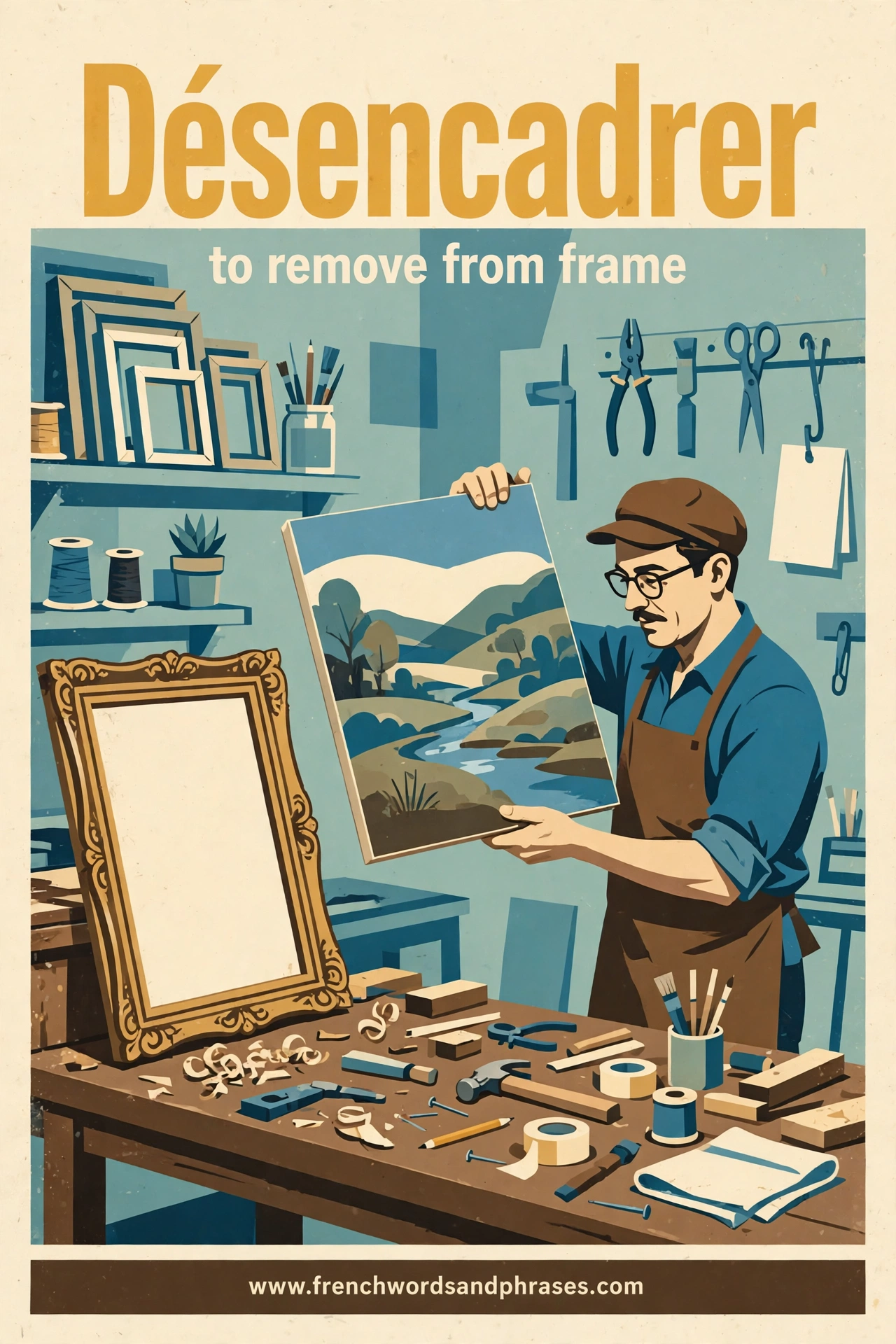
Désencadrer means to remove from frame — to lift a picture, a photograph or a canvas out of the frame that held it.
A restorer’s workshop, gilt frames leaning against the wall, a canvas emerging bare and suddenly fragile — désencadrer is the framer’s reverse verb: taking the picture out so the picture, or the frame, can be mended.
In this guide, you’ll learn how to conjugate désencadrer in all the major French tenses and moods. Explore complete conjugation tables, French examples, English translations, and practice quizzes.
Understanding the French Verb Désencadrer
Désencadrer is a regular French verb belonging to the first group of verbs, those ending in-er.
It means to remove from frame. It is used by framers, restorers, museums and photographers whenever a work must leave its frame — for restoration, for photographing, for travel or for reframing. A désencadré picture is a vulnerable one, and the verb carries that professional care.
Verb classification: First group (-er)
Auxiliary verb: Avoir
Past participle: désencadré
Present participle: désencadrant
English equivalents: To remove from frame, to unframe; désencadrer un tableau — to take a painting out of its frame; désencadrer une photo — to unframe a photograph; l’encadreur — the framer who frames and unframes.
One important detail: désencadrer is simply encadrer read backwards — and encadrer has two lives: to frame a picture, and to supervise people (l’encadrement is management). Désencadrer belongs firmly to the first life only: pictures come out of frames, but nobody désencadre a team. The verb is regular: je désencadre, nous désencadrons. In the workshop the operation is delicate — old canvas is brittle, old gilt sheds — which is why the word belongs to restorers and framers more than to owners.
Experience the Word
Désencadrer is the verb of the picture made naked — out of its gilt and glass, a painting is suddenly just cloth, paint and age.
Imagine a portrait that has hung in the same frame since 1890. The restorer lays it face down, lifts the backing board, frees the canvas tack by tack and le désencadre — and there, hidden against the wood for a century, is a signature nobody knew.
The frame is empty on the bench. The painting has been unframed — désencadré — and it has a secret to tell.
How to Conjugate Désencadrer: Complete French Conjugation Guide
Let’s explore every major conjugation of désencadrer, beginning with the indicative mood.
How to Conjugate Désencadrer in the Indicative Mood
The indicative mood is used to express facts, observations, actions, and events.
How to Conjugate Désencadrer in the Present Tense (Présent)
Used for actions happening now, habitual actions, and general truths.
| Subject | Conjugation |
|---|---|
| je | désencadre |
| tu | désencadres |
| il / elle | désencadre |
| nous | désencadrons |
| vous | désencadrez |
| ils / elles | désencadrent |
Example
L’encadreur désencadre le tableau avec précaution.
The framer takes the painting out of its frame with care.
Quick Quiz 1
Complete the sentence:
Nous ______ le portrait pour la restauration.
Reveal the answer
désencadrons
Nous désencadrons le portrait pour la restauration.
We unframe the portrait for the restoration.
How to Conjugate Désencadrer in the Passé Composé
Used for completed actions in the past. Désencadrer takes the auxiliary verb avoir.
| Subject | Conjugation |
|---|---|
| j’ | ai désencadré |
| tu | as désencadré |
| il / elle | a désencadré |
| nous | avons désencadré |
| vous | avez désencadré |
| ils / elles | ont désencadré |
Example
Elle a désencadré toutes les photos de famille.
She took all the family photographs out of their frames.
How to Conjugate Désencadrer in the Imparfait (Imperfect Tense)
Used for habitual past actions, descriptions, and ongoing situations in the past.
| Subject | Conjugation |
|---|---|
| je | désencadrais |
| tu | désencadrais |
| il / elle | désencadrait |
| nous | désencadrions |
| vous | désencadriez |
| ils / elles | désencadraient |
Example
Dans son atelier, il désencadrait les gravures anciennes.
In his workshop, he used to unframe the old engravings.
Quick Quiz 2
Choose the correct form:
The framer unframed the painting.
L’encadreur ______ le tableau. (a désencadré / est désencadré)
Reveal the answer
a désencadré
L’encadreur a désencadré le tableau.
Désencadrer takes avoir.
How to Conjugate Désencadrer in the Plus-que-parfait
Used to describe an action that had already been completed before another past event.
| Subject | Conjugation |
|---|---|
| j’ | avais désencadré |
| tu | avais désencadré |
| il / elle | avait désencadré |
| nous | avions désencadré |
| vous | aviez désencadré |
| ils / elles | avaient désencadré |
Example
On avait désencadré le portrait avant la restauration.
They had taken the portrait out of its frame before the restoration.
How to Conjugate Désencadrer in the Passé Simple
Primarily used in formal writing, literature, and historical narratives. It is rarely used in everyday conversation.
| Subject | Conjugation |
|---|---|
| je | désencadrai |
| tu | désencadras |
| il / elle | désencadra |
| nous | désencadrâmes |
| vous | désencadrâtes |
| ils / elles | désencadrèrent |
Example
Le restaurateur désencadra la toile et l’examina à la loupe.
The restorer unframed the canvas and examined it under a magnifying glass.
How to Conjugate Désencadrer in the Passé Antérieur
A literary tense used to express an action completed immediately before another past action, generally in the passé simple.
| Subject | Conjugation |
|---|---|
| j’ | eus désencadré |
| tu | eus désencadré |
| il / elle | eut désencadré |
| nous | eûmes désencadré |
| vous | eûtes désencadré |
| ils / elles | eurent désencadré |
Example
Quand il eut désencadré le tableau, il découvrit une signature cachée.
When he had unframed the painting, he discovered a hidden signature.
How to Conjugate Désencadrer in the Future Tense (Futur Simple)
Used to describe actions that will take place in the future.
| Subject | Conjugation |
|---|---|
| je | désencadrerai |
| tu | désencadreras |
| il / elle | désencadrera |
| nous | désencadrerons |
| vous | désencadrerez |
| ils / elles | désencadreront |
Example
Je désencadrerai cette aquarelle pour la photographier.
I will take this watercolour out of its frame to photograph it.
How to Conjugate Désencadrer in the Futur Antérieur (Future Perfect)
Used for an action that will have been completed before a particular point in the future.
| Subject | Conjugation |
|---|---|
| j’ | aurai désencadré |
| tu | auras désencadré |
| il / elle | aura désencadré |
| nous | aurons désencadré |
| vous | aurez désencadré |
| ils / elles | auront désencadré |
Example
À la fin du jour, l’atelier aura désencadré vingt tableaux.
By the end of the day, the workshop will have unframed twenty paintings.
How to Conjugate Désencadrer in the Near Future (Futur Proche)
Used to describe something that is going to happen soon. Formed with aller + infinitive.
| Subject | Conjugation |
|---|---|
| je | vais désencadrer |
| tu | vas désencadrer |
| il / elle | va désencadrer |
| nous | allons désencadrer |
| vous | allez désencadrer |
| ils / elles | vont désencadrer |
Example
Le musée va désencadrer les œuvres prêtées.
The museum is going to unframe the loaned works.
How to Conjugate Désencadrer in the Conditional Mood
The conditional mood expresses what would happen under certain circumstances. It is also frequently used to make polite requests or express wishes.
How to Conjugate Désencadrer in the Present Conditional
| Subject | Conjugation |
|---|---|
| je | désencadrerais |
| tu | désencadrerais |
| il / elle | désencadrerait |
| nous | désencadrerions |
| vous | désencadreriez |
| ils / elles | désencadreraient |
Example
Un bon outil désencadrerait la toile sans l’abîmer.
A good tool would unframe the canvas without damaging it.
How to Conjugate Désencadrer in the Past Conditional
| Subject | Conjugation |
|---|---|
| j’ | aurais désencadré |
| tu | aurais désencadré |
| il / elle | aurait désencadré |
| nous | aurions désencadré |
| vous | auriez désencadré |
| ils / elles | auraient désencadré |
Example
J’aurais désencadré le portrait si le cadre n’était pas d’époque.
I would have unframed the portrait if the frame were not period.
Désencadrer in the Literary Past Conditional Form
This less common literary form uses the imperfect subjunctive of avoir.
| Subject | Conjugation |
|---|---|
| j’ | eusse désencadré |
| tu | eusses désencadré |
| il / elle | eût désencadré |
| nous | eussions désencadré |
| vous | eussiez désencadré |
| ils / elles | eussent désencadré |
Example
L’artiste eût désencadré sa toile sans le vernis fragile.
The artist would have unframed his canvas without the fragile varnish.
How to Conjugate Désencadrer in the Subjunctive Mood
The subjunctive is used to express wishes, emotions, doubts, necessity, and uncertainty. It frequently follows expressions such as il faut que (it is necessary that) or bien que (although).
How to Conjugate Désencadrer in the Present Subjunctive
| Subject | Conjugation |
|---|---|
| que je | désencadre |
| que tu | désencadres |
| qu’il / qu’elle | désencadre |
| que nous | désencadrions |
| que vous | désencadriez |
| qu’ils / qu’elles | désencadrent |
Example
Il faut que le restaurateur désencadre le tableau d’abord.
The restorer must unframe the painting first.
Quick Quiz 3
Complete the sentence using the subjunctive:
Il faut que vous ______ la toile avant le voyage.
Reveal the answer
désencadriez
Il faut que vous désencadriez la toile avant le voyage.
You must unframe the canvas before the journey.
How to Conjugate Désencadrer in the Imperfect Subjunctive
A literary tense, rarely encountered in modern spoken French.
| Subject | Conjugation |
|---|---|
| que je | désencadrasse |
| que tu | désencadrasses |
| qu’il / qu’elle | désencadrât |
| que nous | désencadrassions |
| que vous | désencadrassiez |
| qu’ils / qu’elles | désencadrassent |
Example
Elle cherchait un atelier qui désencadrât les grands formats.
She was looking for a workshop that unframed large formats.
How to Conjugate Désencadrer in the Pluperfect Subjunctive
A literary construction used to express an action completed before another past action.
| Subject | Conjugation |
|---|---|
| que j’ | eusse désencadré |
| que tu | eusses désencadré |
| qu’il / qu’elle | eût désencadré |
| que nous | eussions désencadré |
| que vous | eussiez désencadré |
| qu’ils / qu’elles | eussent désencadré |
Example
On doutait qu’il eût désencadré la toile sans aide.
People doubted he had unframed the canvas without help.
How to Conjugate Désencadrer in the Past Subjunctive
| Subject | Conjugation |
|---|---|
| que j’ | aie désencadré |
| que tu | aies désencadré |
| qu’il / qu’elle | ait désencadré |
| que nous | ayons désencadré |
| que vous | ayez désencadré |
| qu’ils / qu’elles | aient désencadré |
Example
Je suis content que tu aies désencadré la photo.
I am glad you took the photograph out of its frame.
How to Conjugate Désencadrer in the Imperative
The imperative is used to give commands, instructions, invitations, or suggestions. Subject pronouns are omitted.
How to Conjugate Désencadrer in the Present Imperative
| Person | Conjugation |
|---|---|
| (tu) | désencadre |
| (nous) | désencadrons |
| (vous) | désencadrez |
Example
Désencadre la photo doucement, le verre est fragile !
Unframe the photo gently, the glass is fragile!
Quick Quiz 4
How would you say Unframe the photo gently (tu form)?
Reveal the answer
Désencadre la photo doucement !
French Participles of Désencadrer
Participles are verb forms that can be used in compound tenses and other grammatical constructions.
Present Participle of Désencadrer
désencadrant
En désencadrant la gravure, il a trouvé une lettre ancienne.
By unframing the engraving, he found an old letter.
Past Participle of Désencadrer
désencadré
Désencadrée pour l’exposition, la toile voyageait roulée.
Unframed for the exhibition, the canvas travelled rolled up.
Désencadrer in Everyday French: Real-Life Examples
Now that you know the conjugations, let’s see how désencadrer appears in everyday French.
Example 1 — Present
L’encadreur désencadre le tableau.
The framer unframes the painting.
Example 2 — Passé composé
Elle a désencadré les photos.
She took the photographs out of their frames.
Example 3 — Imparfait
Il désencadrait les gravures anciennes.
He used to unframe the old engravings.
Example 4 — Future
Je désencadrerai cette aquarelle.
I will unframe this watercolour.
Example 5 — Conditional
Un bon outil désencadrerait la toile.
A good tool would unframe the canvas.
Example 6 — Imperative
Désencadre la photo doucement !
Unframe the photo gently!
Beyond Translation: The Meaning of Désencadrer
The frame word cadre has colonised French: a picture frame, a framework, an executive (un cadre), a setting.
Désencadrer stays faithful to the original picture.
Before cadre meant managers and structures, it meant the wooden rectangle around a painting — and désencadrer is the small, careful verb of that first world, of workshops that smell of glue, gilt and old canvas.
How to Remember the French Verb Désencadrer
Remember it this way: Désencadrer is about the restorer lifting the painting out of its gilt frame.
- Encadrer puts the picture in; désencadrer takes it out — framers and restorers do both.
- Only pictures get désencadré: the other encadrer (to supervise people) has no dés- twin.
- Regular -er: je désencadre, nous désencadrons, past participle désencadré.
The key idea is the restorer lifting the painting out of its gilt frame.
Test Your Knowledge of Désencadrer
Let’s see how much you’ve learned. Try answering these questions before revealing the answers.
Question 1
Who désencadre pictures for a living?
Reveal the answer
L’encadreur — the framer; restorers and museums désencadrent works for repair, travel and reframing.
Question 2
How do you say She took the photographs out of their frames in French?
Reveal the answer
Elle a désencadré les photos.
Question 3
Translate: I will unframe this watercolour to photograph it.
Reveal the answer
Je désencadrerai cette aquarelle pour la photographier.
Question 4
What is the past participle of désencadrer?
Reveal the answer
Désencadré.
Question 5
Complete the sentence:
Il faut que le restaurateur ______ le tableau d’abord.
Reveal the answer
désencadre
Il faut que le restaurateur désencadre le tableau d’abord.
The restorer must unframe the painting first.
Your Final Challenge
Can You Use It?
How would you say this in French?
He takes the old photograph out of its frame, and a forgotten face looks out at the room.
Reveal the answer
Il désencadre la vieille photo, et un visage oublié regarde la pièce.
He takes the old photograph out of its frame, and a forgotten face looks out at the room.
A little French. A little curiosity. A richer everyday life.
LEARN FRENCH ONE WORD AT A TIME