A French Word to Live By
How to Conjugate Désempeser in French
/de.zɑ̃.pə.ze/
Désempeser means to unstarch — to wash the stiffness out of collars, cuffs and table linen until the cloth is soft again.
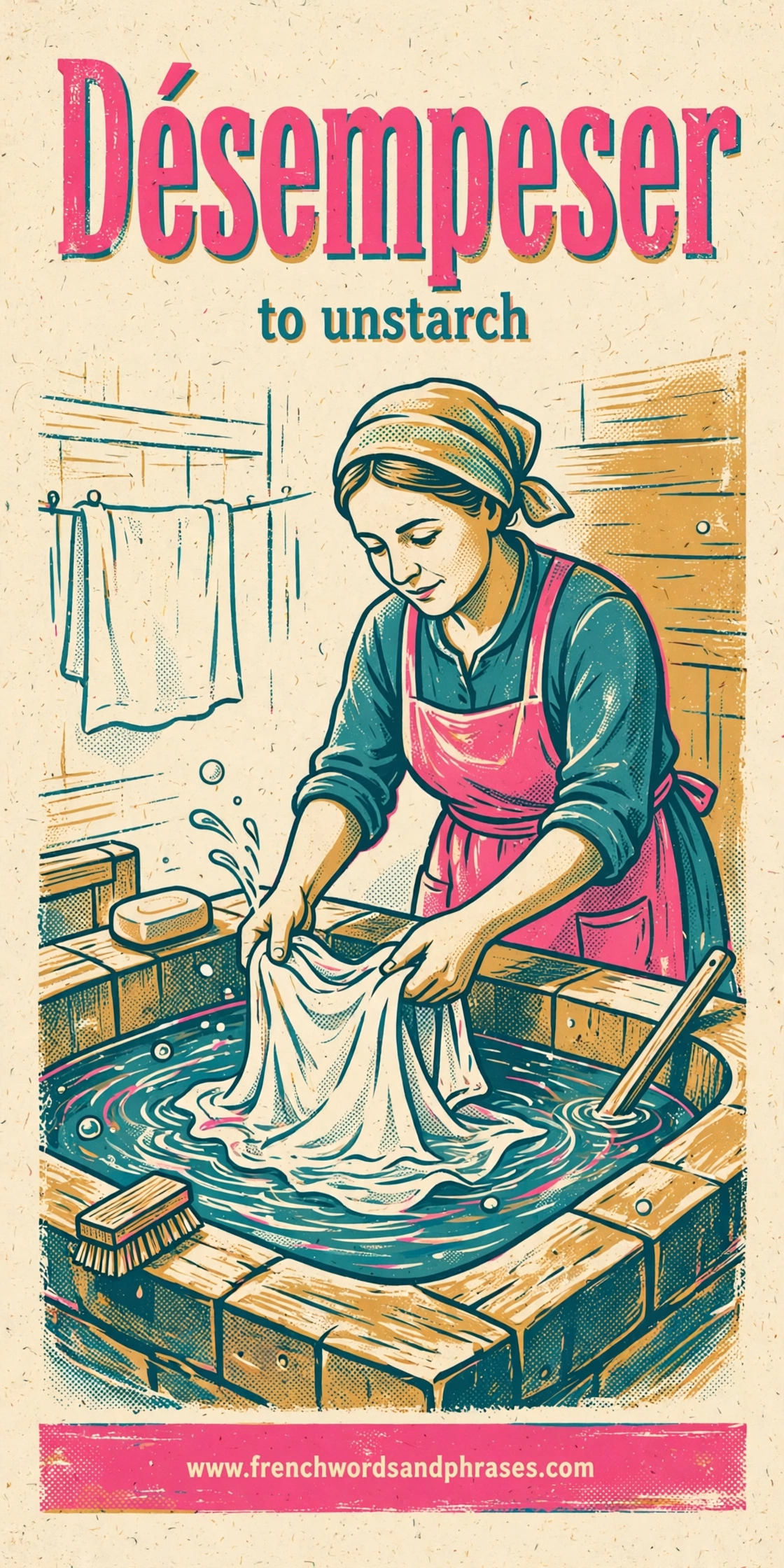
A laundry basin, a pile of collars stiff as cardboard, steam and the smell of hot water — désempeser is the laundress’s verb: soaking the starch out of linen that empeser had made board-stiff.
In this guide, you’ll learn how to conjugate désempeser in all the major French tenses and moods. Explore complete conjugation tables, French examples, English translations, and practice quizzes.
Understanding the French Verb Désempeser
Désempeser is a regular French verb belonging to the first group of verbs, those ending in-er.
It means to unstarch. It belongs to the traditional laundry, when shirts, collars, tablecloths and altar linen were starched stiff and had to be désempesé — soaked and rinsed back to softness — before washing and ironing. Modern ears meet it in grandmothers’ vocabulary and in the linen trade.
Verb classification: First group (-er)
Auxiliary verb: Avoir
Past participle: désempesé
Present participle: désempesant
English equivalents: To unstarch, to take the starch out; désempeser un col — to unstarch a collar; désempeser le linge — to take the starch out of the linen; empeser — to starch, the verb it reverses.
One important detail: désempeser belongs to the peser family of spelling — the mute e of the stem opens to è wherever the ending is mute: je désempèse, tu désempèses, il désempèse, ils désempèsent, and through the future and conditional: je désempèserai, je désempèserais. The plain stem returns wherever the ending is sounded: nous désempesons, vous désempesez, je désempesais, en désempesant. The verb reverses empeser, to starch — the laundry operation that once made collars stand to attention.
Experience the Word
Désempeser is the verb of softness returning — stiffness dissolving in warm water, the collar becoming cloth again.
Imagine a laundry in 1900. The week’s collars arrive stiff as playing cards. The lingère drops them into warm water, works them gently between her hands, and one by one she les désempèse — the starch clouds the water, and the linen comes up supple, ready for the iron.
Nothing has been washed yet, strictly speaking. The linen has been unstarched — désempesé — and softness is the whole point.
How to Conjugate Désempeser: Complete French Conjugation Guide
Let’s explore every major conjugation of désempeser, beginning with the indicative mood.
How to Conjugate Désempeser in the Indicative Mood
The indicative mood is used to express facts, observations, actions, and events.
How to Conjugate Désempeser in the Present Tense (Présent)
Used for actions happening now, habitual actions, and general truths.
| Subject | Conjugation |
|---|---|
| je | désempèse |
| tu | désempèses |
| il / elle | désempèse |
| nous | désempesons |
| vous | désempesez |
| ils / elles | désempèsent |
Example
Je désempèse les cols avant de les repasser.
I take the starch out of the collars before ironing them.
Quick Quiz 1
Complete the sentence:
Nous ______ les nappes à l’eau claire.
Reveal the answer
désempesons
Nous désempesons les nappes à l’eau claire.
We unstarch the tablecloths in clear water.
How to Conjugate Désempeser in the Passé Composé
Used for completed actions in the past. Désempeser takes the auxiliary verb avoir.
| Subject | Conjugation |
|---|---|
| j’ | ai désempesé |
| tu | as désempesé |
| il / elle | a désempesé |
| nous | avons désempesé |
| vous | avez désempesé |
| ils / elles | ont désempesé |
Example
La blanchisseuse a désempesé le linge de table.
The laundress took the starch out of the table linen.
How to Conjugate Désempeser in the Imparfait (Imperfect Tense)
Used for habitual past actions, descriptions, and ongoing situations in the past.
| Subject | Conjugation |
|---|---|
| je | désempesais |
| tu | désempesais |
| il / elle | désempesait |
| nous | désempesions |
| vous | désempesiez |
| ils / elles | désempesaient |
Example
Ma grand-mère désempesait les nappes à l’eau claire.
My grandmother used to unstarch the tablecloths in clear water.
Quick Quiz 2
Choose the correct form:
She unstarched the linen.
Elle ______ le linge. (a désempesé / est désempesée)
Reveal the answer
a désempesé
Elle a désempesé le linge.
Désempeser takes avoir.
How to Conjugate Désempeser in the Plus-que-parfait
Used to describe an action that had already been completed before another past event.
| Subject | Conjugation |
|---|---|
| j’ | avais désempesé |
| tu | avais désempesé |
| il / elle | avait désempesé |
| nous | avions désempesé |
| vous | aviez désempesé |
| ils / elles | avaient désempesé |
Example
Elle avait désempesé les cols avant le repassage.
She had taken the starch out of the collars before the ironing.
How to Conjugate Désempeser in the Passé Simple
Primarily used in formal writing, literature, and historical narratives. It is rarely used in everyday conversation.
| Subject | Conjugation |
|---|---|
| je | désempesai |
| tu | désempesas |
| il / elle | désempesa |
| nous | désempesâmes |
| vous | désempesâtes |
| ils / elles | désempesèrent |
Example
La lingère désempesa les chemises du dimanche.
The linen maid unstarched the Sunday shirts.
How to Conjugate Désempeser in the Passé Antérieur
A literary tense used to express an action completed immediately before another past action, generally in the passé simple.
| Subject | Conjugation |
|---|---|
| j’ | eus désempesé |
| tu | eus désempesé |
| il / elle | eut désempesé |
| nous | eûmes désempesé |
| vous | eûtes désempesé |
| ils / elles | eurent désempesé |
Example
Quand elle eut désempesé le linge, elle le mit à sécher.
When she had unstarched the linen, she put it out to dry.
How to Conjugate Désempeser in the Future Tense (Futur Simple)
Used to describe actions that will take place in the future.
| Subject | Conjugation |
|---|---|
| je | désempèserai |
| tu | désempèseras |
| il / elle | désempèsera |
| nous | désempèserons |
| vous | désempèserez |
| ils / elles | désempèseront |
Example
Je désempèserai ces cols demain matin.
I will take the starch out of these collars tomorrow morning.
How to Conjugate Désempeser in the Futur Antérieur (Future Perfect)
Used for an action that will have been completed before a particular point in the future.
| Subject | Conjugation |
|---|---|
| j’ | aurai désempesé |
| tu | auras désempesé |
| il / elle | aura désempesé |
| nous | aurons désempesé |
| vous | aurez désempesé |
| ils / elles | auront désempesé |
Example
À midi, la blanchisseuse aura désempesé tout le linge.
By noon, the laundress will have unstarched all the linen.
How to Conjugate Désempeser in the Near Future (Futur Proche)
Used to describe something that is going to happen soon. Formed with aller + infinitive.
| Subject | Conjugation |
|---|---|
| je | vais désempeser |
| tu | vas désempeser |
| il / elle | va désempeser |
| nous | allons désempeser |
| vous | allez désempeser |
| ils / elles | vont désempeser |
Example
Je vais désempeser cette nappe, elle est raide comme du carton.
I am going to unstarch this tablecloth, it is stiff as cardboard.
How to Conjugate Désempeser in the Conditional Mood
The conditional mood expresses what would happen under certain circumstances. It is also frequently used to make polite requests or express wishes.
How to Conjugate Désempeser in the Present Conditional
| Subject | Conjugation |
|---|---|
| je | désempèserais |
| tu | désempèserais |
| il / elle | désempèserait |
| nous | désempèserions |
| vous | désempèseriez |
| ils / elles | désempèseraient |
Example
Un bain d’eau tiède désempèserait le col sans l’abîmer.
A bath of warm water would unstarch the collar without damaging it.
How to Conjugate Désempeser in the Past Conditional
| Subject | Conjugation |
|---|---|
| j’ | aurais désempesé |
| tu | aurais désempesé |
| il / elle | aurait désempesé |
| nous | aurions désempesé |
| vous | auriez désempesé |
| ils / elles | auraient désempesé |
Example
J’aurais désempesé la nappe si j’avais eu le temps.
I would have unstarched the tablecloth if I had had the time.
Désempeser in the Literary Past Conditional Form
This less common literary form uses the imperfect subjunctive of avoir.
| Subject | Conjugation |
|---|---|
| j’ | eusse désempesé |
| tu | eusses désempesé |
| il / elle | eût désempesé |
| nous | eussions désempesé |
| vous | eussiez désempesé |
| ils / elles | eussent désempesé |
Example
La lingère eût désempesé les cols sans la fête imprévue.
The linen maid would have unstarched the collars without the unexpected party.
How to Conjugate Désempeser in the Subjunctive Mood
The subjunctive is used to express wishes, emotions, doubts, necessity, and uncertainty. It frequently follows expressions such as il faut que (it is necessary that) or bien que (although).
How to Conjugate Désempeser in the Present Subjunctive
| Subject | Conjugation |
|---|---|
| que je | désempèse |
| que tu | désempèses |
| qu’il / qu’elle | désempèse |
| que nous | désempesions |
| que vous | désempesiez |
| qu’ils / qu’elles | désempèsent |
Example
Il faut que je désempèse ce col avant ce soir.
I must take the starch out of this collar before this evening.
Quick Quiz 3
Complete the sentence using the subjunctive:
Il faut que tu ______ ce col avant ce soir.
Reveal the answer
désempèses
Il faut que tu désempèses ce col avant ce soir.
You must unstarch this collar before this evening.
How to Conjugate Désempeser in the Imperfect Subjunctive
A literary tense, rarely encountered in modern spoken French.
| Subject | Conjugation |
|---|---|
| que je | désempesasse |
| que tu | désempesasses |
| qu’il / qu’elle | désempesât |
| que nous | désempesassions |
| que vous | désempesassiez |
| qu’ils / qu’elles | désempesassent |
Example
Elle voulait que la blanchisseuse désempesât les chemises.
She wanted the laundress to unstarch the shirts.
How to Conjugate Désempeser in the Pluperfect Subjunctive
A literary construction used to express an action completed before another past action.
| Subject | Conjugation |
|---|---|
| que j’ | eusse désempesé |
| que tu | eusses désempesé |
| qu’il / qu’elle | eût désempesé |
| que nous | eussions désempesé |
| que vous | eussiez désempesé |
| qu’ils / qu’elles | eussent désempesé |
Example
On ne pensait pas qu’elle eût désempesé tout le linge à temps.
Nobody thought she had unstarched all the linen in time.
How to Conjugate Désempeser in the Past Subjunctive
| Subject | Conjugation |
|---|---|
| que j’ | aie désempesé |
| que tu | aies désempesé |
| qu’il / qu’elle | ait désempesé |
| que nous | ayons désempesé |
| que vous | ayez désempesé |
| qu’ils / qu’elles | aient désempesé |
Example
C’est bien que tu aies désempesé la nappe.
It is good that you unstarched the tablecloth.
How to Conjugate Désempeser in the Imperative
The imperative is used to give commands, instructions, invitations, or suggestions. Subject pronouns are omitted.
How to Conjugate Désempeser in the Present Imperative
| Person | Conjugation |
|---|---|
| (tu) | désempèse |
| (nous) | désempesons |
| (vous) | désempesez |
Example
Désempèse ce col, il te grattera le cou !
Unstarch this collar, it will scratch your neck!
Quick Quiz 4
How would you say Unstarch this collar (tu form)?
Reveal the answer
Désempèse ce col !
French Participles of Désempeser
Participles are verb forms that can be used in compound tenses and other grammatical constructions.
Present Participle of Désempeser
désempesant
En désempesant les cols, on leur rend leur souplesse.
By unstarching the collars, you give them back their suppleness.
Past Participle of Désempeser
désempesé
Désempesée à l’eau tiède, la nappe a retrouvé sa souplesse.
Unstarched in warm water, the tablecloth regained its suppleness.
Désempeser in Everyday French: Real-Life Examples
Now that you know the conjugations, let’s see how désempeser appears in everyday French.
Example 1 — Present
Je désempèse les cols.
I take the starch out of the collars.
Example 2 — Passé composé
Elle a désempesé le linge.
She unstarched the linen.
Example 3 — Imparfait
On désempesait les nappes à l’eau claire.
They used to unstarch the tablecloths in clear water.
Example 4 — Future
Je désempèserai ces cols demain.
I will unstarch these collars tomorrow.
Example 5 — Conditional
L’eau tiède désempèserait le col.
Warm water would unstarch the collar.
Example 6 — Imperative
Désempèse ce col !
Unstarch this collar!
Beyond Translation: The Meaning of Désempeser
The pair empeser / désempeser preserves a lost world: the age when a collar was a piece of engineering, starched with l’empois until it stood like cardboard.
Stiffness was elegance, and softness had to be earned back.
Désempeser is the earning-back — the soak, the rinse, the moment the linen gives up its parade-ground posture and becomes cloth again.
How to Remember the French Verb Désempeser
Remember it this way: Désempeser is about the stiff collar softening in the washbasin.
- Peser-family spelling: je désempèse with è before mute endings, nous désempesons with the plain stem.
- It reverses empeser, to starch: first the collar stands stiff, then the basin désempèse it soft.
- Otherwise regular: past participle désempesé, imperfect je désempesais with the plain stem.
The key idea is the stiff collar softening in the washbasin.
Test Your Knowledge of Désempeser
Let’s see how much you’ve learned. Try answering these questions before revealing the answers.
Question 1
Why is it je désempèse but nous désempesons?
Reveal the answer
The peser rule — the stem’s mute e opens to è before a mute ending (je désempèse), and stays plain where the ending is sounded (nous désempesons).
Question 2
How do you say The laundress took the starch out of the linen in French?
Reveal the answer
La blanchisseuse a désempesé le linge.
Question 3
Translate: I will unstarch these collars tomorrow.
Reveal the answer
Je désempèserai ces cols demain.
Question 4
What is the past participle of désempeser?
Reveal the answer
Désempesé.
Question 5
Complete the sentence:
Il faut que je ______ ce col avant ce soir.
Reveal the answer
désempèse
Il faut que je désempèse ce col avant ce soir.
I must unstarch this collar before this evening.
Your Final Challenge
Can You Use It?
How would you say this in French?
She un-starches the collars one by one, and the linen finds its old softness again.
Reveal the answer
Elle désempèse les cols un à un, et le linge retrouve sa douceur d’autrefois.
She un-starches the collars one by one, and the linen finds its old softness again.
A little French. A little curiosity. A richer everyday life.
LEARN FRENCH ONE WORD AT A TIME