A French Word to Live By
How to Conjugate Déséchouer in French
/de.ze.ʃwe/
Déséchouer means to refloat — to get a boat that has run aground back into deep water, floating free again.
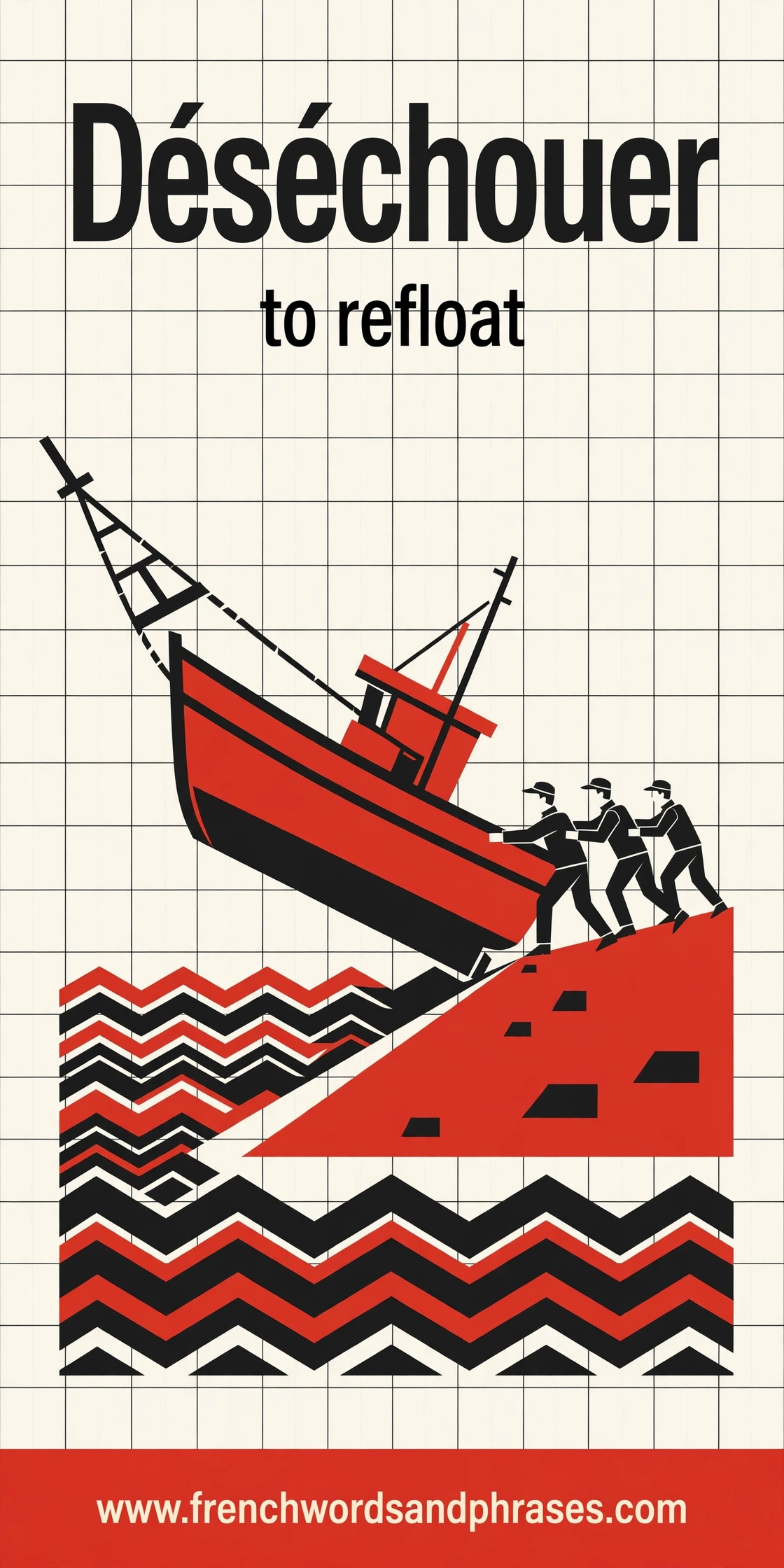
A fishing boat sitting helpless on a sandbank at low tide, a tug straining at the towline, the whole harbour watching the water rise — déséchouer is the salvage verb: the moment a stranded vessel floats again.
In this guide, you’ll learn how to conjugate déséchouer in all the major French tenses and moods. Explore complete conjugation tables, French examples, English translations, and practice quizzes.
Understanding the French Verb Déséchouer
Déséchouer is a regular French verb belonging to the first group of verbs, those ending in-er.
It means to refloat. It is the working word of sailors, harbour masters and salvage crews: a vessel is déséchoué at high tide, usually with tugs pulling and the crew lightening the ship, and the whole operation is called un déséchouage.
Verb classification: First group (-er)
Auxiliary verb: Avoir
Past participle: déséchoué
Present participle: déséchouant
English equivalents: To refloat, to get a boat off the ground; déséchouer un navire — to refloat a ship; déséchouer une barque — to get a small boat afloat again; le déséchouage — the refloating operation itself.
One important detail: déséchouer is built on échouer, to run aground — the prefix dés- simply reverses the accident. The é of the stem never changes: je déséchoue, nous déséchouons, ils déséchouent. But watch the base verb’s double life: échouer also means to fail (échouer à un examen), and déséchouer does not follow it there — you cannot déséchouer an exam. Déséchouer belongs to boats, tides and towlines.
Experience the Word
Déséchouer is the verb of the second chance at sea — the tide returns, the towline tightens, and the ship that was a prisoner of the sandbank becomes a ship again.
Imagine a cargo ship stuck fast on the sand since midnight. At dawn the tugs take the strain, the rising tide lifts a centimetre at a time, and then — a groan, a shudder — le navire se dégage: on l’a déséchoué, and the harbour hoots its horn in salute.
She has not moved a mile. She has been refloated — déséchouée — and that is the whole voyage that matters.
How to Conjugate Déséchouer: Complete French Conjugation Guide
Let’s explore every major conjugation of déséchouer, beginning with the indicative mood.
How to Conjugate Déséchouer in the Indicative Mood
The indicative mood is used to express facts, observations, actions, and events.
How to Conjugate Déséchouer in the Present Tense (Présent)
Used for actions happening now, habitual actions, and general truths.
| Subject | Conjugation |
|---|---|
| je | déséchoue |
| tu | déséchoues |
| il / elle | déséchoue |
| nous | déséchouons |
| vous | déséchouez |
| ils / elles | déséchouent |
Example
Le remorqueur déséchoue lentement le cargo.
The tug slowly refloats the cargo ship.
Quick Quiz 1
Complete the sentence:
Nous ______ le voilier à marée haute.
Reveal the answer
déséchouons
Nous déséchouons le voilier à marée haute.
We refloat the sailing boat at high tide.
How to Conjugate Déséchouer in the Passé Composé
Used for completed actions in the past. Déséchouer takes the auxiliary verb avoir.
| Subject | Conjugation |
|---|---|
| j’ | ai déséchoué |
| tu | as déséchoué |
| il / elle | a déséchoué |
| nous | avons déséchoué |
| vous | avez déséchoué |
| ils / elles | ont déséchoué |
Example
Ils ont déséchoué le voilier à la marée du matin.
They refloated the sailing boat on the morning tide.
How to Conjugate Déséchouer in the Imparfait (Imperfect Tense)
Used for habitual past actions, descriptions, and ongoing situations in the past.
| Subject | Conjugation |
|---|---|
| je | déséchouais |
| tu | déséchouais |
| il / elle | déséchouait |
| nous | déséchouions |
| vous | déséchouiez |
| ils / elles | déséchouaient |
Example
Autrefois, les chevaux déséchouaient les péniches du canal.
In the old days, horses used to pull the canal barges off the mud.
Quick Quiz 2
Choose the correct form:
They refloated the trawler.
Ils ______ le chalutier. (ont déséchoué / sont déséchoués)
Reveal the answer
ont déséchoué
Ils ont déséchoué le chalutier.
Déséchouer takes avoir.
How to Conjugate Déséchouer in the Plus-que-parfait
Used to describe an action that had already been completed before another past event.
| Subject | Conjugation |
|---|---|
| j’ | avais déséchoué |
| tu | avais déséchoué |
| il / elle | avait déséchoué |
| nous | avions déséchoué |
| vous | aviez déséchoué |
| ils / elles | avaient déséchoué |
Example
L’équipe avait déséchoué le chalutier avant la tempête.
The crew had refloated the trawler before the storm.
How to Conjugate Déséchouer in the Passé Simple
Primarily used in formal writing, literature, and historical narratives. It is rarely used in everyday conversation.
| Subject | Conjugation |
|---|---|
| je | déséchouai |
| tu | déséchouas |
| il / elle | déséchoua |
| nous | déséchouâmes |
| vous | déséchouâtes |
| ils / elles | déséchouèrent |
Example
À l’aube, la marée déséchoua la goélette.
At dawn, the tide refloated the schooner.
How to Conjugate Déséchouer in the Passé Antérieur
A literary tense used to express an action completed immediately before another past action, generally in the passé simple.
| Subject | Conjugation |
|---|---|
| j’ | eus déséchoué |
| tu | eus déséchoué |
| il / elle | eut déséchoué |
| nous | eûmes déséchoué |
| vous | eûtes déséchoué |
| ils / elles | eurent déséchoué |
Example
Quand le remorqueur eut déséchoué le navire, les plongeurs inspectèrent la coque.
When the tug had refloated the ship, the divers inspected the hull.
How to Conjugate Déséchouer in the Future Tense (Futur Simple)
Used to describe actions that will take place in the future.
| Subject | Conjugation |
|---|---|
| je | déséchouerai |
| tu | déséchoueras |
| il / elle | déséchouera |
| nous | déséchouerons |
| vous | déséchouerez |
| ils / elles | déséchoueront |
Example
Demain à marée haute, on déséchouera le ferry.
Tomorrow at high tide, they will refloat the ferry.
How to Conjugate Déséchouer in the Futur Antérieur (Future Perfect)
Used for an action that will have been completed before a particular point in the future.
| Subject | Conjugation |
|---|---|
| j’ | aurai déséchoué |
| tu | auras déséchoué |
| il / elle | aura déséchoué |
| nous | aurons déséchoué |
| vous | aurez déséchoué |
| ils / elles | auront déséchoué |
Example
À midi, les sauveteurs auront déséchoué les deux bateaux.
By noon, the rescuers will have refloated both boats.
How to Conjugate Déséchouer in the Near Future (Futur Proche)
Used to describe something that is going to happen soon. Formed with aller + infinitive.
| Subject | Conjugation |
|---|---|
| je | vais déséchouer |
| tu | vas déséchouer |
| il / elle | va déséchouer |
| nous | allons déséchouer |
| vous | allez déséchouer |
| ils / elles | vont déséchouer |
Example
Le remorqueur va déséchouer le cargo cet après-midi.
The tug is going to refloat the cargo ship this afternoon.
How to Conjugate Déséchouer in the Conditional Mood
The conditional mood expresses what would happen under certain circumstances. It is also frequently used to make polite requests or express wishes.
How to Conjugate Déséchouer in the Present Conditional
| Subject | Conjugation |
|---|---|
| je | déséchouerais |
| tu | déséchouerais |
| il / elle | déséchouerait |
| nous | déséchouerions |
| vous | déséchoueriez |
| ils / elles | déséchoueraient |
Example
Avec deux remorqueurs, on déséchouerait le navire en une heure.
With two tugs, they would refloat the ship in an hour.
How to Conjugate Déséchouer in the Past Conditional
| Subject | Conjugation |
|---|---|
| j’ | aurais déséchoué |
| tu | aurais déséchoué |
| il / elle | aurait déséchoué |
| nous | aurions déséchoué |
| vous | auriez déséchoué |
| ils / elles | auraient déséchoué |
Example
Ils auraient déséchoué la barque sans la tempête.
They would have refloated the boat without the storm.
Déséchouer in the Literary Past Conditional Form
This less common literary form uses the imperfect subjunctive of avoir.
| Subject | Conjugation |
|---|---|
| j’ | eusse déséchoué |
| tu | eusses déséchoué |
| il / elle | eût déséchoué |
| nous | eussions déséchoué |
| vous | eussiez déséchoué |
| ils / elles | eussent déséchoué |
Example
La marée eût déséchoué la nef sans les rochers.
The tide would have refloated the ship without the rocks.
How to Conjugate Déséchouer in the Subjunctive Mood
The subjunctive is used to express wishes, emotions, doubts, necessity, and uncertainty. It frequently follows expressions such as il faut que (it is necessary that) or bien que (although).
How to Conjugate Déséchouer in the Present Subjunctive
| Subject | Conjugation |
|---|---|
| que je | déséchoue |
| que tu | déséchoues |
| qu’il / qu’elle | déséchoue |
| que nous | déséchouions |
| que vous | déséchouiez |
| qu’ils / qu’elles | déséchouent |
Example
Il faut que la marée déséchoue le bateau avant la nuit.
The tide must refloat the boat before nightfall.
Quick Quiz 3
Complete the sentence using the subjunctive:
Il faut que vous ______ le cargo avant la nuit.
Reveal the answer
déséchouiez
Il faut que vous déséchouiez le cargo avant la nuit.
You must refloat the cargo ship before nightfall.
How to Conjugate Déséchouer in the Imperfect Subjunctive
A literary tense, rarely encountered in modern spoken French.
| Subject | Conjugation |
|---|---|
| que je | déséchouasse |
| que tu | déséchouasses |
| qu’il / qu’elle | déséchouât |
| que nous | déséchouassions |
| que vous | déséchouassiez |
| qu’ils / qu’elles | déséchouassent |
Example
On attendait que le remorqueur déséchouât le cargo avant la marée basse.
They waited for the tug to refloat the cargo ship before low tide.
How to Conjugate Déséchouer in the Pluperfect Subjunctive
A literary construction used to express an action completed before another past action.
| Subject | Conjugation |
|---|---|
| que j’ | eusse déséchoué |
| que tu | eusses déséchoué |
| qu’il / qu’elle | eût déséchoué |
| que nous | eussions déséchoué |
| que vous | eussiez déséchoué |
| qu’ils / qu’elles | eussent déséchoué |
Example
On espérait que la marée eût déséchoué la barque.
People hoped the tide had refloated the boat.
How to Conjugate Déséchouer in the Past Subjunctive
| Subject | Conjugation |
|---|---|
| que j’ | aie déséchoué |
| que tu | aies déséchoué |
| qu’il / qu’elle | ait déséchoué |
| que nous | ayons déséchoué |
| que vous | ayez déséchoué |
| qu’ils / qu’elles | aient déséchoué |
Example
Je suis content qu’on ait déséchoué le voilier sans dégâts.
I am glad they refloated the sailing boat without damage.
How to Conjugate Déséchouer in the Imperative
The imperative is used to give commands, instructions, invitations, or suggestions. Subject pronouns are omitted.
How to Conjugate Déséchouer in the Present Imperative
| Person | Conjugation |
|---|---|
| (tu) | déséchoue |
| (nous) | déséchouons |
| (vous) | déséchouez |
Example
Déséchoue la barque pendant que la marée monte !
Refloat the boat while the tide is rising!
Quick Quiz 4
How would you say Refloat the boat (tu form)?
Reveal the answer
Déséchoue le bateau !
French Participles of Déséchouer
Participles are verb forms that can be used in compound tenses and other grammatical constructions.
Present Participle of Déséchouer
déséchouant
En déséchouant le chalutier, les remorqueurs ont brûlé beaucoup de gazole.
By refloating the trawler, the tugs burned a lot of diesel.
Past Participle of Déséchouer
déséchoué
Déséchoué à l’aube, le navire a repris la mer le soir même.
Refloated at dawn, the ship put back to sea the same evening.
Déséchouer in Everyday French: Real-Life Examples
Now that you know the conjugations, let’s see how déséchouer appears in everyday French.
Example 1 — Present
Le remorqueur déséchoue le cargo.
The tug refloats the cargo ship.
Example 2 — Passé composé
On a déséchoué le voilier.
They refloated the sailing boat.
Example 3 — Imparfait
La marée déséchouait les barques.
The tide used to refloat the boats.
Example 4 — Future
On déséchouera le ferry à marée haute.
They will refloat the ferry at high tide.
Example 5 — Conditional
Deux remorqueurs déséchoueraient le navire.
Two tugs would refloat the ship.
Example 6 — Imperative
Déséchoue la barque !
Refloat the boat!
Beyond Translation: The Meaning of Déséchouer
English refloat is the exact equivalent, but French keeps the drama inside the word: échouer is to strand, and déséchouer un-strands.
Every harbour knows the suspense of a déséchouage.
Will she come off on this tide, or wait for the next? The verb belongs to that suspended hour when a ship is neither wreck nor vessel, and everyone on the quay is willing her afloat.
How to Remember the French Verb Déséchouer
Remember it this way: Déséchouer is about the tug pulling the ship off the sandbank at high tide.
- It is échouer (to run aground) with the undoing prefix: dés-échouer = un-ground, refloat.
- It needs two accomplices: a rising tide and something that pulls — a tug, horses, a winch.
- Regular -er, é never changes: je déséchoue, nous déséchouons, past participle déséchoué.
The key idea is the tug pulling the ship off the sandbank at high tide.
Test Your Knowledge of Déséchouer
Let’s see how much you’ve learned. Try answering these questions before revealing the answers.
Question 1
What is the base verb inside déséchouer, and what does it mean?
Reveal the answer
Échouer — to run aground (and, in another life, to fail); déséchouer reverses the stranding: to refloat.
Question 2
How do you say They refloated the ship at high tide in French?
Reveal the answer
Ils ont déséchoué le navire à marée haute.
Question 3
Translate: The tug is going to refloat the boat this afternoon.
Reveal the answer
Le remorqueur va déséchouer le bateau cet après-midi.
Question 4
What is the past participle of déséchouer?
Reveal the answer
Déséchoué.
Question 5
Complete the sentence:
Il faut que la marée ______ le bateau avant la nuit.
Reveal the answer
déséchoue
Il faut que la marée déséchoue le bateau avant la nuit.
The tide must refloat the boat before nightfall.
Your Final Challenge
Can You Use It?
How would you say this in French?
At high tide, the tug refloats the old cargo ship, and the harbour applauds.
Reveal the answer
À marée haute, le remorqueur déséchoue le vieux cargo, et le port applaudit.
At high tide, the tug refloats the old cargo ship, and the harbour applauds.
A little French. A little curiosity. A richer everyday life.
LEARN FRENCH ONE WORD AT A TIME