A French Word to Live By
How to Conjugate Désarmer in French
/de.zaʁ.me/
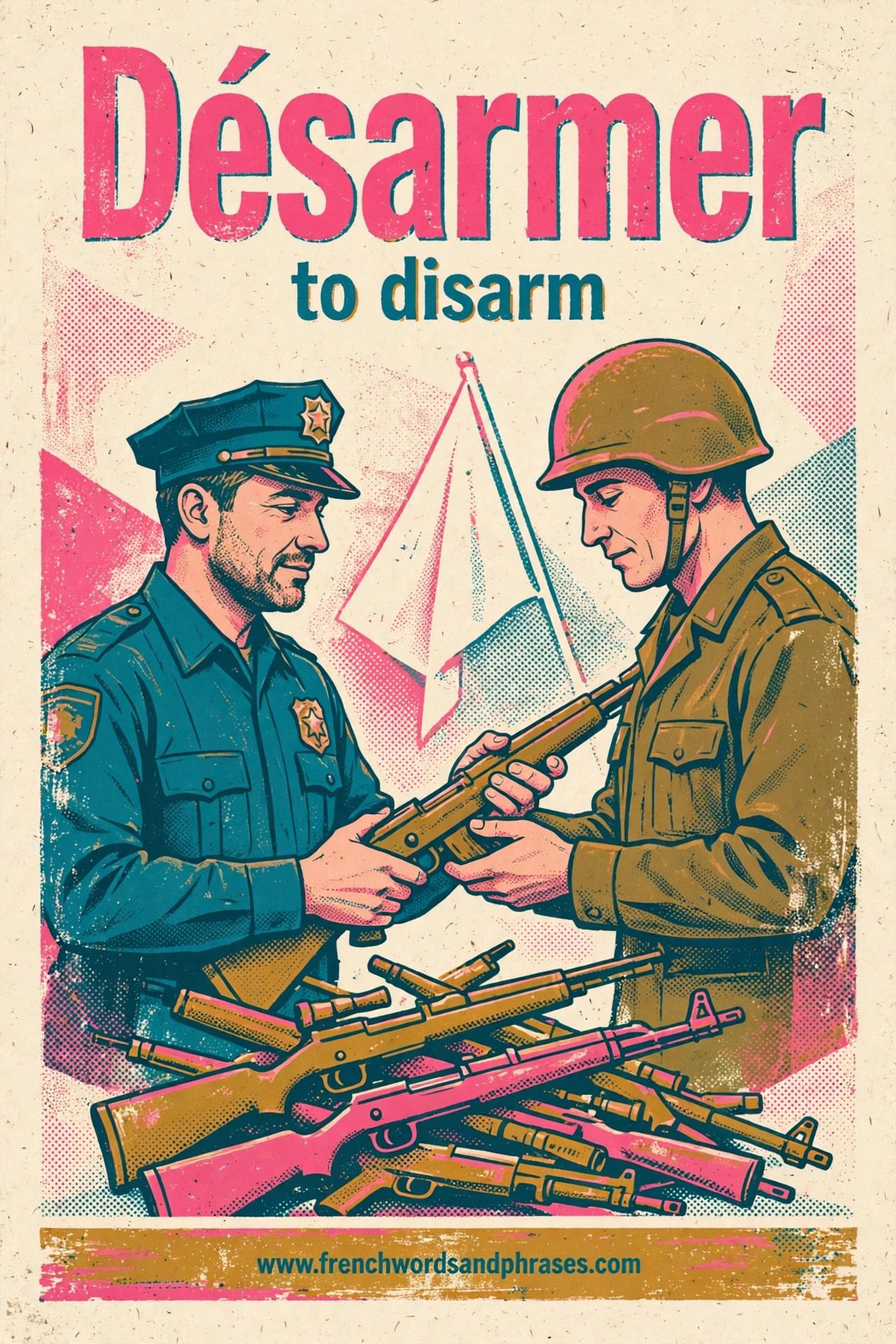
Désarmer means to disarm — to take the weapons away from a soldier, a ship or a whole country, and, with a smile, to melt someone’s anger away.
Soldiers stacking their rifles after a treaty, a warship stripped of its guns, an angry man undone by a child’s smile — désarmer is the verb of weapons laid down, and of the charm that does the same work without touching a weapon.
In this guide, you’ll learn how to conjugate désarmer in all the major French tenses and moods. Explore complete conjugation tables, French examples, English translations, and practice quizzes.
Understanding the French Verb Désarmer
Désarmer is a regular French verb belonging to the first group of verbs, those ending in-er.
It means to disarm. Generals and treaties désarment armies and fleets; navies désarment ships they put into reserve. In everyday life the figurative senses dominate: a disarming smile (un sourire désarmant comes from the same family), and the stubborn ne pas désarmer of campaigners, strikers and grandmothers.
Verb classification: First group (-er)
Auxiliary verb: Avoir
Past participle: désarmé
Present participle: désarmant
English equivalents: To disarm; désarmer un soldat — to disarm a soldier; désarmer un navire — to disarm a warship (lay it up); désarmer quelqu’un (figurative) — to disarm someone with charm; ne pas désarmer — to refuse to give up, to keep fighting (figurative).
One important detail: désarmer is armer undone by dés-, fully regular: je désarme, nous désarmons, ils désarment, past participle désarmé. French also uses it without an object in the figurative phrase ne pas désarmer — to refuse to lay down one’s arms, to keep up the fight long after others would have quit: malgré les échecs, elle ne désarme pas. And a smile, a joke or an apology can désarmer a person more completely than any treaty désarme an army.
Experience the Word
Désarmer is the verb of strength set down — the rifle stacked, the guns removed, the anger quietly evaporating.
Imagine the harbour of a naval town in peacetime. Cranes lift the guns from an old frigate, sailors carry the shells ashore, and by evening the ship rides higher and lighter in the water: on l’a désarmée. She is still a warship in shape, but she could not fire a shot to save herself.
The ship has lost nothing but her power to harm. She has been disarmed — désarmée — and the harbour sleeps more quietly for it.
How to Conjugate Désarmer: Complete French Conjugation Guide
Let’s explore every major conjugation of désarmer, beginning with the indicative mood.
How to Conjugate Désarmer in the Indicative Mood
The indicative mood is used to express facts, observations, actions, and events.
How to Conjugate Désarmer in the Present Tense (Présent)
Used for actions happening now, habitual actions, and general truths.
| Subject | Conjugation |
|---|---|
| je | désarme |
| tu | désarmes |
| il / elle | désarme |
| nous | désarmons |
| vous | désarmez |
| ils / elles | désarment |
Example
Le traité désarme les deux armées en même temps.
The treaty disarms both armies at the same time.
Quick Quiz 1
Complete the sentence:
Nous ______ les rebelles en trois jours.
Reveal the answer
désarmons
Nous désarmons les rebelles en trois jours.
We disarm the rebels in three days.
How to Conjugate Désarmer in the Passé Composé
Used for completed actions in the past. Désarmer takes the auxiliary verb avoir.
| Subject | Conjugation |
|---|---|
| j’ | ai désarmé |
| tu | as désarmé |
| il / elle | a désarmé |
| nous | avons désarmé |
| vous | avez désarmé |
| ils / elles | ont désarmé |
Example
La police a désarmé l’homme avant de l’arrêter.
The police disarmed the man before arresting him.
How to Conjugate Désarmer in the Imparfait (Imperfect Tense)
Used for habitual past actions, descriptions, and ongoing situations in the past.
| Subject | Conjugation |
|---|---|
| je | désarmais |
| tu | désarmais |
| il / elle | désarmait |
| nous | désarmions |
| vous | désarmiez |
| ils / elles | désarmaient |
Example
Après chaque guerre, on désarmait les forteresses de la frontière.
After every war, the border fortresses used to be disarmed.
Quick Quiz 2
Choose the correct form:
The navy disarmed the old ship.
La marine ______ le vieux navire. (a désarmé / est désarmée)
Reveal the answer
a désarmé
La marine a désarmé le vieux navire.
Désarmer takes avoir.
How to Conjugate Désarmer in the Plus-que-parfait
Used to describe an action that had already been completed before another past event.
| Subject | Conjugation |
|---|---|
| j’ | avais désarmé |
| tu | avais désarmé |
| il / elle | avait désarmé |
| nous | avions désarmé |
| vous | aviez désarmé |
| ils / elles | avaient désarmé |
Example
Ils avaient désarmé la milice avant l’arrivée des troupes régulières.
They had disarmed the militia before the regular troops arrived.
How to Conjugate Désarmer in the Passé Simple
Primarily used in formal writing, literature, and historical narratives. It is rarely used in everyday conversation.
| Subject | Conjugation |
|---|---|
| je | désarmai |
| tu | désarmas |
| il / elle | désarma |
| nous | désarmâmes |
| vous | désarmâtes |
| ils / elles | désarmèrent |
Example
Le vainqueur désarma les rebelles en trois jours.
The victor disarmed the rebels in three days.
How to Conjugate Désarmer in the Passé Antérieur
A literary tense used to express an action completed immediately before another past action, generally in the passé simple.
| Subject | Conjugation |
|---|---|
| j’ | eus désarmé |
| tu | eus désarmé |
| il / elle | eut désarmé |
| nous | eûmes désarmé |
| vous | eûtes désarmé |
| ils / elles | eurent désarmé |
Example
Quand la marine eut désarmé le vieux cuirassé, on le remorqua au chantier.
When the navy had disarmed the old battleship, it was towed to the yard.
How to Conjugate Désarmer in the Future Tense (Futur Simple)
Used to describe actions that will take place in the future.
| Subject | Conjugation |
|---|---|
| je | désarmerai |
| tu | désarmeras |
| il / elle | désarmera |
| nous | désarmerons |
| vous | désarmerez |
| ils / elles | désarmeront |
Example
Le nouveau traité désarmera toute la région.
The new treaty will disarm the whole region.
How to Conjugate Désarmer in the Futur Antérieur (Future Perfect)
Used for an action that will have been completed before a particular point in the future.
| Subject | Conjugation |
|---|---|
| j’ | aurai désarmé |
| tu | auras désarmé |
| il / elle | aura désarmé |
| nous | aurons désarmé |
| vous | aurez désarmé |
| ils / elles | auront désarmé |
Example
À la fin de l’année, la flotte aura désarmé ses plus vieux navires.
By the end of the year, the fleet will have disarmed its oldest ships.
How to Conjugate Désarmer in the Near Future (Futur Proche)
Used to describe something that is going to happen soon. Formed with aller + infinitive.
| Subject | Conjugation |
|---|---|
| je | vais désarmer |
| tu | vas désarmer |
| il / elle | va désarmer |
| nous | allons désarmer |
| vous | allez désarmer |
| ils / elles | vont désarmer |
Example
Son sourire va désarmer même le plus furieux des voisins.
Her smile is going to disarm even the angriest of neighbours.
How to Conjugate Désarmer in the Conditional Mood
The conditional mood expresses what would happen under certain circumstances. It is also frequently used to make polite requests or express wishes.
How to Conjugate Désarmer in the Present Conditional
| Subject | Conjugation |
|---|---|
| je | désarmerais |
| tu | désarmerais |
| il / elle | désarmerait |
| nous | désarmerions |
| vous | désarmeriez |
| ils / elles | désarmeraient |
Example
Un accord sincère désarmerait les deux camps.
A sincere agreement would disarm both camps.
How to Conjugate Désarmer in the Past Conditional
| Subject | Conjugation |
|---|---|
| j’ | aurais désarmé |
| tu | aurais désarmé |
| il / elle | aurait désarmé |
| nous | aurions désarmé |
| vous | auriez désarmé |
| ils / elles | auraient désarmé |
Example
Elle aurait désarmé son père avec une simple excuse.
She would have disarmed her father with a simple apology.
Désarmer in the Literary Past Conditional Form
This less common literary form uses the imperfect subjunctive of avoir.
| Subject | Conjugation |
|---|---|
| j’ | eusse désarmé |
| tu | eusses désarmé |
| il / elle | eût désarmé |
| nous | eussions désarmé |
| vous | eussiez désarmé |
| ils / elles | eussent désarmé |
Example
Le roi eût désarmé les rebelles par la clémence seule.
The king would have disarmed the rebels by clemency alone.
How to Conjugate Désarmer in the Subjunctive Mood
The subjunctive is used to express wishes, emotions, doubts, necessity, and uncertainty. It frequently follows expressions such as il faut que (it is necessary that) or bien que (although).
How to Conjugate Désarmer in the Present Subjunctive
| Subject | Conjugation |
|---|---|
| que je | désarme |
| que tu | désarmes |
| qu’il / qu’elle | désarme |
| que nous | désarmions |
| que vous | désarmiez |
| qu’ils / qu’elles | désarment |
Example
Il faut que la police désarme le forcené avant toute chose.
The police must disarm the madman before anything else.
Quick Quiz 3
Complete the sentence using the subjunctive:
Il faut que vous ______ ces hommes avant de les interroger.
Reveal the answer
désarmiez
Il faut que vous désarmiez ces hommes avant de les interroger.
You must disarm these men before questioning them.
How to Conjugate Désarmer in the Imperfect Subjunctive
A literary tense, rarely encountered in modern spoken French.
| Subject | Conjugation |
|---|---|
| que je | désarmasse |
| que tu | désarmasses |
| qu’il / qu’elle | désarmât |
| que nous | désarmassions |
| que vous | désarmassiez |
| qu’ils / qu’elles | désarmassent |
Example
On exigeait que la garnison désarmât la citadelle en une semaine.
It was demanded that the garrison disarm the citadel within a week.
How to Conjugate Désarmer in the Pluperfect Subjunctive
A literary construction used to express an action completed before another past action.
| Subject | Conjugation |
|---|---|
| que j’ | eusse désarmé |
| que tu | eusses désarmé |
| qu’il / qu’elle | eût désarmé |
| que nous | eussions désarmé |
| que vous | eussiez désarmé |
| qu’ils / qu’elles | eussent désarmé |
Example
On racontait que le traité eût désarmé tout le continent.
People said the treaty had disarmed the whole continent.
How to Conjugate Désarmer in the Past Subjunctive
| Subject | Conjugation |
|---|---|
| que j’ | aie désarmé |
| que tu | aies désarmé |
| qu’il / qu’elle | ait désarmé |
| que nous | ayons désarmé |
| que vous | ayez désarmé |
| qu’ils / qu’elles | aient désarmé |
Example
Je suis heureux que son sourire ait désarmé le directeur.
I am glad her smile disarmed the director.
How to Conjugate Désarmer in the Imperative
The imperative is used to give commands, instructions, invitations, or suggestions. Subject pronouns are omitted.
How to Conjugate Désarmer in the Present Imperative
| Person | Conjugation |
|---|---|
| (tu) | désarme |
| (nous) | désarmons |
| (vous) | désarmez |
Example
Désarmez ces hommes et conduisez-les au poste !
Disarm these men and take them to the station!
Quick Quiz 4
How would you say Disarm these men (tu form)?
Reveal the answer
Désarme ces hommes !
French Participles of Désarmer
Participles are verb forms that can be used in compound tenses and other grammatical constructions.
Present Participle of Désarmer
désarmant
En désarmant ses adversaires par la douceur, elle a gagné sans combattre.
By disarming her opponents with gentleness, she won without fighting.
Past Participle of Désarmer
désarmé
Désarmé par son sourire, le vieux gardien a ouvert la grille.
Disarmed by her smile, the old keeper opened the gate.
Désarmer in Everyday French: Real-Life Examples
Now that you know the conjugations, let’s see how désarmer appears in everyday French.
Example 1 — Present
Le traité désarme les deux armées.
The treaty disarms both armies.
Example 2 — Passé composé
La police a désarmé l’homme.
The police disarmed the man.
Example 3 — Imparfait
On désarmait les forteresses après la guerre.
Fortresses used to be disarmed after the war.
Example 4 — Future
Son sourire désarmera le directeur.
Her smile will disarm the director.
Example 5 — Conditional
Une excuse désarmerait son père.
An apology would disarm her father.
Example 6 — Imperative
Désarmez ces hommes immédiatement !
Disarm these men at once!
Beyond Translation: The Meaning of Désarmer
English disarm is the same word wearing the same prefix, and both languages let charm do the work of treaties — a disarming smile, un sourire désarmant.
French adds the stubborn twin: ne pas désarmer.
To refuse to disarm is to refuse to stop: the campaigner who ne désarme pas after ten defeats has laid down nothing at all — the verb of peace becomes, by negation, the verb of endurance.
How to Remember the French Verb Désarmer
Remember it this way: Désarmer is about rifles stacked after the treaty — and the smile that does the same job.
- Armer undone: désarmer takes the weapons away — from soldiers, ships and fortresses.
- Figurative gold: un sourire désarme, and the stubborn ne pas désarmer means never giving up.
- Regular -er: je désarme, nous désarmons, past participle désarmé.
The key idea is rifles stacked after the treaty — and the smile that does the same job.
Test Your Knowledge of Désarmer
Let’s see how much you’ve learned. Try answering these questions before revealing the answers.
Question 1
What does the expression ne pas désarmer mean?
Reveal the answer
To refuse to give up — literally not to lay down one’s arms: malgré les échecs, elle ne désarme pas.
Question 2
How do you say The police disarmed the man in French?
Reveal the answer
La police a désarmé l’homme.
Question 3
Translate: The treaty disarms both armies.
Reveal the answer
Le traité désarme les deux armées.
Question 4
What is the past participle of désarmer?
Reveal the answer
Désarmé.
Question 5
Complete the sentence:
Il faut que la police ______ le forcené avant toute chose.
Reveal the answer
désarme
Il faut que la police désarme le forcené avant toute chose.
The police must disarm the madman before anything else.
Your Final Challenge
Can You Use It?
How would you say this in French?
She disarms her enemies with a smile, and her friends say she has never needed any other weapon.
Reveal the answer
Elle désarme ses ennemis d’un sourire, et ses amis disent qu’elle n’a jamais eu besoin d’une autre arme.
She disarms her enemies with a smile, and her friends say she has never needed any other weapon.
A little French. A little curiosity. A richer everyday life.
LEARN FRENCH ONE WORD AT A TIME