A French Word to Live By
How to Conjugate Désagréger in French
/de.za.ɡʁe.ʒe/
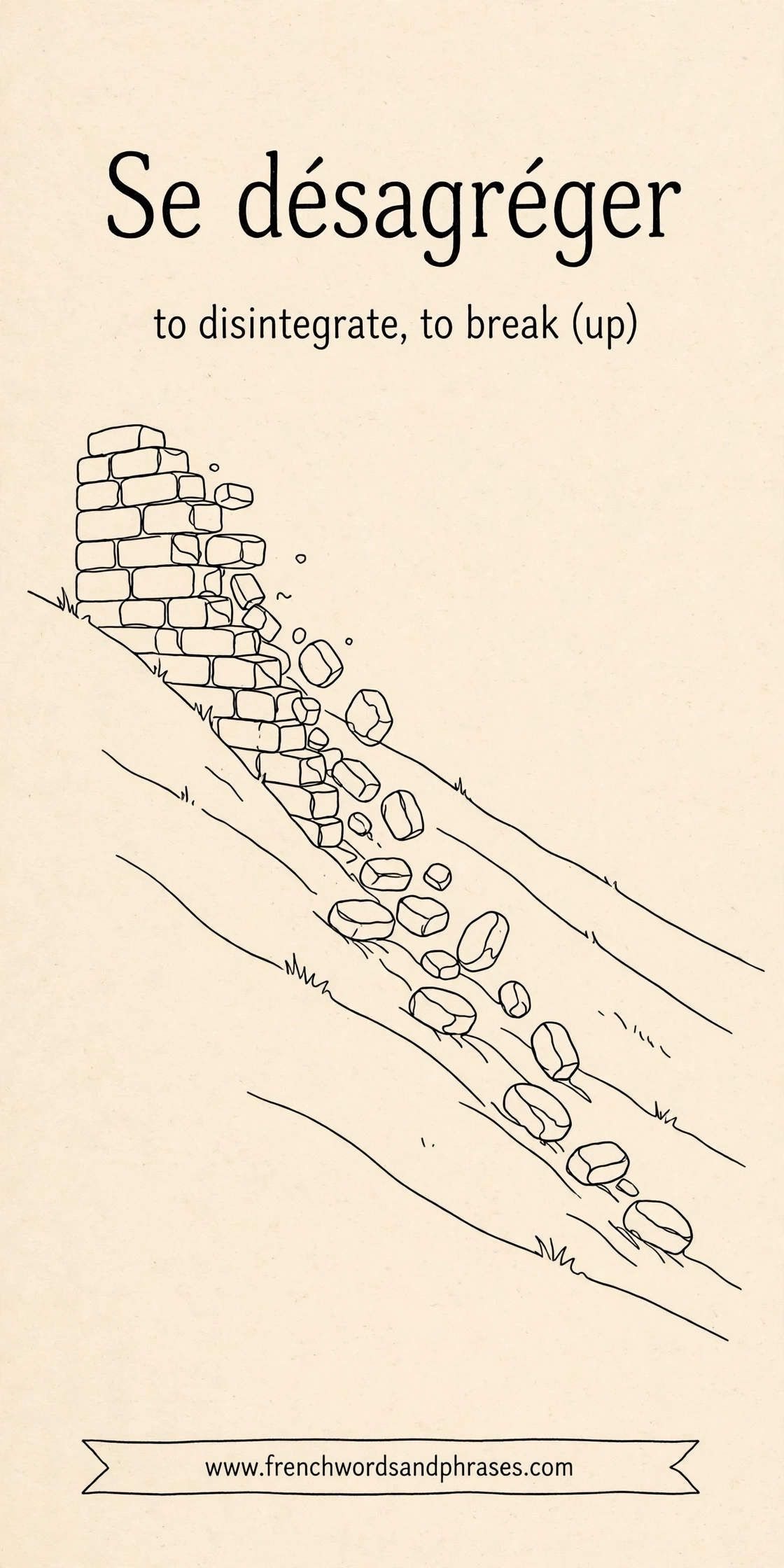
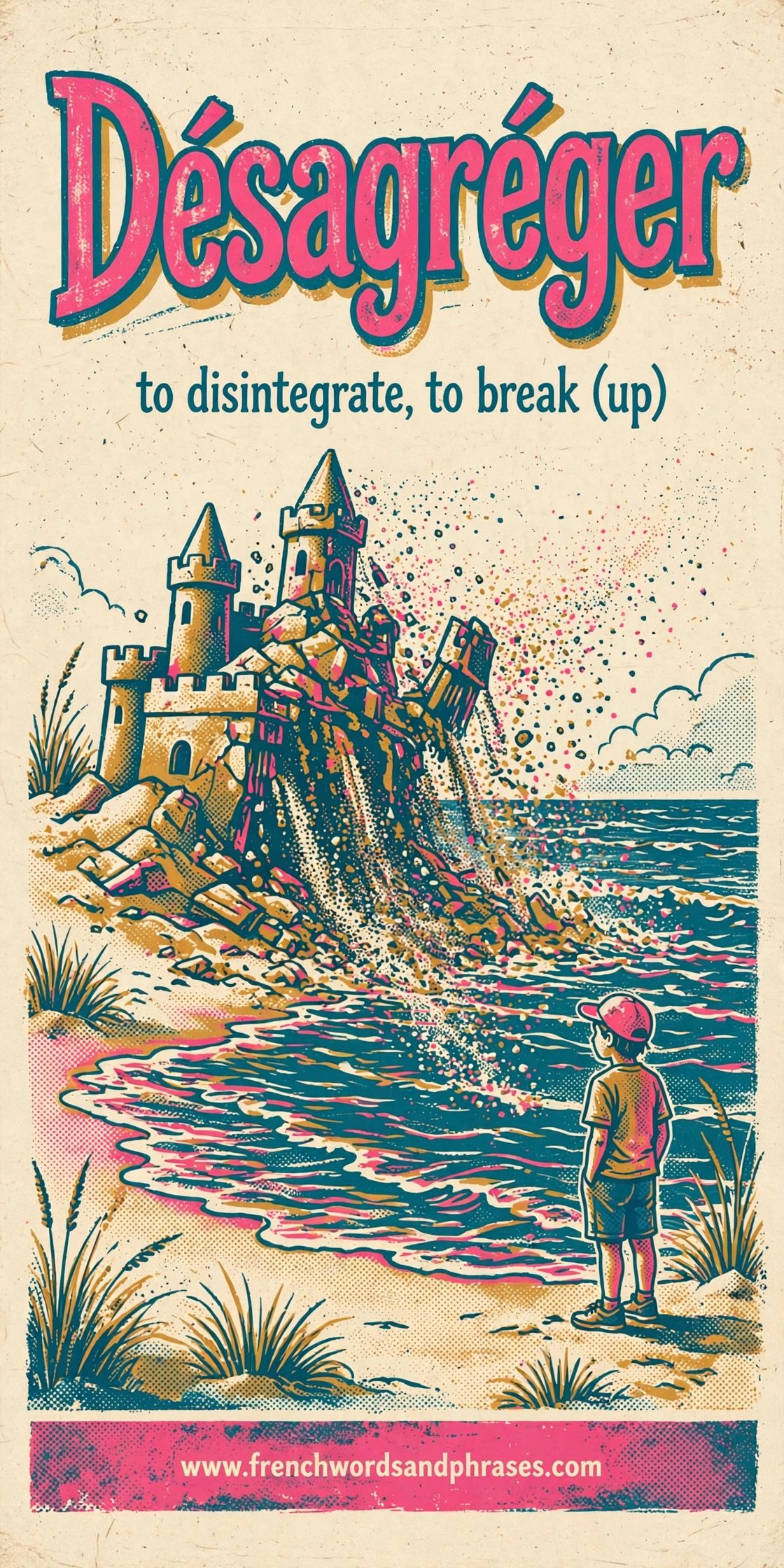
Désagréger means to disintegrate, to break (up) — to take apart what was bound into one mass, rock into grains, concrete into crumbs, a group into scattered pieces.
Rain working on a cliff, frost splitting a wall, acid eating a stone — désagréger is the verb of the solid coming undone: what was one hard mass is slowly separated back into the grains it was made of.
In this guide, you’ll learn how to conjugate désagréger in all the major French tenses and moods. Explore complete conjugation tables, French examples, English translations, and practice quizzes.
Understanding the French Verb Désagréger
Désagréger is a regular French verb belonging to the first group of verbs, those ending in-er.
It means to disintegrate, to break (up). It is used by geologists and builders of rock, soil and concrete breaking down, and figuratively of empires, parties and families breaking up. Its reflexive twin se désagréger describes the mass that crumbles by itself; the plain verb needs an agent or a force — water, frost, time — doing the breaking.
Verb classification: First group (-er)
Auxiliary verb: Avoir
Past participle: désagrégé
Present participle: désagrégeant
English equivalents: To disintegrate, to break (up), to break down; désagréger la roche — to break up the rock; désagréger le béton — to disintegrate the concrete; désagréger un groupe — to break up a group; la désagrégation — disintegration, breaking up.
One important detail: désagréger belongs to the protéger family. The é opens to è before a mute syllable — je désagrège, tu désagrèges, il désagrège, ils désagrègent — while the é stays where the ending is sounded: vous désagrégez, je désagrégeais, and through the future and conditional, je désagrégerai, je désagrégerais. And because the stem ends in g, an extra e guards the soft g before a and o: nous désagrégeons, en désagrégeant, je désagrégeai.
Experience the Word
Désagréger is the verb of the solid unmade — a cliff, a wall or an empire returned to separate grains.
Imagine a chalk cliff above the Channel. Each winter the frost enters the cracks, each tide steals the fallen pieces, et la mer désagrège la falaise grain après grain. Nothing dramatic ever happens, yet in a century the cliff has retreated a hundred metres.
No blow was ever struck. The cliff was simply unbound — désagrégée, patiently, by water and frost.
How to Conjugate Désagréger: Complete French Conjugation Guide
Let’s explore every major conjugation of désagréger, beginning with the indicative mood.
How to Conjugate Désagréger in the Indicative Mood
The indicative mood is used to express facts, observations, actions, and events.
How to Conjugate Désagréger in the Present Tense (Présent)
Used for actions happening now, habitual actions, and general truths.
| Subject | Conjugation |
|---|---|
| je | désagrège |
| tu | désagrèges |
| il / elle | désagrège |
| nous | désagrégeons |
| vous | désagrégez |
| ils / elles | désagrègent |
Example
Le gel désagrège la roche en quelques hivers.
Frost breaks up the rock within a few winters.
Quick Quiz 1
Complete the sentence:
Nous ______ le béton avec cette machine.
Reveal the answer
désagrégeons
Nous désagrégeons le béton avec cette machine.
We break up the concrete with this machine.
How to Conjugate Désagréger in the Passé Composé
Used for completed actions in the past. Désagréger takes the auxiliary verb avoir.
| Subject | Conjugation |
|---|---|
| j’ | ai désagrégé |
| tu | as désagrégé |
| il / elle | a désagrégé |
| nous | avons désagrégé |
| vous | avez désagrégé |
| ils / elles | ont désagrégé |
Example
L’acide a désagrégé la pierre en surface.
The acid disintegrated the stone at the surface.
How to Conjugate Désagréger in the Imparfait (Imperfect Tense)
Used for habitual past actions, descriptions, and ongoing situations in the past.
| Subject | Conjugation |
|---|---|
| je | désagrégeais |
| tu | désagrégeais |
| il / elle | désagrégeait |
| nous | désagrégions |
| vous | désagrégiez |
| ils / elles | désagrégeaient |
Example
Les pluies désagrégeaient lentement le vieux mur.
The rains were slowly breaking up the old wall.
Quick Quiz 2
Choose the correct form:
The acid disintegrated the stone.
L’acide ______ la pierre. (a désagrégé / est désagrégé)
Reveal the answer
a désagrégé
L’acide a désagrégé la pierre.
Désagréger takes avoir.
How to Conjugate Désagréger in the Plus-que-parfait
Used to describe an action that had already been completed before another past event.
| Subject | Conjugation |
|---|---|
| j’ | avais désagrégé |
| tu | avais désagrégé |
| il / elle | avait désagrégé |
| nous | avions désagrégé |
| vous | aviez désagrégé |
| ils / elles | avaient désagrégé |
Example
La mer avait désagrégé la base de la falaise.
The sea had broken up the base of the cliff.
How to Conjugate Désagréger in the Passé Simple
Primarily used in formal writing, literature, and historical narratives. It is rarely used in everyday conversation.
| Subject | Conjugation |
|---|---|
| je | désagrégeai |
| tu | désagrégeas |
| il / elle | désagrégea |
| nous | désagrégeâmes |
| vous | désagrégeâtes |
| ils / elles | désagrégeèrent |
Example
Le temps désagrégea le monument plus sûrement que les hommes.
Time broke up the monument more surely than men did.
How to Conjugate Désagréger in the Passé Antérieur
A literary tense used to express an action completed immediately before another past action, generally in the passé simple.
| Subject | Conjugation |
|---|---|
| j’ | eus désagrégé |
| tu | eus désagrégé |
| il / elle | eut désagrégé |
| nous | eûmes désagrégé |
| vous | eûtes désagrégé |
| ils / elles | eurent désagrégé |
Example
Quand le gel eut désagrégé le rocher, la route fut coupée.
When the frost had broken up the rock, the road was cut off.
How to Conjugate Désagréger in the Future Tense (Futur Simple)
Used to describe actions that will take place in the future.
| Subject | Conjugation |
|---|---|
| je | désagrègerai |
| tu | désagrègeras |
| il / elle | désagrègera |
| nous | désagrègerons |
| vous | désagrègerez |
| ils / elles | désagrègeront |
Example
Cette solution désagrégera le dépôt sans effort.
This solution will break down the deposit effortlessly.
How to Conjugate Désagréger in the Futur Antérieur (Future Perfect)
Used for an action that will have been completed before a particular point in the future.
| Subject | Conjugation |
|---|---|
| j’ | aurai désagrégé |
| tu | auras désagrégé |
| il / elle | aura désagrégé |
| nous | aurons désagrégé |
| vous | aurez désagrégé |
| ils / elles | auront désagrégé |
Example
À la fin de l’hiver, le gel aura désagrégé tout le talus.
By the end of winter, the frost will have broken up the whole bank.
How to Conjugate Désagréger in the Near Future (Futur Proche)
Used to describe something that is going to happen soon. Formed with aller + infinitive.
| Subject | Conjugation |
|---|---|
| je | vais désagréger |
| tu | vas désagréger |
| il / elle | va désagréger |
| nous | allons désagréger |
| vous | allez désagréger |
| ils / elles | vont désagréger |
Example
L’eau va désagréger ce béton de mauvaise qualité.
The water is going to disintegrate this poor-quality concrete.
How to Conjugate Désagréger in the Conditional Mood
The conditional mood expresses what would happen under certain circumstances. It is also frequently used to make polite requests or express wishes.
How to Conjugate Désagréger in the Present Conditional
| Subject | Conjugation |
|---|---|
| je | désagrègerais |
| tu | désagrègerais |
| il / elle | désagrègerait |
| nous | désagrègerions |
| vous | désagrègeriez |
| ils / elles | désagrègeraient |
Example
Un produit plus fort désagrégerait la roche en une nuit.
A stronger product would break up the rock in one night.
How to Conjugate Désagréger in the Past Conditional
| Subject | Conjugation |
|---|---|
| j’ | aurais désagrégé |
| tu | aurais désagrégé |
| il / elle | aurait désagrégé |
| nous | aurions désagrégé |
| vous | auriez désagrégé |
| ils / elles | auraient désagrégé |
Example
Sans le gel, rien n’aurait désagrégé la falaise si vite.
Without the frost, nothing would have broken up the cliff so fast.
Désagréger in the Literary Past Conditional Form
This less common literary form uses the imperfect subjunctive of avoir.
| Subject | Conjugation |
|---|---|
| j’ | eusse désagrégé |
| tu | eusses désagrégé |
| il / elle | eût désagrégé |
| nous | eussions désagrégé |
| vous | eussiez désagrégé |
| ils / elles | eussent désagrégé |
Example
Le temps eût désagrégé l’empire le plus solide.
Time would have broken up the most solid empire.
How to Conjugate Désagréger in the Subjunctive Mood
The subjunctive is used to express wishes, emotions, doubts, necessity, and uncertainty. It frequently follows expressions such as il faut que (it is necessary that) or bien que (although).
How to Conjugate Désagréger in the Present Subjunctive
| Subject | Conjugation |
|---|---|
| que je | désagrège |
| que tu | désagrèges |
| qu’il / qu’elle | désagrège |
| que nous | désagrégions |
| que vous | désagrégiez |
| qu’ils / qu’elles | désagrègent |
Example
Il faut que ce traitement désagrège le calcaire accumulé.
This treatment must break down the accumulated limescale.
Quick Quiz 3
Complete the sentence using the subjunctive:
Il faut que vous ______ ce dépôt avant l’hiver.
Reveal the answer
désagrégiez
Il faut que vous désagrégiez ce dépôt avant l’hiver.
You must break down this deposit before winter.
How to Conjugate Désagréger in the Imperfect Subjunctive
A literary tense, rarely encountered in modern spoken French.
| Subject | Conjugation |
|---|---|
| que je | désagrégasse |
| que tu | désagrégasses |
| qu’il / qu’elle | désagrégât |
| que nous | désagrégassions |
| que vous | désagrégassiez |
| qu’ils / qu’elles | désagrégassent |
Example
On craignait que l’infiltration désagrégeât les fondations.
People feared the seepage might break up the foundations.
How to Conjugate Désagréger in the Pluperfect Subjunctive
A literary construction used to express an action completed before another past action.
| Subject | Conjugation |
|---|---|
| que j’ | eusse désagrégé |
| que tu | eusses désagrégé |
| qu’il / qu’elle | eût désagrégé |
| que nous | eussions désagrégé |
| que vous | eussiez désagrégé |
| qu’ils / qu’elles | eussent désagrégé |
Example
Le géologue a montré que la mer eût désagrégé la côte depuis des siècles.
The geologist showed that the sea had been breaking up the coast for centuries.
How to Conjugate Désagréger in the Past Subjunctive
| Subject | Conjugation |
|---|---|
| que j’ | aie désagrégé |
| que tu | aies désagrégé |
| qu’il / qu’elle | ait désagrégé |
| que nous | ayons désagrégé |
| que vous | ayez désagrégé |
| qu’ils / qu’elles | aient désagrégé |
Example
Je suis étonné que le gel ait désagrégé le mur en un seul hiver.
I am surprised the frost broke up the wall in a single winter.
How to Conjugate Désagréger in the Imperative
The imperative is used to give commands, instructions, invitations, or suggestions. Subject pronouns are omitted.
How to Conjugate Désagréger in the Present Imperative
| Person | Conjugation |
|---|---|
| (tu) | désagrège |
| (nous) | désagrégeons |
| (vous) | désagrégez |
Example
Désagrège ce bloc lentement, sans le faire éclater !
Break up this block slowly, without shattering it!
Quick Quiz 4
How would you say Break up this block slowly (tu form)?
Reveal the answer
Désagrège ce bloc lentement !
French Participles of Désagréger
Participles are verb forms that can be used in compound tenses and other grammatical constructions.
Present Participle of Désagréger
désagrégeant
En désagrégeant le béton, la machine dégage une poussière fine.
By breaking up the concrete, the machine gives off a fine dust.
Past Participle of Désagréger
désagrégé
Désagrégée par les siècles, la falaise a reculé de cent mètres.
Broken up by the centuries, the cliff has retreated a hundred metres.
Désagréger in Everyday French: Real-Life Examples
Now that you know the conjugations, let’s see how désagréger appears in everyday French.
Example 1 — Present
Le gel désagrège la roche.
Frost breaks up the rock.
Example 2 — Passé composé
L’acide a désagrégé la pierre.
The acid disintegrated the stone.
Example 3 — Imparfait
Les pluies désagrégeaient le vieux mur.
The rains were breaking up the old wall.
Example 4 — Future
Cette solution désagrégera le dépôt.
This solution will break down the deposit.
Example 5 — Conditional
Un produit plus fort désagrégerait la roche en une nuit.
A stronger product would break up the rock in one night.
Example 6 — Imperative
Désagrège ce bloc lentement !
Break up this block slowly!
Beyond Translation: The Meaning of Désagréger
The verb is built on the Latin grex, a flock: an agrégat is a mass gathered into one body, and désagréger scatters the flock back into grains.
From one, back to many.
Geologists use it for cliffs, historians for empires — and in both cases the story is the same: the bonds give way, one grain at a time, until the whole no longer holds.
How to Remember the French Verb Désagréger
Remember it this way: Désagréger is about the chalk cliff unbound by frost and tide, grain after grain.
- Protéger family: je désagrège with è, but nous désagrégeons with é — and an extra e after the g.
- Water, frost and time are its usual agents: le gel désagrège la roche.
- Future keeps the é: je désagrégerai; past participle désagrégé.
The key idea is the chalk cliff unbound by frost and tide, grain after grain.
Test Your Knowledge of Désagréger
Let’s see how much you’ve learned. Try answering these questions before revealing the answers.
Question 1
Why do we write nous désagrégeons with an extra e?
Reveal the answer
To keep the g soft before o — désagrégeons; and the é stays because the ending is sounded.
Question 2
How do you say Frost breaks up the rock in French?
Reveal the answer
Le gel désagrège la roche.
Question 3
Translate: The acid disintegrated the stone at the surface.
Reveal the answer
L’acide a désagrégé la pierre en surface.
Question 4
What is the past participle of désagréger?
Reveal the answer
Désagrégé.
Question 5
Complete the sentence:
Il faut que ce traitement ______ le calcaire accumulé.
Reveal the answer
désagrège
Il faut que ce traitement désagrège le calcaire accumulé.
This treatment must break down the accumulated limescale.
Your Final Challenge
Can You Use It?
How would you say this in French?
Frost breaks up the cliff in silence, and each morning the sea carries away the night’s work.
Reveal the answer
Le gel désagrège la falaise sans bruit, et la mer emporte chaque matin le travail de la nuit.
Frost breaks up the cliff in silence, and each morning the sea carries away the night’s work.
A little French. A little curiosity. A richer everyday life.
LEARN FRENCH ONE WORD AT A TIME