A French Word to Live By
How to Conjugate Dérocher in French
/de.ʁɔ.ʃe/
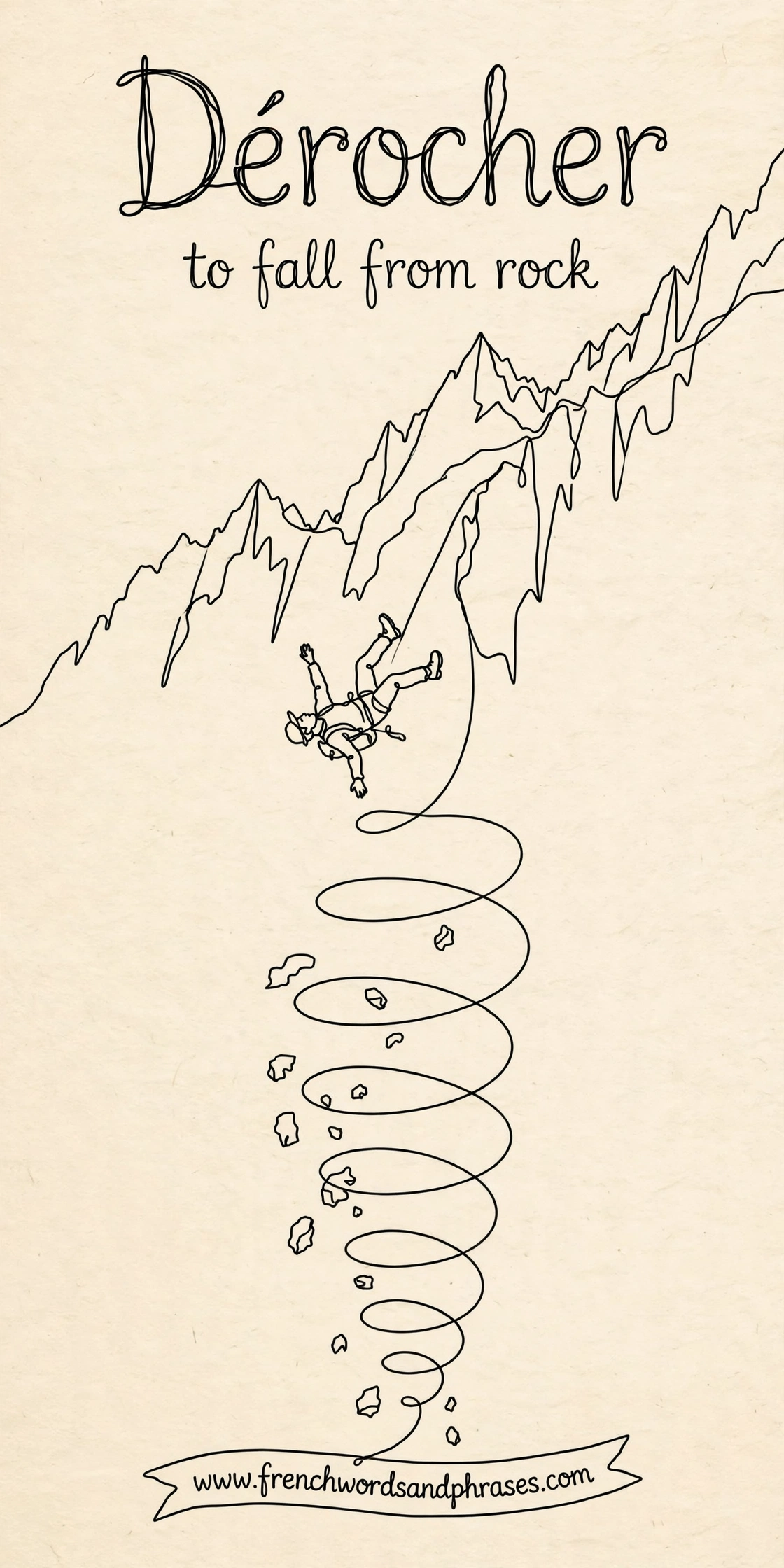
Dérocher means to fall from rock — the rare, technical word for a vessel coming off its course onto the rocks, or rock coming down from the face.
A black coast of granite, a lighthouse out of reach, a sailing boat thrown by the swell against the one rock the chart forgot — dérocher belongs to that hard world of reefs and quarries, where things that meet rock fall, and fall badly.
In this guide, you’ll learn how to conjugate dérocher in all the major French tenses and moods. Explore complete conjugation tables, French examples, English translations, and practice quizzes.
Understanding the French Verb Dérocher
Dérocher is a regular French verb belonging to the first group of verbs, those ending in-er.
It means to fall from rock. It appears in maritime accounts of wrecks on rocky coasts — Brittany’s granite is its classic scenery — and in the language of quarries and mines, where dérocher is to bring down or clear rock from the face being worked.
Verb classification: First group (-er)
Auxiliary verb: Avoir
Past participle: déroché
Present participle: dérochant
English equivalents: To fall from rock, to strike the rocks; (of a vessel) to be thrown onto the rocks, to come off a rock; (in quarries) to bring rock down from the face; une côte où les navires dérochent — a coast where ships come to grief on the rocks.
One important detail: dérocher is a rare, technical verb, and it should be used soberly — of ships on a rocky coast and of rock in a quarry or on a cliff face, not as a general word for falling. It is built on un rocher, a rock, with the prefix dé- marking the violent separation: the vessel leaves the water for the rock, the block leaves the face for the ground. Conjugation is perfectly regular: je déroche, nous dérochons, ils dérochent, past participle déroché.
Experience the Word
Dérocher is the verb of the meeting nobody survives unchanged — hull against granite, block against the quarry floor.
Imagine a November night off a rocky island. The swell lifts the little cargo boat, carries it ten metres sideways, and sets it down where no boat should ever be set down — le navire déroche, once, twice, and the sound of timber on rock crosses the whole harbour.
It has not sunk in deep water. It has fallen — déroché, dropped from the sea onto the rock.
How to Conjugate Dérocher: Complete French Conjugation Guide
Let’s explore every major conjugation of dérocher, beginning with the indicative mood.
How to Conjugate Dérocher in the Indicative Mood
The indicative mood is used to express facts, observations, actions, and events.
How to Conjugate Dérocher in the Present Tense (Présent)
Used for actions happening now, habitual actions, and general truths.
| Subject | Conjugation |
|---|---|
| je | déroche |
| tu | déroches |
| il / elle | déroche |
| nous | dérochons |
| vous | dérochez |
| ils / elles | dérochent |
Example
Par gros temps, les barques dérochent sur les rochers du large.
In heavy weather, the boats fall on the offshore rocks.
Quick Quiz 1
Complete the sentence:
Par gros temps, nous ______ sur les rochers si nous quittons le chenal.
Reveal the answer
dérocherons
Par gros temps, nous dérocherons sur les rochers si nous quittons le chenal.
In heavy weather, we will fall on the rocks if we leave the channel.
How to Conjugate Dérocher in the Passé Composé
Used for completed actions in the past. Dérocher takes the auxiliary verb avoir.
| Subject | Conjugation |
|---|---|
| j’ | ai déroché |
| tu | as déroché |
| il / elle | a déroché |
| nous | avons déroché |
| vous | avez déroché |
| ils / elles | ont déroché |
Example
Le voilier a déroché contre la falaise pendant la tempête.
The sailing boat fell against the cliff during the storm.
How to Conjugate Dérocher in the Imparfait (Imperfect Tense)
Used for habitual past actions, descriptions, and ongoing situations in the past.
| Subject | Conjugation |
|---|---|
| je | dérochais |
| tu | dérochais |
| il / elle | dérochait |
| nous | dérochions |
| vous | dérochiez |
| ils / elles | dérochaient |
Example
Autrefois, les navires dérochaient souvent sur cette côte de granit.
In the old days, ships often came to grief on this granite coast.
Quick Quiz 2
Choose the correct form:
The schooner had fallen on the rocks.
La goélette ______ sur les rochers. (avait déroché / était dérochée)
Reveal the answer
avait déroché
La goélette avait déroché sur les rochers.
Dérocher takes avoir.
How to Conjugate Dérocher in the Plus-que-parfait
Used to describe an action that had already been completed before another past event.
| Subject | Conjugation |
|---|---|
| j’ | avais déroché |
| tu | avais déroché |
| il / elle | avait déroché |
| nous | avions déroché |
| vous | aviez déroché |
| ils / elles | avaient déroché |
Example
La goélette avait déroché avant l’arrivée des secours.
The schooner had fallen on the rocks before help arrived.
How to Conjugate Dérocher in the Passé Simple
Primarily used in formal writing, literature, and historical narratives. It is rarely used in everyday conversation.
| Subject | Conjugation |
|---|---|
| je | dérochai |
| tu | dérochas |
| il / elle | dérocha |
| nous | dérochâmes |
| vous | dérochâtes |
| ils / elles | dérochèrent |
Example
Le trois-mâts dérocha sur un écueil au large de l’île.
The three-master fell on a reef off the island.
How to Conjugate Dérocher in the Passé Antérieur
A literary tense used to express an action completed immediately before another past action, generally in the passé simple.
| Subject | Conjugation |
|---|---|
| j’ | eus déroché |
| tu | eus déroché |
| il / elle | eut déroché |
| nous | eûmes déroché |
| vous | eûtes déroché |
| ils / elles | eurent déroché |
Example
Quand le navire eut déroché, l’équipage gagna la côte à la nage.
When the ship had fallen on the rocks, the crew swam to the shore.
How to Conjugate Dérocher in the Future Tense (Futur Simple)
Used to describe actions that will take place in the future.
| Subject | Conjugation |
|---|---|
| je | dérocherai |
| tu | dérocheras |
| il / elle | dérochera |
| nous | dérocherons |
| vous | dérocherez |
| ils / elles | dérocheront |
Example
Sans phare, d’autres bateaux dérocheront sur ces rochers.
Without a lighthouse, other boats will fall on these rocks.
How to Conjugate Dérocher in the Futur Antérieur (Future Perfect)
Used for an action that will have been completed before a particular point in the future.
| Subject | Conjugation |
|---|---|
| j’ | aurai déroché |
| tu | auras déroché |
| il / elle | aura déroché |
| nous | aurons déroché |
| vous | aurez déroché |
| ils / elles | auront déroché |
Example
À marée basse, on verra combien de coques auront déroché ici.
At low tide, we shall see how many hulls will have fallen here.
How to Conjugate Dérocher in the Near Future (Futur Proche)
Used to describe something that is going to happen soon. Formed with aller + infinitive.
| Subject | Conjugation |
|---|---|
| je | vais dérocher |
| tu | vas dérocher |
| il / elle | va dérocher |
| nous | allons dérocher |
| vous | allez dérocher |
| ils / elles | vont dérocher |
Example
Attention, la barque va dérocher si le vent tourne.
Careful, the boat is going to fall on the rocks if the wind turns.
How to Conjugate Dérocher in the Conditional Mood
The conditional mood expresses what would happen under certain circumstances. It is also frequently used to make polite requests or express wishes.
How to Conjugate Dérocher in the Present Conditional
| Subject | Conjugation |
|---|---|
| je | dérocherais |
| tu | dérocherais |
| il / elle | dérocherait |
| nous | dérocherions |
| vous | dérocheriez |
| ils / elles | dérocheraient |
Example
Avec un meilleur balisage, aucun navire ne dérocherait ici.
With better markers, no ship would come to grief here.
How to Conjugate Dérocher in the Past Conditional
| Subject | Conjugation |
|---|---|
| j’ | aurais déroché |
| tu | aurais déroché |
| il / elle | aurait déroché |
| nous | aurions déroché |
| vous | auriez déroché |
| ils / elles | auraient déroché |
Example
Le chalutier aurait déroché sans l’intervention du remorqueur.
The trawler would have fallen on the rocks without the tug’s intervention.
Dérocher in the Literary Past Conditional Form
This less common literary form uses the imperfect subjunctive of avoir.
| Subject | Conjugation |
|---|---|
| j’ | eusse déroché |
| tu | eusses déroché |
| il / elle | eût déroché |
| nous | eussions déroché |
| vous | eussiez déroché |
| ils / elles | eussent déroché |
Example
La frégate eût déroché sur les brisants sans son pilote.
The frigate would have fallen on the breakers without its pilot.
How to Conjugate Dérocher in the Subjunctive Mood
The subjunctive is used to express wishes, emotions, doubts, necessity, and uncertainty. It frequently follows expressions such as il faut que (it is necessary that) or bien que (although).
How to Conjugate Dérocher in the Present Subjunctive
| Subject | Conjugation |
|---|---|
| que je | déroche |
| que tu | déroches |
| qu’il / qu’elle | déroche |
| que nous | dérochions |
| que vous | dérochiez |
| qu’ils / qu’elles | dérochent |
Example
Il est à craindre que la coque ne déroche sur les récifs.
It is to be feared the hull may fall on the reefs.
Quick Quiz 3
Complete the sentence using the subjunctive:
Le capitaine veillait pour que vous ne ______ point.
Reveal the answer
dérochiez
Le capitaine veillait pour que vous ne dérochiez point.
The captain kept watch so that you should not fall on the rocks.
How to Conjugate Dérocher in the Imperfect Subjunctive
A literary tense, rarely encountered in modern spoken French.
| Subject | Conjugation |
|---|---|
| que je | dérochasse |
| que tu | dérochasses |
| qu’il / qu’elle | dérochât |
| que nous | dérochassions |
| que vous | dérochassiez |
| qu’ils / qu’elles | dérochassent |
Example
Le capitaine veillait pour que le navire ne dérochât point.
The captain kept watch so that the ship should not fall on the rocks.
How to Conjugate Dérocher in the Pluperfect Subjunctive
A literary construction used to express an action completed before another past action.
| Subject | Conjugation |
|---|---|
| que j’ | eusse déroché |
| que tu | eusses déroché |
| qu’il / qu’elle | eût déroché |
| que nous | eussions déroché |
| que vous | eussiez déroché |
| qu’ils / qu’elles | eussent déroché |
Example
On racontait que le galion eût déroché, chargé d’or, au pied de la falaise.
People said the galleon had fallen, laden with gold, at the foot of the cliff.
How to Conjugate Dérocher in the Past Subjunctive
| Subject | Conjugation |
|---|---|
| que j’ | aie déroché |
| que tu | aies déroché |
| qu’il / qu’elle | ait déroché |
| que nous | ayons déroché |
| que vous | ayez déroché |
| qu’ils / qu’elles | aient déroché |
Example
Je suis surpris que le bateau ait déroché par temps calme.
I am surprised the boat fell on the rocks in calm weather.
How to Conjugate Dérocher in the Imperative
The imperative is used to give commands, instructions, invitations, or suggestions. Subject pronouns are omitted.
How to Conjugate Dérocher in the Present Imperative
| Person | Conjugation |
|---|---|
| (tu) | déroche |
| (nous) | dérochons |
| (vous) | dérochez |
Example
Ne dérochez pas sur la barre, suivez le chenal !
Do not fall on the bar, follow the channel!
Quick Quiz 4
How would you say Do not fall on the rocks (tu form)?
Reveal the answer
Ne déroche pas sur les rochers !
French Participles of Dérocher
Participles are verb forms that can be used in compound tenses and other grammatical constructions.
Present Participle of Dérocher
dérochant
En dérochant sur les rochers, le navire a perdu sa quille.
By falling on the rocks, the ship lost its keel.
Past Participle of Dérocher
déroché
Dérochée sur les écueils, l’épave attirait les plongeurs.
Fallen on the reefs, the wreck attracted the divers.
Dérocher in Everyday French: Real-Life Examples
Now that you know the conjugations, let’s see how dérocher appears in everyday French.
Example 1 — Present
Par gros temps, les barques dérochent sur les rochers du large.
In heavy weather, the boats fall on the offshore rocks.
Example 2 — Passé composé
Le voilier a déroché contre la falaise pendant la tempête.
The sailing boat fell against the cliff during the storm.
Example 3 — Imparfait
Autrefois, les navires dérochaient souvent sur cette côte de granit.
In the old days, ships often came to grief on this granite coast.
Example 4 — Future
Sans phare, d’autres bateaux dérocheront sur ces rochers.
Without a lighthouse, other boats will fall on these rocks.
Example 5 — Conditional
Avec un meilleur balisage, aucun navire ne dérocherait ici.
With better markers, no ship would come to grief here.
Example 6 — Imperative
Ne dérochez pas sur la barre, suivez le chenal !
Do not fall on the bar, follow the channel!
Beyond Translation: The Meaning of Dérocher
English has no verb for this — a ship strikes, grounds or is wrecked; French dérocher names the exact moment of separation, built on rocher, the rock itself.
It is a word from the age of sail and stone.
You will meet it in wreck reports and quarrymen’s talk rather than in cafés, but on a granite coast it still says, in one word, what a whole sentence of English struggles to land: the fall from water onto rock.
How to Remember the French Verb Dérocher
Remember it this way: Dérocher is about the sailing boat set down by the swell onto the one forgotten rock.
- Rocher is the rock — dérocher is the fall onto or from it: ships on reefs, blocks in a quarry.
- A rare, technical word: keep it for coasts, cliffs and quarries, not for everyday falling.
- Regular -er: je déroche, nous dérochons, past participle déroché.
The key idea is the sailing boat set down by the swell onto the one forgotten rock.
Test Your Knowledge of Dérocher
Let’s see how much you’ve learned. Try answering these questions before revealing the answers.
Question 1
In what two worlds is dérocher at home?
Reveal the answer
At sea — a vessel falling on the rocks — and in quarries, where rock is brought down from the face.
Question 2
How do you say The sailing boat fell against the cliff during the storm in French?
Reveal the answer
Le voilier a déroché contre la falaise pendant la tempête.
Question 3
Translate: In the old days, ships often came to grief on this granite coast.
Reveal the answer
Autrefois, les navires dérochaient souvent sur cette côte de granit.
Question 4
What is the past participle of dérocher?
Reveal the answer
Déroché.
Question 5
Complete the sentence:
Il est à craindre que la coque ne ______ sur les récifs.
Reveal the answer
déroche
Il est à craindre que la coque ne déroche sur les récifs.
It is to be feared the hull may fall on the reefs.
Your Final Challenge
Can You Use It?
How would you say this in French?
On this granite coast, the old sailors still tell of the nights when ships fell on the rocks beneath the storm.
Reveal the answer
Sur cette côte de granit, les vieux marins racontent encore les nuits où les navires dérochaient sous la tempête.
On this granite coast, the old sailors still tell of the nights when ships fell on the rocks beneath the storm.
A little French. A little curiosity. A richer everyday life.
LEARN FRENCH ONE WORD AT A TIME