A French Word to Live By
How to Conjugate Dériver in French
/de.ʁi.ve/
Dériver means to divert, to derive — to lead a river out of its bed, or a word out of its ancestor.
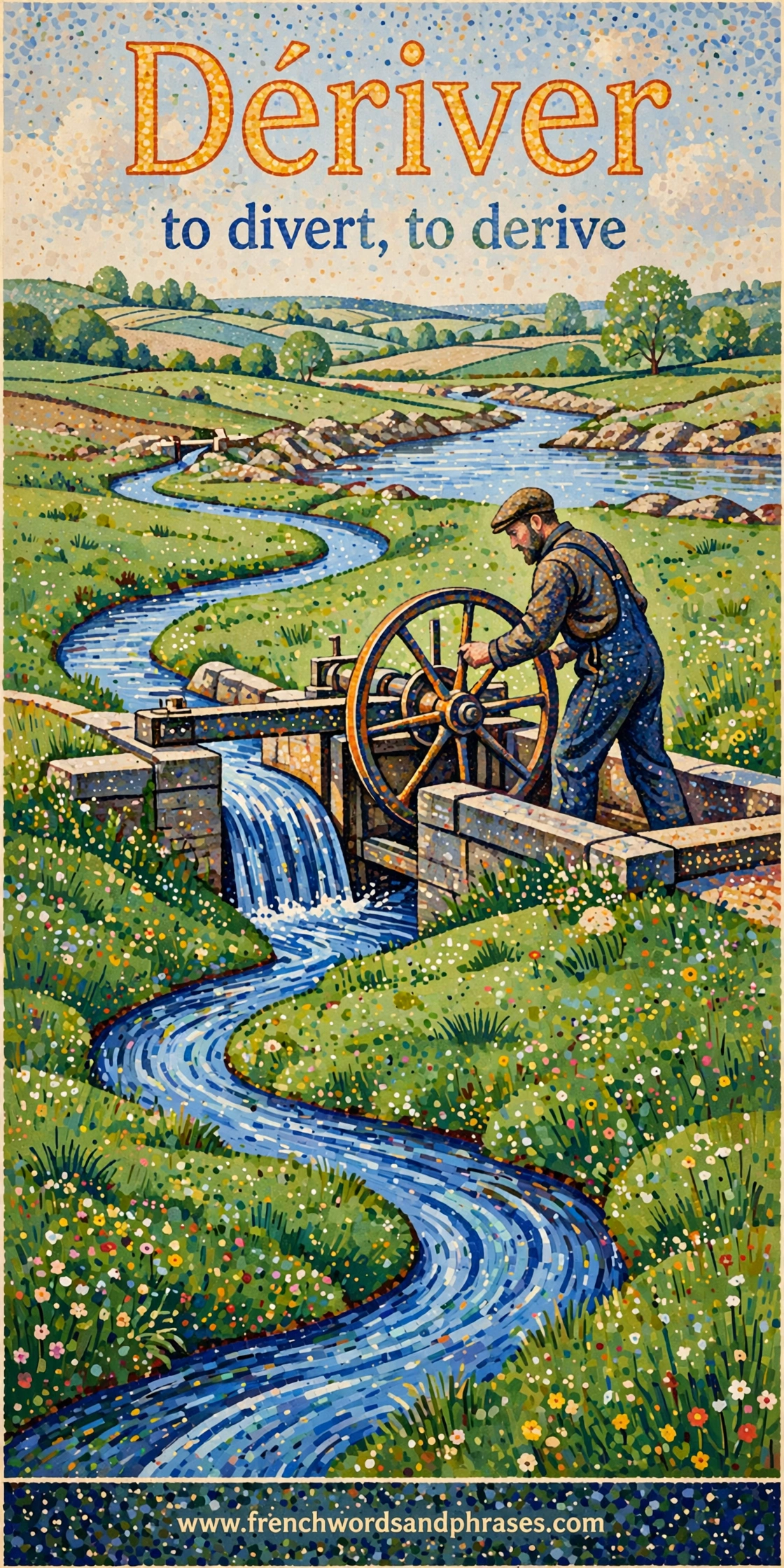
Engineers turning a river aside to build a bridge, a scholar tracing a French word back to a Latin root — dériver is the verb of the channel and the family tree: water led out of its course, words led out of their source.
In this guide, you’ll learn how to conjugate dériver in all the major French tenses and moods. Explore complete conjugation tables, French examples, English translations, and practice quizzes.
Understanding the French Verb Dériver
Dériver is a regular French verb belonging to the first group of verbs, those ending in-er.
It means to divert, to derive. It is the standard verb of etymology — every French dictionary entry traces how a word dérive de its Latin, Greek or Gaulish ancestor — and the standard verb of hydraulic engineering, where rivers and canals are dérivés to feed mills, fields and reservoirs.
Verb classification: First group (-er)
Auxiliary verb: Avoir
Past participle: dérivé
Present participle: dérivant
English equivalents: To divert, to derive; dériver un cours d’eau — to divert a watercourse; dériver de — to derive from, to come from: ce mot dérive du latin — this word derives from Latin; faire dériver un sens — to shift a meaning; un mot dérivé — a derived word.
One important detail: dériver lives with the preposition de. Whatever comes out of a source dérive de that source: ce mot dérive du latin, cette coutume dérive d’un rite ancien, son nom dérive d’un surnom. The same verb, used transitively, diverts water or traffic out of its bed: dériver une rivière, dériver la circulation. It is a perfectly regular -er verb: je dérive, nous dérivons, ils dérivent, past participle dérivé — the word French grammar itself uses for a word formed from another: un dérivé.
Experience the Word
Dériver is the verb of the second channel — the river persuaded out of its bed, the word traced back out of its root.
Imagine a class of schoolchildren with one question: where does the word fenêtre come from? The teacher draws a line on the board — fenestra, Latin — and the class watches the modern word dériver, century by century, out of its ancestor, the way a canal leaves a river.
The word has travelled far. It has derived — dérivé, led out of Latin by a thousand years of mouths.
How to Conjugate Dériver: Complete French Conjugation Guide
Let’s explore every major conjugation of dériver, beginning with the indicative mood.
How to Conjugate Dériver in the Indicative Mood
The indicative mood is used to express facts, observations, actions, and events.
How to Conjugate Dériver in the Present Tense (Présent)
Used for actions happening now, habitual actions, and general truths.
| Subject | Conjugation |
|---|---|
| je | dérive |
| tu | dérives |
| il / elle | dérive |
| nous | dérivons |
| vous | dérivez |
| ils / elles | dérivent |
Example
Ce mot dérive du latin populaire.
This word derives from popular Latin.
Quick Quiz 1
Complete the sentence:
Nous ______ ce mot d’une racine très ancienne.
Reveal the answer
dérivons
Nous dérivons ce mot d’une racine très ancienne.
We derive this word from a very ancient root.
How to Conjugate Dériver in the Passé Composé
Used for completed actions in the past. Dériver takes the auxiliary verb avoir.
| Subject | Conjugation |
|---|---|
| j’ | ai dérivé |
| tu | as dérivé |
| il / elle | a dérivé |
| nous | avons dérivé |
| vous | avez dérivé |
| ils / elles | ont dérivé |
Example
Les ingénieurs ont dérivé la rivière pour construire le pont.
The engineers diverted the river to build the bridge.
How to Conjugate Dériver in the Imparfait (Imperfect Tense)
Used for habitual past actions, descriptions, and ongoing situations in the past.
| Subject | Conjugation |
|---|---|
| je | dérivais |
| tu | dérivais |
| il / elle | dérivait |
| nous | dérivions |
| vous | dériviez |
| ils / elles | dérivaient |
Example
Le canal dérivait les eaux vers les marais salants.
The canal used to divert the waters towards the salt marshes.
Quick Quiz 2
Choose the correct form:
They diverted the river.
Ils ______ la rivière. (ont dérivé / sont dérivés)
Reveal the answer
ont dérivé
Ils ont dérivé la rivière.
Dériver takes avoir.
How to Conjugate Dériver in the Plus-que-parfait
Used to describe an action that had already been completed before another past event.
| Subject | Conjugation |
|---|---|
| j’ | avais dérivé |
| tu | avais dérivé |
| il / elle | avait dérivé |
| nous | avions dérivé |
| vous | aviez dérivé |
| ils / elles | avaient dérivé |
Example
Le nom du village avait dérivé d’un surnom médiéval.
The village’s name had derived from a medieval nickname.
How to Conjugate Dériver in the Passé Simple
Primarily used in formal writing, literature, and historical narratives. It is rarely used in everyday conversation.
| Subject | Conjugation |
|---|---|
| je | dérivai |
| tu | dérivas |
| il / elle | dériva |
| nous | dérivâmes |
| vous | dérivâtes |
| ils / elles | dérivèrent |
Example
On dériva le ruisseau en une nuit de travail.
They diverted the stream in one night of work.
How to Conjugate Dériver in the Passé Antérieur
A literary tense used to express an action completed immediately before another past action, generally in the passé simple.
| Subject | Conjugation |
|---|---|
| j’ | eus dérivé |
| tu | eus dérivé |
| il / elle | eut dérivé |
| nous | eûmes dérivé |
| vous | eûtes dérivé |
| ils / elles | eurent dérivé |
Example
Quand on eut dérivé le fleuve, les travaux purent commencer.
When they had diverted the river, the work could begin.
How to Conjugate Dériver in the Future Tense (Futur Simple)
Used to describe actions that will take place in the future.
| Subject | Conjugation |
|---|---|
| je | dériverai |
| tu | dériveras |
| il / elle | dérivera |
| nous | dériverons |
| vous | dériverez |
| ils / elles | dériveront |
Example
Le nouveau canal dérivera les crues loin du village.
The new canal will divert floodwaters away from the village.
How to Conjugate Dériver in the Futur Antérieur (Future Perfect)
Used for an action that will have been completed before a particular point in the future.
| Subject | Conjugation |
|---|---|
| j’ | aurai dérivé |
| tu | auras dérivé |
| il / elle | aura dérivé |
| nous | aurons dérivé |
| vous | aurez dérivé |
| ils / elles | auront dérivé |
Example
À la fin des travaux, on aura dérivé trois ruisseaux.
By the end of the works, they will have diverted three streams.
How to Conjugate Dériver in the Near Future (Futur Proche)
Used to describe something that is going to happen soon. Formed with aller + infinitive.
| Subject | Conjugation |
|---|---|
| je | vais dériver |
| tu | vas dériver |
| il / elle | va dériver |
| nous | allons dériver |
| vous | allez dériver |
| ils / elles | vont dériver |
Example
On va dériver le cours d’eau demain matin.
They are going to divert the watercourse tomorrow morning.
How to Conjugate Dériver in the Conditional Mood
The conditional mood expresses what would happen under certain circumstances. It is also frequently used to make polite requests or express wishes.
How to Conjugate Dériver in the Present Conditional
| Subject | Conjugation |
|---|---|
| je | dériverais |
| tu | dériverais |
| il / elle | dériverait |
| nous | dériverions |
| vous | dériveriez |
| ils / elles | dériveraient |
Example
Un bon étymologiste dériverait ce mot du grec.
A good etymologist would derive this word from Greek.
How to Conjugate Dériver in the Past Conditional
| Subject | Conjugation |
|---|---|
| j’ | aurais dérivé |
| tu | aurais dérivé |
| il / elle | aurait dérivé |
| nous | aurions dérivé |
| vous | auriez dérivé |
| ils / elles | auraient dérivé |
Example
Sans la pluie, on aurait dérivé le canal plus tôt.
Without the rain, they would have diverted the canal earlier.
Dériver in the Literary Past Conditional Form
This less common literary form uses the imperfect subjunctive of avoir.
| Subject | Conjugation |
|---|---|
| j’ | eusse dérivé |
| tu | eusses dérivé |
| il / elle | eût dérivé |
| nous | eussions dérivé |
| vous | eussiez dérivé |
| ils / elles | eussent dérivé |
Example
Le fleuve eût dérivé ses eaux vers le sud sans la colline.
The river would have diverted its waters southwards without the hill.
How to Conjugate Dériver in the Subjunctive Mood
The subjunctive is used to express wishes, emotions, doubts, necessity, and uncertainty. It frequently follows expressions such as il faut que (it is necessary that) or bien que (although).
How to Conjugate Dériver in the Present Subjunctive
| Subject | Conjugation |
|---|---|
| que je | dérive |
| que tu | dérives |
| qu’il / qu’elle | dérive |
| que nous | dérivions |
| que vous | dériviez |
| qu’ils / qu’elles | dérivent |
Example
Je doute que ce sens dérive du latin classique.
I doubt that this meaning derives from classical Latin.
Quick Quiz 3
Complete the sentence using the subjunctive:
Je doute que vous ______ ce mot de la bonne racine.
Reveal the answer
dériviez
Je doute que vous dériviez ce mot de la bonne racine.
I doubt you are deriving this word from the right root.
How to Conjugate Dériver in the Imperfect Subjunctive
A literary tense, rarely encountered in modern spoken French.
| Subject | Conjugation |
|---|---|
| que je | dérivasse |
| que tu | dérivasses |
| qu’il / qu’elle | dérivât |
| que nous | dérivassions |
| que vous | dérivassiez |
| qu’ils / qu’elles | dérivassent |
Example
On ne pensait pas que le mot dérivât du grec.
People did not think the word derived from Greek.
How to Conjugate Dériver in the Pluperfect Subjunctive
A literary construction used to express an action completed before another past action.
| Subject | Conjugation |
|---|---|
| que j’ | eusse dérivé |
| que tu | eusses dérivé |
| qu’il / qu’elle | eût dérivé |
| que nous | eussions dérivé |
| que vous | eussiez dérivé |
| qu’ils / qu’elles | eussent dérivé |
Example
Il semblait que le mot eût dérivé d’une langue oubliée.
It seemed the word had derived from a forgotten language.
How to Conjugate Dériver in the Past Subjunctive
| Subject | Conjugation |
|---|---|
| que j’ | aie dérivé |
| que tu | aies dérivé |
| qu’il / qu’elle | ait dérivé |
| que nous | ayons dérivé |
| que vous | ayez dérivé |
| qu’ils / qu’elles | aient dérivé |
Example
Je suis étonné que ce verbe ait dérivé si loin de son sens premier.
I am amazed this verb has derived so far from its original meaning.
How to Conjugate Dériver in the Imperative
The imperative is used to give commands, instructions, invitations, or suggestions. Subject pronouns are omitted.
How to Conjugate Dériver in the Present Imperative
| Person | Conjugation |
|---|---|
| (tu) | dérive |
| (nous) | dérivons |
| (vous) | dérivez |
Example
Dérive le ruisseau avant la crue !
Divert the stream before the flood!
Quick Quiz 4
How would you say Divert the stream (tu form)?
Reveal the answer
Dérive le ruisseau !
French Participles of Dériver
Participles are verb forms that can be used in compound tenses and other grammatical constructions.
Present Participle of Dériver
dérivant
En dérivant le canal, les ouvriers ont asséché le marais.
By diverting the canal, the workers drained the marsh.
Past Participle of Dériver
dérivé
Dérivé du latin, ce mot a gardé sa forme ancienne.
Derived from Latin, this word has kept its ancient shape.
Dériver in Everyday French: Real-Life Examples
Now that you know the conjugations, let’s see how dériver appears in everyday French.
Example 1 — Present
Ce mot dérive du latin.
This word derives from Latin.
Example 2 — Passé composé
Les ingénieurs ont dérivé la rivière.
The engineers diverted the river.
Example 3 — Imparfait
Le canal dérivait les eaux vers les marais.
The canal used to divert the waters towards the marshes.
Example 4 — Future
Le nouveau canal dérivera les crues loin du village.
The new canal will divert floodwaters away from the village.
Example 5 — Conditional
Un bon étymologiste dériverait ce mot du grec.
A good etymologist would derive this word from Greek.
Example 6 — Imperative
Dérive le ruisseau avant la crue !
Divert the stream before the flood!
Beyond Translation: The Meaning of Dériver
English derive and divert split the work between them; French dériver keeps both jobs in one word, because both come from the same picture — dé- plus rive, the bank: to lead something away from its bank, its bed, its source.
A derived word is a diverted river.
That is why the same verb serves the engineer with his canal and the linguist with his dictionary: each is following a channel back to where the water came from.
How to Remember the French Verb Dériver
Remember it this way: Dériver is about the canal leaving the river — and the word leaving its Latin root.
- Think of rive, the bank: dériver leads water away from its bank — or a word back to its source.
- The construction is dériver de: ce mot dérive du latin, cette coutume dérive d’un rite.
- Regular -er: je dérive, nous dérivons, past participle dérivé — itself the word for a derived word.
The key idea is the canal leaving the river — and the word leaving its Latin root.
Test Your Knowledge of Dériver
Let’s see how much you’ve learned. Try answering these questions before revealing the answers.
Question 1
Which preposition does dériver take for a source, and in what example?
Reveal the answer
De — ce mot dérive du latin: the word comes out of its source, like water out of a riverbed.
Question 2
How do you say This word derives from Latin in French?
Reveal the answer
Ce mot dérive du latin.
Question 3
Translate: The engineers diverted the river.
Reveal the answer
Les ingénieurs ont dérivé la rivière.
Question 4
What is the past participle of dériver?
Reveal the answer
Dérivé — the same word French uses for a derived word.
Question 5
Complete the sentence:
Je doute que ce sens ______ du latin classique.
Reveal the answer
dérive
Je doute que ce sens dérive du latin classique.
I doubt that this meaning derives from classical Latin.
Your Final Challenge
Can You Use It?
How would you say this in French?
Every word in the language derives from a distant source, just as every canal derives from a river.
Reveal the answer
Chaque mot de la langue dérive d’une source lointaine, comme chaque canal dérive d’un fleuve.
Every word in the language derives from a distant source, just as every canal derives from a river.
A little French. A little curiosity. A richer everyday life.
LEARN FRENCH ONE WORD AT A TIME