A French Word to Live By
How to Conjugate Vouloir in French
Pronunciation: /vu.lwaʁ/
Vouloir means “to want” or “to wish” in French.
We all want something: a little more time, another cup of coffee, a chance to travel, or simply a better understanding of the world around us. The French verb vouloir is how you express those wishes and desires. It is an essential verb for everyday conversation, and learning it will make your French sound more natural.
In this guide, you will learn how to conjugate vouloir in the major French tenses and moods, understand how it is used, and practice with examples.
Understanding the French Verb Vouloir
- Infinitive: vouloir
- English meaning: to want; to wish
- Verb group: Third group (irregular)
- Auxiliary verb: avoir
- Past participle: voulu
- Present participle: voulant
Vouloir is an irregular verb. Its forms change considerably, especially between the present tense and the future and conditional tenses. The most useful forms to remember include je veux, nous voulons, je voudrai, and je voudrais.
Experience the Word
One of the most useful things about vouloir is how easily it fits into everyday situations. You can use it to express a desire, make a request, or explain what you would like to do.
For example:
- Je veux un café. — I want a coffee.
- Nous voulons partir. — We want to leave.
- Je voudrais un café. — I would like a coffee.
That last example is especially important. The conditional form je voudrais is generally more polite than je veux when making a request.
Now let’s explore the complete conjugation of vouloir.
Indicatif (Indicative Mood)
The indicative mood is used to express facts, statements, and things considered certain or real.
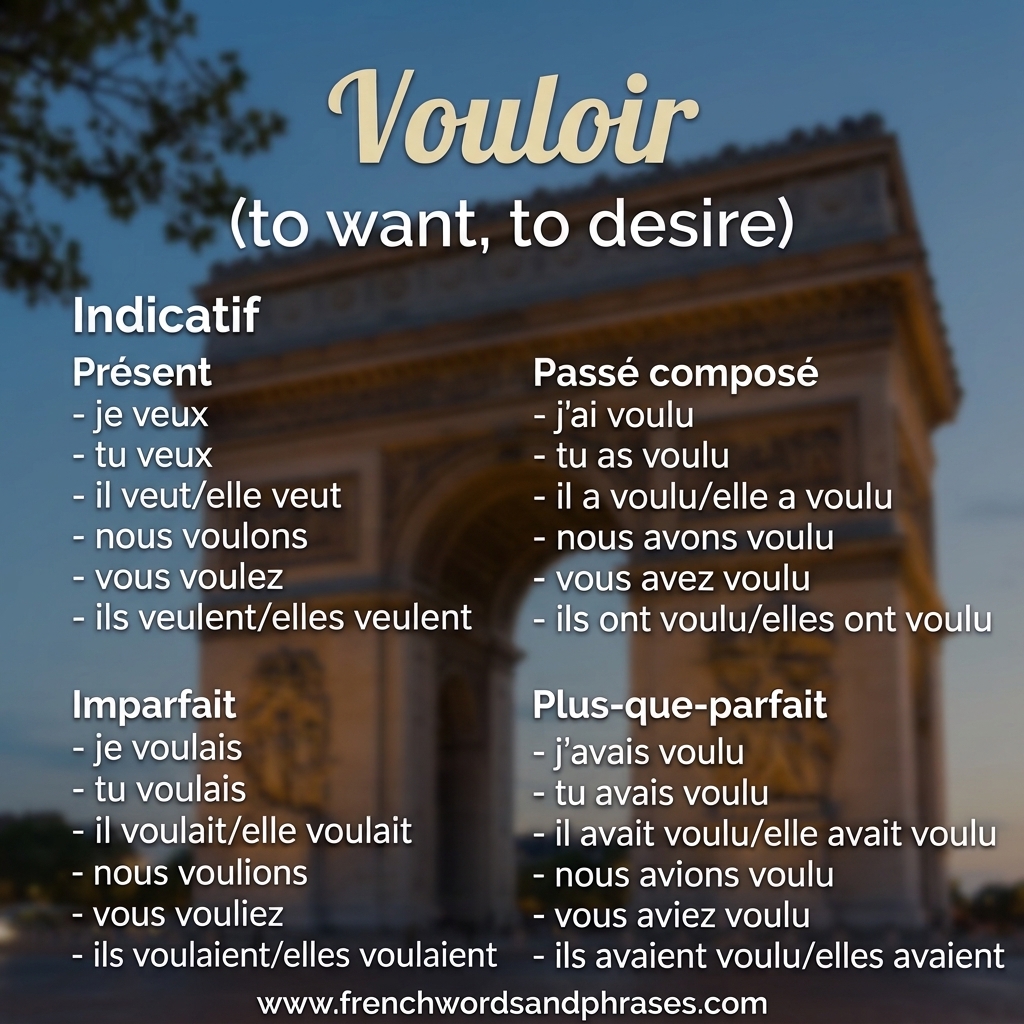
Présent (Present)
| French | English |
|---|---|
| je veux | I want |
| tu veux | you want |
| il veut / elle veut | he wants / she wants |
| nous voulons | we want |
| vous voulez | you want |
| ils veulent / elles veulent | they want |
Passé composé (Past Completed Action)
| French | English |
|---|---|
| j’ai voulu | I wanted |
| tu as voulu | you wanted |
| il a voulu / elle a voulu | he wanted / she wanted |
| nous avons voulu | we wanted |
| vous avez voulu | you wanted |
| ils ont voulu / elles ont voulu | they wanted |
Imparfait (Imperfect)
| French | English |
|---|---|
| je voulais | I wanted / I used to want |
| tu voulais | you wanted / you used to want |
| il voulait / elle voulait | he wanted / she wanted |
| nous voulions | we wanted / we used to want |
| vous vouliez | you wanted / you used to want |
| ils voulaient / elles voulaient | they wanted / they used to want |
Plus-que-parfait (Pluperfect)
| French | English |
|---|---|
| j’avais voulu | I had wanted |
| tu avais voulu | you had wanted |
| il avait voulu / elle avait voulu | he had wanted / she had wanted |
| nous avions voulu | we had wanted |
| vous aviez voulu | you had wanted |
| ils avaient voulu / elles avaient voulu | they had wanted |
Passé simple (Simple Past)
| French | English |
|---|---|
| je voulus | I wanted |
| tu voulus | you wanted |
| il voulut / elle voulut | he wanted / she wanted |
| nous voulûmes | we wanted |
| vous voulûtes | you wanted |
| ils voulurent / elles voulurent | they wanted |
Passé antérieur (Anterior Past)
| French | English |
|---|---|
| j’eus voulu | I had wanted |
| tu eus voulu | you had wanted |
| il eut voulu / elle eut voulu | he had wanted / she had wanted |
| nous eûmes voulu | we had wanted |
| vous eûtes voulu | you had wanted |
| ils eurent voulu / elles eurent voulu | they had wanted |
Futur (Future)
| French | English |
|---|---|
| je voudrai | I will want |
| tu voudras | you will want |
| il voudra / elle voudra | he will want / she will want |
| nous voudrons | we will want |
| vous voudrez | you will want |
| ils voudront / elles voudront | they will want |
Futur antérieur (Future Perfect)
| French | English |
|---|---|
| j’aurai voulu | I will have wanted |
| tu auras voulu | you will have wanted |
| il aura voulu / elle aura voulu | he will have wanted / she will have wanted |
| nous aurons voulu | we will have wanted |
| vous aurez voulu | you will have wanted |
| ils auront voulu / elles auront voulu | they will have wanted |
Futur proche (Near Future)
| French | English |
|---|---|
| je vais vouloir | I am going to want |
| tu vas vouloir | you are going to want |
| il va vouloir / elle va vouloir | he is going to want / she is going to want |
| nous allons vouloir | we are going to want |
| vous allez vouloir | you are going to want |
| ils vont vouloir / elles vont vouloir | they are going to want |
Conditionnel (Conditional Mood)
The conditional is used to express what someone would want, what they would do, or what might happen under certain circumstances. It is also especially useful for polite requests.
Présent (Present)
| French | English |
|---|---|
| je voudrais | I would like / I would want |
| tu voudrais | you would like / you would want |
| il voudrait / elle voudrait | he would like / she would like |
| nous voudrions | we would like |
| vous voudriez | you would like |
| ils voudraient / elles voudraient | they would like |
Je voudrais is one of the most useful expressions in French. It is a polite way to say “I would like,” especially when ordering food or asking for something.
Passé (Past)
| French | English |
|---|---|
| j’aurais voulu | I would have wanted |
| tu aurais voulu | you would have wanted |
| il aurait voulu / elle aurait voulu | he would have wanted / she would have wanted |
| nous aurions voulu | we would have wanted |
| vous auriez voulu | you would have wanted |
| ils auraient voulu / elles auraient voulu | they would have wanted |
Passé – forme alternative (Alternative Past Form)
| French | English |
|---|---|
| j’eusse voulu | I would have wanted |
| tu eusses voulu | you would have wanted |
| il eût voulu / elle eût voulu | he would have wanted / she would have wanted |
| nous eussions voulu | we would have wanted |
| vous eussiez voulu | you would have wanted |
| ils eussent voulu / elles eussent voulu | they would have wanted |
This alternative form is literary and very uncommon in everyday conversation.
Subjonctif (Subjunctive Mood)
The subjunctive is used after certain expressions of emotion, doubt, necessity, possibility, and judgment. It often appears in a subordinate clause introduced by que.
Présent (Present)
| French | English |
|---|---|
| que je veuille | that I want |
| que tu veuilles | that you want |
| qu’il veuille / qu’elle veuille | that he wants / that she wants |
| que nous voulions | that we want |
| que vous vouliez | that you want |
| qu’ils veuillent / qu’elles veuillent | that they want |
Imparfait (Imperfect)
| French | English |
|---|---|
| que je voulusse | that I wanted |
| que tu voulusses | that you wanted |
| qu’il voulût / qu’elle voulût | that he wanted / that she wanted |
| que nous voulussions | that we wanted |
| que vous voulussiez | that you wanted |
| qu’ils voulussent / qu’elles voulussent | that they wanted |
Plus-que-parfait (Pluperfect)
| French | English |
|---|---|
| que j’eusse voulu | that I had wanted |
| que tu eusses voulu | that you had wanted |
| qu’il eût voulu / qu’elle eût voulu | that he had wanted / that she had wanted |
| que nous eussions voulu | that we had wanted |
| que vous eussiez voulu | that you had wanted |
| qu’ils eussent voulu / qu’elles eussent voulu | that they had wanted |
Passé (Past)
| French | English |
|---|---|
| que j’aie voulu | that I have wanted |
| que tu aies voulu | that you have wanted |
| qu’il ait voulu / qu’elle ait voulu | that he has wanted / that she has wanted |
| que nous ayons voulu | that we have wanted |
| que vous ayez voulu | that you have wanted |
| qu’ils aient voulu / qu’elles aient voulu | that they have wanted |
Impératif (Imperative Mood)
The imperative is used to give commands, instructions, or advice. It uses the tu, nous, and vous forms without the subject pronoun.
Présent (Present)
| French | English |
|---|---|
| veuille | want (informal singular); please be willing |
| veuillons | let’s want (rare in ordinary speech) |
| veuillez | please; be willing (formal or plural) |
The imperative of vouloir is a little unusual. Veuillez is especially common in formal instructions and polite requests.
For example:
- Veuillez patienter. — Please wait.
- Veuillez entrer. — Please come in.
- Veuillez remplir ce formulaire. — Please fill out this form.
Participe (Participles)
Présent (Present Participle)
| French | English |
|---|---|
| voulant | wanting |
Passé (Past Participle)
| French | English |
|---|---|
| voulu | wanted (masculine singular) |
| voulus | wanted (masculine plural) |
| voulue | wanted (feminine singular) |
| voulues | wanted (feminine plural) |
In compound tenses, vouloir uses avoir. The past participle voulu normally does not agree with the subject. Agreement can occur when a preceding direct object requires it.
Vouloir in Everyday French
Here are some useful expressions that bring the verb vouloir into everyday conversation.
- Je veux apprendre le français. — I want to learn French.
- Qu’est-ce que tu veux ? — What do you want?
- Je voudrais un café, s’il vous plaît. — I would like a coffee, please.
- Nous voulons partir. — We want to leave.
- Il veut réussir. — He wants to succeed.
- Je ne veux pas. — I don’t want to.
- Comme tu veux. — As you wish / Whatever you want.
- Je veux bien. — I’d be happy to / I don’t mind.
- Voulez-vous danser ? — Would you like to dance?
- Qui ne veut rien ne risque rien. — Those who want nothing risk nothing.
Vouloir vs. Aimer
Both vouloir and aimer can appear in sentences about things you would like, but they do not mean the same thing.
- Vouloir expresses wanting or wishing for something.
- Aimer expresses liking or loving something.
Compare these examples:
- Je veux du café. — I want some coffee.
- J’aime le café. — I like coffee.
- Je veux voyager. — I want to travel.
- J’aime voyager. — I like traveling.
In short, vouloir is about desire, while aimer is about affection or enjoyment.
Beyond Translation
In French, the difference between je veux and je voudrais is worth remembering.
Je veux means “I want.” It is direct and perfectly appropriate in many situations, but it can sound demanding when used to make a request.
Je voudrais means “I would like.” It is softer and more polite, making it a particularly useful expression when ordering in a restaurant, shopping, or asking someone for something.
For example, when ordering at a café, Je voudrais un café, s’il vous plaît is a natural and courteous choice.
How to Remember Vouloir
- Present: je veux, tu veux, il veut—but nous voulons and vous voulez.
- Future: remember the stem voudr-, as in je voudrai.
- Conditional: je voudrais is a very common polite expression.
- Past participle: voulu.
- Present participle: voulant.
- Useful expression: veuillez patienter means “please wait.”
Practice the two expressions Je veux and Je voudrais. Once you understand the difference, you will have a useful tool for expressing wishes and making polite requests in French.
Test Your Knowledge
Choose the correct French form of vouloir. Open each answer to check yourself.
1. How do you say “I want”?
Answer: Je veux.
2. How do you say “We want”?
Answer: Nous voulons.
3. What is the past participle of vouloir?
Answer: Voulu.
4. How do you politely say “I would like”?
Answer: Je voudrais.
5. What does “Veuillez patienter” mean?
Answer: Please wait.
Your French Challenge
Translate this sentence into French:
“I would like to learn French because I want to travel.”
Reveal the answer
Je voudrais apprendre le français parce que je veux voyager.
A little French. A little curiosity. A richer everyday life.
LEARN FRENCH ONE WORD AT A TIME.