A French Word to Live By
Translate Tranquille to English
/tʁɑ̃kil/
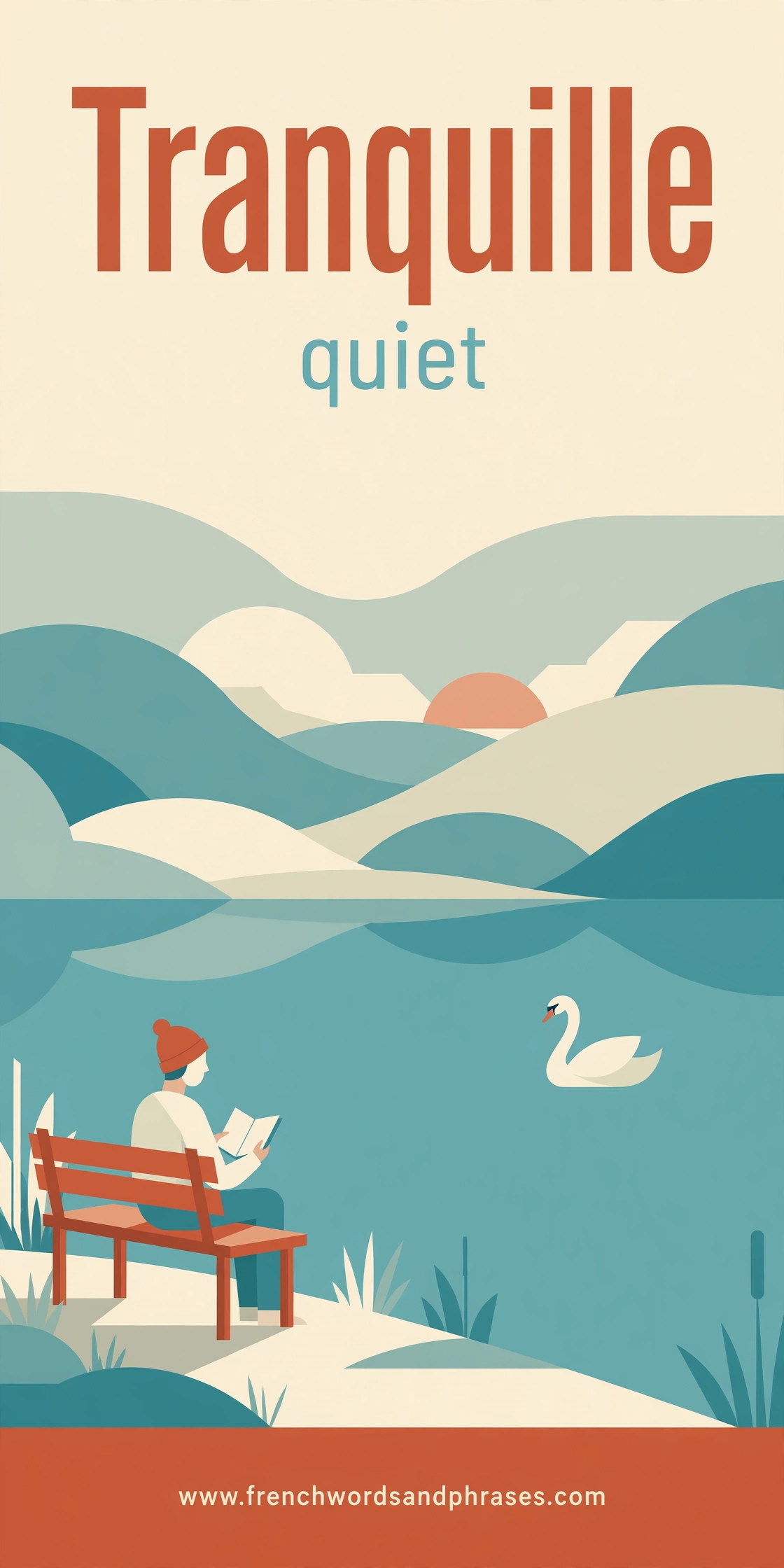
Tranquille means quiet.
A small town an hour after lunch in August: the shutters are half closed, a cat owns the middle of the street, and the only sound is a fountain talking to itself in the square. Nobody is in a hurry, because nobody needs to be. This is a town that is tranquille.
In this guide, you’ll learn what tranquille means in English, why it never changes between masculine and feminine, where it stands in the sentence, and how French uses it to say ‘don’t worry’. Explore French examples, English translations, and practice quizzes.
Understanding the French Adjective Tranquille
Tranquille is a French adjective of quality — the adjective of peace and quiet. It already ends in -e, so masculine and feminine are identical: only the plural adds an s. Une rue tranquille, un village tranquille — one form does almost all the work.
It means quiet — calm, peaceful, undisturbed. It describes streets (une rue tranquille, a quiet street), villages, districts and evenings. It also describes people who are calm, and it carries a promise: sois tranquille means don’t worry, everything is fine.
Type: Adjective of quality — calm and quiet
Answers the question: What is the place like? — quiet
Changes form: Only in the plural — tranquille / tranquilles, the same for masculine and feminine
English equivalents: Quiet; calm; peaceful.
One important usage detail: tranquille stands AFTER the noun — une rue tranquille, un quartier tranquille. And French leans on it for reassurance: sois tranquille, don’t worry; laisse-moi tranquille, leave me in peace.
Experience the Word
Tranquille is the adjective of the street where you can hear your own footsteps — the village square at dawn, the residential road where children still play outside.
Imagine renting a little house at the end of a lane in Provence. In the morning: birdsong and a distant tractor. In the evening: crickets and the church bell. By the second day, your own breathing has slowed down to match the place.
You have not just described a silent place. You have described a place at peace with itself.
How to Use Tranquille in French: Complete Guide
Let’s explore how tranquille works in French, beginning with the whole word on one card.
Tranquille at a Glance
Before the details, here is the whole word on one card.
The Whole Word on One Card
Meaning, type, position and forms — tranquille in four lines.
| Point | Tranquille |
|---|---|
| Meaning | quiet |
| Type | adjective of quality — calm and quiet |
| Usual position | after the noun — une rue tranquille |
| Form | tranquille for everyone — tranquilles in the plural |
Example
C’est un village tranquille.
It’s a quiet village.
The Four Forms of Tranquille
Here is one of the easiest agreements in French: tranquille already ends in -e, so the feminine changes nothing. Only the plural adds an s.
| Form | Tranquille | Example |
|---|---|---|
| Masculine singular | tranquille | un village tranquille — a quiet village |
| Feminine singular | tranquille | une rue tranquille — a quiet street |
| Masculine plural | tranquilles | des villages tranquilles — quiet villages |
| Feminine plural | tranquilles | des rues tranquilles — quiet streets |
Example
Un village tranquille et des rues tranquilles.
A quiet village and quiet streets.
Quick Quiz 1
Does tranquille change for a feminine noun?
Reveal the answer
No
Un village tranquille, une rue tranquille — the form is identical.
A quiet village, a quiet street.
The Feminine of Tranquille: Nothing Changes
Most adjectives build their feminine by adding an e. Tranquille was born with one, so the feminine has nothing to add — a small holiday for learners.
| Situation | Example |
|---|---|
| Masculine | un quartier tranquille — a quiet district |
| Feminine | une ville tranquille — identical |
| Why | tranquille already ends in -e, so the feminine adds nothing |
| The plural | add s — des rues tranquilles, quiet streets |
Example
Elle cherche une ville tranquille pour sa retraite.
She is looking for a quiet town for her retirement.
Where Tranquille Goes: After the Noun
Tranquille follows the noun it describes, like most French adjectives, and it sits comfortably after être. Adverbs slide in front of it without moving it.
| Pattern | Example |
|---|---|
| After the noun | une rue tranquille — a quiet street |
| After être | ce village est tranquille — this village is quiet |
| With an adverb | un quartier très tranquille — a very quiet district |
| Before the noun | une tranquille rue — not in everyday French |
Example
Notre rue est tranquille, même le samedi.
Our street is quiet, even on Saturdays.
Quick Quiz 2
How do you say ‘a quiet street’ — une tranquille rue or une rue tranquille?
Reveal the answer
une rue tranquille
Tranquille stands after the noun.
A quiet street.
More Quiet: Comparing with Tranquille
Tranquille compares the regular way, with plus, moins and aussi — and the superlative keeps the same single form: le plus tranquille, la plus tranquille.
| Degree | Example |
|---|---|
| As quiet as | aussi tranquille que — as quiet as |
| More quiet | plus tranquille — quieter |
| Less quiet | moins tranquille — less quiet |
| The most quiet (masc.) | le plus tranquille — le plus tranquille des villages |
| The most quiet (fem.) | la plus tranquille — la plus tranquille des rues |
Example
Cette rue est plus tranquille que l’avenue.
This street is quieter than the avenue.
Everyday Expressions with Tranquille
Tranquille is the word French reaches for whenever peace is being promised, requested or enjoyed.
| Expression | In English |
|---|---|
| une rue tranquille | a quiet street |
| un coin tranquille | a quiet corner, a peaceful spot |
| sois tranquille | don’t worry — literally, be calm |
| laisse-moi tranquille | leave me alone, leave me in peace |
| un week-end tranquille | a quiet weekend |
| dormir tranquille | to sleep peacefully, with an easy mind |
Example
Sois tranquille, le village est très sûr.
Don’t worry, the village is very safe.
Quick Quiz 3
What does laisse-moi tranquille mean?
Reveal the answer
Leave me alone
Laisse-moi tranquille — literally, leave me in peace.
Leave me alone.
Tranquille and Its Neighbours
Tranquille shares its stillness with calme and paisible; at the other end, bruyant and animé describe the streets where the noise lives.
| French | In English |
|---|---|
| calme | calm — the closest synonym |
| paisible | peaceful — of places and people |
| silencieux | silent — no sound at all |
| reposant | restful — good for recovering |
| bruyant | noisy — the opposite |
| animé | lively, bustling — the busy opposite |
Example
Le village est calme et paisible, jamais bruyant.
The village is calm and peaceful, never noisy.
Watch Out: The Traps Around Tranquille
The traps here are a spelling with a double l to remember, and a word that promises more than silence.
| Trap | The truth |
|---|---|
| Spelling | double l and a u after the q — tranquille, pronounced /tʁɑ̃kil/ |
| Not just silent | tranquille means undisturbed, not soundless — a tranquille town still has its church bell |
| sois tranquille | said to a person, it means don’t worry, not be quiet |
| Agreement | do not add a second e — une femme tranquille, never ‘tranquillée’ |
Example
Sois tranquille, ce quartier est calme la nuit.
Don’t worry, this district is calm at night.
Quick Quiz 4
How do you say ‘a quiet village’?
Reveal the answer
un village tranquille
Tranquille follows the noun and does not change.
A quiet village.
Tranquille in Everyday French: Real-Life Examples
Now that you know the word, let’s see how tranquille appears in everyday French.
Example 1 — A village
Nous passons nos vacances dans un village tranquille.
We spend our holidays in a quiet village.
Example 2 — A street
C’est une rue tranquille, les enfants jouent dehors.
It’s a quiet street, the children play outside.
Example 3 — Choosing a flat
Je cherche un quartier tranquille, loin du centre.
I’m looking for a quiet district, far from the centre.
Example 4 — The evening
La ville devient tranquille après dix heures.
The town becomes quiet after ten o’clock.
Example 5 — Reassurance
Sois tranquille, tout va bien ici.
Don’t worry, everything is fine here.
Example 6 — A contrast
Le centre est bruyant, mais notre rue est tranquille.
The centre is noisy, but our street is quiet.
Beyond Translation: The Meaning of Tranquille
English says quiet for the meaning of tranquille — but tranquille promises more than the absence of noise. It is the quiet of a mind at rest: that is why a mother says sois tranquille to a worried child, and why dormir tranquille means to sleep with an easy conscience.
A tranquille town is a town where your worries slow down.
Streets, weekends and consciences all pass the same test in French — not silence, but peace. Tranquille is the word that grants it.
How to Remember the French Adjective Tranquille
Remember it this way: Tranquille is the peaceful adjective — one form for him and her, an s for the plural, its place behind the noun, and a second job as a promise: don’t worry.
- You see one form for everyone — un village tranquille, une rue tranquille.
- You add only an s in the plural — des rues tranquilles.
- You hear the promise inside it — sois tranquille, don’t worry.
The key idea is tranquille never changes except in the plural, and sois tranquille means don’t worry.
Test Your Knowledge of Tranquille
Let’s see how much you’ve learned. Try answering these questions before revealing the answers.
Question 1
What does tranquille mean?
Reveal the answer
Quiet — calm, peaceful, undisturbed.
Question 2
What is the feminine of tranquille?
Reveal the answer
tranquille — identical. The word already ends in -e.
Question 3
Translate: a quiet street.
Reveal the answer
Une rue tranquille.
Question 4
Complete the sentence:
Nous habitons un quartier très ______ .
Reveal the answer
tranquille
Nous habitons un quartier très tranquille.
We live in a very quiet district.
Question 5
How do you say ‘leave me alone’ with tranquille?
Reveal the answer
Laisse-moi tranquille — literally, leave me in peace.
Your Final Challenge
Can You Use It?
How would you say this in French?
“We live in a quiet village, far from the noise of the city.”
Reveal the answer
Nous habitons un village tranquille, loin du bruit de la ville.
We live in a quiet village, far from the noise of the city.
A little French. A little curiosity. A richer everyday life.
LEARN FRENCH ONE WORD AT A TIME