A French Word to Live By
Translate Ému to English
/emy/
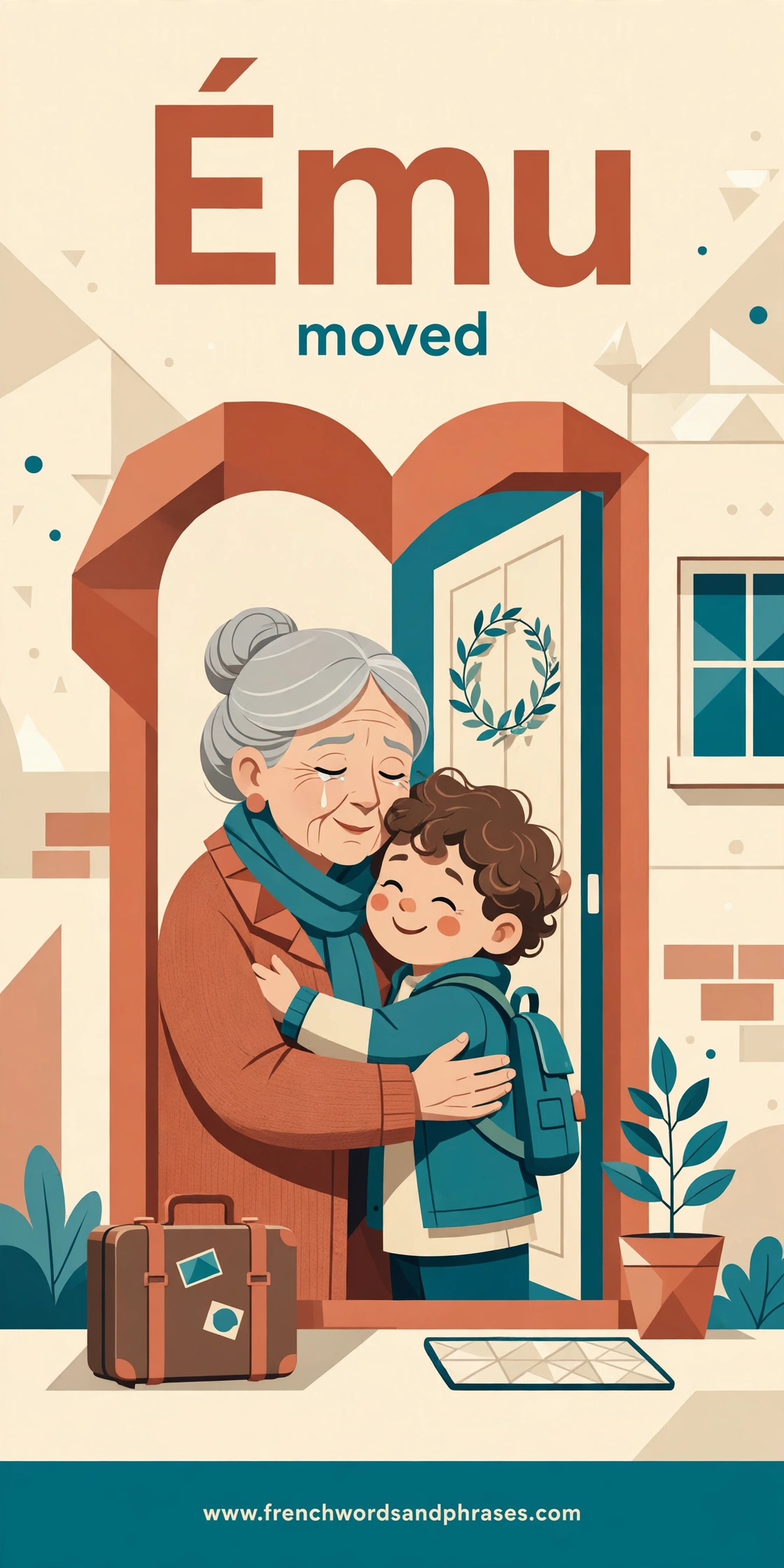
Ému means moved.
A village hall, a choir of schoolchildren singing an old song, and in the third row a white-haired man pressing his lips together and looking at the ceiling the way people do when they do not want to cry in public. The song was his mother’s favourite. He is not sad. He is ému.
In this guide, you’ll learn what ému means in English, how its feminine keeps the accent aigu, why it is followed by par, and how it differs from its loud cousin excité. Explore French examples, English translations, and practice quizzes.
Understanding the French Adjective Ému
Ému is a French adjective of quality — the adjective of the touched heart. It is the past participle of émouvoir, to move emotionally, and it agrees in the regular way: ému, émue, émus, émues — the accent aigu on the é never leaves.
It means moved — touched emotionally, stirred by something tender, sad or beautiful. It describes audiences (le public ému, the moved audience), voices that tremble (une voix émue, a voice full of emotion) and anyone caught by a memory. Ému is the quiet tear at a wedding and at a farewell alike: feeling that has been reached, not shaken.
Type: Adjective of quality — feelings and emotion
Answers the question: What is he or she like? — moved
Changes form: Yes — ému, émue, émus, émues
Feminine: émue
English equivalents: Moved; touched; stirred.
One important usage detail: ému lives after être — il est ému — and the cause follows with par: émue par ses paroles (moved by his words). For the strongest form, French adds a beautiful measure: ému aux larmes, moved to tears.
Experience the Word
Ému is the adjective of the trembling voice and the eyes turned politely to the ceiling — emotion arriving quietly and completely.
Imagine a bride’s father standing to make his speech. He has written three lines on a card. He reads the first, looks up at his daughter, and the other two lines have to wait a full minute while the room pretends to study the tablecloth.
You have not just described sadness or joy. You have described a heart that has been reached.
How to Use Ému in French: Complete Guide
Let’s explore how ému works in French, beginning with the whole word on one card.
Ému at a Glance
Before the details, here is the whole word on one card.
The Whole Word on One Card
Meaning, type, position and forms — ému in four lines.
| Point | Ému |
|---|---|
| Meaning | moved |
| Type | adjective of quality — feelings and emotion |
| Usual position | after être — elle est émue par la chanson |
| Form | ému / émue / émus / émues |
Example
Elle est émue par la chanson.
She is moved by the song.
The Four Forms of Ému
Ému agrees with the person who is moved. The feminine adds an e, the plurals add an s — and the accent aigu stays on the é in every single form.
| Form | Ému | Example |
|---|---|---|
| Masculine singular | ému | un homme ému — a moved man |
| Feminine singular | émue | une femme émue — a moved woman |
| Masculine plural | émus | des spectateurs émus — moved spectators |
| Feminine plural | émues | des spectatrices émues — moved spectators |
Example
Il est ému et elle est émue par le même discours.
He is moved and she is moved by the same speech.
Quick Quiz 1
Which form of ému goes with femme (feminine)?
Reveal the answer
émue
Une femme émue.
A moved woman.
Émue: The Feminine Keeps the Accent Aigu
The feminine of ému is formed by adding an e — and the é keeps its accent aigu throughout the family. Ému and émue sound exactly alike; only the spelling changes.
| Situation | Example |
|---|---|
| The rule | just add -e — ému → émue |
| The accent | the accent aigu stays — émue, émus, émues |
| The sound | ému and émue sound exactly the same: /emy/ |
| Feminine plural | émues — des mères émues |
Example
La mariée était émue en lisant la lettre de sa grand-mère.
The bride was moved as she read her grandmother’s letter.
Where Ému Goes: After Être, with Par for the Cause
Ému follows être and the verbs of feeling, and what did the moving follows behind with par — the song, the words, the gesture.
| Pattern | Example |
|---|---|
| After être | il est ému — he is moved |
| With par (the cause) | émue par ses paroles — moved by his words |
| With aux larmes | ému aux larmes — moved to tears |
| Before the noun | un ému public — not in everyday French |
Example
Le public est ému par la fin du film.
The audience is moved by the end of the film.
Quick Quiz 2
What does ému aux larmes mean?
Reveal the answer
Moved to tears
Il était ému aux larmes.
He was moved to tears.
More Moved: Comparing with Ému
Ému compares the regular way, with plus, moins and aussi — and très ému and profondément ému do the everyday deepening.
| Degree | Example |
|---|---|
| As moved as | aussi ému que — as moved as |
| More moved | plus ému — more moved |
| Less moved | moins ému — less moved |
| The most moved (masc.) | le plus ému — le plus ému des invités |
| The most moved (fem.) | la plus émue — la plus émue des invitées |
Example
Elle est plus émue que lui, ses yeux brillent.
She is more moved than him, her eyes are shining.
Everyday Expressions with Ému
Ému belongs to ceremonies and reunions — weddings, farewells, homecomings — wherever feeling is allowed to show.
| Expression | In English |
|---|---|
| ému aux larmes | moved to tears |
| une voix émue | a voice full of emotion, a trembling voice |
| un public ému | a moved audience |
| profondément ému | deeply moved |
| ému de + infinitive | moved to do something — ému de la retrouver, moved to see her again |
| un silence ému | a moved, emotional silence |
Example
D’une voix émue, il a remercié toute sa famille.
In a voice full of emotion, he thanked his whole family.
Quick Quiz 3
What does une voix émue mean?
Reveal the answer
A voice full of emotion
Elle a répondu d’une voix émue.
She answered in a voice full of emotion.
Ému and Its Neighbours
Ému shares its tender field with touché, its exact twin; bouleversé is the same feeling after an earthquake, and indifférent is its absence.
| French | In English |
|---|---|
| touché | touched — the closest synonym |
| bouleversé | overwhelmed, shaken — much stronger |
| attendri | softened, melted — of hearts growing tender |
| ému | moved — the balanced middle of the scale |
| excité | excited — emotion turned loud and eager, a different colour |
| indifférent | indifferent — the opposite: unmoved |
Example
Il était touché, presque bouleversé, par cet accueil.
He was touched, almost overwhelmed, by this welcome.
Watch Out: The Traps Around Ému
The traps here are the travelling accent, and the verb émouvoir, whose present tense likes to surprise learners.
| Trap | The truth |
|---|---|
| The accent | émue keeps the accent aigu — never write ’emue’ |
| émouvoir | the verb is émouvoir — il émeut, ils émeuvent; its past participle is ému |
| English ‘moved house’ | a false trail: ému is emotional only — moving house is déménager |
| Agreement | une spectatrice émue, with the e — the feeling agrees |
Example
Les spectatrices sont émues par la pièce.
The women in the audience are moved by the play.
Quick Quiz 4
Does ému keep its accent aigu in the feminine?
Reveal the answer
Yes
Émue, émus, émues — the é never loses its accent.
A moved woman — une femme émue.
Ému in Everyday French: Real-Life Examples
Now that you know the word, let’s see how ému appears in everyday French.
Example 1 — At the cinema
Le public est ému par la fin du film.
The audience is moved by the end of the film.
Example 2 — A wedding
Le père de la mariée est ému aux larmes.
The bride’s father is moved to tears.
Example 3 — A reunion
Elle est émue de retrouver son amie d’enfance.
She is moved to see her childhood friend again.
Example 4 — A speech
D’une voix émue, il remercie ses parents.
In a voice full of emotion, he thanks his parents.
Example 5 — Music
Nous sommes émus par cette vieille chanson.
We are moved by this old song.
Example 6 — A letter
Elle a lu la lettre, très émue.
She read the letter, deeply moved.
Beyond Translation: The Meaning of Ému
English says moved for the meaning of ému — and for once the two languages agree on the picture: an emotion is a movement, something that shifts the heart from where it was sitting.
Ému is the moment the heart changes place.
French trusts the word with its biggest occasions — the wedding speech, the soldier’s homecoming, the last song of the evening — because ému never exaggerates: it is feeling at exactly the size of the heart that holds it.
How to Remember the French Adjective Ému
Remember it this way: Ému is the moved adjective — the touched heart, regular in its forms, keeping its accent aigu everywhere, and followed by par for the cause.
- You keep the accent in every form — ému, émue, émus, émues.
- You name the cause with par — ému par la chanson, émue par ses paroles.
- You measure the strongest form in tears — ému aux larmes.
The key idea is ému means moved, keeps its accent aigu in émue, and takes par for the cause.
Test Your Knowledge of Ému
Let’s see how much you’ve learned. Try answering these questions before revealing the answers.
Question 1
What does ému mean?
Reveal the answer
Moved — touched emotionally by something tender, sad or beautiful.
Question 2
What is the feminine of ému?
Reveal the answer
émue — add an e, and the accent aigu stays.
Question 3
Translate: moved to tears.
Reveal the answer
Ému aux larmes.
Question 4
Complete the sentence:
Elle est ______ par ses paroles.
Reveal the answer
émue
Elle est émue par ses paroles.
She is moved by his words.
Question 5
Which verb is ému the participle of?
Reveal the answer
émouvoir — to move emotionally.
Your Final Challenge
Can You Use It?
How would you say this in French?
“The audience is moved by the end of the play.”
Reveal the answer
Le public est ému par la fin de la pièce.
The audience is moved by the end of the play.
A little French. A little curiosity. A richer everyday life.
LEARN FRENCH ONE WORD AT A TIME