A French Word to Live By
Translate Angle to English
/ɑ̃ɡl/
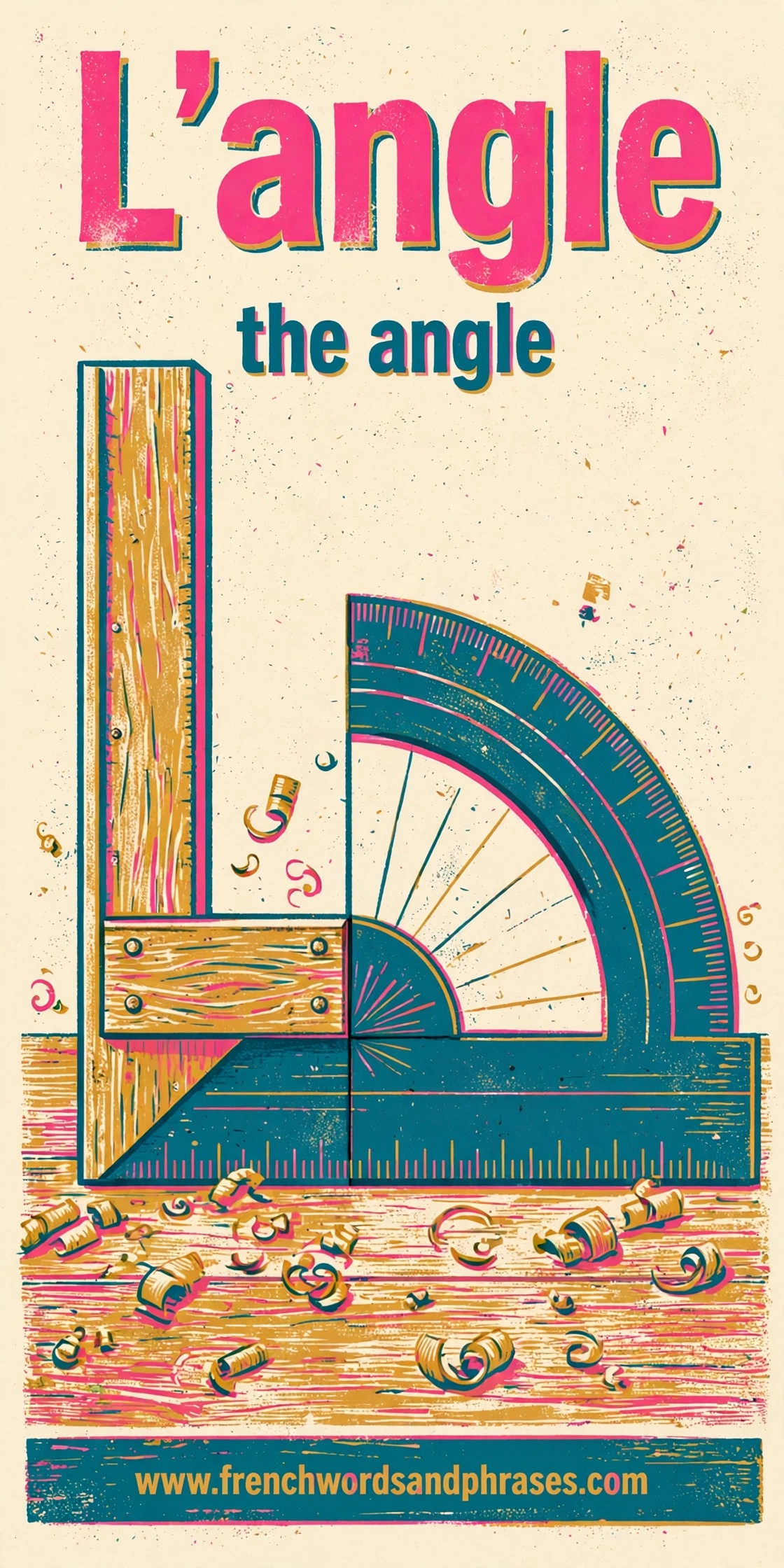
L’angle means the angle.
The driving instructor leans forward: « Attention à l’angle mort ! » — the hidden corner of the mirror where a cyclist can disappear: l’angle, the angle you cannot see.
In this guide, you’ll learn what angle means in English, how to use it with its articles, how to form its plural, and how it appears in everyday French. Explore French examples, English translations, and practice quizzes.
Understanding the French Noun Angle
Angle is a masculine French noun that begins with a vowel, so le shrinks to l’: l’angle, but always un angle. It names the corner where two lines meet — in geometry, in a room, and at the crossing of two streets.
It means the angle — the space between two meeting lines, measured in degrees: un angle droit is a right angle. In everyday life it is also a corner: à l’angle de la rue, on the corner of the street, and sous cet angle, from that angle, that point of view.
Gender: Masculine
Definite article: l’ — l’angle (the angle) — le shrinks before the vowel
Indefinite article: un — un angle (an angle)
Plural: les angles
English equivalents: The angle; a corner (of a street, of a room).
One important usage detail: because angle starts with a vowel sound, several little words change shape before it — le becomes l’ and ce becomes cet: cet angle, this angle. The noun itself stays firmly masculine: un angle droit.
Experience the Word
Angle is where French geometry meets French streets. It measures the triangle, hides the cyclist from the driver, and gives its name to the café on the corner where everyone meets.
Imagine the maths class: the protractor turns, the pencil marks ninety degrees, and the first perfect angle droit appears — the corner every wall in the world is built on.
You have not just measured a shape. You have found the corner where lines, streets and opinions all meet.
How to Use Angle in French: Complete Guide
Let’s explore how angle works in French, beginning with its articles — and watch le turn into l’ before its opening vowel.
Angle with the Definite Article (L’, Les)
Angle begins with a vowel, so le becomes l’ — l’angle — while the plural is simply les angles.
| Form | French |
|---|---|
| Singular | l’angle |
| Plural | les angles |
Example
L’angle de la rue est dangereux pour les piétons.
The street corner is dangerous for pedestrians.
Angle with the Indefinite Article (Un, Des)
The indefinite article does not shrink: un angle, never shortened, whatever follows.
| Form | French |
|---|---|
| Singular | un angle |
| Plural | des angles |
Example
Un angle droit mesure quatre-vingt-dix degrés.
A right angle measures ninety degrees.
Around the Angle: Degrees and Corners
The vocabulary of the geometry lesson and the street corner.
| French | In English |
|---|---|
| le degré | the degree |
| le coin | the corner (everyday word) |
| droit | right, straight — un angle droit |
| aigu | acute — un angle aigu |
| obtus | obtuse — un angle obtus |
| mesurer | to measure |
Example
Mesure l’angle avec un rapporteur.
Measure the angle with a protractor.
Quick Quiz 1
Complete the sentence:
Un ______ droit fait quatre-vingt-dix degrés.
Reveal the answer
angle
Un angle droit fait quatre-vingt-dix degrés.
A right angle makes ninety degrees.
The Plural of Angle
Angle adds an -s in the plural — les angles of a triangle, of a room, of a table.
| Number | French |
|---|---|
| Singular | l’angle |
| Plural | les angles |
Example
Un triangle a trois angles et trois côtés.
A triangle has three angles and three sides.
Angle with Possessive Adjectives (Mon, Ton, Son…)
Before a vowel, ma, ta, sa become mon, ton, son — so angle takes mon, ton, son even in careful speech.
| Owner | French |
|---|---|
| my | mon angle |
| your (tu) | ton angle |
| his / her | son angle |
| our | notre angle |
| your (vous) | votre angle |
| their | leur angle |
Example
Son angle mort cache les cyclistes au carrefour.
His blind spot hides the cyclists at the junction.
Quick Quiz 2
Complete the sentence:
______ angle mort cache les vélos. (his)
Reveal the answer
Son
Son angle mort cache les vélos.
His blind spot hides the bikes — son, because angle starts with a vowel.
Angle with Demonstrative Adjectives (Cet, Ces)
Before a vowel, ce becomes cet: cet angle, this angle.
| Form | French |
|---|---|
| Singular | cet angle |
| Plural | ces angles |
Example
Cet angle de la pièce reçoit la lumière du matin.
This corner of the room catches the morning light.
Angle with Adjectives
The classic angles of the geometry book — droit, aigu, obtus and the driver’s mort.
| Adjective | With Angle |
|---|---|
| droit (right) | un angle droit |
| aigu (acute) | un angle aigu |
| obtus (obtuse) | un angle obtus |
| mort (dead — blind) | l’angle mort |
| de vue (of view) | un angle de vue |
Example
Attention à l’angle mort quand tu changes de voie.
Watch your blind spot when you change lanes.
Quick Quiz 3
Why do we say « cet angle » and not « ce angle »?
Reveal the answer
Because angle begins with a vowel — ce becomes cet before a vowel sound.
Regarde cet angle de la photo.
Look at this angle of the photo.
Everyday Expressions with Angle
Blind spots, viewpoints and softened disagreements — the angle phrases of daily life.
| Expression | In English |
|---|---|
| l’angle mort | the blind spot |
| sous cet angle | from that angle, from that point of view |
| à l’angle de la rue | on the corner of the street |
| l’angle de vue | the viewing angle, the viewpoint |
| arrondir les angles | to smooth things over, to soften disagreements |
| la pierre angulaire | the cornerstone (from the family of angle) |
Example
Le café se trouve à l’angle de la rue principale.
The café stands on the corner of the main street.
Words from the Same Family as Angle
Cornerstones and angular faces — the words that travel with angle.
| French | In English |
|---|---|
| angulaire | angular |
| la pierre angulaire | the cornerstone |
| anguleux | angular (a face, a shape) |
| le triangle | the triangle |
| le rectangle | the rectangle |
| le coin | the corner (the everyday word) |
Example
La pierre angulaire de l’édifice est posée avec cérémonie.
The cornerstone of the building is laid with ceremony.
Quick Quiz 4
How do you say « blind spot » in French?
Reveal the answer
L’angle mort — literally, the dead angle.
Vérifie ton angle mort avant de tourner.
Check your blind spot before turning.
Angle in Everyday French: Real-Life Examples
Now that you know the word, let’s see how angle appears in everyday French.
Example 1 — Geometry
Mesure l’angle avec un rapporteur.
Measure the angle with a protractor.
Example 2 — A corner
Le café se trouve à l’angle de la rue.
The café is on the corner of the street.
Example 3 — Driving
Vérifie ton angle mort avant de tourner.
Check your blind spot before turning.
Example 4 — A photo
Sous cet angle, la tour semble penchée.
From this angle, the tower looks as if it is leaning.
Example 5 — A room
Elle pose la plante dans l’angle de la pièce.
She puts the plant in the corner of the room.
Example 6 — Opinion
Vu sous cet angle, la décision est logique.
Seen from that angle, the decision makes sense.
Beyond Translation: The Meaning of Angle
Every French driver knows l’angle mort before they ever sit a geometry exam — the dead angle is a matter of safety, tested and re-tested. And every French diplomat knows the softer art the same word inspires: arrondir les angles, rounding off the angles between people.
Angle is where measurement meets tact.
It evokes protractors and Parisian corner cafés, the angle de vue of the photographer, and the cornerstone — la pierre angulaire — on which the whole building, and the whole argument, depends.
How to Remember the French Noun Angle
Remember it this way: Angle is the angle and the corner — and it hides in your blind spot: l’angle mort.
- You measure it — un angle droit, ninety degrees.
- You meet at it — à l’angle de la rue.
- You check it — l’angle mort, the blind spot.
The key idea is l’angle — right angles and blind spots.
Test Your Knowledge of Angle
Let’s see how much you’ve learned. Try answering these questions before revealing the answers.
Question 1
Is angle masculine or feminine?
Reveal the answer
Masculine — l’angle, un angle; le becomes l’ before the vowel.
Question 2
Translate: The café is on the corner of the street.
Reveal the answer
Le café est à l’angle de la rue.
Question 3
What is « un angle droit »?
Reveal the answer
A right angle — ninety degrees.
Question 4
Complete the sentence:
______ angle de la pièce est sombre. (this)
Reveal the answer
Cet
Cet angle de la pièce est sombre.
This corner of the room is dark — ce becomes cet before a vowel.
Question 5
What does « arrondir les angles » mean?
Reveal the answer
To smooth things over — literally, to round off the angles between people.
Your Final Challenge
Can You Use It?
How would you say this in French?
“The café stands on the corner of the street.”
Reveal the answer
Le café se trouve à l’angle de la rue.
The café stands on the corner of the street.
A little French. A little curiosity. A richer everyday life.
LEARN FRENCH ONE WORD AT A TIME