A French Word to Live By
Translate Anglais to English
/ɑ̃.ɡlɛ/
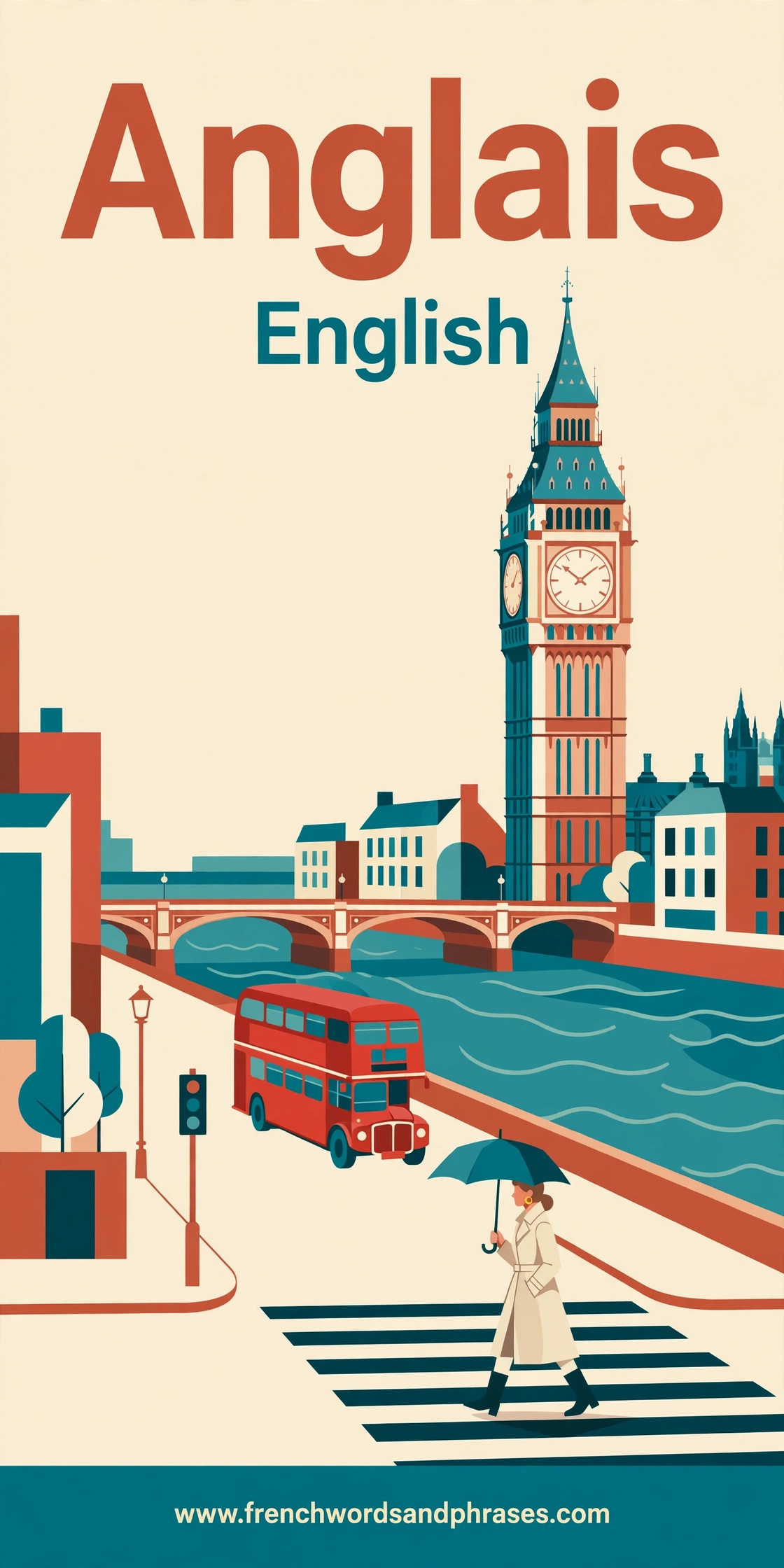
Anglais means English.
A bookshop in Paris, a rainy afternoon, and a student sounding out her very first English sentence at the counter — ‘Do you speak English?’ — asked, of course, in French: « Vous parlez anglais ? » The word anglais is the bridge between her language and yours.
In this guide, you’ll learn what anglais means in English, how its feminine anglaise is formed, where it stands in the sentence, and when French gives the word a capital letter. Explore French examples, English translations, and practice quizzes.
Understanding the French Adjective Anglais
Anglais is a French nationality adjective — masculine anglais, feminine anglaise. Like français, it belongs to the -ais family: the feminine replaces the silent ending with -aise. In the plural, the masculine does not change (anglais) while the feminine adds an s (anglaises).
It means English — of England, its people, its language and its culture. It describes people (un écrivain anglais, an English writer), things (un jardin anglais, an English garden) and institutions (la littérature anglaise, English literature). With a capital letter it becomes a person — un Anglais — and in lower case, l’anglais, it is the English language itself.
Type: Nationality adjective
Masculine: anglais
Feminine: anglaise
English equivalents: English.
One important usage detail: the capital letter. An English person takes one — un Anglais, une Anglaise — but the adjective and the language never do: un film anglais, elle parle anglais. Like most adjectives, anglais also stands after the noun it describes.
Experience the Word
Anglais is the adjective of two languages shaking hands — the word a French learner reaches for when talking about your language, and the one you reach for when talking about theirs.
Imagine a village cricket match watched by a French exchange student, who writes home that the Anglais play a strange game with tea in the middle. Anglais, in her letter, is a whole country summed up in seven letters.
You have not just named a nationality. You have named the language this page is written in — from the other side of the Channel.
How to Use Anglais in French: Complete Guide
Let’s explore how anglais works in French, beginning with the whole word on one card.
Anglais at a Glance
Before the details, here is the whole word on one card.
The Whole Word on One Card
Meaning, type, position and forms — anglais in four lines.
| Point | Anglais |
|---|---|
| Meaning | English |
| Type | nationality adjective |
| Usual position | after the noun — un film anglais |
| Forms | anglais / anglaise / anglais / anglaises |
Example
C’est un film anglais.
It’s an English film.
The Four Forms of Anglais
Nationality adjectives agree like other adjectives: here are the four forms of anglais, with the feminine waking up the final letter.
| Form | Anglais | Example |
|---|---|---|
| Masculine singular | anglais | un écrivain anglais — an English writer |
| Feminine singular | anglaise | une écrivaine anglaise — an English writer (female) |
| Masculine plural | anglais | des écrivains anglais — English writers |
| Feminine plural | anglaises | des écrivaines anglaises — English writers (female) |
Example
Un écrivain anglais et une écrivaine anglaise signent leurs livres.
An English writer and an English writer (female) are signing their books.
Quick Quiz 1
What is the feminine of anglais?
Reveal the answer
anglaise
Une femme anglaise, des traditions anglaises.
An English woman, English traditions.
The Feminine of Anglais: -ais Becomes -aise
Anglais belongs to the -ais family, exactly like français: the feminine replaces the silent ending with -aise, and suddenly the final letter is heard.
| Situation | Example |
|---|---|
| Masculine | anglais — the final s is silent |
| Feminine | anglaise — the ending is pronounced, like a z |
| Masculine plural | anglais — no change at all |
| Feminine plural | anglaises — add s |
Example
Elle est anglaise et elle habite à Londres.
She is English and she lives in London.
Where Anglais Goes: After the Noun
Anglais follows the noun it describes, like most French adjectives, and it sits comfortably after être. Adverbs slide in front of it without moving it.
| Pattern | Example |
|---|---|
| After the noun | un jardin anglais — an English garden |
| After être | elle est anglaise — she is English |
| With an adverb | très anglais — very English |
| Before the noun | un anglais film — not in everyday French |
Example
Ce thé est très anglais.
This tea is very English.
Quick Quiz 2
How do you say ‘an English garden’ — un anglais jardin or un jardin anglais?
Reveal the answer
un jardin anglais
Anglais stands after the noun.
An English garden.
More English: Comparing with Anglais
Anglais compares the regular way, with plus, moins and aussi — handy for the eternal debate about which village is plus anglais, more English, than the other.
| Degree | Example |
|---|---|
| As English as | aussi anglais que — as English as |
| More English | plus anglais — more English |
| Less English | moins anglais — less English |
| The most English (masc.) | le plus anglais — le plus anglais des villages |
| The most English (fem.) | la plus anglaise — la plus anglaise des villes |
Example
Ce village est plus anglais que l’autre.
This village is more English than the other one.
Everyday Expressions with Anglais
Anglais does triple duty in French: adjective, person and language. The capital letter tells you which job it is doing.
| Expression | In English |
|---|---|
| un Anglais / une Anglaise | an Englishman / an Englishwoman — capital letter for the person |
| l’anglais | the English language |
| parler anglais | to speak English |
| à l’anglaise | in the English way, English-style |
| le petit-déjeuner anglais | a full English breakfast |
| une clé anglaise | an adjustable spanner — French names the tool after the English! |
Example
Elle parle anglais avec un Anglais de Londres.
She speaks English with an Englishman from London.
Quick Quiz 3
What does l’anglais mean, written in lower case with l’?
Reveal the answer
The English language
Je parle anglais et j’apprends le français.
I speak English and I’m learning French.
Anglais and Its Neighbours
Anglais lives among the nationalities of the British Isles and France’s other close neighbours — and note that English is not the same as British.
| French | In English |
|---|---|
| écossais | Scottish — un Écossais, une Écossaise |
| irlandais | Irish — un Irlandais, une Irlandaise |
| gallois | Welsh — un Gallois, une Galloise |
| américain | American — un Américain, une Américaine |
| français | French — un Français, une Française |
| allemand | German — un Allemand, une Allemande |
Example
Un Écossais et un Anglais regardent le match ensemble.
A Scotsman and an Englishman are watching the match together.
Watch Out: The Traps Around Anglais
The traps here are the capital letter, the invented feminine, and confusing English with British.
| Trap | The truth |
|---|---|
| The capital letter | people take one — un Anglais; the adjective and the language never do |
| The feminine | anglaise — never ‘anglaine’ |
| English or British? | anglais means English (England); British is britannique — a Scotsman is écossais, not anglais |
| The masculine plural | anglais — the plural looks exactly like the singular |
Example
Un Anglais parle anglais.
An Englishman speaks English.
Quick Quiz 4
Which is correct for an English woman — une Anglais or une Anglaise?
Reveal the answer
une Anglaise
A capital letter for the person, and the feminine form anglaise.
An Englishwoman.
Anglais in Everyday French: Real-Life Examples
Now that you know the word, let’s see how anglais appears in everyday French.
Example 1 — A neighbour
Ma voisine est anglaise, elle vient de Londres.
My neighbour is English, she comes from London.
Example 2 — At school
Il apprend l’anglais à l’école.
He is learning English at school.
Example 3 — A film
Nous avons regardé un film anglais hier soir.
We watched an English film last night.
Example 4 — Food
Le petit-déjeuner anglais est très copieux.
The English breakfast is very filling.
Example 5 — Travel
Un touriste anglais visite la cathédrale.
An English tourist is visiting the cathedral.
Example 6 — Gardens
Ces jardins anglais sont magnifiques au printemps.
These English gardens are magnificent in spring.
Beyond Translation: The Meaning of Anglais
English needs separate words where French uses one: English the adjective, an Englishman the person, English the language are all anglais — only the capital letter and the article change.
Anglais is the mirror word of français.
Between them, the two adjectives carry a thousand years of rivalry and friendship across the Channel — and between them, they are the two words every learner of French uses most.
How to Remember the French Adjective Anglais
Remember it this way: Anglais changes its ending for women, keeps its s in the masculine plural, and only wears a capital letter when it names a person.
- You see two singular forms — un homme anglais, une femme anglaise.
- You keep the masculine plural unchanged — des hommes anglais, des femmes anglaises.
- You give the person a capital letter — un Anglais — but never the language: l’anglais.
The key idea is anglais / anglaise — and a capital letter only for the person.
Test Your Knowledge of Anglais
Let’s see how much you’ve learned. Try answering these questions before revealing the answers.
Question 1
What does anglais mean?
Reveal the answer
English — of England, its people and its language.
Question 2
What is the feminine of anglais?
Reveal the answer
anglaise — the -ais ending becomes -aise.
Question 3
Translate: an English film.
Reveal the answer
Un film anglais.
Question 4
Complete the sentence:
Elle est ______ . (English)
Reveal the answer
anglaise
Elle est anglaise.
She is English.
Question 5
How do you say ‘an Englishman’?
Reveal the answer
Un Anglais — with a capital letter, because it names a person.
Your Final Challenge
Can You Use It?
How would you say this in French?
“He is English, and he teaches English in an English town.”
Reveal the answer
Il est anglais, et il enseigne l’anglais dans une ville anglaise.
He is English, and he teaches English in an English town.
A little French. A little curiosity. A richer everyday life.
LEARN FRENCH ONE WORD AT A TIME