A French Word to Live By
How to Conjugate Chérir in French
/ʃe.ʁiʁ/
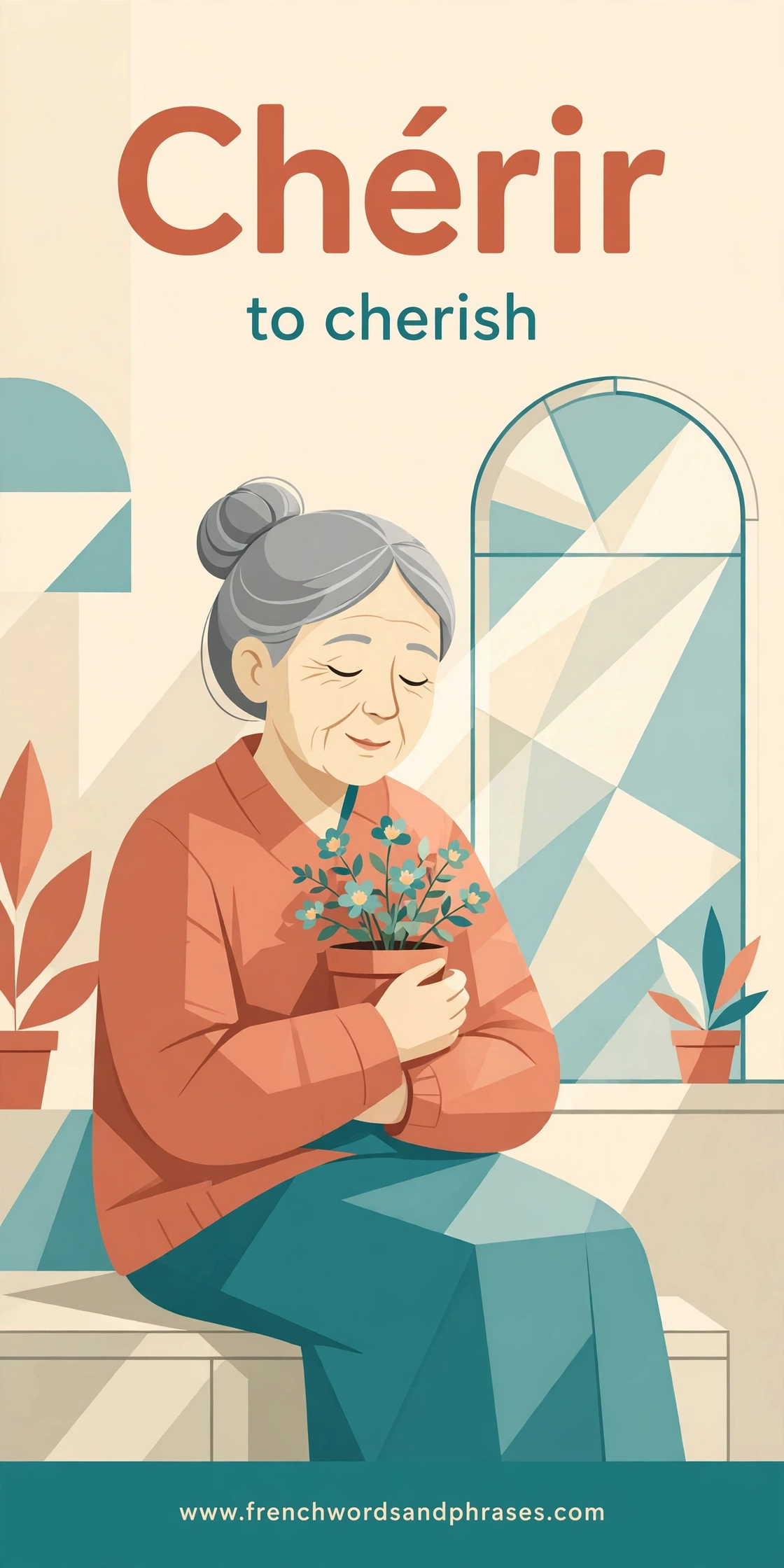
Chérir means to cherish — to hold a person, a memory or a hope dear, and to guard it tenderly.
A grandmother’s arms around a grandchild, a soldier’s photograph kept in a breast pocket through a whole war, an old man’s hope of seeing the sea once more — chérir is the verb of tender keeping: what the heart holds dearest, it chérit.
In this guide, you’ll learn how to conjugate chérir in all the major French tenses and moods. Explore complete conjugation tables, French examples, English translations, and practice quizzes.
Understanding the French Verb Chérir
Chérir is a regular French verb belonging to the second group of verbs, those ending in -ir.
It means to cherish. It is warmer and more deliberate than aimer: aimer is to love or like, chérir is to hold dear and protect — one chérit children, grandparents, memories, freedoms and hopes. It belongs to a slightly elevated, heartfelt register, at home in letters, speeches and family talk, and it is the standard verb for treasuring what time might take away.
Verb classification: Second group (-ir)
Auxiliary verb: Avoir
Past participle: chéri
Present participle: chérissant
English equivalents: To cherish, to hold dear, to treasure; chérir ses enfants — to cherish one’s children; chérir un souvenir — to treasure a memory; chérir l’espoir de partir — to cherish the hope of leaving; un souvenir chéri — a treasured memory; mon chéri, ma chérie — my darling.
One important detail: chérir is a completely regular -ir verb of the finir family — je chéris, tu chéris, il chérit, nous chérissons, vous chérissez, ils chérissent, past participle chéri. The é never moves and the stem grows its -iss- in the plural exactly like finir. That participle leads a second life as a word of tenderness: un souvenir chéri is a treasured memory, and mon chéri / ma chérie — my darling — is how French addresses the person it chérit most.
Experience the Word
Chérir is love with its arms around something — not just feeling affection, but keeping, guarding and treasuring.
Imagine an old fisherman in Brittany who has kept, for sixty years, the chipped cup his wife drank from on their wedding morning. He owns boats, nets, a house — but ask him what he chérit, and he takes down the cup, holding it in both hands like something alive.
The cup is worth nothing at market. Chéri, it is beyond price — guarded by both hands and a whole life.
How to Conjugate Chérir: Complete French Conjugation Guide
Let’s explore every major conjugation of chérir, beginning with the indicative mood.
How to Conjugate Chérir in the Indicative Mood
The indicative mood is used to express facts, observations, actions, and events.
How to Conjugate Chérir in the Present Tense (Présent)
Used for actions happening now, habitual actions, and general truths.
| Subject | Conjugation |
|---|---|
| je | chéris |
| tu | chéris |
| il / elle | chérit |
| nous | chérissons |
| vous | chérissez |
| ils / elles | chérissent |
Example
Elle chérit ses petits-enfants plus que tout au monde.
She cherishes her grandchildren more than anything in the world.
Quick Quiz 1
Complete the sentence:
Nous ______ nos souvenirs d’enfance.
Reveal the answer
chérissons
Nous chérissons nos souvenirs d’enfance.
We cherish our childhood memories.
How to Conjugate Chérir in the Passé Composé
Used for completed actions in the past. Chérir takes the auxiliary verb avoir.
| Subject | Conjugation |
|---|---|
| j’ | ai chéri |
| tu | as chéri |
| il / elle | a chéri |
| nous | avons chéri |
| vous | avez chéri |
| ils / elles | ont chéri |
Example
Il a chéri ce vieux violon toute sa vie.
He cherished this old violin all his life.
How to Conjugate Chérir in the Imparfait (Imperfect Tense)
Used for habitual past actions, descriptions, and ongoing situations in the past.
| Subject | Conjugation |
|---|---|
| je | chérissais |
| tu | chérissais |
| il / elle | chérissait |
| nous | chérissions |
| vous | chérissiez |
| ils / elles | chérissaient |
Example
Nous chérissions ces étés à la mer, libres et sans montre.
We used to cherish those summers by the sea, free and without a watch.
Quick Quiz 2
Choose the correct form:
He cherished this violin all his life.
Il ______ ce violon toute sa vie. (a chéri / est chéri)
Reveal the answer
a chéri
Il a chéri ce violon toute sa vie.
Chérir takes avoir.
How to Conjugate Chérir in the Plus-que-parfait
Used to describe an action that had already been completed before another past event.
| Subject | Conjugation |
|---|---|
| j’ | avais chéri |
| tu | avais chéri |
| il / elle | avait chéri |
| nous | avions chéri |
| vous | aviez chéri |
| ils / elles | avaient chéri |
Example
Elle avait chéri l’espoir de le revoir un jour.
She had cherished the hope of seeing him again one day.
How to Conjugate Chérir in the Passé Simple
Primarily used in formal writing, literature, and historical narratives. It is rarely used in everyday conversation.
| Subject | Conjugation |
|---|---|
| je | chéris |
| tu | chéris |
| il / elle | chérit |
| nous | chérîmes |
| vous | chérîtes |
| ils / elles | chérirent |
Example
Les moines chérirent le silence de leur cloître.
The monks cherished the silence of their cloister.
How to Conjugate Chérir in the Passé Antérieur
A literary tense used to express an action completed immediately before another past action, generally in the passé simple.
| Subject | Conjugation |
|---|---|
| j’ | eus chéri |
| tu | eus chéri |
| il / elle | eut chéri |
| nous | eûmes chéri |
| vous | eûtes chéri |
| ils / elles | eurent chéri |
Example
Quand il eut chéri cet espoir dix ans, la lettre arriva enfin.
When he had cherished this hope for ten years, the letter finally arrived.
How to Conjugate Chérir in the Future Tense (Futur Simple)
Used to describe actions that will take place in the future.
| Subject | Conjugation |
|---|---|
| je | chérirai |
| tu | chériras |
| il / elle | chérira |
| nous | chérirons |
| vous | chérirez |
| ils / elles | chériront |
Example
Tu chériras ces souvenirs quand tu seras loin d’ici.
You will cherish these memories when you are far from here.
How to Conjugate Chérir in the Futur Antérieur (Future Perfect)
Used for an action that will have been completed before a particular point in the future.
| Subject | Conjugation |
|---|---|
| j’ | aurai chéri |
| tu | auras chéri |
| il / elle | aura chéri |
| nous | aurons chéri |
| vous | aurez chéri |
| ils / elles | auront chéri |
Example
À la fin de sa vie, elle aura chéri chaque instant passé dans cette maison.
By the end of her life, she will have cherished every moment spent in this house.
How to Conjugate Chérir in the Near Future (Futur Proche)
Used to describe something that is going to happen soon. Formed with aller + infinitive.
| Subject | Conjugation |
|---|---|
| je | vais chérir |
| tu | vas chérir |
| il / elle | va chérir |
| nous | allons chérir |
| vous | allez chérir |
| ils / elles | vont chérir |
Example
Nous allons chérir ce moment, il ne reviendra pas.
We are going to cherish this moment, it will not come back.
How to Conjugate Chérir in the Conditional Mood
The conditional mood expresses what would happen under certain circumstances. It is also frequently used to make polite requests or express wishes.
How to Conjugate Chérir in the Present Conditional
| Subject | Conjugation |
|---|---|
| je | chérirais |
| tu | chérirais |
| il / elle | chérirait |
| nous | chéririons |
| vous | chéririez |
| ils / elles | chériraient |
Example
Sans sa famille, il chérirait bien peu de choses.
Without his family, he would cherish very few things.
How to Conjugate Chérir in the Past Conditional
| Subject | Conjugation |
|---|---|
| j’ | aurais chéri |
| tu | aurais chéri |
| il / elle | aurait chéri |
| nous | aurions chéri |
| vous | auriez chéri |
| ils / elles | auraient chéri |
Example
Elle aurait chéri ce cadeau si elle l’avait reçu.
She would have cherished this gift if she had received it.
Chérir in the Literary Past Conditional Form
This less common literary form uses the imperfect subjunctive of avoir.
| Subject | Conjugation |
|---|---|
| j’ | eusse chéri |
| tu | eusses chéri |
| il / elle | eût chéri |
| nous | eussions chéri |
| vous | eussiez chéri |
| ils / elles | eussent chéri |
Example
Il eût chéri sa liberté plus que l’or.
He would have cherished his freedom more than gold.
How to Conjugate Chérir in the Subjunctive Mood
The subjunctive is used to express wishes, emotions, doubts, necessity, and uncertainty. It frequently follows expressions such as il faut que (it is necessary that) or bien que (although).
How to Conjugate Chérir in the Present Subjunctive
| Subject | Conjugation |
|---|---|
| que je | chérisse |
| que tu | chérisses |
| qu’il / qu’elle | chérisse |
| que nous | chérissions |
| que vous | chérissiez |
| qu’ils / qu’elles | chérissent |
Example
Il faut que tu chérisses ces moments avec tes parents.
You must cherish these moments with your parents.
Quick Quiz 3
Complete the sentence using the subjunctive:
Il faut que tu ______ ces moments avec tes parents.
Reveal the answer
chérisses
Il faut que tu chérisses ces moments avec tes parents.
You must cherish these moments with your parents.
How to Conjugate Chérir in the Imperfect Subjunctive
A literary tense, rarely encountered in modern spoken French.
| Subject | Conjugation |
|---|---|
| que je | chérisse |
| que tu | chérisses |
| qu’il / qu’elle | chérît |
| que nous | chérissions |
| que vous | chérissiez |
| qu’ils / qu’elles | chérissent |
Example
Je ne croyais pas qu’il chérît autant ses vieux livres.
I did not think he cherished his old books so much.
How to Conjugate Chérir in the Pluperfect Subjunctive
A literary construction used to express an action completed before another past action.
| Subject | Conjugation |
|---|---|
| que j’ | eusse chéri |
| que tu | eusses chéri |
| qu’il / qu’elle | eût chéri |
| que nous | eussions chéri |
| que vous | eussiez chéri |
| qu’ils / qu’elles | eussent chéri |
Example
On sentait qu’elle eût chéri cet enfant de tout son cœur.
One felt that she would have cherished this child with all her heart.
How to Conjugate Chérir in the Past Subjunctive
| Subject | Conjugation |
|---|---|
| que j’ | aie chéri |
| que tu | aies chéri |
| qu’il / qu’elle | ait chéri |
| que nous | ayons chéri |
| que vous | ayez chéri |
| qu’ils / qu’elles | aient chéri |
Example
Je suis touché qu’elle ait chéri mon cadeau.
I am touched that she cherished my gift.
How to Conjugate Chérir in the Imperative
The imperative is used to give commands, instructions, invitations, or suggestions. Subject pronouns are omitted.
How to Conjugate Chérir in the Present Imperative
| Person | Conjugation |
|---|---|
| (tu) | chéris |
| (nous) | chérissons |
| (vous) | chérissez |
Example
Chéris tes amis, ils sont plus rares que tu ne crois !
Cherish your friends, they are rarer than you think!
Quick Quiz 4
How would you say Cherish this moment (tu form)?
Reveal the answer
Chéris ce moment !
French Participles of Chérir
Participles are verb forms that can be used in compound tenses and other grammatical constructions.
Present Participle of Chérir
chérissant
En chérissant ses souvenirs, elle garde les absents vivants.
By cherishing her memories, she keeps the absent ones alive.
Past Participle of Chérir
chéri
Chérie de tous, la grand-mère régnait doucement sur la famille.
Cherished by everyone, the grandmother reigned gently over the family.
Chérir in Everyday French: Real-Life Examples
Now that you know the conjugations, let’s see how chérir appears in everyday French.
Example 1 — Present
Elle chérit ses petits-enfants.
She cherishes her grandchildren.
Example 2 — Passé composé
Il a chéri ce violon toute sa vie.
He cherished this violin all his life.
Example 3 — Imparfait
Nous chérissions ces étés à la mer.
We used to cherish those summers by the sea.
Example 4 — Future
Tu chériras ces souvenirs.
You will cherish these memories.
Example 5 — Conditional
Je chérirais un tel ami plus que tout.
I would cherish such a friend more than anything.
Example 6 — Imperative
Chérissez vos parents tant qu’ils sont là !
Cherish your parents while they are here!
Beyond Translation: The Meaning of Chérir
Here is a pleasing reversal: English cherish is not a cousin of chérir — it is chérir itself, borrowed from Old French into English centuries ago.
Both languages kept the same tender word.
It is built on cher, dear — from the Latin carus, dear and costly — the same root that gives charité and English charity. What is cher is what costs the heart something; what we chérissons is what we would not sell.
How to Remember the French Verb Chérir
Remember it this way: Chérir is about the chipped wedding cup, held in both hands for sixty years.
- Regular -ir of the finir family: je chéris, nous chérissons — look for the -iss- in the plural.
- Warmer than aimer: you chérissez children, memories, hopes and freedoms — what you hold dear and guard.
- The participle is a term of endearment: mon chéri, ma chérie — my darling; past participle chéri.
The key idea is the chipped wedding cup, held in both hands for sixty years.
Test Your Knowledge of Chérir
Let’s see how much you’ve learned. Try answering these questions before revealing the answers.
Question 1
How is chérir conjugated in the nous form of the present, and which family does it follow?
Reveal the answer
Nous chérissons — it follows finir, the regular second group in -ir.
Question 2
How do you say She cherishes her grandchildren in French?
Reveal the answer
Elle chérit ses petits-enfants.
Question 3
Translate: He cherished this old violin all his life.
Reveal the answer
Il a chéri ce vieux violon toute sa vie.
Question 4
What is the past participle of chérir?
Reveal the answer
Chéri — also used in mon chéri, ma chérie, my darling.
Question 5
Complete the sentence:
Il faut que vous ______ vos parents tant qu’ils sont là.
Reveal the answer
chérissiez
Il faut que vous chérissiez vos parents tant qu’ils sont là.
You must cherish your parents while they are here.
Your Final Challenge
Can You Use It?
How would you say this in French?
She cherishes the old cup from her wedding, and sixty years of love fit inside her two hands.
Reveal the answer
Elle chérit la vieille tasse de son mariage, et soixante ans d’amour tiennent dans ses deux mains.
She cherishes the old cup from her wedding, and sixty years of love fit inside her two hands.
A little French. A little curiosity. A richer everyday life.
LEARN FRENCH ONE WORD AT A TIME