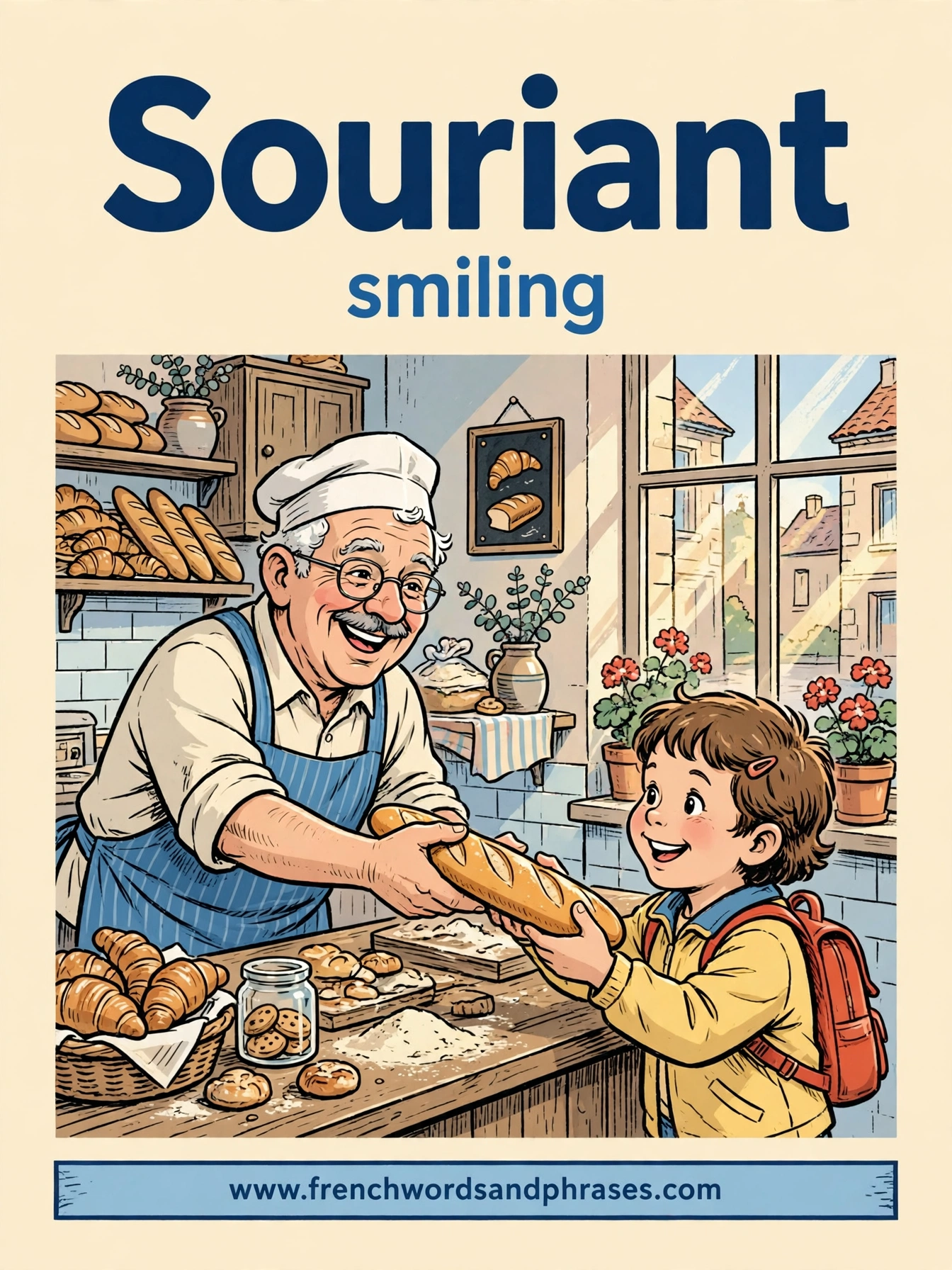
A French Word to Live By
Translate Souriant to English
/suʁjɑ̃/
Souriant means smiling.
The little train pulls into the mountain station, and on the platform a whole family is waving — grandparents, cousins, and one small girl in front, waving with both arms. Every face is turned towards the windows, and every face is doing the same thing. In French, the whole platform is souriant.
In this guide, you’ll learn what souriant means in English, how its feminine is formed, why it stands after the noun, and how it grows out of one of the happiest verbs in French: sourire, to smile. Explore French examples, English translations, and practice quizzes.
Understanding the French Adjective Souriant
Souriant is a French adjective of quality — the adjective of the smile, and the present participle of the verb sourire turned adjective. It belongs to the -ant family: souriant, souriante, souriants, souriantes.
It means smiling — of faces, people and welcomes: un visage souriant, a smiling face; une hôtesse souriante, a smiling hostess; un accueil souriant, a warm, smiling welcome. Wherever a face is lit from inside, souriant is the word that reports it.
Type: Adjective of quality — the smile
Answers the question: What does it look like? — smiling
Changes form: Yes — souriant, souriante, souriants, souriantes
English equivalents: Smiling; beaming; cheerful-looking.
One important usage detail: souriant stands AFTER the noun — un visage souriant. And keep the family apart: le sourire is the smile itself (a noun), sourire is the verb (to smile), and souriant is the adjective that describes the face wearing it.
Experience the Word
Souriant is the adjective of the station platform and the bakery counter — the face that answers before a single word is spoken.
Imagine the night porter of a small hotel, at three in the morning, opening the door to soaked travellers. He is tired to his bones, and still the welcome is souriant. That smile is not a mood. It is a decision he makes every night.
You have not just described an expression. You have described kindness made visible.
How to Use Souriant in French: Complete Guide
Let’s explore how souriant works in French, beginning with the whole word on one card.
Souriant at a Glance
Before the details, here is the whole word on one card.
The Whole Word on One Card
Meaning, type, position and forms — souriant in four lines.
| Point | Souriant |
|---|---|
| Meaning | smiling |
| Type | adjective of quality — the smile |
| Usual position | after the noun — un visage souriant |
| Form | souriant / souriante / souriants / souriantes |
Example
Il a un visage souriant.
He has a smiling face.
The Four Forms of Souriant
Souriant agrees with the noun it describes. The feminine changes -ant into -ante, and suddenly the silent t is heard.
| Form | Souriant | Example |
|---|---|---|
| Masculine singular | souriant | un enfant souriant — a smiling child |
| Feminine singular | souriante | une femme souriante — a smiling woman |
| Masculine plural | souriants | des visages souriants — smiling faces |
| Feminine plural | souriantes | des hôtesses souriantes — smiling hostesses |
Example
Les enfants souriants attendent devant l’école.
The smiling children are waiting in front of the school.
Quick Quiz 1
Which form of souriant goes with femme (feminine)?
Reveal the answer
souriante
Une femme souriante.
A smiling woman.
Souriante: The Feminine in -ante
Adjectives ending in -ant build their feminine in -ante: souriant becomes souriante. The spelling wakes up the final t — souriante is pronounced with a clear /t/ at the end.
| Situation | Example |
|---|---|
| The rule | change -ant to -ante — souriant → souriante |
| The sound | in souriante you hear the t: /suʁjɑ̃t/ |
| Masculine plural | souriants — des enfants souriants |
| Feminine plural | souriantes — des vendeuses souriantes |
Example
La vendeuse souriante nous accueille à la porte.
The smiling saleswoman welcomes us at the door.
Where Souriant Goes: After the Noun
Souriant follows the noun it describes, like most adjectives of appearance, and it appears constantly after être in descriptions of people.
| Pattern | Example |
|---|---|
| After the noun | un visage souriant — a smiling face |
| After être | elle est souriante — she is smiling |
| With an adverb | toujours souriant — always smiling |
| Before the noun | un souriant visage — literary, not everyday French |
Example
Le boulanger souriant connaît tous ses clients.
The smiling baker knows all his customers.
Quick Quiz 2
How do you say ‘a smiling face’ — un souriant visage or un visage souriant?
Reveal the answer
un visage souriant
Souriant stands after the noun in everyday French.
A smiling face.
More Smiling: Comparing with Souriant
Souriant compares the regular way, with plus, moins and aussi — and the superlative agrees as usual: le plus souriant, la plus souriante.
| Degree | Example |
|---|---|
| As smiling as | aussi souriant que — as smiling as |
| More smiling | plus souriant — more smiling |
| Less smiling | moins souriant — less smiling |
| The most smiling (masc.) | le plus souriant — le plus souriant des enfants |
| The most smiling (fem.) | la plus souriante — la plus souriante des vendeuses |
Example
Elle est plus souriante le matin que le soir.
She is more smiling in the morning than in the evening.
Everyday Expressions with Souriant
Souriant belongs to the welcome — at hotel desks, market stalls and station platforms — and its family holds the noun and the verb of the smile itself.
| Expression | In English |
|---|---|
| un visage souriant | a smiling face |
| un accueil souriant | a warm, smiling welcome |
| le sourire | the smile (the noun) |
| sourire jusqu’aux oreilles | to grin from ear to ear |
| garder le sourire | to keep smiling |
| toujours souriant | always smiling, ever-cheerful |
Example
Malgré la pluie, elle garde le sourire.
Despite the rain, she keeps smiling.
Quick Quiz 3
What does garder le sourire mean?
Reveal the answer
To keep smiling
Il garde le sourire même dans les difficultés.
He keeps smiling even in difficulties.
Souriant and Its Neighbours
Souriant is the bright end of the face family — joyeux and radieux shine beside it, while triste and renfrogné close the shutters at the other end.
| French | In English |
|---|---|
| joyeux | joyful, merry |
| radieux | radiant, beaming |
| accueillant | welcoming — of people and places |
| triste | sad — the opposite expression |
| renfrogné | sullen, scowling — the closed face |
Example
Elle est joyeuse et souriante dès le matin.
She is joyful and smiling from the morning on.
Watch Out: The Traps Around Souriant
The traps here are family confusion — the noun and the verb look almost identical — and a feminine that must not double its t.
| Trap | The truth |
|---|---|
| le sourire | the smile is a noun: un beau sourire; sourire alone is also the verb, to smile |
| The feminine | souriante has a single t — never ‘souriantte’ |
| Agreement | hostesses are feminine plural: des hôtesses souriantes |
| Spelling | souriant keeps its i after the r — souriant, from sourire |
Example
Elle nous accueille avec un beau sourire.
She welcomes us with a beautiful smile.
Quick Quiz 4
What is the feminine of souriant?
Reveal the answer
souriante
Une hôtesse souriante.
A smiling hostess.
Souriant in Everyday French: Real-Life Examples
Now that you know the word, let’s see how souriant appears in everyday French.
Example 1 — At the station
Les enfants souriants font signe au train qui arrive.
The smiling children wave at the arriving train.
Example 2 — At the market
La marchande souriante offre une fraise aux enfants.
The smiling stallholder offers a strawberry to the children.
Example 3 — A photo
Sur toutes les photos, elle est souriante et bronzée.
In all the photos, she is smiling and tanned.
Example 4 — At the hotel
Un accueil souriant attend les voyageurs fatigués.
A smiling welcome awaits the tired travellers.
Example 5 — Describing a friend
C’est le monsieur souriant avec le chapeau gris.
He’s the smiling gentleman with the grey hat.
Example 6 — Good advice
Reste souriant, la journée va bien se passer.
Keep smiling, the day will go well.
Beyond Translation: The Meaning of Souriant
English says smiling for the meaning of souriant — a plain description of a face. French hears more in it: souriant is the visible form of accueil, of welcome, the adjective of everyone whose work begins with a door opening.
To call a face souriant is to say the welcome has already happened.
And the family keeps its treasure in the noun: un sourire, a smile — which French gives to babies, to Mona Lisa, and to the stranger who holds the door.
How to Remember the French Adjective Souriant
Remember it this way: Souriant is the smile turned into an adjective — it follows the noun, and its feminine wakes up the t in -ante.
- You hear the verb inside it — sourire — because souriant is the smile at work.
- You put it after the noun — un visage souriant, une hôtesse souriante.
- You hear the t wake up for her — souriante — where souriant keeps it silent.
The key idea is souriant stands after the noun, and its feminine souriante changes -ant to -ante.
Test Your Knowledge of Souriant
Let’s see how much you’ve learned. Try answering these questions before revealing the answers.
Question 1
What does souriant mean?
Reveal the answer
Smiling — of faces, people and welcomes.
Question 2
What is the feminine of souriant?
Reveal the answer
souriante — the -ant becomes -ante.
Question 3
Translate: a smiling face.
Reveal the answer
Un visage souriant.
Question 4
Complete the sentence:
Les vendeuses ______ accueillent les clients.
Reveal the answer
souriantes
Les vendeuses souriantes accueillent les clients.
The smiling saleswomen welcome the customers.
Question 5
What is the noun for ‘a smile’ in French?
Reveal the answer
Le sourire — and sourire is also the verb, to smile.
Your Final Challenge
Can You Use It?
How would you say this in French?
“The smiling children wave at the train.”
Reveal the answer
Les enfants souriants font signe au train.
The smiling children wave at the train.
A little French. A little curiosity. A richer everyday life.
LEARN FRENCH ONE WORD AT A TIME