A French Word to Live By
Translate Journaliste to English
/ʒuʁ.na.list/
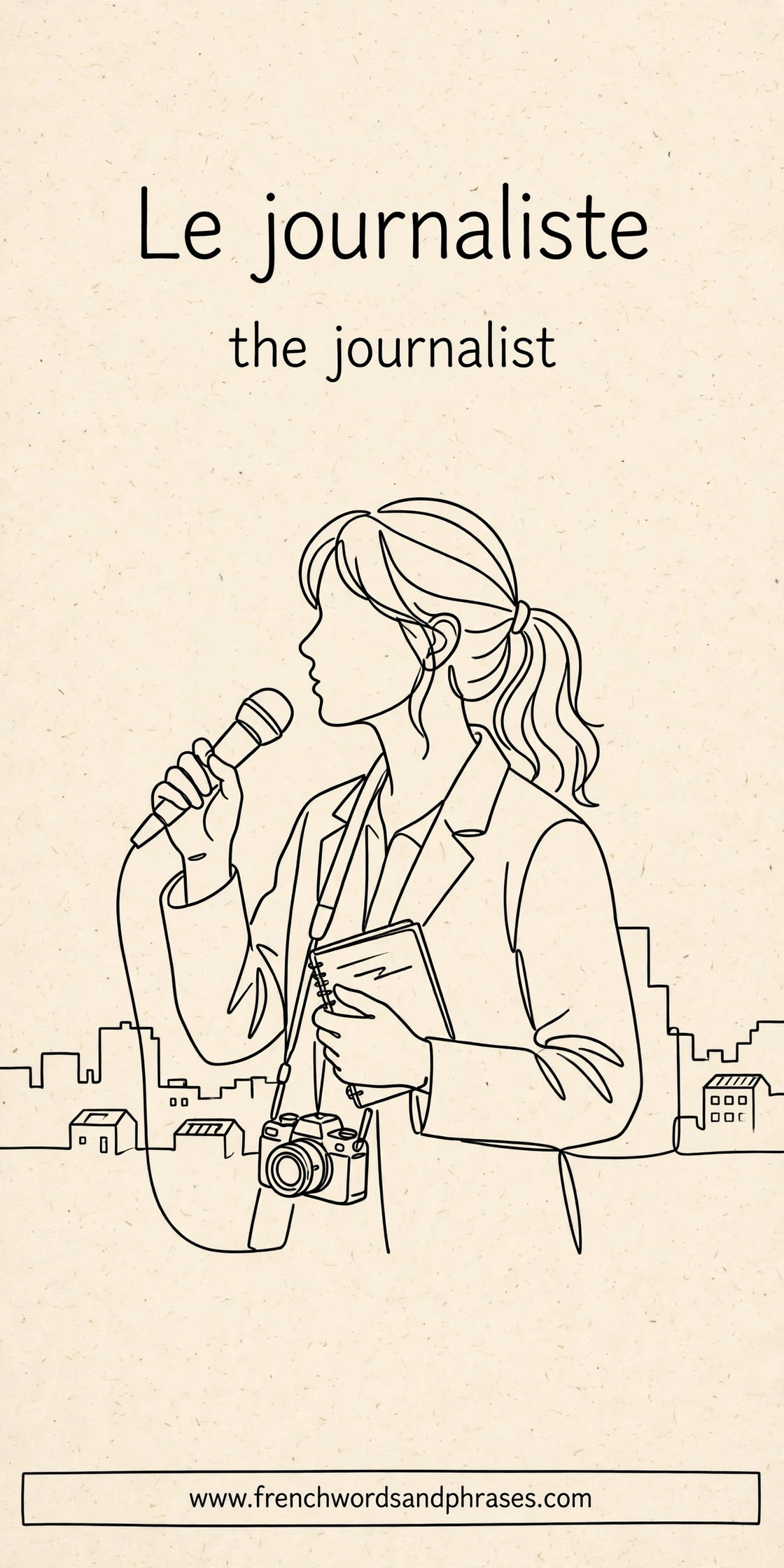
Le journaliste means the journalist.
Six in the morning, the newsroom is already loud: phones ringing, keyboards hammering, a television murmuring in the corner. In the middle of it, coffee in hand, stands the person who will turn the day into a story — le journaliste.
In this guide, you’ll learn what journaliste means in English, how to use it with its articles, how to form its plural, and how it appears in everyday French. Explore French examples, English translations, and practice quizzes.
Understanding the French Noun Journaliste
Journaliste is a French profession noun that keeps exactly the same form for men and women: un journaliste, une journaliste. Only the article tells you who you are talking about. It names the people who find, check and tell the news — for a newspaper, a television channel, a radio station or a website.
It means the journalist — the reporter who writes un article, records un reportage (a report) and asks the questions in une interview. Journalistes work in la rédaction, the newsroom, and their stories appear in le journal (the newspaper), on the radio or on screen. Man or woman, the word itself never changes: un and une, le and la do all the talking.
Gender: Same form for men and women — un journaliste, une journaliste
Definite article: le / la — le journaliste, la journaliste (the journalist)
Indefinite article: un / une — un journaliste, une journaliste
Plural: les journalistes (for men, women and mixed groups alike)
English equivalents: The journalist; a reporter, a correspondent.
One important usage detail: journaliste ends in -e and never adds another letter for the feminine — the article alone changes. You will also meet the proud title grand reporter: a senior reporter or foreign correspondent, the journaliste sent to the far end of the world with a notebook and a camera.
Experience the Word
Journaliste is more than a job title. It is a licence to ask questions — to knock on doors, to check a fact three times, and to be first with the story.
Imagine the press conference: the minister enters, the cameras rise, and thirty hands go up at once. The journaliste’s question is the one everyone will quote tomorrow.
You have not just written an article. You have told the day to everyone who was not there.
How to Use Journaliste in French: Complete Guide
Let’s explore how journaliste works in French — beginning with its articles, where all the gender work happens.
Journaliste with the Definite Article (Le, La, Les)
The word never changes, so the article carries the gender: le journaliste for a man, la journaliste for a woman.
| Gender | French |
|---|---|
| Masculine | le journaliste |
| Feminine | la journaliste |
| Plural | les journalistes |
Example
La journaliste arrive à la conférence de presse.
The journalist — a woman — arrives at the press conference.
Journaliste with the Indefinite Article (Un, Une)
Used for a journalist in general — the one asking the questions, the one writing the story.
| Gender | French |
|---|---|
| Masculine | un journaliste |
| Feminine | une journaliste |
| Plural | des journalistes |
Example
Une journaliste pose une question au ministre.
A journalist — a woman — asks the minister a question.
In the Newsroom
Articles, reports and front pages — the vocabulary of the journaliste’s working day.
| French | In English |
|---|---|
| l’article | the article |
| le reportage | the report, the feature |
| l’interview | the interview |
| la rédaction | the newsroom |
| la une | the front page |
| le journal | the newspaper |
Example
Son reportage fait la une du journal.
Her report makes the front page of the newspaper.
Quick Quiz 1
Claire writes for a newspaper. Do we say un journaliste or une journaliste?
Reveal the answer
Une journaliste — the word journaliste stays exactly the same; only the article changes.
Claire est une journaliste sportive.
Claire is a sports journalist.
The Plural of Journaliste
Journaliste adds an -s in the plural, and les journalistes serves for men, women and mixed newsrooms alike.
| Number | French |
|---|---|
| Singular (masculine) | le journaliste |
| Singular (feminine) | la journaliste |
| Plural | les journalistes |
Example
Les journalistes attendent devant le ministère.
The journalists are waiting in front of the ministry.
Journaliste with Possessive Adjectives (Mon, Ma…)
Possessives agree with the person’s gender here: mon journaliste for a man, ma journaliste for a woman.
| Owner | French |
|---|---|
| my | mon journaliste, ma journaliste |
| your (tu) | ton journaliste, ta journaliste |
| his / her | son journaliste, sa journaliste |
| our | notre journaliste |
| your (vous) | votre journaliste |
| their | leur journaliste |
Example
Ma journaliste préférée présente le journal de vingt heures.
My favourite journalist — a woman — presents the eight o’clock news.
Quick Quiz 2
Complete the sentence:
______ journaliste sportif commente le match. (Our)
Reveal the answer
Notre
Notre journaliste sportif commente le match.
Our sports journalist is commentating on the match.
Journaliste with Demonstrative Adjectives (Ce, Cette, Ces)
Used to point: this journalist here, those journalists there.
| Gender | French |
|---|---|
| Masculine singular | ce journaliste |
| Feminine singular | cette journaliste |
| Plural | ces journalistes |
Example
Cette journaliste a gagné un prix pour son reportage.
This journalist — a woman — won a prize for her report.
Journaliste with Adjectives
The noun stays put, but adjectives agree: un journaliste sportif, une journaliste sportive.
| Adjective | With Journaliste |
|---|---|
| sportif / sportive (sports) | un journaliste sportif, une journaliste sportive |
| indépendant / indépendante (independent) | un journaliste indépendant, une journaliste indépendante |
| célèbre (famous) | un journaliste célèbre, une journaliste célèbre |
| politique (political) | un journaliste politique, une journaliste politique |
Example
Une journaliste sportive suit l’équipe de France.
A sports journalist — a woman — follows the French team.
Quick Quiz 3
Complete the sentence:
C’est une journaliste très ______. (independent)
Reveal the answer
indépendante
C’est une journaliste très indépendante.
She is a very independent journalist — the adjective takes the feminine form; the noun does not.
Everyday Expressions with Journaliste
Questions, reports and events — the journaliste phrases of the week.
| Expression | In English |
|---|---|
| écrire un article | to write an article |
| faire un reportage | to make a report |
| couvrir un événement | to cover an event |
| poser des questions | to ask questions |
| un journaliste sportif | a sports journalist |
| travailler pour un journal | to work for a newspaper |
Example
Le journaliste couvre l’événement pour la télévision.
The journalist is covering the event for television.
Words from the Same Family as Journaliste
Newspapers, press and newsrooms — the words that travel with journaliste.
| French | In English |
|---|---|
| le journal | the newspaper; the news (on TV) |
| le journalisme | journalism |
| la presse | the press |
| informer | to inform |
| une interview | an interview |
| la rédaction | the newsroom |
Example
Le journalisme demande de vérifier chaque fait.
Journalism requires checking every fact.
Quick Quiz 4
A headline reads: « Une journaliste reçoit un prix ». What tells you the journalist is a woman?
Reveal the answer
The article une — journaliste itself never changes; the gender lives in un/une and le/la.
La journaliste reçoit le prix ce soir.
The journalist receives the prize this evening.
Journaliste in Everyday French: Real-Life Examples
Now that you know the word, let’s see how journaliste appears in everyday French.
Example 1 — In the newsroom
La journaliste écrit son article avant midi.
The journalist — a woman — writes her article before noon.
Example 2 — At a press conference
Un journaliste pose une question au maire.
A journalist asks the mayor a question.
Example 3 — On television
Cette journaliste présente les nouvelles du soir.
This journalist — a woman — presents the evening news.
Example 4 — Covering sport
Le journaliste sportif suit le match en direct.
The sports journalist follows the match live.
Example 5 — An interview
La journaliste interviewe une actrice célèbre.
The journalist — a woman — is interviewing a famous actress.
Example 6 — A career dream
Il veut devenir journaliste pour voyager.
He wants to become a journalist in order to travel.
Beyond Translation: The Meaning of Journaliste
France has loved its journalists since the great newspaper age, when le journal arrived with the morning bread and the whole café argued over its pages. The carte de presse — the press card — is still a small badge of honour, carried from the rédaction to the far corners of the world.
To say journaliste is to ask the question nobody else dares to ask.
It evokes the notebook in the rain outside the ministry, the phone call at midnight, the front page at dawn — la une — where one person’s questions become everyone’s morning.
How to Remember the French Noun Journaliste
Remember it this way: Journaliste is the journalist — one word for everyone; the article does all the gender work.
- You change only the article — un journaliste, une journaliste.
- You never add a letter — journaliste finit déjà par -e.
- You watch the adjectives — un journaliste sportif, une journaliste sportive.
The key idea is le ou la journaliste — the article tells the story.
Test Your Knowledge of Journaliste
Let’s see how much you’ve learned. Try answering these questions before revealing the answers.
Question 1
Does the word journaliste change for a woman?
Reveal the answer
No — journaliste is identical; only the article changes: une journaliste.
Question 2
What is un grand reporter?
Reveal the answer
A senior reporter, a foreign correspondent — the journaliste sent far away to cover great events.
Question 3
Translate: The journalists are waiting outside.
Reveal the answer
Les journalistes attendent dehors.
Question 4
What is la rédaction?
Reveal the answer
The newsroom — the office where journalistes write and prepare the news.
Question 5
Complete the sentence:
______ journaliste pose des questions au ministre. (The — for a woman)
Reveal the answer
La
La journaliste pose des questions au ministre.
The journalist — a woman — asks the minister questions.
Your Final Challenge
Can You Use It?
How would you say this in French?
“The journalist asks questions at the press conference.”
Reveal the answer
La journaliste pose des questions à la conférence de presse.
The journalist asks questions at the press conference.
A little French. A little curiosity. A richer everyday life.
LEARN FRENCH ONE WORD AT A TIME