A French Word to Live By
How to Conjugate Relaxer in French
/ʁə.lak.se/
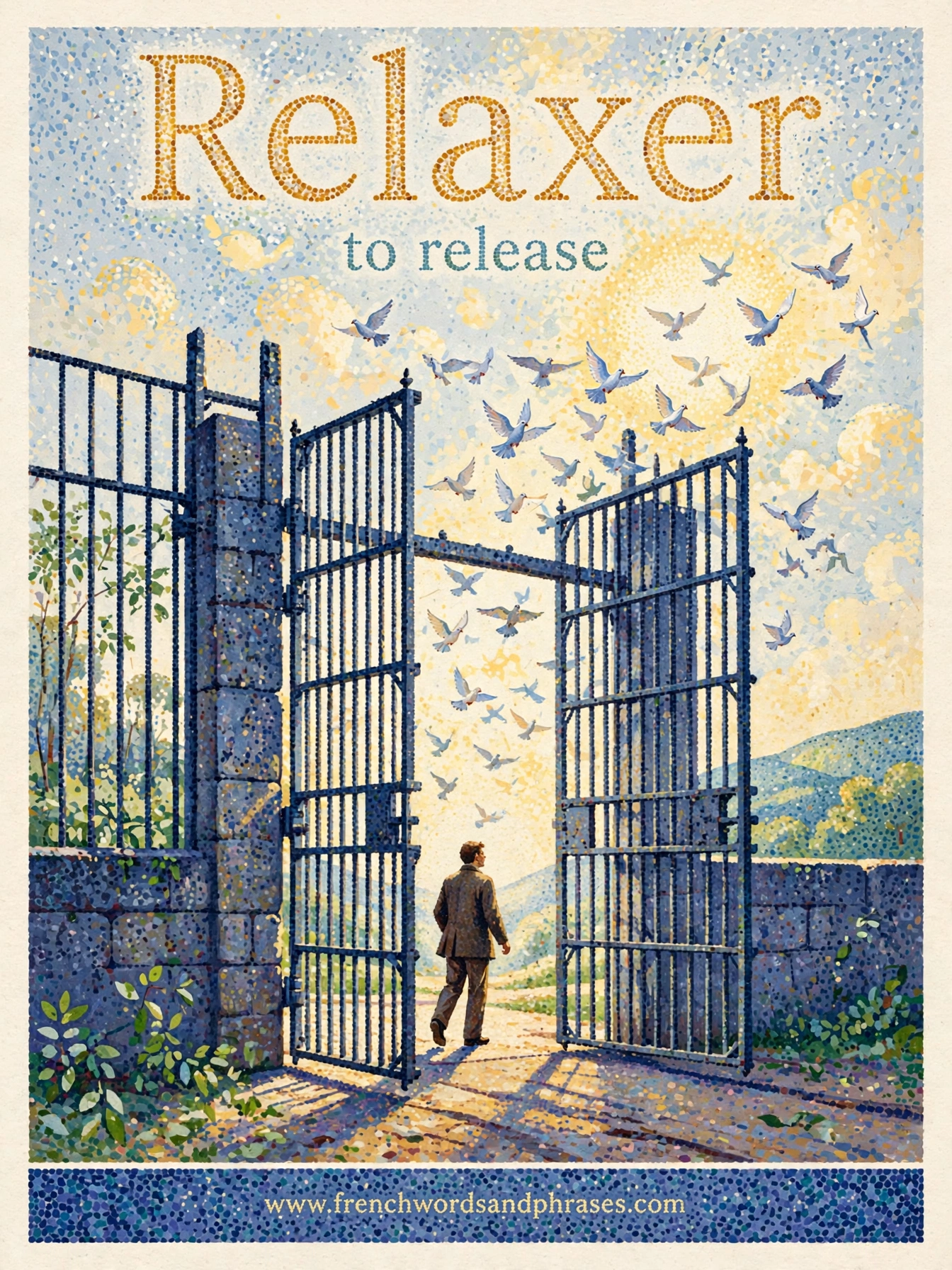
Relaxer means to release — to set a prisoner or an accused person free when the court lets the case go.
A courtroom at the end of a long trial, a judge closing a file, a cell door swinging open — relaxer is the verb of the law letting go: when the charges fall away, the accused walks out, relaxé.
In this guide, you’ll learn how to conjugate relaxer in all the major French tenses and moods. Explore complete conjugation tables, French examples, English translations, and practice quizzes.
Understanding the French Verb Relaxer
Relaxer is a regular French verb belonging to the first group of verbs, those ending in-er.
It means to release. It is the standard verb of legal journalism: «le suspect a été relaxé» in a French newspaper always means the suspect was released or cleared, never that he put his feet up. The noun la relaxe is the formal outcome — defence lawyers plaider la relaxe, plead for the case to be dismissed.
Verb classification: First group (-er)
Auxiliary verb: Avoir
Past participle: relaxé
Present participle: relaxant
English equivalents: To release, to set free, to let go; relaxer un prisonnier — to release a prisoner; relaxer un accusé — to acquit and free an accused person; être relaxé au bénéfice du doute — to be acquitted on the benefit of the doubt; la relaxe — the dismissal of the charges, the acquittal.
One important trap: English speakers expect relaxer to mean chilling out, but in French the plain verb belongs to the courtroom — it means to release from custody, to acquit and set free. The holiday sense exists only in the reflexive se relaxer, which has its own page. A second, quieter life: in physiotherapy, relaxer un muscle is to loosen a tense muscle. The conjugation itself is perfectly regular: je relaxe, nous relaxons, past participle relaxé.
Experience the Word
Relaxer is the verb of the door opening — the moment the law unhands someone and gives them back their freedom.
Imagine a young man accused of a theft he swears he did not commit. Three days of hearings, one collapsing witness, one alibi that finally checks out — and on the third afternoon, le juge le relaxe: the file closes, the guard steps aside, and the corridor outside is full of daylight.
He has not escaped or been forgiven. He has been released — relaxé, by the court’s own word.
How to Conjugate Relaxer: Complete French Conjugation Guide
Let’s explore every major conjugation of relaxer, beginning with the indicative mood.
How to Conjugate Relaxer in the Indicative Mood
The indicative mood is used to express facts, observations, actions, and events.
How to Conjugate Relaxer in the Present Tense (Présent)
Used for actions happening now, habitual actions, and general truths.
| Subject | Conjugation |
|---|---|
| je | relaxe |
| tu | relaxes |
| il / elle | relaxe |
| nous | relaxons |
| vous | relaxez |
| ils / elles | relaxent |
Example
Le juge relaxe l’accusé faute de preuves.
The judge releases the accused for lack of evidence.
Quick Quiz 1
Complete the sentence:
Le juge ______ l’accusé faute de preuves.
Reveal the answer
relaxe
Le juge relaxe l’accusé faute de preuves.
The judge releases the accused for lack of evidence.
How to Conjugate Relaxer in the Passé Composé
Used for completed actions in the past. Relaxer takes the auxiliary verb avoir.
| Subject | Conjugation |
|---|---|
| j’ | ai relaxé |
| tu | as relaxé |
| il / elle | a relaxé |
| nous | avons relaxé |
| vous | avez relaxé |
| ils / elles | ont relaxé |
Example
Le tribunal a relaxé le suspect après trois jours de procès.
The court released the suspect after three days of trial.
How to Conjugate Relaxer in the Imparfait (Imperfect Tense)
Used for habitual past actions, descriptions, and ongoing situations in the past.
| Subject | Conjugation |
|---|---|
| je | relaxais |
| tu | relaxais |
| il / elle | relaxait |
| nous | relaxions |
| vous | relaxiez |
| ils / elles | relaxaient |
Example
Autrefois, le juge relaxait souvent les prévenus après un rappel à la loi.
In the old days, the judge often released defendants after a formal warning.
Quick Quiz 2
Choose the correct form:
The suspect was released.
Le suspect ______ hier soir. (a été relaxé / s’est relaxé)
Reveal the answer
a été relaxé
Le suspect a été relaxé hier soir.
Being set free by the court is the plain legal verb relaxer in the passive; s’est relaxé would mean he chilled out.
How to Conjugate Relaxer in the Plus-que-parfait
Used to describe an action that had already been completed before another past event.
| Subject | Conjugation |
|---|---|
| j’ | avais relaxé |
| tu | avais relaxé |
| il / elle | avait relaxé |
| nous | avions relaxé |
| vous | aviez relaxé |
| ils / elles | avaient relaxé |
Example
La cour avait relaxé l’homme avant même l’arrivée des journalistes.
The court had released the man before the journalists even arrived.
How to Conjugate Relaxer in the Passé Simple
Primarily used in formal writing, literature, and historical narratives. It is rarely used in everyday conversation.
| Subject | Conjugation |
|---|---|
| je | relaxai |
| tu | relaxas |
| il / elle | relaxa |
| nous | relaxâmes |
| vous | relaxâtes |
| ils / elles | relaxèrent |
Example
Le juge relaxa le prisonnier dès la première audience.
The judge released the prisoner at the very first hearing.
How to Conjugate Relaxer in the Passé Antérieur
A literary tense used to express an action completed immediately before another past action, generally in the passé simple.
| Subject | Conjugation |
|---|---|
| j’ | eus relaxé |
| tu | eus relaxé |
| il / elle | eut relaxé |
| nous | eûmes relaxé |
| vous | eûtes relaxé |
| ils / elles | eurent relaxé |
Example
Quand le tribunal eut relaxé l’accusé, la salle applaudit.
When the court had released the accused, the room applauded.
How to Conjugate Relaxer in the Future Tense (Futur Simple)
Used to describe actions that will take place in the future.
| Subject | Conjugation |
|---|---|
| je | relaxerai |
| tu | relaxeras |
| il / elle | relaxera |
| nous | relaxerons |
| vous | relaxerez |
| ils / elles | relaxeront |
Example
Si les analyses confirment son innocence, on le relaxera demain.
If the tests confirm his innocence, he will be released tomorrow.
How to Conjugate Relaxer in the Futur Antérieur (Future Perfect)
Used for an action that will have been completed before a particular point in the future.
| Subject | Conjugation |
|---|---|
| j’ | aurai relaxé |
| tu | auras relaxé |
| il / elle | aura relaxé |
| nous | aurons relaxé |
| vous | aurez relaxé |
| ils / elles | auront relaxé |
Example
À la fin de l’audience, le juge aura relaxé les trois prévenus.
By the end of the hearing, the judge will have released the three defendants.
How to Conjugate Relaxer in the Near Future (Futur Proche)
Used to describe something that is going to happen soon. Formed with aller + infinitive.
| Subject | Conjugation |
|---|---|
| je | vais relaxer |
| tu | vas relaxer |
| il / elle | va relaxer |
| nous | allons relaxer |
| vous | allez relaxer |
| ils / elles | vont relaxer |
Example
Le procureur va relaxer le suspect, l’alibi est solide.
The prosecutor is going to release the suspect; the alibi is solid.
How to Conjugate Relaxer in the Conditional Mood
The conditional mood expresses what would happen under certain circumstances. It is also frequently used to make polite requests or express wishes.
How to Conjugate Relaxer in the Present Conditional
| Subject | Conjugation |
|---|---|
| je | relaxerais |
| tu | relaxerais |
| il / elle | relaxerait |
| nous | relaxerions |
| vous | relaxeriez |
| ils / elles | relaxeraient |
Example
Avec un tel dossier, aucun juge ne le relaxerait.
With such a file, no judge would release him.
How to Conjugate Relaxer in the Past Conditional
| Subject | Conjugation |
|---|---|
| j’ | aurais relaxé |
| tu | aurais relaxé |
| il / elle | aurait relaxé |
| nous | aurions relaxé |
| vous | auriez relaxé |
| ils / elles | auraient relaxé |
Example
Le tribunal l’aurait relaxé si le témoin s’était présenté.
The court would have released him if the witness had turned up.
Relaxer in the Literary Past Conditional Form
This less common literary form uses the imperfect subjunctive of avoir.
| Subject | Conjugation |
|---|---|
| j’ | eusse relaxé |
| tu | eusses relaxé |
| il / elle | eût relaxé |
| nous | eussions relaxé |
| vous | eussiez relaxé |
| ils / elles | eussent relaxé |
Example
Sans la vidéo, le tribunal l’eût relaxé dès le premier jour.
Without the video, the court would have released him on the very first day.
How to Conjugate Relaxer in the Subjunctive Mood
The subjunctive is used to express wishes, emotions, doubts, necessity, and uncertainty. It frequently follows expressions such as il faut que (it is necessary that) or bien que (although).
How to Conjugate Relaxer in the Present Subjunctive
| Subject | Conjugation |
|---|---|
| que je | relaxe |
| que tu | relaxes |
| qu’il / qu’elle | relaxe |
| que nous | relaxions |
| que vous | relaxiez |
| qu’ils / qu’elles | relaxent |
Example
Il est rare que le juge relaxe un accusé aussi vite.
It is rare for the judge to release an accused person so quickly.
Quick Quiz 3
Complete the sentence using the subjunctive:
Il est rare que le tribunal ______ les prévenus sans examen.
Reveal the answer
relaxe
Il est rare que le tribunal relaxe les prévenus sans examen.
It is rare for the court to release defendants without examination.
How to Conjugate Relaxer in the Imperfect Subjunctive
A literary tense, rarely encountered in modern spoken French.
| Subject | Conjugation |
|---|---|
| que je | relaxasse |
| que tu | relaxasses |
| qu’il / qu’elle | relaxât |
| que nous | relaxassions |
| que vous | relaxassiez |
| qu’ils / qu’elles | relaxassent |
Example
Personne ne s’attendait à ce que le tribunal relaxât le prévenu.
Nobody expected the court to release the defendant.
How to Conjugate Relaxer in the Pluperfect Subjunctive
A literary construction used to express an action completed before another past action.
| Subject | Conjugation |
|---|---|
| que j’ | eusse relaxé |
| que tu | eusses relaxé |
| qu’il / qu’elle | eût relaxé |
| que nous | eussions relaxé |
| que vous | eussiez relaxé |
| qu’ils / qu’elles | eussent relaxé |
Example
On racontait que le juge eût relaxé l’homme bien avant le verdict officiel.
People said the judge had released the man well before the official verdict.
How to Conjugate Relaxer in the Past Subjunctive
| Subject | Conjugation |
|---|---|
| que j’ | aie relaxé |
| que tu | aies relaxé |
| qu’il / qu’elle | ait relaxé |
| que nous | ayons relaxé |
| que vous | ayez relaxé |
| qu’ils / qu’elles | aient relaxé |
Example
Je suis soulagé que le tribunal ait relaxé ton frère.
I am relieved that the court released your brother.
How to Conjugate Relaxer in the Imperative
The imperative is used to give commands, instructions, invitations, or suggestions. Subject pronouns are omitted.
How to Conjugate Relaxer in the Present Imperative
| Person | Conjugation |
|---|---|
| (tu) | relaxe |
| (nous) | relaxons |
| (vous) | relaxez |
Example
Relaxez cet homme, son innocence est prouvée !
Release this man, his innocence is proven!
Quick Quiz 4
How would you say Release this man (tu form)?
Reveal the answer
Relaxe cet homme !
French Participles of Relaxer
Participles are verb forms that can be used in compound tenses and other grammatical constructions.
Present Participle of Relaxer
relaxant
En relaxant l’accusé, le juge a reconnu l’erreur de la police.
By releasing the accused, the judge acknowledged the police’s mistake.
Past Participle of Relaxer
relaxé
Relaxé après deux ans de détention, il a retrouvé sa famille.
Released after two years in custody, he was reunited with his family.
Relaxer in Everyday French: Real-Life Examples
Now that you know the conjugations, let’s see how relaxer appears in everyday French.
Example 1 — Present
Le juge relaxe l’accusé.
The judge releases the accused.
Example 2 — Passé composé
Le tribunal a relaxé le suspect.
The court released the suspect.
Example 3 — Imparfait
On relaxait les prévenus faute de preuves.
Defendants were released for lack of evidence.
Example 4 — Future
On le relaxera demain matin.
He will be released tomorrow morning.
Example 5 — Conditional
Aucun juge ne le relaxerait avec ce dossier.
No judge would release him with that file.
Example 6 — Imperative
Relaxez ce prisonnier, il est innocent !
Release this prisoner, he is innocent!
Beyond Translation: The Meaning of Relaxer
English relax and French relaxer are the same Latin word, relaxare, to loosen — but the two languages divided the inheritance. English kept the loosening of muscles and minds; French gave the plain verb the official loosening: the loosening of a grip, of custody, of charges. The leisure sense then travelled back into French from English, wearing a reflexive pronoun — se relaxer — which is why the courtroom and the beach share one verb between them.
How to Remember the French Verb Relaxer
Remember it this way: Relaxer is about the cell door swinging open.
- In French, plain relaxer belongs to the courtroom: relaxer un accusé = to release him, not to chill him out.
- The holiday sense needs the reflexive: se relaxer — see its own page.
- Regular -er: je relaxe, nous relaxons, past participle relaxé; the name of the outcome is la relaxe.
The key idea is the cell door swinging open.
Test Your Knowledge of Relaxer
Let’s see how much you’ve learned. Try answering these questions before revealing the answers.
Question 1
What does relaxer mean when a French newspaper writes «le suspect a été relaxé»?
Reveal the answer
He was released — the court let him go; relaxer here is the legal verb, to free or acquit, not to relax.
Question 2
How do you say The judge releases the accused in French?
Reveal the answer
Le juge relaxe l’accusé.
Question 3
Translate: The court released the suspect after the hearing.
Reveal the answer
Le tribunal a relaxé le suspect après l’audience.
Question 4
What is the past participle of relaxer?
Reveal the answer
Relaxé.
Question 5
Complete the sentence:
Il est rare que le juge ______ un accusé aussi vite.
Reveal the answer
relaxe
Il est rare que le juge relaxe un accusé aussi vite.
It is rare for the judge to release an accused person so quickly.
Your Final Challenge
Can You Use It?
How would you say this in French?
The judge closes the file, releases the accused, and the whole courtroom finally breathes.
Reveal the answer
Le juge referme le dossier, relaxe l’accusé, et la salle entière respire enfin.
The judge closes the file, releases the accused, and the whole courtroom finally breathes.
A little French. A little curiosity. A richer everyday life.
LEARN FRENCH ONE WORD AT A TIME