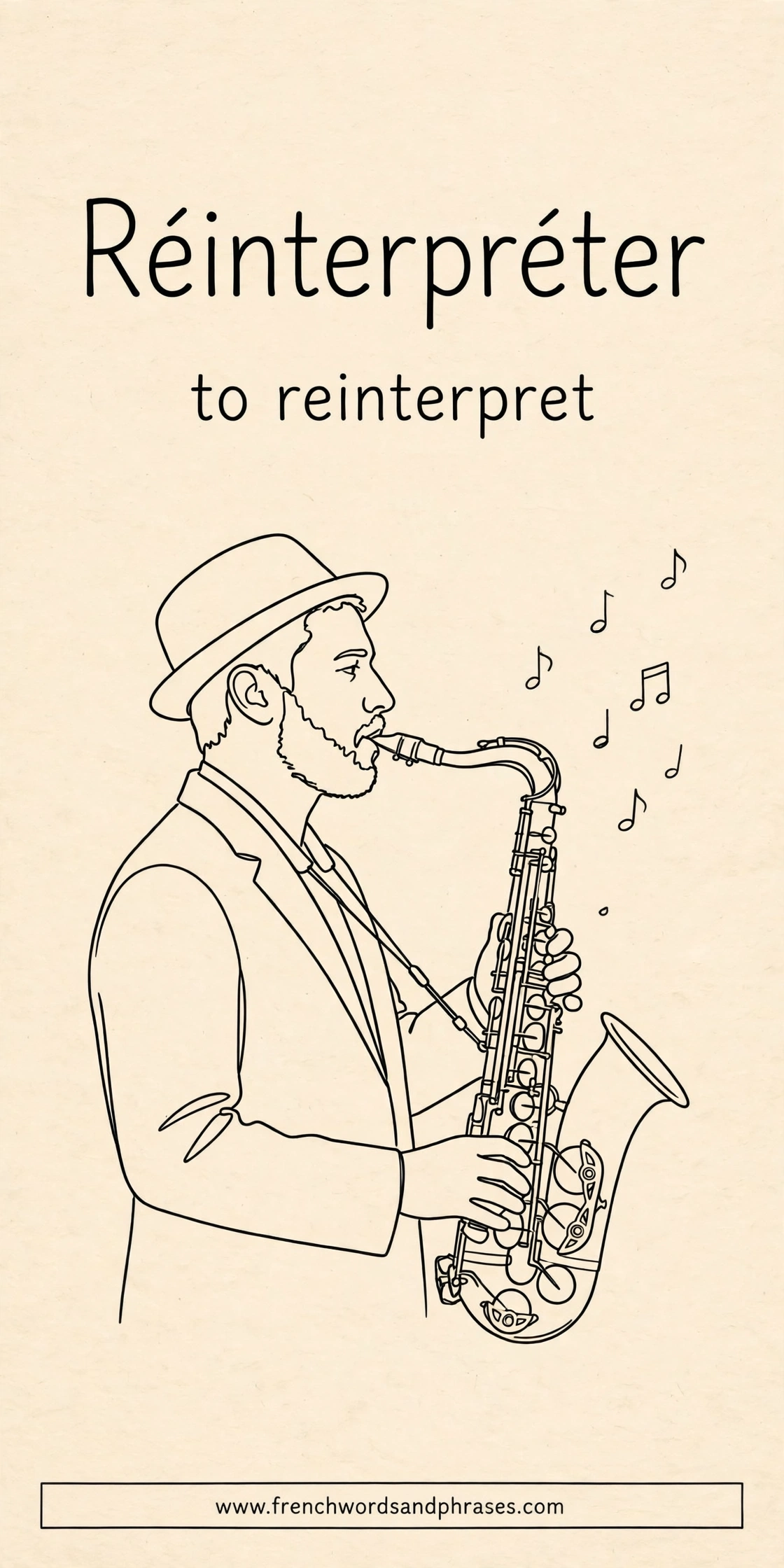
A French Word to Live By
How to Conjugate Réinterpréter in French
/ʁe.ɛ̃.tɛʁ.pʁe.te/
Réinterpréter means to reinterpret — to perform or read something familiar in a new way, so that it comes out meaning something it never quite meant before.
A jazz singer taking an old chanson apart note by note, a director staging Molière in jeans and trainers, an actor finding the joke inside a tragic line — réinterpréter is the artist’s verb of respectful disobedience: the work is the same, and yet nobody has ever heard it quite like this.
In this guide, you’ll learn how to conjugate réinterpréter in all the major French tenses and moods. Explore complete conjugation tables, French examples, English translations, and practice quizzes.
Understanding the French Verb Réinterpréter
Réinterpréter is a regular French verb belonging to the first group of verbs, those ending in-er.
It means to reinterpret. It lives wherever old material meets new eyes: actors réinterprètent roles, singers réinterprètent standards, directors réinterprètent classics, and — beyond the arts — lawyers, historians and journalists réinterprètent facts and texts. The word always implies a reading, a point of view: the notes stay, the meaning moves.
Verb classification: First group (-er)
Auxiliary verb: Avoir
Past participle: réinterprété
Present participle: réinterprétant
English equivalents: To reinterpret, to perform anew, to cover (a song); réinterpréter une chanson — to cover a song in one’s own style; réinterpréter un rôle — to reinterpret a role; réinterpréter les faits — to reinterpret the facts; une réinterprétation — a reinterpretation, a fresh reading, a cover version.
One important detail: réinterpréter is a céder-type verb wearing two accents — the stem’s last é opens to è wherever the next syllable is mute: je réinterprète, tu réinterprètes, ils réinterprètent, and through the future: je réinterprèterai. The é survives where the ending is sounded: nous réinterprétons, vous réinterprétez, en réinterprétant, and in the infinitive itself. In the music world, note, réinterpréter is the respectful word for what English calls a cover: a great chanteuse does not copy Piaf, she la réinterprète.
Experience the Word
Réinterpréter is the verb of the second life of works of art — proof that a song, a role or a text is not finished when its author is.
Imagine a young singer in a small Paris club, one guitarist beside her, taking on a Piaf standard everyone in the room knows by heart. She slows it down, drops the drama, almost whispers it — and the old song about lost love suddenly sounds like a song about starting again. She has not changed a word. She l’a réinterprétée.
The melody is a hundred years old. It has been reinterpreted — réinterprétée — and tonight it belongs to her.
How to Conjugate Réinterpréter: Complete French Conjugation Guide
Let’s explore every major conjugation of réinterpréter, beginning with the indicative mood.
How to Conjugate Réinterpréter in the Indicative Mood
The indicative mood is used to express facts, observations, actions, and events.
How to Conjugate Réinterpréter in the Present Tense (Présent)
Used for actions happening now, habitual actions, and general truths.
| Subject | Conjugation |
|---|---|
| je | réinterprète |
| tu | réinterprètes |
| il / elle | réinterprète |
| nous | réinterprétons |
| vous | réinterprétez |
| ils / elles | réinterprètent |
Example
La chanteuse réinterprète les classiques avec une simple guitare.
The singer reinterprets the classics with a single guitar.
Quick Quiz 1
Complete the sentence:
La chanteuse ______ les classiques à la guitare.
Reveal the answer
réinterprète
La chanteuse réinterprète les classiques à la guitare.
The singer reinterprets the classics on guitar — è, because the ending is mute.
How to Conjugate Réinterpréter in the Passé Composé
Used for completed actions in the past. Réinterpréter takes the auxiliary verb avoir.
| Subject | Conjugation |
|---|---|
| j’ | ai réinterprété |
| tu | as réinterprété |
| il / elle | a réinterprété |
| nous | avons réinterprété |
| vous | avez réinterprété |
| ils / elles | ont réinterprété |
Example
Le metteur en scène a réinterprété la pièce dans un décor moderne.
The director reinterpreted the play in a modern setting.
How to Conjugate Réinterpréter in the Imparfait (Imperfect Tense)
Used for habitual past actions, descriptions, and ongoing situations in the past.
| Subject | Conjugation |
|---|---|
| je | réinterprétais |
| tu | réinterprétais |
| il / elle | réinterprétait |
| nous | réinterprétions |
| vous | réinterprétiez |
| ils / elles | réinterprétaient |
Example
Chaque génération réinterprétait les vieilles chansons à sa façon.
Each generation reinterpreted the old songs in its own way.
Quick Quiz 2
Choose the correct form:
The band covered that old hit.
Le groupe ______ ce vieux tube. (a réinterprété / est réinterprété)
Reveal the answer
a réinterprété
Le groupe a réinterprété ce vieux tube.
Réinterpréter takes avoir.
How to Conjugate Réinterpréter in the Plus-que-parfait
Used to describe an action that had already been completed before another past event.
| Subject | Conjugation |
|---|---|
| j’ | avais réinterprété |
| tu | avais réinterprété |
| il / elle | avait réinterprété |
| nous | avions réinterprété |
| vous | aviez réinterprété |
| ils / elles | avaient réinterprété |
Example
Elle avait réinterprété le rôle tant de fois qu’il était devenu le sien.
She had reinterpreted the role so many times that it had become her own.
How to Conjugate Réinterpréter in the Passé Simple
Primarily used in formal writing, literature, and historical narratives. It is rarely used in everyday conversation.
| Subject | Conjugation |
|---|---|
| je | réinterprétai |
| tu | réinterprétas |
| il / elle | réinterpréta |
| nous | réinterprétâmes |
| vous | réinterprétâtes |
| ils / elles | réinterprétèrent |
Example
Le pianiste réinterpréta la sonate avec une lenteur bouleversante.
The pianist reinterpreted the sonata with moving slowness.
How to Conjugate Réinterpréter in the Passé Antérieur
A literary tense used to express an action completed immediately before another past action, generally in the passé simple.
| Subject | Conjugation |
|---|---|
| j’ | eus réinterprété |
| tu | eus réinterprété |
| il / elle | eut réinterprété |
| nous | eûmes réinterprété |
| vous | eûtes réinterprété |
| ils / elles | eurent réinterprété |
Example
Quand il eut réinterprété le morceau, le public se leva d’un bloc.
When he had reinterpreted the piece, the audience rose as one.
How to Conjugate Réinterpréter in the Future Tense (Futur Simple)
Used to describe actions that will take place in the future.
| Subject | Conjugation |
|---|---|
| je | réinterprèterai |
| tu | réinterprèteras |
| il / elle | réinterprètera |
| nous | réinterprèterons |
| vous | réinterprèterez |
| ils / elles | réinterprèteront |
Example
Demain, l’orchestre réinterprètera les grands thèmes du cinéma.
Tomorrow, the orchestra will reinterpret the great film themes.
How to Conjugate Réinterpréter in the Futur Antérieur (Future Perfect)
Used for an action that will have been completed before a particular point in the future.
| Subject | Conjugation |
|---|---|
| j’ | aurai réinterprété |
| tu | auras réinterprété |
| il / elle | aura réinterprété |
| nous | aurons réinterprété |
| vous | aurez réinterprété |
| ils / elles | auront réinterprété |
Example
À la fin de la tournée, elle aura réinterprété tout le répertoire.
By the end of the tour, she will have reinterpreted the whole repertoire.
How to Conjugate Réinterpréter in the Near Future (Futur Proche)
Used to describe something that is going to happen soon. Formed with aller + infinitive.
| Subject | Conjugation |
|---|---|
| je | vais réinterpréter |
| tu | vas réinterpréter |
| il / elle | va réinterpréter |
| nous | allons réinterpréter |
| vous | allez réinterpréter |
| ils / elles | vont réinterpréter |
Example
Tu vas réinterpréter cette scène une fois de plus ?
Are you going to reinterpret that scene once more?
How to Conjugate Réinterpréter in the Conditional Mood
The conditional mood expresses what would happen under certain circumstances. It is also frequently used to make polite requests or express wishes.
How to Conjugate Réinterpréter in the Present Conditional
| Subject | Conjugation |
|---|---|
| je | réinterprèterais |
| tu | réinterprèterais |
| il / elle | réinterprèterait |
| nous | réinterprèterions |
| vous | réinterprèteriez |
| ils / elles | réinterprèteraient |
Example
Un bon acteur réinterprèterait ce rôle sans copier personne.
A good actor would reinterpret this role without copying anyone.
How to Conjugate Réinterpréter in the Past Conditional
| Subject | Conjugation |
|---|---|
| j’ | aurais réinterprété |
| tu | aurais réinterprété |
| il / elle | aurait réinterprété |
| nous | aurions réinterprété |
| vous | auriez réinterprété |
| ils / elles | auraient réinterprété |
Example
Elle aurait réinterprété la chanson si on le lui avait demandé.
She would have covered the song if she had been asked.
Réinterpréter in the Literary Past Conditional Form
This less common literary form uses the imperfect subjunctive of avoir.
| Subject | Conjugation |
|---|---|
| j’ | eusse réinterprété |
| tu | eusses réinterprété |
| il / elle | eût réinterprété |
| nous | eussions réinterprété |
| vous | eussiez réinterprété |
| ils / elles | eussent réinterprété |
Example
Il eût réinterprété les anciens maîtres avec une audace joyeuse.
He would have reinterpreted the old masters with joyful boldness.
How to Conjugate Réinterpréter in the Subjunctive Mood
The subjunctive is used to express wishes, emotions, doubts, necessity, and uncertainty. It frequently follows expressions such as il faut que (it is necessary that) or bien que (although).
How to Conjugate Réinterpréter in the Present Subjunctive
| Subject | Conjugation |
|---|---|
| que je | réinterprète |
| que tu | réinterprètes |
| qu’il / qu’elle | réinterprète |
| que nous | réinterprétions |
| que vous | réinterprétiez |
| qu’ils / qu’elles | réinterprètent |
Example
Il faut que chaque comédien réinterprète le personnage à sa manière.
Every actor must reinterpret the character in his own way.
Quick Quiz 3
Complete the sentence using the subjunctive:
Il faut que chaque comédien ______ le rôle à sa manière.
Reveal the answer
réinterprète
Il faut que chaque comédien réinterprète le rôle à sa manière.
Every actor must reinterpret the role in his own way.
How to Conjugate Réinterpréter in the Imperfect Subjunctive
A literary tense, rarely encountered in modern spoken French.
| Subject | Conjugation |
|---|---|
| que je | réinterprétasse |
| que tu | réinterprétasses |
| qu’il / qu’elle | réinterprétât |
| que nous | réinterprétassions |
| que vous | réinterprétassiez |
| qu’ils / qu’elles | réinterprétassent |
Example
Le professeur voulait que les élèves réinterprétassent le poème librement.
The teacher wanted the pupils to reinterpret the poem freely.
How to Conjugate Réinterpréter in the Pluperfect Subjunctive
A literary construction used to express an action completed before another past action.
| Subject | Conjugation |
|---|---|
| que j’ | eusse réinterprété |
| que tu | eusses réinterprété |
| qu’il / qu’elle | eût réinterprété |
| que nous | eussions réinterprété |
| que vous | eussiez réinterprété |
| qu’ils / qu’elles | eussent réinterprété |
Example
On admirait qu’elle eût réinterprété ce rôle centenaire.
People admired that she had reinterpreted this century-old role.
How to Conjugate Réinterpréter in the Past Subjunctive
| Subject | Conjugation |
|---|---|
| que j’ | aie réinterprété |
| que tu | aies réinterprété |
| qu’il / qu’elle | ait réinterprété |
| que nous | ayons réinterprété |
| que vous | ayez réinterprété |
| qu’ils / qu’elles | aient réinterprété |
Example
Je suis ravi que le groupe ait réinterprété ce vieux tube.
I am delighted the band covered that old hit.
How to Conjugate Réinterpréter in the Imperative
The imperative is used to give commands, instructions, invitations, or suggestions. Subject pronouns are omitted.
How to Conjugate Réinterpréter in the Present Imperative
| Person | Conjugation |
|---|---|
| (tu) | réinterprète |
| (nous) | réinterprétons |
| (vous) | réinterprétez |
Example
Réinterprète la scène, mais avec ton cœur, cette fois !
Reinterpret the scene, but with your heart this time!
Quick Quiz 4
How would you say Reinterpret the scene your way (tu form)?
Reveal the answer
Réinterprète la scène à ta façon !
French Participles of Réinterpréter
Participles are verb forms that can be used in compound tenses and other grammatical constructions.
Present Participle of Réinterpréter
réinterprétant
En réinterprétant Piaf, elle a trouvé sa propre voix.
By reinterpreting Piaf, she found her own voice.
Past Participle of Réinterpréter
réinterprété
Réinterprétée par un chœur d’enfants, la vieille chanson a ému toute la salle.
Reinterpreted by a children’s choir, the old song moved the whole hall.
Réinterpréter in Everyday French: Real-Life Examples
Now that you know the conjugations, let’s see how réinterpréter appears in everyday French.
Example 1 — Present
Elle réinterprète les classiques à la guitare.
She reinterprets the classics on guitar.
Example 2 — Passé composé
Il a réinterprété la pièce en décor moderne.
He reinterpreted the play in a modern setting.
Example 3 — Imparfait
Chaque génération réinterprétait ces chansons.
Each generation reinterpreted these songs.
Example 4 — Future
L’orchestre réinterprètera les thèmes du cinéma.
The orchestra will reinterpret the film themes.
Example 5 — Conditional
Je réinterprèterais ce rôle tout autrement.
I would reinterpret this role quite differently.
Example 6 — Imperative
Réinterprétez la scène à votre façon !
Reinterpret the scene in your own way!
Beyond Translation: The Meaning of Réinterpréter
An interprète in French is two people at once: the interpreter who translates languages, and the performer who embodies a role or a song.
Réinterpréter is where the two meanings shake hands.
To perform a work is already to translate it — from the page into a voice, from one century into another — and to réinterpréter it is to translate it again, deliberately differently, and sign the translation with your own name.
How to Remember the French Verb Réinterpréter
Remember it this way: Réinterpréter is about the young singer whispering a Piaf standard until it sounds brand new.
- Céder-type spelling: je réinterprète with è, nous réinterprétons with é — the word wears both accents.
- In music it is the proud word for a cover: réinterpréter Piaf, réinterpréter un standard.
- Regular endings with avoir: elle a réinterprété le rôle, past participle réinterprété.
The key idea is the young singer whispering a Piaf standard until it sounds brand new.
Test Your Knowledge of Réinterpréter
Let’s see how much you’ve learned. Try answering these questions before revealing the answers.
Question 1
Why does je réinterprète have a grave accent but nous réinterprétons an acute one?
Reveal the answer
The céder-type rule — é becomes è before a mute syllable (je réinterprète), and stays é where the ending is sounded (nous réinterprétons).
Question 2
How do you say The director reinterpreted the play in a modern setting in French?
Reveal the answer
Le metteur en scène a réinterprété la pièce dans un décor moderne.
Question 3
Translate: She reinterprets the classics on guitar.
Reveal the answer
Elle réinterprète les classiques à la guitare.
Question 4
What is the past participle of réinterpréter?
Reveal the answer
Réinterprété.
Question 5
Complete the sentence:
Il faut que chaque comédien ______ le personnage à sa manière.
Reveal the answer
réinterprète
Il faut que chaque comédien réinterprète le personnage à sa manière.
Every actor must reinterpret the character in his own way.
Your Final Challenge
Can You Use It?
How would you say this in French?
To reinterpret an old song is to prove that a melody only grows old if we stop loving it.
Reveal the answer
Réinterpréter une vieille chanson, c’est prouver qu’une mélodie ne vieillit que si l’on cesse de l’aimer.
To reinterpret an old song is to prove that a melody only grows old if we stop loving it.
A little French. A little curiosity. A richer everyday life.
LEARN FRENCH ONE WORD AT A TIME