A French Word to Live By
How to Conjugate Regarnir in French
/ʁə.ɡaʁ.niʁ/
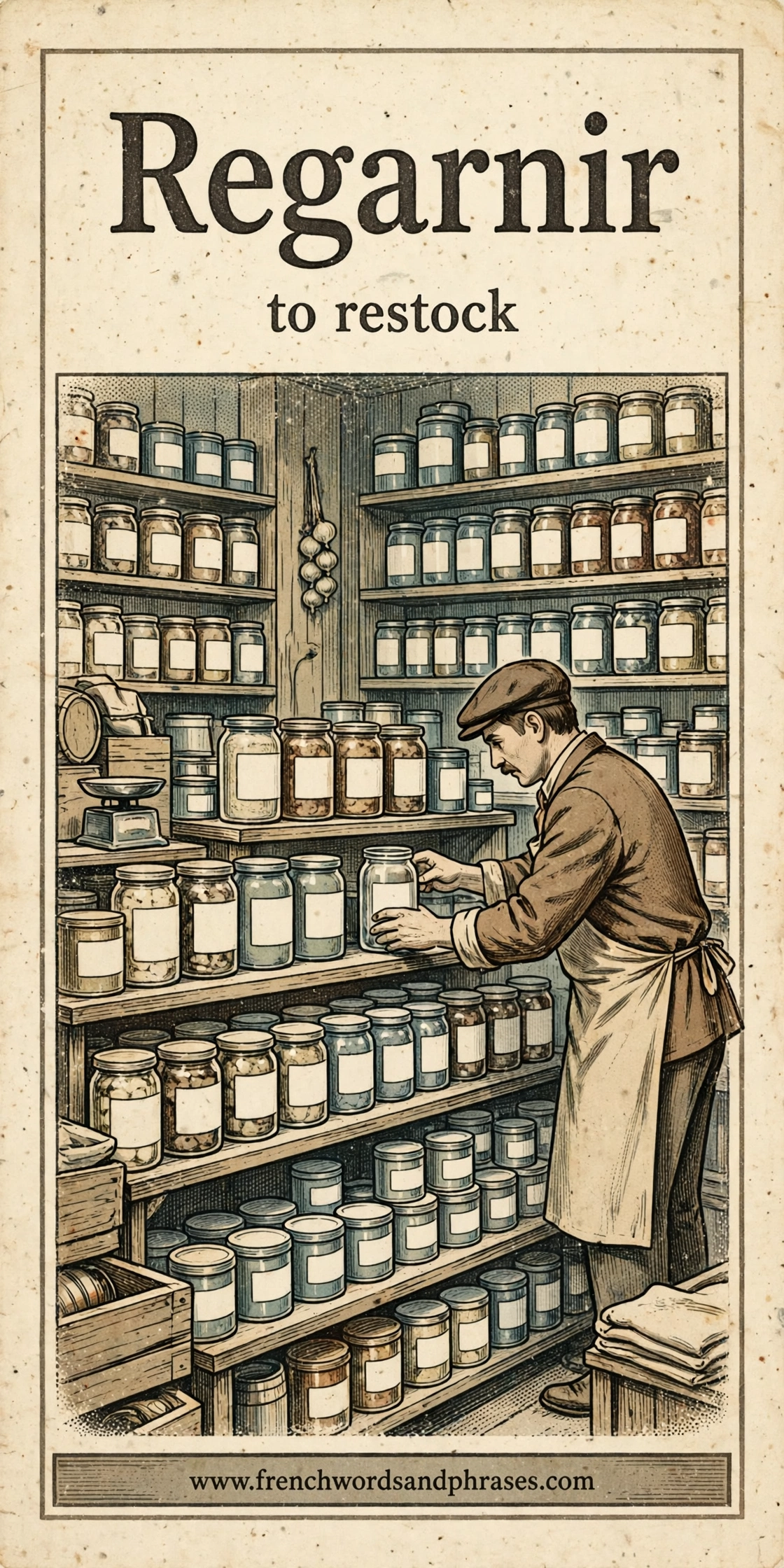
Regarnir means to restock — to fill up again what use has emptied: shelves, buffets, ranks and cellars.
The shopkeeper refilling the shelf before opening, the waiter setting fresh bottles where the evening emptied them, an army dressing its thinned ranks — regarnir is the verb of the refill, the quiet second fullness.
In this guide, you’ll learn how to conjugate regarnir in all the major French tenses and moods. Explore complete conjugation tables, French examples, English translations, and practice quizzes.
Understanding the French Verb Regarnir
Regarnir is a regular French verb belonging to the second group of verbs, those ending in -ir.
It means to restock. Shopkeepers, quartermasters and hosts live by it: shelves, buffets, wine cellars and ranks all empty and all get regarnis. Where garnir fills for the first time, regarnir answers the second, third and hundredth emptying.
Verb classification: Second group (-ir)
Auxiliary verb: Avoir
Past participle: regarni
Present participle: regarnissant
English equivalents: To restock, to refill, to replenish; regarnir un rayon — to restock a shelf; regarnir un buffet — to replenish a buffet; regarnir les rangs — to refill the ranks; regarnir sa cave — to restock one’s cellar.
One fingerprint to learn: regarnir is a finir-type -ir verb, so the stem grows its famous -iss- wherever more than one person is involved: nous regarnissons, vous regarnissez, ils regarnissent, and in the imperfect and the present participle too — je regarnissais, en regarnissant. The singular stays lean: je regarnis, il regarnit. It is garnir — to garnish, to fill — with the re- of renewal: what was garnished once is garnished again.
Experience the Word
Regarnir is the verb of the second fullness — the shelf made whole again before anyone notices it was empty.
Imagine a village baker at five in the morning. Yesterday’s shelves are bare boards. Flour, hands, oven — and by seven, elle a regarni chaque rayon: bread in rows, croissants in their basket, the shop smelling of morning. The first customers never guess the shelves were ever empty.
Emptiness came and went. She restocked — regarni — and the day could begin.
How to Conjugate Regarnir: Complete French Conjugation Guide
Let’s explore every major conjugation of regarnir, beginning with the indicative mood.
How to Conjugate Regarnir in the Indicative Mood
The indicative mood is used to express facts, observations, actions, and events.
How to Conjugate Regarnir in the Present Tense (Présent)
Used for actions happening now, habitual actions, and general truths.
| Subject | Conjugation |
|---|---|
| je | regarnis |
| tu | regarnis |
| il / elle | regarnit |
| nous | regarnissons |
| vous | regarnissez |
| ils / elles | regarnissent |
Example
Le magasin regarnit ses rayons chaque nuit.
The shop restocks its shelves every night.
Quick Quiz 1
Complete the sentence:
Nous ______ les rayons chaque nuit.
Reveal the answer
regarnissons
Nous regarnissons les rayons chaque nuit.
We restock the shelves every night.
How to Conjugate Regarnir in the Passé Composé
Used for completed actions in the past. Regarnir takes the auxiliary verb avoir.
| Subject | Conjugation |
|---|---|
| j’ | ai regarni |
| tu | as regarni |
| il / elle | a regarni |
| nous | avons regarni |
| vous | avez regarni |
| ils / elles | ont regarni |
Example
Elle a regarni le buffet avant l’arrivée des invités.
She replenished the buffet before the guests arrived.
How to Conjugate Regarnir in the Imparfait (Imperfect Tense)
Used for habitual past actions, descriptions, and ongoing situations in the past.
| Subject | Conjugation |
|---|---|
| je | regarnissais |
| tu | regarnissais |
| il / elle | regarnissait |
| nous | regarnissions |
| vous | regarnissiez |
| ils / elles | regarnissaient |
Example
Nous regarnissions la cave après chaque vendange.
We used to restock the cellar after each grape harvest.
Quick Quiz 2
Choose the correct form:
You (tu) restock the shelf.
Tu ______ le rayon. (regarnis / regarnissons)
Reveal the answer
regarnis
Tu regarnis le rayon.
The -iss- appears only from nous onwards.
How to Conjugate Regarnir in the Plus-que-parfait
Used to describe an action that had already been completed before another past event.
| Subject | Conjugation |
|---|---|
| j’ | avais regarni |
| tu | avais regarni |
| il / elle | avait regarni |
| nous | avions regarni |
| vous | aviez regarni |
| ils / elles | avaient regarni |
Example
Ils avaient regarni les étagères quand le magasin a ouvert.
They had restocked the shelves when the shop opened.
How to Conjugate Regarnir in the Passé Simple
Primarily used in formal writing, literature, and historical narratives. It is rarely used in everyday conversation.
| Subject | Conjugation |
|---|---|
| je | regarnis |
| tu | regarnis |
| il / elle | regarnit |
| nous | regarnîmes |
| vous | regarnîtes |
| ils / elles | regarnirent |
Example
Le libraire regarnit son étal dès l’aube.
The bookseller restocked his stall at dawn.
How to Conjugate Regarnir in the Passé Antérieur
A literary tense used to express an action completed immediately before another past action, generally in the passé simple.
| Subject | Conjugation |
|---|---|
| j’ | eus regarni |
| tu | eus regarni |
| il / elle | eut regarni |
| nous | eûmes regarni |
| vous | eûtes regarni |
| ils / elles | eurent regarni |
Example
Dès qu’il eut regarni les rangs, le régiment repartit.
As soon as he had refilled the ranks, the regiment set off again.
How to Conjugate Regarnir in the Future Tense (Futur Simple)
Used to describe actions that will take place in the future.
| Subject | Conjugation |
|---|---|
| je | regarnirai |
| tu | regarniras |
| il / elle | regarnira |
| nous | regarnirons |
| vous | regarnirez |
| ils / elles | regarniront |
Example
Je regarnirai la réserve avant l’hiver.
I will restock the store cupboard before winter.
How to Conjugate Regarnir in the Futur Antérieur (Future Perfect)
Used for an action that will have been completed before a particular point in the future.
| Subject | Conjugation |
|---|---|
| j’ | aurai regarni |
| tu | auras regarni |
| il / elle | aura regarni |
| nous | aurons regarni |
| vous | aurez regarni |
| ils / elles | auront regarni |
Example
À l’ouverture, vous aurez regarni tous les rayons.
By opening time, you will have restocked all the shelves.
How to Conjugate Regarnir in the Near Future (Futur Proche)
Used to describe something that is going to happen soon. Formed with aller + infinitive.
| Subject | Conjugation |
|---|---|
| je | vais regarnir |
| tu | vas regarnir |
| il / elle | va regarnir |
| nous | allons regarnir |
| vous | allez regarnir |
| ils / elles | vont regarnir |
Example
Le serveur va regarnir le buffet, il ne reste presque rien.
The waiter is going to replenish the buffet, there is almost nothing left.
How to Conjugate Regarnir in the Conditional Mood
The conditional mood expresses what would happen under certain circumstances. It is also frequently used to make polite requests or express wishes.
How to Conjugate Regarnir in the Present Conditional
| Subject | Conjugation |
|---|---|
| je | regarnirais |
| tu | regarnirais |
| il / elle | regarnirait |
| nous | regarnirions |
| vous | regarniriez |
| ils / elles | regarniraient |
Example
Avec plus de personnel, on regarnirait les rayons deux fois par jour.
With more staff, we would restock the shelves twice a day.
How to Conjugate Regarnir in the Past Conditional
| Subject | Conjugation |
|---|---|
| j’ | aurais regarni |
| tu | aurais regarni |
| il / elle | aurait regarni |
| nous | aurions regarni |
| vous | auriez regarni |
| ils / elles | auraient regarni |
Example
Elle aurait regarni la cave si le marchand avait livré à temps.
She would have restocked the cellar if the merchant had delivered on time.
Regarnir in the Literary Past Conditional Form
This less common literary form uses the imperfect subjunctive of avoir.
| Subject | Conjugation |
|---|---|
| j’ | eusse regarni |
| tu | eusses regarni |
| il / elle | eût regarni |
| nous | eussions regarni |
| vous | eussiez regarni |
| ils / elles | eussent regarni |
Example
Le fourrier eût regarni les magasins sans la crue de la rivière.
The quartermaster would have restocked the stores if the river had not flooded.
How to Conjugate Regarnir in the Subjunctive Mood
The subjunctive is used to express wishes, emotions, doubts, necessity, and uncertainty. It frequently follows expressions such as il faut que (it is necessary that) or bien que (although).
How to Conjugate Regarnir in the Present Subjunctive
| Subject | Conjugation |
|---|---|
| que je | regarnisse |
| que tu | regarnisses |
| qu’il / qu’elle | regarnisse |
| que nous | regarnissions |
| que vous | regarnissiez |
| qu’ils / qu’elles | regarnissent |
Example
Il faut que tu regarnisses le présentoir avant midi.
You must restock the display stand before noon.
Quick Quiz 3
Complete the sentence using the subjunctive:
Il faut que vous ______ la cave avant l’hiver.
Reveal the answer
regarnissiez
Il faut que vous regarnissiez la cave avant l’hiver.
You must restock the cellar before winter.
How to Conjugate Regarnir in the Imperfect Subjunctive
A literary tense, rarely encountered in modern spoken French.
| Subject | Conjugation |
|---|---|
| que je | regarnisse |
| que tu | regarnisses |
| qu’il / qu’elle | regarnît |
| que nous | regarnissions |
| que vous | regarnissiez |
| qu’ils / qu’elles | regarnissent |
Example
Le patron exigeait que nous regarnissions les rayons chaque soir.
The boss required us to restock the shelves every evening.
How to Conjugate Regarnir in the Pluperfect Subjunctive
A literary construction used to express an action completed before another past action.
| Subject | Conjugation |
|---|---|
| que j’ | eusse regarni |
| que tu | eusses regarni |
| qu’il / qu’elle | eût regarni |
| que nous | eussions regarni |
| que vous | eussiez regarni |
| qu’ils / qu’elles | eussent regarni |
Example
On vérifia qu’ils eussent regarni les réserves de l’hôpital.
They checked that they had restocked the hospital’s supplies.
How to Conjugate Regarnir in the Past Subjunctive
| Subject | Conjugation |
|---|---|
| que j’ | aie regarni |
| que tu | aies regarni |
| qu’il / qu’elle | ait regarni |
| que nous | ayons regarni |
| que vous | ayez regarni |
| qu’ils / qu’elles | aient regarni |
Example
Je suis content qu’elle ait regarni le buffet à temps.
I am glad she replenished the buffet in time.
How to Conjugate Regarnir in the Imperative
The imperative is used to give commands, instructions, invitations, or suggestions. Subject pronouns are omitted.
How to Conjugate Regarnir in the Present Imperative
| Person | Conjugation |
|---|---|
| (tu) | regarnis |
| (nous) | regarnissons |
| (vous) | regarnissez |
Example
Regarnis le buffet, les invités arrivent !
Replenish the buffet, the guests are coming!
Quick Quiz 4
How would you say Restock the buffet (tu form)?
Reveal the answer
Regarnis le buffet !
French Participles of Regarnir
Participles are verb forms that can be used in compound tenses and other grammatical constructions.
Present Participle of Regarnir
regarnissant
En regarnissant les étagères, il a retrouvé la liste perdue.
While restocking the shelves, he found the lost list.
Past Participle of Regarnir
regarni
Regarni à l’aube, le rayon brillait de bouteilles neuves.
Restocked at dawn, the shelf shone with new bottles.
Regarnir in Everyday French: Real-Life Examples
Now that you know the conjugations, let’s see how regarnir appears in everyday French.
Example 1 — Present
Le magasin regarnit ses rayons chaque nuit.
The shop restocks its shelves every night.
Example 2 — Passé composé
Elle a regarni le buffet avant les invités.
She replenished the buffet before the guests.
Example 3 — Imparfait
Nous regarnissions la cave après les vendanges.
We used to restock the cellar after the harvest.
Example 4 — Future
Je regarnirai la réserve avant l’hiver.
I will restock the store cupboard before winter.
Example 5 — Conditional
On regarnirait les rayons deux fois par jour avec plus de personnel.
We would restock the shelves twice a day with more staff.
Example 6 — Imperative
Regarnis le buffet, vite !
Replenish the buffet, quickly!
Beyond Translation: The Meaning of Regarnir
Under regarnir sits garnir — to fill, to garnish, to trim — the same root that gives English garnish and garment: to fill a plate’s edge, to fill a shelf, to fill a coat with a body. The re- adds the rhythm of trade: everything filled will empty, and everything emptied, in a well-run house, gets regarni.
How to Remember the French Verb Regarnir
Remember it this way: Regarnir is about the shelf made whole again before opening time.
- Finir-type fingerprint: -iss- in the plural — nous regarnissons, ils regarnissent.
- Garnir fills the first time; regarnir is every filling after that — shelves, buffets, ranks, cellars.
- Regular -ir endings otherwise: je regarnis, il regarnit, past participle regarni.
The key idea is the shelf made whole again before opening time.
Test Your Knowledge of Regarnir
Let’s see how much you’ve learned. Try answering these questions before revealing the answers.
Question 1
What is the nous form of regarnir in the present?
Reveal the answer
Nous regarnissons — finir-type verbs grow -iss- in the plural.
Question 2
How do you say She replenished the buffet in French?
Reveal the answer
Elle a regarni le buffet.
Question 3
Translate: The shop restocks its shelves every night.
Reveal the answer
Le magasin regarnit ses rayons chaque nuit.
Question 4
What is the past participle of regarnir?
Reveal the answer
Regarni.
Question 5
Complete the sentence:
Il faut que tu ______ le présentoir avant midi.
Reveal the answer
regarnisses
Il faut que tu regarnisses le présentoir avant midi.
You must restock the display stand before noon.
Your Final Challenge
Can You Use It?
How would you say this in French?
At dawn, she restocks the shelves one by one, and the shop wakes up as full as on its first day.
Reveal the answer
À l’aube, elle regarnit les rayons un à un, et le magasin s’éveille plein comme au premier jour.
At dawn, she restocks the shelves one by one, and the shop wakes up as full as on its first day.
A little French. A little curiosity. A richer everyday life.
LEARN FRENCH ONE WORD AT A TIME