A French Word to Live By
How to Conjugate Régaler in French
/ʁe.ɡa.le/
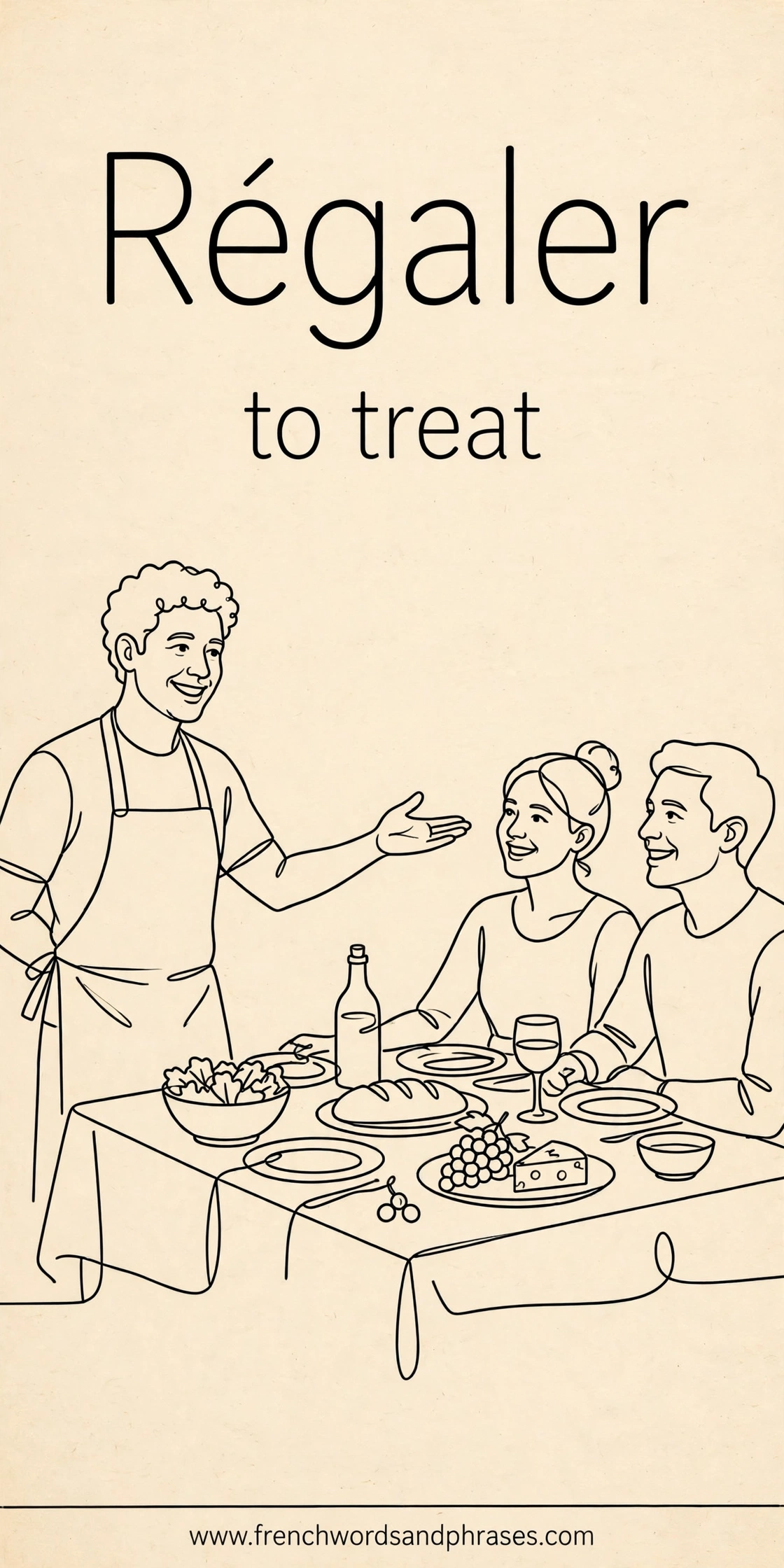
Régaler means to treat — to give someone a feast, a story or a spectacle they will remember.
A grandmother laying out the good dishes, a host pouring the wine he has been saving, a grandfather holding the whole table spellbound — régaler is the verb of the generous host: to feast someone properly.
In this guide, you’ll learn how to conjugate régaler in all the major French tenses and moods. Explore complete conjugation tables, French examples, English translations, and practice quizzes.
Understanding the French Verb Régaler
Régaler is a regular French verb belonging to the first group of verbs, those ending in-er.
It means to treat. Its kingdom is the table — food, wine, celebration — but it happily serves stories, music and spectacles too: un conteur régale son public. Anything given generously, to be savoured, can be régalé.
Verb classification: First group (-er)
Auxiliary verb: Avoir
Past participle: régalé
Present participle: régalant
English equivalents: To treat, to feast, to regale; régaler quelqu’un de quelque chose — to treat someone to something; régaler ses invités d’un festin — to feast one’s guests; régaler l’assistance d’une histoire — to regale the company with a story; un régal — a treat, a delight.
The construction is the trap: régaler links host and gift with de — elle régale ses invités d’un festin, il nous a régalés de ses souvenirs. Forget the de and the sentence starves. Note too the participle’s manners: when the person treated comes before the verb, it agrees — les invités qu’elle a régalés. The reflexive twin, se régaler (to have a delicious time), is another page’s story; here the hero is the host, not the guest.
Experience the Word
Régaler is the verb of the host who holds nothing back — the good bottle, the long story, the second helping.
Imagine a fisherman in a small Breton port who eats simply all year. But when his grandchildren visit, il les régale: oysters, crêpes, cider for the grown-ups, and stories of storms until the candles drown. For one evening, his little kitchen is a palace.
The children came for a holiday. They were treated — régalés — like kings.
How to Conjugate Régaler: Complete French Conjugation Guide
Let’s explore every major conjugation of régaler, beginning with the indicative mood.
How to Conjugate Régaler in the Indicative Mood
The indicative mood is used to express facts, observations, actions, and events.
How to Conjugate Régaler in the Present Tense (Présent)
Used for actions happening now, habitual actions, and general truths.
| Subject | Conjugation |
|---|---|
| je | régale |
| tu | régales |
| il / elle | régale |
| nous | régalons |
| vous | régalez |
| ils / elles | régalent |
Example
Ma grand-mère régale toute la famille le dimanche.
My grandmother treats the whole family on Sundays.
Quick Quiz 1
Complete the sentence:
Nous ______ nos amis d’un rôti le dimanche.
Reveal the answer
régalons
Nous régalons nos amis d’un rôti le dimanche.
We treat our friends to a roast on Sundays.
How to Conjugate Régaler in the Passé Composé
Used for completed actions in the past. Régaler takes the auxiliary verb avoir.
| Subject | Conjugation |
|---|---|
| j’ | ai régalé |
| tu | as régalé |
| il / elle | a régalé |
| nous | avons régalé |
| vous | avez régalé |
| ils / elles | ont régalé |
Example
Il nous a régalés d’un dîner inoubliable.
He treated us to an unforgettable dinner.
How to Conjugate Régaler in the Imparfait (Imperfect Tense)
Used for habitual past actions, descriptions, and ongoing situations in the past.
| Subject | Conjugation |
|---|---|
| je | régalais |
| tu | régalais |
| il / elle | régalait |
| nous | régalions |
| vous | régaliez |
| ils / elles | régalaient |
Example
Le vieux marin régalait les enfants de ses histoires.
The old sailor used to regale the children with his stories.
Quick Quiz 2
Choose the correct form:
He treated us to dinner.
Il nous ______ d’un dîner. (a régalés / a régalé)
Reveal the answer
a régalés
Il nous a régalés d’un dîner.
Nous comes before the verb, so the participle agrees.
How to Conjugate Régaler in the Plus-que-parfait
Used to describe an action that had already been completed before another past event.
| Subject | Conjugation |
|---|---|
| j’ | avais régalé |
| tu | avais régalé |
| il / elle | avait régalé |
| nous | avions régalé |
| vous | aviez régalé |
| ils / elles | avaient régalé |
Example
Ils nous avaient régalés d’un festin la veille de notre départ.
They had treated us to a feast the day before our departure.
How to Conjugate Régaler in the Passé Simple
Primarily used in formal writing, literature, and historical narratives. It is rarely used in everyday conversation.
| Subject | Conjugation |
|---|---|
| je | régalai |
| tu | régalas |
| il / elle | régala |
| nous | régalâmes |
| vous | régalâtes |
| ils / elles | régalèrent |
Example
Le roi régala ses ambassadeurs pendant trois jours.
The king feasted his ambassadors for three days.
How to Conjugate Régaler in the Passé Antérieur
A literary tense used to express an action completed immediately before another past action, generally in the passé simple.
| Subject | Conjugation |
|---|---|
| j’ | eus régalé |
| tu | eus régalé |
| il / elle | eut régalé |
| nous | eûmes régalé |
| vous | eûtes régalé |
| ils / elles | eurent régalé |
Example
Quand il eut régalé ses hôtes, il sortit son vieux cognac.
When he had treated his guests, he brought out his old cognac.
How to Conjugate Régaler in the Future Tense (Futur Simple)
Used to describe actions that will take place in the future.
| Subject | Conjugation |
|---|---|
| je | régalerai |
| tu | régaleras |
| il / elle | régalera |
| nous | régalerons |
| vous | régalerez |
| ils / elles | régaleront |
Example
Dimanche, je régalerai mes amis d’une bouillabaisse.
On Sunday, I will treat my friends to a bouillabaisse.
How to Conjugate Régaler in the Futur Antérieur (Future Perfect)
Used for an action that will have been completed before a particular point in the future.
| Subject | Conjugation |
|---|---|
| j’ | aurai régalé |
| tu | auras régalé |
| il / elle | aura régalé |
| nous | aurons régalé |
| vous | aurez régalé |
| ils / elles | auront régalé |
Example
À Noël, elle aura régalé trois générations autour de la même table.
By Christmas, she will have treated three generations around the same table.
How to Conjugate Régaler in the Near Future (Futur Proche)
Used to describe something that is going to happen soon. Formed with aller + infinitive.
| Subject | Conjugation |
|---|---|
| je | vais régaler |
| tu | vas régaler |
| il / elle | va régaler |
| nous | allons régaler |
| vous | allez régaler |
| ils / elles | vont régaler |
Example
Ce soir, le chef va régaler les clients avec un menu surprise.
Tonight, the chef is going to treat the customers to a surprise menu.
How to Conjugate Régaler in the Conditional Mood
The conditional mood expresses what would happen under certain circumstances. It is also frequently used to make polite requests or express wishes.
How to Conjugate Régaler in the Present Conditional
| Subject | Conjugation |
|---|---|
| je | régalerais |
| tu | régalerais |
| il / elle | régalerait |
| nous | régalerions |
| vous | régaleriez |
| ils / elles | régaleraient |
Example
Avec un jardin pareil, elle régalerait tout le quartier.
With a garden like that, she would treat the whole neighbourhood.
How to Conjugate Régaler in the Past Conditional
| Subject | Conjugation |
|---|---|
| j’ | aurais régalé |
| tu | aurais régalé |
| il / elle | aurait régalé |
| nous | aurions régalé |
| vous | auriez régalé |
| ils / elles | auraient régalé |
Example
Il nous aurait régalés si son four n’était pas tombé en panne.
He would have treated us if his oven had not broken down.
Régaler in the Literary Past Conditional Form
This less common literary form uses the imperfect subjunctive of avoir.
| Subject | Conjugation |
|---|---|
| j’ | eusse régalé |
| tu | eusses régalé |
| il / elle | eût régalé |
| nous | eussions régalé |
| vous | eussiez régalé |
| ils / elles | eussent régalé |
Example
Le seigneur eût régalé ses vassaux sans la disette.
The lord would have feasted his vassals had there not been a famine.
How to Conjugate Régaler in the Subjunctive Mood
The subjunctive is used to express wishes, emotions, doubts, necessity, and uncertainty. It frequently follows expressions such as il faut que (it is necessary that) or bien que (although).
How to Conjugate Régaler in the Present Subjunctive
| Subject | Conjugation |
|---|---|
| que je | régale |
| que tu | régales |
| qu’il / qu’elle | régale |
| que nous | régalions |
| que vous | régaliez |
| qu’ils / qu’elles | régalent |
Example
Je veux que tu régales tes invités comme des rois.
I want you to treat your guests like kings.
Quick Quiz 3
Complete the sentence using the subjunctive:
Je veux que vous ______ vos invités comme des rois.
Reveal the answer
régaliez
Je veux que vous régaliez vos invités comme des rois.
I want you to treat your guests like kings.
How to Conjugate Régaler in the Imperfect Subjunctive
A literary tense, rarely encountered in modern spoken French.
| Subject | Conjugation |
|---|---|
| que je | régalasse |
| que tu | régalasses |
| qu’il / qu’elle | régalât |
| que nous | régalassions |
| que vous | régalassiez |
| qu’ils / qu’elles | régalassent |
Example
Il tenait à ce qu’elle régalât ses amis de ses spécialités.
He was keen for her to treat her friends to her specialities.
How to Conjugate Régaler in the Pluperfect Subjunctive
A literary construction used to express an action completed before another past action.
| Subject | Conjugation |
|---|---|
| que j’ | eusse régalé |
| que tu | eusses régalé |
| qu’il / qu’elle | eût régalé |
| que nous | eussions régalé |
| que vous | eussiez régalé |
| qu’ils / qu’elles | eussent régalé |
Example
On racontait qu’il eût régalé des princes dans sa petite auberge.
People said he had treated princes in his little inn.
How to Conjugate Régaler in the Past Subjunctive
| Subject | Conjugation |
|---|---|
| que j’ | aie régalé |
| que tu | aies régalé |
| qu’il / qu’elle | ait régalé |
| que nous | ayons régalé |
| que vous | ayez régalé |
| qu’ils / qu’elles | aient régalé |
Example
Je suis heureux qu’elle ait régalé les enfants de ses contes.
I am happy she treated the children to her tales.
How to Conjugate Régaler in the Imperative
The imperative is used to give commands, instructions, invitations, or suggestions. Subject pronouns are omitted.
How to Conjugate Régaler in the Present Imperative
| Person | Conjugation |
|---|---|
| (tu) | régale |
| (nous) | régalons |
| (vous) | régalez |
Example
Régalez vos invités, c’est la fête !
Treat your guests, it’s a celebration!
Quick Quiz 4
How would you say Treat your guests (tu form)?
Reveal the answer
Régale tes invités !
French Participles of Régaler
Participles are verb forms that can be used in compound tenses and other grammatical constructions.
Present Participle of Régaler
régalant
En régalant ses voisins, elle a gagné des amis pour la vie.
By treating her neighbours, she made friends for life.
Past Participle of Régaler
régalé
Régalés de crêpes et de chansons, les enfants ne voulaient plus partir.
Treated to crêpes and songs, the children no longer wanted to leave.
Régaler in Everyday French: Real-Life Examples
Now that you know the conjugations, let’s see how régaler appears in everyday French.
Example 1 — Present
Ma grand-mère régale toute la famille.
My grandmother treats the whole family.
Example 2 — Passé composé
Il nous a régalés d’un dîner superbe.
He treated us to a superb dinner.
Example 3 — Imparfait
Le vieux marin régalait les enfants de ses histoires.
The old sailor used to regale the children with his stories.
Example 4 — Future
Je régalerai mes amis d’une bouillabaisse.
I will treat my friends to a bouillabaisse.
Example 5 — Conditional
Elle régalerait tout le quartier avec son jardin.
She would treat the whole neighbourhood with her garden.
Example 6 — Imperative
Régale tes invités comme des rois !
Treat your guests like kings!
Beyond Translation: The Meaning of Régaler
English kept the twin: to regale — to regale guests with stories is exactly régaler. Both come from old French regale, a feast, cousin of gala. The noun un régal is still the word for anything delicious: ce gâteau est un régal — and a host who régale is, literally, laying on a gala for the people he loves.
How to Remember the French Verb Régaler
Remember it this way: Régaler is about the host opening the good bottle for his guests.
- The gift hangs on de: régaler ses invités d’un festin, nous régaler de ses histoires.
- Host’s verb: the person treated is the object — il nous a régalés, with agreement when the object comes first.
- Regular -er: je régale, nous régalons, past participle régalé — and un régal is the treat itself.
The key idea is the host opening the good bottle for his guests.
Test Your Knowledge of Régaler
Let’s see how much you’ve learned. Try answering these questions before revealing the answers.
Question 1
Which preposition links the treat to the verb in régaler ses invités ___ un festin?
Reveal the answer
De — régaler quelqu’un de quelque chose.
Question 2
How do you say He treated us to an unforgettable dinner in French?
Reveal the answer
Il nous a régalés d’un dîner inoubliable.
Question 3
Translate: The old sailor used to regale the children with his stories.
Reveal the answer
Le vieux marin régalait les enfants de ses histoires.
Question 4
What is the past participle of régaler?
Reveal the answer
Régalé — agreeing with a preceding direct object: les invités qu’elle a régalés.
Question 5
Complete the sentence:
Je veux que tu ______ tes invités comme des rois.
Reveal the answer
régales
Je veux que tu régales tes invités comme des rois.
I want you to treat your guests like kings.
Your Final Challenge
Can You Use It?
How would you say this in French?
Every Sunday, she treats her grandchildren to crêpes, songs and her own recovered youth.
Reveal the answer
Chaque dimanche, elle régale ses petits-enfants de crêpes, de chansons et de sa jeunesse retrouvée.
Every Sunday, she treats her grandchildren to crêpes, songs and her own recovered youth.
A little French. A little curiosity. A richer everyday life.
LEARN FRENCH ONE WORD AT A TIME